




On this page
See Tech Prescient in Action
Automate access, reduce risk, and stay audit-ready
User Access Review (UAR) is a security and compliance process used to verify that users have only the access required for their current job roles. It supports enforcement of the principle of least privilege, reduces insider risk, and helps organizations meet audit requirements such as SOX, HIPAA, GDPR, and PCI DSS.
UARs, also known as access certifications or periodic access reviews, are a core function of Identity Governance and Administration (IGA). They provide a structured way to discover who has access to critical systems and data and to confirm that access remains appropriate over time.
User access reviews play a central role in identifying excessive or outdated permissions and ensuring that only the right individuals have access at the right time. This is particularly important in dynamic environments where role changes, contractor access, and cloud services increase the likelihood of permission sprawl and internal exposure.
In 2019, a single misconfigured AWS role at Capital One contributed to one of the largest financial data breaches on record. An overly privileged Web Application Firewall role was exploited, allowing unauthorized access to more than 100 million customer records. The incident demonstrated how mismanaged access, rather than advanced malware, can lead to large-scale data compromise.
Incidents of this nature are not isolated. Industry research, including the Verizon Data Breach Investigations Report, consistently shows that compromised or misused credentials are among the most common factors in security breaches. Excessive permissions significantly increase the impact of these events when access is not regularly reviewed. User Access Reviews are a primary control for reducing this risk. However, many organizations still rely on manual, bulk review processes that are time-consuming, difficult to audit, and resource intensive. Analyst research from Gartner and Forrester has found that manual access reviews take substantially longer to complete and are more prone to approval errors than automated IGA workflows.
Key takeaways
- Ensures access rights remain aligned with current job roles
- Supports compliance with HIPAA, GDPR, SOX, and PCI DSS
- Reduces insider risk and long-term privilege accumulation, as reflected in industry breach reports
- Manual reviews are significantly slower and less reliable than automated reviews, according to Gartner and Forrester
- Delivers measurable risk and cost reduction through access rationalization
What Is the User Access Review Process?
The User Access Review (UAR) process is a structured, repeatable method for validating who has access to an organization's systems, what level of access they hold, and whether that access remains appropriate based on current job responsibilities, risk posture, and compliance requirements. The objective is to identify and remove unnecessary, excessive, or high-risk permissions before they result in security incidents or audit findings.
User Access Reviews are a core identity governance practice used to continuously assess access entitlements across systems. By routinely evaluating access and business justification, organizations reduce long-term exposure created by permission sprawl and outdated access assignments.
Why do User Access Reviews matter?
Over time, most organizations accumulate access that is no longer required. Employees change roles, contractors complete engagements, and vendors end services, yet access is often retained beyond its original purpose. These lingering permissions create security gaps that increase the likelihood of data exposure and compliance failures. Regular access reviews help organizations detect and remediate these gaps while maintaining audit readiness.

Pro Tip
Prioritize reviews based on data sensitivity and privilege level, not system count. Certifying high-risk access first reduces breach impact faster than reviewing low-risk applications in bulk.
How do User Access Reviews work?
The first step in the UAR process is to determine four questions:
- Who is accessing what systems and data?
- What type of access do these users have?
- Why do they need that access in their current role?
- What changes need to be made?
The New UAR Process
User access reviews extend beyond full-time employees. A comprehensive review process includes:
- Employees - Full-time, part-time, and temporary employees who need access to perform their job functions
- Business Partners - External organizations that need access to certain systems, limited to their specific assignments
- Vendors - Service providers (i.e., IT support or cloud providers) that need access to support your system or services
- Contractors - Temporary personnel who need access for a specific time to complete work
- Former Employees - The most important category of risk, when a former employee's access is not rescinded
How Does the UAR Process Flow Work?
The user access review process flow follows a consistent lifecycle that ensures continuous governance and audit readiness rather than one-time compliance.
The Process
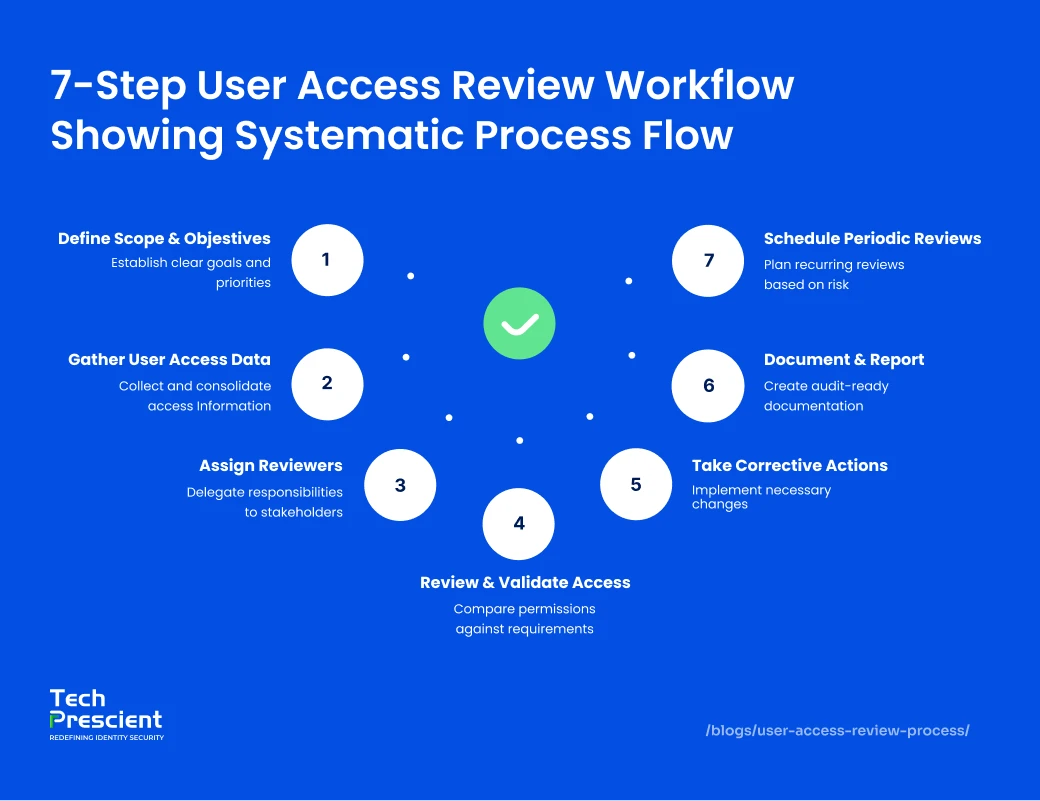
A thorough UAR includes the following steps:
- Define scope by identifying systems and users in review
- Gather current access data from relevant systems
- Assign reviewers, typically managers or system owners
- Validate permissions against job responsibilities
- Remove inappropriate or excessive access
- Document decisions for audit purposes
- Schedule recurring reviews based on risk level
Business Impact
Organizations with a mature user access review procedure had 40% fewer access security incidents than organizations performing annual employee reviews. This illustrates that when you perform access certification regularly, you bolster your security posture while adhering to policies and regulations such as SOX, GDPR, and HIPAA.
Why User Access Reviews Are Critical
User access reviews are one of the first lines of defense against unauthorized access and security incidents for your organization. They help protect sensitive information, adhere to compliance requirements, and mitigate operational risk through proper access control. Organizations that do not conduct UARs regularly are exposing themselves to increased security risks and regulatory action that can result in financial consequences and damage business operations.
Protecting Sensitive Data
Data breaches continue to be driven primarily by compromised or misused credentials rather than novel attack techniques. This pattern reinforces the importance of strong access governance and routine validation of user permissions.
The 2019 breach at Capital One illustrates this risk clearly. A single AWS role was configured with excessive privileges that violated the principle of least privilege. That access was later exploited, resulting in the exposure of more than 100 million customer records and significant financial and regulatory impact. Regular access reviews could have identified the unnecessary permissions before they were abused.
Healthcare organizations are facing even stricter penalties. The Anthem breach resulted in nearly 79 million records being exposed after a lack of controls around admin accounts led to significant costs and regulatory penalties, emphasizing the need for audit readiness.
Preventing Common Access Issues
There are three common issues that most organizations deal with, namely, employees retaining old access associated with prior roles, orphaned accounts from employees who have left, and sprawling admin privileges that expand without restraint, all violations of least privilege principles.
Privilege creep occurs naturally within organizations as employees change roles or take on special projects. An employee with many years of service may have access that spans multiple departments, all of which they no longer operate in, requiring periodic user access review procedure to identify these issues.
Orphaned accounts are remnants of former employees or employees who have changed roles. These dormant credentials are appealing to attackers who know they are hard to target. The SolarWinds attack was partly successful due to poorly monitored development accounts, highlighting gaps in identity governance.
Meeting Regulatory Requirements
Compliance is no longer a luxury. It is now mandatory with real financial implications:
- SOX requires an audit of financial systems quarterly, with significant corporate penalties and potential executive and personal liabilities
- HIPAA requires that you develop and document access procedures for data, and it has very significant fines associated with violations
- GDPR requires regular security testing, with penalties of €20 million or 4% of global revenues
- PCI DSS now requires a semi-annual review of user access, and fines on an ongoing basis for non-compliance
If an auditor walked in tomorrow, would your access reviews hold up?
Think your UAR process is in place? See how it performs under real audit pressure.
Reducing Licensing Costs
Proper access reviews typically uncover cost savings as well. Companies frequently uncover software licenses assigned to individuals no longer employed by the organization or applications that are no longer in use.
Regular access reviews will identify these inefficiencies, allowing funds to be repurposed or unused licenses canceled. In addition, access reviews reduce administrative overhead by simplifying account and permission control as unnecessary accounts and permissions are identified and removed through effective IAM practices.
Step-by-Step User Access Review Process
The following seven steps outline a structured and compliant User Access Review process designed to reduce access risk while meeting regulatory and audit requirements.
Scope and Purpose
Begin by identifying all systems, applications, and platforms in scope. Create an inventory of all users, including employees, contractors, external partners, vendors, and terminated users. For each user, document assigned roles, access levels, and privileges across systems, clearly distinguishing between standard and privileged access.
Once the inventory is complete, assess whether each access entitlement remains appropriate based on the user's current role, job responsibilities, and security requirements. Any access that does not align with business need or the principle of least privilege should be flagged for review.
Populate User Access Data
Export user listings, roles, and permissions from all systems using IAM automation tools. Request and extract user access data from all applications, including username, role, user access level, and last access date. Compile this data into a central location (preferably a secure database or data warehouse) with separate tables and fields for every user, organized by department, role, system, or access level, for ease of access review processing.
Leverage Reviewers
Assign user access reviewers by involving business executives, such as system owners and managers, who can weigh the operational requirements of access. When identifying reviewers for each system and application, the typical reviewers will include department heads for business applications, IT security teams for infrastructure access, and system owners for specialized applications. Differentiate roles with clear communication on reviewer responsibilities with stakeholders as part of identity governance.
Review & Validate Access
Compare permissions to job duties using principles of role-based access control and identify unnecessary privileges. Use methodical validation against job descriptions, actual job duties, and identification of unnecessary privileges through the principle of least privilege. Validate with HR records for employment and role verification to confirm employment, and validate any discrepancies that require remediation immediately to maintain audit readiness.
Remediation Actions
In accordance with the results of the risk assessment, rights may be removed, changed, or downgraded. Access rights must be revoked immediately from terminated employees, partners, and third-party vendors. In addition, access rights must be verifiably reviewed for current employees for any role limitations and/or access changes that are applicable to their duties. Also, a careful review of excessive rights must be done to ensure that legitimate business functions aren't affected during the process, maintaining cybersecurity best practices.
Documenting & Reporting
Retain records of all review efforts that are audit-ready, including all decisions and remediation actions taken against each user. Compile a comprehensive review report, including the review scope, review methodology, review findings, and the remedial actions that were taken. Maintain standard documents to record review decisions and rationale for each change, such as signed authorization, supporting compliance audit requirements.
Schedule the Reviews
Schedule reviews regularly and according to risk levels, quarterly for really high-risk systems and annually for lower-risk systems as part of your periodic user access review procedure. Use a standardized calendar for the review process that takes into account when the organization conducts operational periods, compliance periods, and considers the capacity of staff to conduct reviews. Include a method to use event-driven review cycles for events such as employees leaving the organization, role changes, or security occurrences following your user access review process flow.
During the review, there will need to be controls established to provide evidence of governance principles. These include:
- Approval Authority: Ensure you know who has approved authority to access requests and how you can ensure that all access requests have gone through proper security approvals with designated approvers, depending on access level.
- Evidence of Documentation: Provide compliance with a complete audit trail that outlines who made the request, approval, and subsequently modified access permissions. You will also need details of the timestamps of the action.
- Authentication Controls: Ensure there is evidence of the MFA and authentication controls in place, this is especially pertinent for sensitive accounts that require additional layers of authentication.
Best Practice
Build a fast-track remediation workflow for critical findings like terminated users or excessive admin rights. Immediate revocation reduces exposure while the broader review cycle continues.
User Access Review Process Best Practices
Successful UAR programs require strategic implementation that balances thoroughness with efficiency, following cybersecurity best practices.
- Maintain consistent review frequency by defining risk-based schedules aligned to business operations and regulatory expectations. Privileged accounts, financial systems, and sensitive platforms should be reviewed quarterly, while standard user access may be certified annually. These schedules should be formally documented and communicated in advance to support planning and audit readiness.
- Integrate reviews into employee lifecycle management to ensure access changes align with role transitions, promotions, and departures through effective IAM processes. Implement automated workflows that trigger access reviews when HR systems detect role changes, and establish standard user access review procedures for both onboarding and offboarding that include comprehensive access validation. This integration prevents access debt from accumulating between formal review cycles.
- Enforce the least privilege principle consistently across all access decisions, granting only the minimum permissions necessary for job functions. Train reviewers to understand this principle and provide clear guidelines for evaluating access appropriateness. Regular training ensures reviewers can distinguish between necessary access and convenience access that increases security risk without business benefit, supporting audit readiness.
- Document every change with clear rationale, approval chains, and timestamps to meet audit requirements and support future reviews. Implement standardized templates that capture decision rationale, business justification for exceptions, and approval signatures. This documentation serves dual purposes of satisfying compliance requirements and creating institutional knowledge for future reviews through proper identity governance.
- Leverage automation tools like Tech Prescient's Identity Confluence to turn manual processes into intelligent automation workflows. This modern IGA platform applies AI to automatically discover high-risk access patterns, converts technical permissions into business-friendly descriptions, and automates low-risk decisions, all to reduce review demands while improving security outcomes via intelligent risk assessment and bounded human decision-making using IAM automation tools.
Best Practice Insight
Integrate access reviews into employee lifecycle events such as role changes, transfers, and exits. Event-driven certifications prevent access debt from accumulating between periodic reviews.
Common Challenges & How to Overcome Them
Even well-designed User Access Review programs encounter operational and organizational friction. Scale, system diversity, staffing constraints, and inconsistent processes can all reduce review effectiveness if left unaddressed. Understanding these challenges and applying targeted controls allows organizations to sustain access governance without compromising security, compliance, or business efficiency.
User Access Reviews can be resource intensive
This is particularly true for organizations with limited IT and security staff. Manual data collection and validation place sustained pressure on teams that are already managing competing operational priorities.
Solution: Implement automation platforms that eliminate tedious data collection work and provide intelligent risk-based filtering. Start with high-volume, low-complexity reviews to demonstrate quick wins, then expand automation to more complex access decisions.
Complexity in large environments
This multiplies as organizations manage 500+ applications across cloud, on-premises, and hybrid infrastructures. Inconsistent user naming, limited API availability, and fragmented identity data create visibility gaps.
Solution: Implement a centralized identity governance platform with built-in connectors for the major applications that your organization uses, along with custom integration support for proprietary applications. Organizations can achieve total visibility across 50+ cloud and on-prem applications with advanced platforms that integrate with SCIM, REST APIs, SAML, and OAuth, with the ability to create a unified identity view that removes fragmentation and enables real-time governance and operational capabilities as organizations traverse hybrid environments.
Resistance from stakeholders
This occurs when business users view access reviews as IT impositions that interrupt productive work without clear value. Department managers may lack context to make informed access decisions or fear that removing access will disrupt operations.
Solution: Provide executive sponsorship demonstrating organizational commitment while educating stakeholders on security benefits. Streamline workflows to minimize business disruption and create feedback loops showing how reviews improve security posture.
Poor documentation practices
These lead to repeated evaluation of the same access issues and an inability to demonstrate compliance during audits. Many organizations lack standardized templates or fail to capture decision rationale, creating gaps in audit trails.
Solution: Implement standardized documentation templates with immutable logs that retain all review activities, decisions, and timestamps. Deploy systems that produce compliance-ready documentation for on-demand compliance with SOX, GDPR, HIPAA, and other regulatory frameworks, with downloadable templates and exportable reports that indicate continuous compliance with audit requirements.
Tools to Automate User Access Reviews
The identity governance market has many solutions available for automating the UAR process, including enterprise platforms with multiple functions and tools that focus on a specific niche. All of the modern IGA platforms can support the automation of user provisioning, provide role-based access controls, and enhance compliance processes.
Some capabilities to consider include:
- Automated user lifecycle management with provisioning in real-time
- Enforcement of role-based access control to mitigate the risk of privilege abuse
- Automation of compliance standards in tandem with regulatory frameworks
- The ability to monitor in real-time while tracking user activity
- Connector integration with existing Identity Providers through API
- Custom reporting capabilities for audit purposes
Engaging with market options can provide enterprise solutions that provide holistic IGA suites, intuitive platforms with many integrations included, or niche or specialized solutions that only address privileged access management.
Supercharge the UAR process with Tech Prescient's Identity Confluence, which presents a cloud-native AI-driven solution that has intelligent capability through automation, without fluffing out configuration requirements, and can be easily integrated with existing infrastructure through API or pre-built connectors as part of comprehensive IAM automation tools.
When looking at the various automation platforms, keep in mind that reviewed capabilities provide value, whether they demonstrate a purpose or demonstrate risk-based review prioritization, as well as useful workflows that provide risk-based review where permission has been obtained. Effective platform, choose a platform that provides the necessary capabilities, but is adaptable for implementation following your user access review process flow. The worst-case scenarios with adoption are choosing a basic platform that needs replacement or a highly engineered platform that is never used.
Final Thoughts
User access reviews have transitioned from a manual compliance activity to an automated, intelligent security control. Organizations cannot risk lengthy review cycles or whether access governance is just compliance, given the increased costs of breaches and insider threats, making cybersecurity best practices essential.
Identity governance is a strategic security initiative, and not a checkbox activity. The organizations with the most successful identity governance programs integrate direct executive sponsorship, try as much as possible to integrate business into the governance, integrate risk-based automation with human review through IAM automation tools, and create a culture of continual monitoring with periodic user access review procedures. Organizations like this will have fewer security incidents, less review overhead, and save significant costs based on better license management.
FAQs
It's a structured procedure to verify that users have only the access they need for their current job roles. The process systematically examines user permissions across systems and applications, validates access against business requirements, and removes or adjusts inappropriate privileges to maintain security and compliance.
Review frequency depends on risk levels and regulatory requirements. Quarterly reviews are recommended for privileged accounts and financial systems, semi-annual for healthcare and regulated industries, and annual for standard user access in low-risk environments. Event-driven reviews should occur for role changes and security incidents.
User access reviews are ongoing operational controls that organizations perform regularly to maintain proper access governance. Audits are formal assessments conducted by independent parties to verify compliance with regulations and internal policies. Reviews prevent issues that audits might discover.
Modern Identity Governance and Administration (IGA) platforms like Tech Prescient Identity Confluence, SailPoint, Okta, and Microsoft Entra ID Governance provide automation capabilities. These tools offer risk-based prioritization, automated data collection, intelligent recommendations, and compliance reporting to streamline the review process.
The principle of least privilege means granting users only the minimum access necessary to perform their job functions effectively. During access reviews, this principle guides decisions to remove excessive permissions, downgrade unnecessary privileges, and ensure access aligns with current role requirements rather than accumulated historical permissions.
UAR stands for User Access Review. In security and compliance contexts, it refers to the periodic evaluation of user permissions to ensure access aligns with job roles and least privilege principles.
UAR testing is the process of validating whether user access rights comply with internal policies and regulatory requirements. It typically occurs during access reviews or pre-audit readiness checks.
A periodic user access review is a scheduled review of user permissions conducted quarterly, semi-annually, or annually depending on system risk and regulatory requirements.
The access certification process is a formal review where managers or system owners attest that user access is appropriate. It is a key control within Identity Governance and Administration (IGA).
Common documents include access review reports, approval records, remediation logs, role definitions, segregation of duties analysis, and reviewer sign-offs with timestamps.
Share



Brinda Bhatt
Digital Marketing Strategist
A Digital Marketing Strategist who makes complex identity governance accessible to security and technology leaders through clear, data-driven content. Her insight-led, audience-focused approach supports Tech Prescient's mission of redefining identity security for modern enterprises.
Most Popular Blogs
Identity Security· 21 min read
Data Access Governance Solutions: How to Secure Sensitive Data at Scale
Compare data access governance solutions for 2026: how DAG platforms discover sensitive data, run access reviews, automate remediation, and prove compliance.
Brinda Bhatt· September 7, 2026
Identity Security· 24 min read
What Is Zero Trust Network Access (ZTNA)?
Learn what Zero Trust Network Access (ZTNA) is, how it works, and why it’s replacing VPNs for secure, identity-based access control.
Yatin Laygude· August 14, 2026
Identity Security· 24 min read
Cyber Essentials Certification: Complete Guide
Learn Cyber Essentials certification, cost, requirements, and steps. Compare Cyber Essentials vs Plus and get certified faster.
Yatin Laygude· August 10, 2026