




On this page
See Tech Prescient in Action
Automate access, reduce risk, and stay audit-ready
Workforce identity and access management (WIAM) is the framework used to manage and secure employee, contractor, and partner identities across enterprise systems. It ensures the right people have the right access to the right resources at the right time while supporting security, compliance, and operational efficiency.
The definition sounds procedural. The failure mode is not. An employee resigns on a Friday, the badge is collected, and on Monday, their credentials still open the CRM and a shared drive full of contracts. Nothing malicious happened. The offboarding process simply never reached those systems. Workforce IAM exists so that identity and access never drift apart like that in the first place.
Key Takeaways:
- Workforce IAM binds identity to access, so when someone joins, moves, or leaves, their access changes with them automatically.
- SSO, MFA, lifecycle automation, RBAC, and governance work as one system; remove any one and the others weaken.
- Zero Trust runs on workforce IAM: without a verified identity record and an entitlement map, there is nothing to enforce.
- Identity governance turns everyday provisioning and reviews into audit evidence, so compliance proof exists before anyone asks for it.
- Workforce IAM optimizes for security and governance; CIAM optimizes for customer experience. They solve different problems.
What Is Workforce Identity and Access Management?
Workforce IAM is the practice of managing workforce identities and controlling access to enterprise resources throughout the user lifecycle. It answers two questions continuously: who this person is and what they should be able to reach right now.
The "workforce" in the name covers every internal identity acting on the organization's behalf:
Employees: full-time and part-time staff whose access follows their role and department. Contractors: time-bound workers whose access should expire with the engagement, not after it.
Vendors: external service providers who need scoped access to specific systems, nothing more. Partners: business collaborators reaching shared platforms under defined agreements.
The relationship between identity and access is the mechanism underneath all of it. An identity is the verified record of who someone is. Access is the set of entitlements attached to that record. WIAM binds the two together so that when the identity changes state, joins, moves, or leaves, the access changes with it. The Friday-resignation scenario above is what happens when that binding breaks.
Why Workforce IAM Matters
Workforce IAM reduces security risks, improves productivity, and supports compliance through controlled access management. Each of those outcomes fails in a specific, observable way when identity goes unmanaged.
Reduce Unauthorized Access
Most unauthorized access does not involve breaking anything. IBM's Cost of a Data Breach report 2025 puts the average time to identify and contain a breach at 241 days, with breaches caught after 200 days costing roughly 52% more, and the entry point is usually credentials and entitlements that should not have existed anymore: a former contractor's live account or a transferred employee's leftover permissions. Insider threat prevention starts here, because employees can only misuse what their current role still justifies. Account compromise mitigation follows the same logic: a stolen credential inherits a tightly scoped set of entitlements instead of years of accumulated ones, so the breach is bounded by design.
Improve User Productivity
Security controls that slow people down get bypassed, so a workable program has to make legitimate access faster, not slower. Single sign-on gives users faster application access and collapses a dozen logins into one. Reduced password fatigue is a security gain as much as a convenience: people who manage fewer passwords reuse fewer passwords, and helpdesk queues stop filling with reset tickets.
Support Compliance Requirements
SOX, HIPAA, GDPR, and ISO 27001 converge on the same underlying demand: prove that access to sensitive systems maps to a legitimate business need, and prove someone reviewed it. Workforce IAM produces that proof as a byproduct of operating correctly. Provisioning events, approvals, user access reviews, and revocations each leave a timestamped record. Platforms that map this evidence to specific control clauses, the way the Evidence Center does, turn audit preparation into retrieval rather than reconstruction.
Enable Zero Trust Security
Zero Trust assumes no user or device is trustworthy by default, which makes identity the control that every other decision depends on. You cannot verify explicitly if you cannot verify identity, and you cannot enforce least privilege if you do not know what privilege each identity holds. Workforce IAM supplies both the authoritative identity record and the entitlement map that Zero Trust policies evaluate on every request. A dedicated section below covers this relationship in full.
Core Components of Workforce IAM
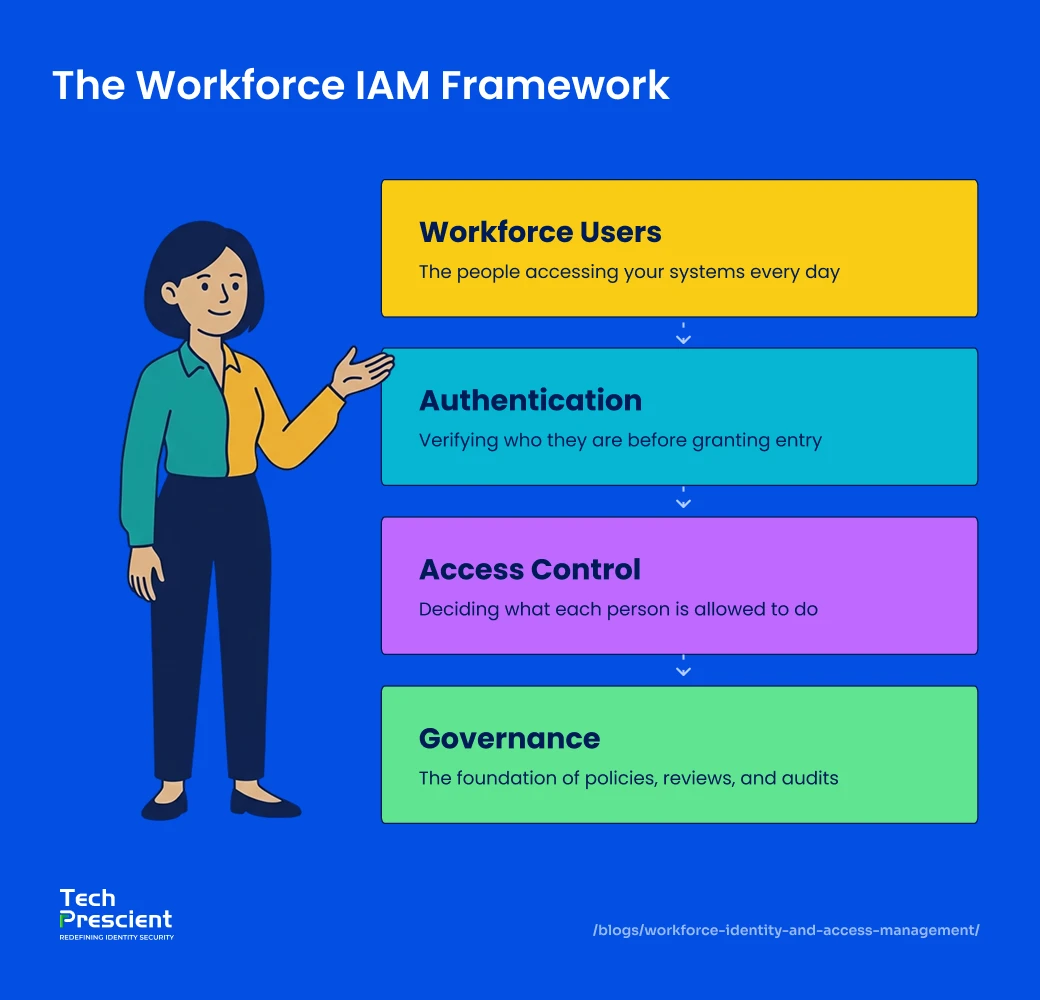
Workforce IAM combines identity lifecycle management, authentication, authorization, governance, and monitoring into a unified framework. Remove any one component, and the others weaken.
Identity Lifecycle Management
Identity lifecycle management handles the full arc of a workforce identity: onboarding when someone joins, access adjustments on role changes, and deprovisioning when they leave. The industry shorthand is the Joiner-Mover-Leaver process, and it is where most access debt originates. Joiners are handled well because someone is waiting for their access. Movers and leavers fail quietly, because removal is nobody's urgent problem.
Authentication
Authentication proves the identity is who it claims to be, and the methods span a spectrum of assurance. Passwords remain the baseline and the weakest link. Multi-factor authentication (MFA) requires a second proof, something the user has or is. Biometrics tie authentication to a physical characteristic. Passwordless methods remove the shared secret entirely, which removes the phishing target with it.
Insight:
MFA is not immune to attack. Push-notification bombing, where an attacker triggers repeated approval prompts until a tired user taps yes, has compromised MFA-protected accounts at major enterprises. Number matching and phishing-resistant factors close this gap; plain push approval no longer counts as strong authentication on sensitive systems.
Authorization
Authorization decides what an authenticated identity can do. Role-based access control (RBAC) grants entitlements through roles mapped to job functions, which keeps assignments consistent and reviewable. Attribute-based access control (ABAC) evaluates attributes of the user, resource, and context at request time. Policy-based access sits above both, encoding organizational rules such as segregation of duties. This is also where dangerous permission pairings get caught: two entitlements that are safe apart can form toxic access when one identity holds both.
Single Sign-On (SSO)
Single sign-on lets a user authenticate once and reach every connected application without logging in again. For the user, it removes credential juggling. For the security team, it centralizes the authentication event: one place to enforce MFA, one place to log sessions, and one switch to cut when an identity must be disabled. During offboarding or incident response, disabling a single SSO identity severs access to everything behind it.
Identity Governance and Administration (IGA)
Identity governance and administration is the oversight layer. Where lifecycle management executes access changes, IGA verifies they were correct: certification campaigns where managers confirm their teams still need what they hold, segregation-of-duties enforcement, and the audit trail behind every decision. Governance extends to the rules themselves, since policies and roles age; a mechanism like initiate certification keeps them on a scheduled review cycle so the rules governing access do not fall behind the organization they were written for.
Monitoring and Audit Logging
Monitoring records what identities actually do with their access: login events, permission changes, anomalous patterns, and dormant accounts. The challenge is less about collecting this data and more about keeping it current and readable for the people acting on it, which is the argument for a purpose-built CISO dashboard over raw logs and for measurement like an identity risk score that turns thousands of signals into a number that can be tracked and defended.
How Workforce IAM Works Across the Identity Lifecycle
Workforce IAM manages access from hiring to departure through automated identity lifecycle processes. Each stage fails differently, so each deserves its own look.
Step 1: Employee Onboarding
Onboarding starts in the HR system, not the IT queue. When a new record is created in the HRIS, HR-driven provisioning triggers automated account creation across the applications that the role requires. Done well, the new hire is productive on day one, and no human ever types their entitlements by hand. Done manually, onboarding becomes a template copied from the last hire, along with every permission that hire accumulated.
Step 2: Role Changes and Transfers
Transfers are where entitlements quietly pile up. A finance analyst moves to marketing, gains marketing access, and keeps finance access because nothing forced its removal. Automated access adjustments treat a role change as both a grant and a revocation event in one operation, and dynamic permissions tied to department and role attributes keep the adjustment accurate without a human deciding line by line. What the person owned needs the same treatment: ownership succession transfers responsibility for the roles, policies, and accounts they governed, so accountability moves when the person does.
Step 3: Employee Offboarding
Offboarding is the stage with the least tolerance for delay. Immediate deprovisioning, triggered by the termination event in the HR system, revokes access across every connected application at once. The risk reduction is direct: the window between departure and revocation is exactly the window in which a departed identity can be misused. Ticket-driven offboarding leaves that window open for days. Automation closes it in minutes.

Pro Tip:
Disabling the account is not the whole job. Active sessions and OAuth tokens issued before termination can survive a password reset and keep working for hours. A complete offboarding sequence revokes sessions and tokens alongside the account, not just the login.
Step 4: Continuous Access Monitoring
The lifecycle stages handle transitions, but access also drifts between them. Permissions get granted directly inside applications, and accounts get created outside standard provisioning, so the governance record slowly separates from what is live. Continuous identity reconciliation catches that drift on every sync cycle by comparing the identity provider against live application accounts, and identity posture monitoring keeps the resulting picture current for the people making decisions on it.
Workforce IAM vs Customer IAM (CIAM)
Workforce IAM secures internal users, while customer identity and access management (CIAM) focuses on customer identities and user experience. The differences run deeper than who logs in.
| Feature | Workforce IAM | CIAM |
|---|---|---|
| Users | Employees & Contractors | Customers |
| Goal | Security & Compliance | User Experience |
| Scale | Thousands | Millions |
| Governance | High | Limited |
| Authentication | Strong MFA | Frictionless Access |
The design tension is easiest to see in authentication. A workforce program can mandate hardware-backed MFA because employees must comply. A customer program demanding the same would watch signups collapse. Neither approach is wrong; they are optimized against different failure modes, a breached employee account versus an abandoned signup.
When to Use Workforce IAM
Use workforce IAM wherever the identity belongs to someone acting on the organization's behalf: employees, contractors, vendors, and partners reaching internal systems. The governance obligations that come with that relationship, lifecycle automation, access certification, and segregation of duties are exactly what WIAM platforms are built to satisfy. If an auditor could ever ask about the access, it belongs under workforce IAM.
When to Use CIAM
Use CIAM when the identity belongs to a customer or end user of your product. The priorities invert: registration must be effortless, authentication must balance security with friction, and the platform must scale to millions of identities with consent and privacy management built in. Running customer identity through a workforce platform produces friction that customers will not tolerate, and running workforce identity through CIAM produces governance that auditors will not accept.
Workforce IAM and Zero Trust Architecture
Workforce IAM acts as the identity foundation for Zero Trust by continuously validating users and access requests. Every Zero Trust principle depends on an identity capability underneath it.
Verify Explicitly
Verify explicitly means every access request is authenticated and authorized using all available signals, with no request trusted because of where it came from. Workforce IAM supplies the verification machinery: the authoritative identity record, the MFA challenge, and the entitlement check that together decide whether this request, from this identity for this resource, should proceed.
Least Privilege Access
Least privilege limits every identity to the minimum access its function requires. In practice, this is a governance problem more than a technology one, because access is easy to grant and awkward to take away. Workforce IAM enforces the principle at grant time through role design and at review time through certification, the only combination that keeps privilege from accumulating in one direction. This principle sits at the center of Zero Trust identity security, and it is where most programs are furthest from their stated posture.
Assume Breach
Assume breach means designing as though an attacker is already inside. Under that assumption, the entitlement map defines the blast radius: a compromised account can only reach what its access allows. Lifecycle discipline keeps that map small. Orphaned accounts, dormant credentials, and leftover permissions are exactly the assets an attacker inside the environment hunts for first.
Continuous Authentication
Continuous authentication extends verification past the login moment. Instead of trusting a session indefinitely, the system re-evaluates as context changes: a new location, an unusual resource request, or a risk signal from another tool. Workforce IAM makes this possible by maintaining a live identity state, so a session that was legitimate at 9 AM can be challenged or terminated at 2 PM when its behavior stops matching its history.
Common Workforce IAM Challenges
Organizations often struggle with identity sprawl, over-provisioned access, hybrid environments, and governance gaps. Naming the challenge precisely is half of scoping the fix.
Identity Sprawl
Every application creates accounts, and few organizations know how many identities each person has accumulated across them. The population is also larger than the workforce: according to KPMG's Cybersecurity Considerations 2026 report, machine identities now outnumber human users by more than 80 to 1, and they receive a fraction of the scrutiny. A complete inventory is the prerequisite for everything else, which is why identity governance discovery treats visibility as a continuous layer rather than a one-time project.
Manual Provisioning
Manual provisioning means every access change waits in a queue for a human to execute it, and executes only as consistently as that human's attention. The failure pattern is not incompetence. It is repetition: the same process run hundreds of times eventually produces a missed step, and with access, a missed step means either a blocked employee or an unrevoked entitlement. Replacing ticket-driven grants with workflow automation removes the queue and the variance at the same time.
Shadow IT
Departments buy software without IT involvement, and each tool accumulates accounts nobody governs. Those identities never appear in any review, because the platform running the review does not know the application exists. Closing the gap takes two capabilities: non-human identity discovery to surface accounts that were never provisioned through official channels and fast application onboarding so bringing a discovered application under governance takes days, not a quarter.
Excessive Permissions
Access accumulates in one direction because granting is easy and revoking is politically awkward. The result is identities holding entitlements their current role cannot justify: leftover access from previous positions, temporary exceptions that never expired, and defaults nobody tightened. The condition has a name, excessive permissions, and a structural fix: usage-informed reviews, automated revocation at role change, and time-bound exceptions.
Hybrid & Multi-Cloud Complexity
Most enterprises run identity across an on-premises directory, multiple cloud platforms, hundreds of SaaS applications, and a long tail of legacy systems, each with its own account model. On-premises shared drives governed through AD groups need dedicated handling, which is what file server access management addresses. Applications with no API carry the same compliance obligations as connected ones, which is the problem disconnected application governance exists to solve. A program is only as complete as its coverage of these hard cases.
Workforce IAM Best Practices
Successful workforce IAM programs combine automation, governance, least privilege, and continuous monitoring. These six practices cover most of the distance between a program on paper and one that holds up in an audit.
Implement MFA Everywhere
MFA on some applications is a speed bump; MFA everywhere is a control. Attackers who phish a password go looking for the systems that accept it alone, so partial coverage concentrates risk on exactly the applications that skipped it. Enforce MFA at the SSO layer so it applies to everything behind it, and reserve phishing-resistant factors for administrative and finance access.
Automate Provisioning and Deprovisioning
Every access change that depends on someone remembering is an access change that will eventually be missed. Connect provisioning to the HR system so joiner, mover, and leaver events fire automatically, with the HR record as the single source of truth. Deprovisioning deserves the strictest treatment: revocation should trigger on the termination event itself, not on a ticket filed afterward.
Enforce Least Privilege
Design roles around what the job requires today, not what previous holders happened to have. Grant elevated access as time-bound exceptions rather than permanent entitlements, and let exceptions expire by default. Where a new grant would create a conflicting combination, block it at request time instead of discovering it at audit time.
Conduct Access Reviews
Certification campaigns are where granted access gets verified against actual need, and they only work when reviewers can make real decisions instead of clearing queues. Give reviewers context: what the entitlement does, when it was last used, and what risk it carries. Run reviews on a cadence that matches risk, and remove the friction that turns careful review into speed-clicking.
Integrate IAM with HR Systems
The HR system knows about a departure before any IT system does, which makes HRIS integration the single highest-value connection in a workforce IAM program. Every lifecycle automation depends on it: onboarding triggers, transfer adjustments, and termination revocations all originate from HR events. Without it, the IAM platform governs a picture of the workforce that is always slightly out of date.
Monitor User Behavior
Provisioned access describes what an identity can do; behavior describes what it actually does. Monitoring the gap surfaces what reviews miss: dormant accounts nobody uses, but nobody revoked, sudden access outside a role's pattern, and activity at hours no business process explains. Feed those signals back into reviews and risk scoring so the program learns from its own telemetry.
Six best practices on paper. How many are running in your environment?
Score your program against identity management best practices, from provisioning to review.
Top Workforce IAM Technologies and Solutions
Modern workforce IAM platforms provide identity lifecycle management, authentication, governance, and analytics, typically as a stack of platform categories rather than one tool.
Identity Providers (IdPs)
The identity provider holds the authoritative directory of workforce identities and performs authentication against it. It is the system every other identity tool queries to answer "who is this," which makes it the anchor of the stack. Cloud directories have largely taken this role from on-premises ones, though most enterprises run both together through identity federation, the trust relationship that lets one identity provider vouch for a user to another, so a single workforce identity works across cloud and on-premises systems without duplicate accounts. Federation is what holds a hybrid directory estate together during the years-long migration most enterprises are still in the middle of.
Single Sign-On Platforms
SSO platforms sit on top of the identity provider and broker authentication to connected applications through standards like SAML and OIDC. Their value scales with coverage: every application behind SSO gains centralized authentication, session control, and one-switch revocation. Applications left outside keep their own credentials and their own risk.
MFA Solutions
MFA solutions supply the additional authentication factors, from one-time codes and push notifications to hardware keys and biometrics. The category is converging into IdP and SSO platforms, but dedicated solutions persist where organizations need phishing-resistant factors, offline coverage, or reach into systems the main stack cannot serve.
IGA Platforms
Governance platforms provide the oversight layer: lifecycle automation, access requests and approvals, certification campaigns, segregation-of-duties enforcement, and audit reporting. This is the category that answers the auditor's questions and is increasingly the category expected to govern machine identities alongside human ones.
PAM Solutions
Privileged access platforms handle the highest-risk slice of workforce access: administrative credentials, root accounts, and infrastructure access. They add controls that ordinary access does not need, such as credential vaulting, session recording, and just-in-time elevation that grants admin rights only for the window a task requires. PAM complements governance rather than replacing it; one governs the breadth of access, and the other hardens its most dangerous edge.
Workforce IAM Use Cases
The same identity framework serves several distinct enterprise scenarios, and each shows the components combining differently.
Enterprise Workforce Security
The baseline case: a large organization managing thousands of employees across hundreds of applications. Lifecycle automation keeps access aligned through constant organizational change, SSO and MFA secure the authentication layer, and governance produces the review and audit records regulators expect. At this scale, the difference between manual and automated identity operations is measured in headcount.
Remote Workforce Access
Distributed teams removed the network perimeter as a meaningful control, leaving identity as the check that travels with the user. Remote access decisions rest on verified identity, device posture, and context rather than network location. Strong authentication matters more here, not less: the office's implicit safeguards are gone, and the login is all that stands between a stolen credential and the environment.
Third-Party Access Management
Contractor, vendor, and partner access outlives its purpose more often than employee access does, because no HR termination event fires when an engagement ends. The Verizon 2026 Data Breach Investigations Report, drawn from more than 22,000 confirmed breaches, found third-party involvement in 48% of breaches, up from 30% a year earlier. Time-bound access tied to contract dates, a named internal sponsor for every external identity, and reviews that explicitly cover third parties close most of the gap.
Cloud Application Access
SaaS adoption multiplied the systems holding workforce access, each with its own admin console and permission model. Workforce IAM brings them under one framework: SSO for authentication, SCIM or connector-based provisioning for lifecycle events, and unified reviews across the portfolio. The long tail matters as much as the major platforms, since the hundredth application holds real access even if nobody remembers buying it.
Regulatory Compliance
For regulated industries, workforce IAM is the control set behind a large share of audit requirements: access mapped to job function, terminations executed promptly, reviews performed and documented, and duties separated in financial processes. Programs that handle audits calmly are the ones whose evidence accumulates continuously, structured the way a centralized compliance reporting framework describes, instead of being assembled in the weeks before the auditor arrives.
Future Trends in Workforce Identity Management
AI, passwordless authentication, continuous verification, and identity-centric security are shaping the future of Workforce IAM, and most of the movement points in one direction: identity decisions becoming continuous, automated, and applied to a population far larger than the human workforce.
Passwordless Authentication
Passkeys and hardware-backed credentials are replacing passwords for workforce authentication, removing the shared secret that phishing depends on. Adoption is being pulled from both sides: users prefer the experience, and security teams prefer eliminating the credential-theft vector to mitigating it. The transition will take years because of legacy applications, but the direction is settled.
AI-Driven Identity Security
AI is entering identity operations where the decision space is too large for manual work: detecting anomalous access patterns, prioritizing review queues by risk, and suggesting role assignments from actual access data. The pattern that works in practice is assistive rather than autonomous; the system shortlists and the human decides, which is the model behind capabilities like AI role recommendation. Expect the assistive surface to widen every year.
Continuous Access Evaluation
The industry is moving from point-in-time authentication toward continuous evaluation, where sessions are reassessed as risk signals change. A session granted under one set of conditions can be stepped up or revoked when conditions shift, without waiting for the next login. Access stops being a gate at the front door and becomes a policy enforced for the duration of the visit.
Identity Threat Detection and Response (ITDR)
ITDR treats the identity infrastructure itself as an attack surface to defend, monitoring for credential misuse, privilege escalation, and manipulation of the identity systems that attackers increasingly target first. It closes the gap between IAM, which grants access, and traditional detection tools, which watch endpoints and networks but not the identity layer connecting them.
Convergence of IAM and IGA
Access management and governance grew up as separate categories, one handling authentication and the other handling oversight, and the boundary is dissolving. The forcing function is the identity population itself: service accounts, API keys, and AI agents need lifecycle, ownership, and review just as employees do, and running them through a separate program produces two records that never align. The destination is unified human and non-human identity governance, one platform and one audit trail for every identity type, with disciplines like continuous service account governance applying workforce-grade rigor to the machine side.
Final Thoughts
Workforce IAM is no longer just an access management solution. It is a foundational component of modern identity security and Zero Trust architecture, and the gap between organizations that treat it as a login tool and those that treat it as a lifecycle discipline shows up in every audit and every incident.
Organizations that combine workforce IAM with governance and automation are better positioned to reduce risk, improve compliance, and support digital transformation. That combination is what Identity Confluence delivers: identity governed continuously, for every identity type, with the record to prove it.
Govern every workforce identity, both human and machine, from one system
Identity Confluence automates the joiner-mover-leaver lifecycle, runs access reviews with usage context, and produces audit evidence continuously across SOC 2, ISO 27001, SOX, HIPAA, and GDPR.
FAQs
Workforce Identity and Access Management (WIAM) is the framework used to manage employee identities and control access to business applications and systems.
There is no single workforce IAM standard, but organizations commonly align IAM programs with Zero Trust, NIST, ISO 27001, SOX, and GDPR requirements.
The four primary pillars are identity lifecycle management, authentication, authorization, and governance.
Workforce IAM manages employee access, while CIAM manages customer identities and focuses on user experience and scalability.
Zero Trust relies on continuous identity verification, making Workforce IAM the foundation for authentication, authorization, and least-privilege access.
It provides audit trails, user access review records, policy enforcement, and lifecycle automation that support regulatory and compliance requirements.
Share



Brinda Bhatt
Digital Marketing Strategist
A Digital Marketing Strategist who makes complex identity governance accessible to security and technology leaders through clear, data-driven content. Her insight-led, audience-focused approach supports Tech Prescient's mission of redefining identity security for modern enterprises.
Most Popular Blogs
Identity Security· 21 min read
Data Access Governance Solutions: How to Secure Sensitive Data at Scale
Compare data access governance solutions for 2026: how DAG platforms discover sensitive data, run access reviews, automate remediation, and prove compliance.
Brinda Bhatt· September 7, 2026
Identity Security· 24 min read
What Is Zero Trust Network Access (ZTNA)?
Learn what Zero Trust Network Access (ZTNA) is, how it works, and why it’s replacing VPNs for secure, identity-based access control.
Yatin Laygude· August 14, 2026
Identity Security· 24 min read
Cyber Essentials Certification: Complete Guide
Learn Cyber Essentials certification, cost, requirements, and steps. Compare Cyber Essentials vs Plus and get certified faster.
Yatin Laygude· August 10, 2026