
What Is FedRAMP Compliance? Requirements, Process & Checklist (2026 Guide)
Last Updated date: July 12, 2026
On this page
See Tech Prescient in Action
Automate access, reduce risk, and stay audit-ready
The Federal Risk and Authorization Management Program (FedRAMP) is a U.S. government-wide framework that standardizes how cloud services are assessed, authorized, and continuously monitored for security. Introduced to eliminate inconsistent and repetitive security evaluations across federal agencies, FedRAMP creates a unified approach that improves efficiency while enforcing strong cybersecurity baselines.
Built on NIST SP 800-53 controls, FedRAMP ensures that cloud service providers (CSPs) meet rigorous security and compliance requirements before handling federal data. For providers, achieving FedRAMP compliance is not just a regulatory step, it is essential for accessing government contracts, building trust, and proving a mature security posture in a highly regulated environment.
According to FedRAMP Program Management Office, the FedRAMP Marketplace currently includes 300+ authorized cloud services supporting federal agencies, highlighting the rapid adoption of secure cloud solutions across government. This growth underscores how critical FedRAMP compliance has become for cloud providers aiming to operate in the federal ecosystem. Let’s explore everything you need to know about FedRAMP compliance, from requirements and authorization to checklists and best practices.
Key Takeaways:
- FedRAMP is a standardized cloud security framework for U.S. federal agencies.
- Built on NIST SP 800-53 controls for consistent security.
- Requires authorization through ATO or JAB P-ATO.
- Includes continuous monitoring after approval.
- Essential for cloud providers selling to government agencies.
What Is FedRAMP?
FedRAMP, or the Federal Risk and Authorization Management Program, is a U.S. government-wide framework that standardizes cloud security assessments, authorization, and continuous monitoring for services used by federal agencies. It provides a consistent approach to evaluating cloud security, ensuring that all providers meet the same baseline before handling government data.
In simple terms, FedRAMP creates a single, standardized security framework that replaces multiple agency-specific cloud security assessments.
1. Established to Support FISMA Compliance
FedRAMP was introduced to support FISMA (Federal Information Security Modernization Act) requirements by aligning cloud security practices with federal risk management standards and ensuring consistent implementation across agencies.
2. Mandatory for Cloud Service Providers
FedRAMP compliance is required for cloud providers offering SaaS, PaaS, and IaaS solutions to federal agencies. Without authorization, providers cannot store, process, or transmit federal data in the cloud.
3. Standardized Security Based on NIST
The framework is built on NIST SP 800-53 controls, which define strict requirements across access control, encryption, monitoring, and incident response, ensuring a high level of federal cybersecurity.
4. Cost and Timeline Considerations
Achieving FedRAMP compliance typically takes 12 to 24 months and can cost between $250,000 and $750,000+, depending on system complexity, readiness, and required impact level.
Why FedRAMP Compliance Matters for Cloud Providers
FedRAMP compliance plays a critical role in enabling secure cloud adoption across the U.S. federal ecosystem. By introducing a standardized authorization process, it ensures that cloud service providers (CSPs) meet strict NIST SP 800-53 security controls before handling federal data. This not only strengthens cybersecurity posture but also eliminates redundant agency-level assessments, making cloud adoption faster, more consistent, and scalable.
In essence, FedRAMP creates a trusted bridge between federal agencies and cloud providers by combining rigorous security validation with a reusable authorization model.
Benefits for Federal Agencies
1. Risk Reduction
FedRAMP requires cloud services to undergo a rigorous 3PAO assessment, ensuring vulnerabilities are identified and mitigated before adoption. This significantly reduces the risk of data breaches involving sensitive information such as PII, financial records, or mission-critical systems.
2. Standardized Evaluation
By aligning with FISMA compliance and NIST SP 800-53 controls, FedRAMP provides a uniform framework for evaluating cloud security. This consistency removes variations across agencies and ensures all providers meet the same high-security baseline.
3. Faster Procurement
Once a CSP achieves authorization, its security package can be reused across agencies. This eliminates the need for repeated assessments, accelerating procurement cycles and enabling faster adoption of secure cloud solutions.
Benefits for Cloud Service Providers
1. Access to Federal Contracts
FedRAMP authorization, whether through an Agency Authorization to Operate (ATO) or Joint Authorization Board (JAB) Provisional ATO (P-ATO), allows CSPs to offer their services to federal agencies, unlocking access to one of the largest cloud markets.
2. Increased Trust and Credibility
Achieving FedRAMP compliance demonstrates that a provider meets rigorous federal cybersecurity standards. This enhances credibility not only with government agencies but also with private-sector customers who value proven security and compliance.
3. Competitive Differentiation
FedRAMP compliance positions CSPs ahead of competitors by showcasing strong security practices, continuous monitoring capabilities, and long-term commitment to risk management, making them a preferred choice for high-security environments.
4. Expanded Access to Federal Cloud Providers
FedRAMP compliance broadens the pool of vetted cloud service providers available to federal agencies. With more providers meeting federal security requirements, agencies gain access to a wider range of pre-authorized solutions, enabling greater flexibility, faster vendor selection, and improved alignment with mission and operational needs.
FedRAMP Requirements Explained
FedRAMP compliance requires cloud service providers (CSPs) to implement a comprehensive set of security controls, maintain detailed documentation, and demonstrate ongoing adherence through continuous monitoring. Rather than a one-time certification, it is a structured and continuous process aligned with federal cybersecurity standards.
At its core, FedRAMP ensures that CSPs consistently meet a high-security baseline through standardized controls, validated assessments, and continuous oversight.
1. Based on NIST SP 800-53 Rev. 5
FedRAMP requirements are built on NIST SP 800-53 Rev. 5, which defines a broad set of security and privacy controls. These controls span critical areas such as access control, encryption, incident response, system integrity, and risk management, forming the foundation of FedRAMP cybersecurity.
2. 300–400+ Security Controls
Depending on the system’s impact level (Low, Moderate, or High), CSPs must implement 300 to 400+ security controls. These controls are mapped to FIPS 199 categorization, ensuring that the level of protection aligns with the sensitivity of federal data being handled.
3. Documentation Requirements (SSP, SAR, POA&M)
CSPs must produce a complete authorization package that demonstrates compliance:
- System Security Plan (SSP): დეტailed documentation of how security controls are implemented
- Security Assessment Report (SAR): Findings from an accredited 3PAO assessment
- Plan of Action and Milestones (POA&M): A structured plan to remediate identified gaps and vulnerabilities
4. Continuous Monitoring Plan
FedRAMP requires a formal Continuous Monitoring (ConMon) program to maintain compliance post-authorization. This includes monthly vulnerability scans, regular security assessments, incident reporting, and ongoing updates to ensure controls remain effective against evolving threats.

Pro Tip
Prioritize identity and access controls early. Addressing least privilege and role governance first reduces gaps across multiple FedRAMP control families.
FedRAMP Impact Levels (Low, Moderate, High)
FedRAMP defines three levels of FedRAMP based on the potential impact a security breach could have on data confidentiality, integrity, and availability. These impact levels determine the number and rigor of NIST SP 800-53 controls, along with the depth of assessment required for authorization.
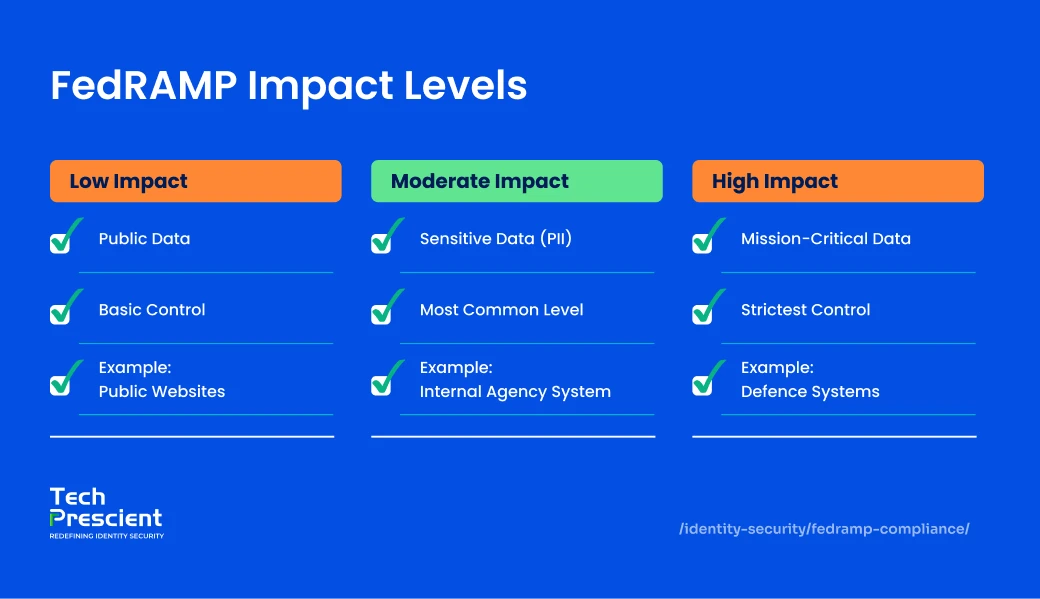
In simple terms, the higher the data sensitivity, the stricter the security controls and compliance requirements.
| Sr No | Level | Data Type | Example |
|---|---|---|---|
| 1 | Low Impact | Public or non-sensitive data | Public websites, general information portals |
| 2 | Moderate Impact | Sensitive but unclassified data (including PII) | Internal agency systems, financial records |
| 3 | High Impact | Highly sensitive or mission-critical data | Defense systems, law enforcement, critical infrastructure |
At the Low impact level, systems handle publicly available data and require a baseline set of security controls.
The Moderate impact level, which is the most common, applies to systems managing sensitive data such as personally identifiable information (PII) and requires significantly more controls and monitoring.
The High impact level is designed for systems supporting national security, critical infrastructure, or highly sensitive government operations. These environments must implement the most extensive set of controls and undergo the most rigorous assessment process.
Organizations handling mission-critical or highly sensitive data should pursue FedRAMP High authorization, as it provides the most comprehensive level of protection within the framework.
FedRAMP Authorization Process (Step-by-Step)
FedRAMP authorization is a structured, multi-phase process that validates whether a cloud service provider (CSP) can securely handle federal data. It involves defining system scope, implementing NIST SP 800-53 controls, undergoing an independent 3PAO assessment, and obtaining an Authorization to Operate (ATO), followed by continuous monitoring to maintain compliance.
In simple terms, FedRAMP ensures a cloud service is thoroughly assessed, officially authorized, and continuously monitored for security throughout its lifecycle.
Step 1: Define Cloud Service Boundary
The CSP defines the cloud service offering (CSO) by outlining system architecture, data flows, components, and security boundaries. This step establishes the scope of the assessment and ensures all in-scope assets and processes are clearly identified.
Step 2: Select Impact Level
The system is categorized using FIPS 199 as Low, Moderate, or High impact based on data sensitivity and potential risk. This classification determines the number and stringency of security controls required for compliance.
Step 3: Prepare System Security Plan (SSP)
The System Security Plan (SSP) is developed to document how each FedRAMP control is implemented. It provides a comprehensive view of security controls, policies, and procedures, forming the core of the authorization package.
Step 4: Engage 3PAO
An accredited Third-Party Assessment Organization (3PAO) is engaged to conduct a readiness assessment and perform an independent evaluation of the system. This ensures the CSP is prepared for the formal authorization process and meets baseline requirements.
Step 5: Assessment & Remediation
The CSP undergoes a detailed security assessment that includes control testing, vulnerability scanning, and penetration testing. Results are documented in the Security Assessment Report (SAR), and identified gaps are addressed through a Plan of Action and Milestones (POA&M).
Step 6: Authorization (Agency ATO or JAB P-ATO)
The CSP submits the complete authorization package for review. Authorization can be granted either through an Agency Authorization to Operate (ATO) or a Joint Authorization Board (JAB) Provisional ATO (P-ATO), confirming that the system meets FedRAMP security requirements and can be used by federal agencies.
Step 7: Continuous Monitoring
After authorization, the CSP must implement a Continuous Monitoring (ConMon) program that includes monthly vulnerability scans, regular reporting, and ongoing assessments. This ensures that security controls remain effective and that compliance is maintained as threats evolve.
Planning FedRAMP authorization?
Evaluate controls, documentation, and readiness with this practical assessment framework.
FedRAMP Compliance Checklist (Quick Overview)
Achieving FedRAMP compliance requires a structured approach that combines security implementation, documentation, assessment, and ongoing monitoring. This checklist highlights the essential steps cloud service providers (CSPs) must complete to successfully obtain and maintain authorization.
Use this high-level checklist to align your cloud environment with FedRAMP requirements and streamline the authorization process.
1. Conduct Gap Assessment
Perform a comprehensive gap analysis against NIST SP 800-53 controls to identify security weaknesses, control deficiencies, and compliance gaps. This step helps define the remediation roadmap before entering the formal FedRAMP authorization process.
2. Implement NIST Controls
Implement required security controls across key domains such as access control, encryption, logging, incident response, and system integrity. Ensure controls are aligned with the appropriate FIPS 199 impact level (Low, Moderate, or High) based on data sensitivity.
3. Complete Documentation
Develop a complete FedRAMP authorization package, including the System Security Plan (SSP) to document control implementation, the Security Assessment Report (SAR) for assessment findings, and the Plan of Action and Milestones (POA&M) to address identified risks and remediation timelines.
4. Perform 3PAO Assessment
Engage an accredited Third-Party Assessment Organization (3PAO) to conduct an independent evaluation of your cloud environment. This includes control testing, vulnerability assessments, and validation of security practices against FedRAMP requirements.
5. Submit Authorization Package
Submit the finalized documentation and assessment results to either a sponsoring agency for an Authorization to Operate (ATO) or to the Joint Authorization Board (JAB) for a Provisional ATO (P-ATO), depending on the chosen authorization path.
6. Establish Continuous Monitoring
Implement a Continuous Monitoring (ConMon) program that includes monthly vulnerability scans, periodic security assessments, incident reporting, and ongoing updates to ensure that security controls remain effective and compliant over time.
Assess your readiness before starting authorization.
Use this structured framework to identify gaps and prepare for FedRAMP.
FedRAMP vs Other Compliance Frameworks
FedRAMP is specifically designed for federal cloud security, while other frameworks address broader information security, industry-specific regulations, or global standards. Although many of these frameworks share common foundations such as NIST-based controls, their scope, application, and authorization models differ significantly.
In simple terms, FedRAMP is purpose-built for cloud services used by U.S. federal agencies, whereas other frameworks apply across industries, regions, or use cases.
| Sr No | Framework Comparison | Focus | Scope | Key Difference |
|---|---|---|---|---|
| 1 | FedRAMP vs ISO 27001 | Federal cloud security vs global ISMS standard | Cloud services for U.S. federal agencies vs all industries globally | FedRAMP is mandatory for federal cloud providers, while ISO 27001 is a voluntary certification for broader information security management |
| 2 | FedRAMP vs SOC 2 | Government cloud security vs private-sector compliance framework | Federal agencies vs commercial organizations | FedRAMP is more prescriptive and requires 3PAO assessment, while SOC 2 is flexible and audited by CPA firms based on Trust Services Criteria |
| 3 | FedRAMP vs FISMA | Cloud-specific framework vs federal law | Cloud environments vs all federal information systems | FISMA sets the legal requirement, while FedRAMP operationalizes it for cloud through standardized controls and authorization |
FedRAMP vs FISMA
FISMA (Federal Information Security Modernization Act) is the law that governs security across all federal information systems. FedRAMP builds on FISMA by translating its requirements into a standardized, cloud-specific authorization framework, enabling a consistent approach to security assessment and authorization for cloud services.
FedRAMP vs NIST RMF
The NIST Risk Management Framework (RMF) provides a standardized methodology for managing risk across federal systems. FedRAMP applies RMF principles specifically to cloud environments while adding requirements such as accredited 3PAO assessments and a centralized authorization supported by the FedRAMP Marketplace.
FedRAMP vs StateRAMP
StateRAMP is modeled after FedRAMP but is designed for state and local governments. It uses NIST SP 800-53 controls and similar assessment practices, but its scope is limited to state-level agencies rather than federal organizations.
Managing Multiple Frameworks
Organizations often need to comply with multiple frameworks simultaneously. Since many of these standards rely on NIST security controls, implementing FedRAMP can support alignment with frameworks like FISMA or StateRAMP. Successful organizations adopt a “build once, comply many” strategy, mapping controls across frameworks to reduce duplication and streamline audits while maintaining consistent security practices.
How Identity Governance Supports FedRAMP Compliance
Strong identity governance plays a foundational role in achieving and maintaining FedRAMP compliance. Since FedRAMP is built on NIST SP 800-53 controls, many of its requirements directly focus on identity, access control, and continuous monitoring. Effective identity governance helps cloud service providers (CSPs) enforce least-privilege access, maintain audit readiness, and ensure consistent security across users, systems, and workloads.
Organizations that combine identity governance with access management frameworks gain better visibility and control over permissions, reducing risks like over-provisioning and access drift.
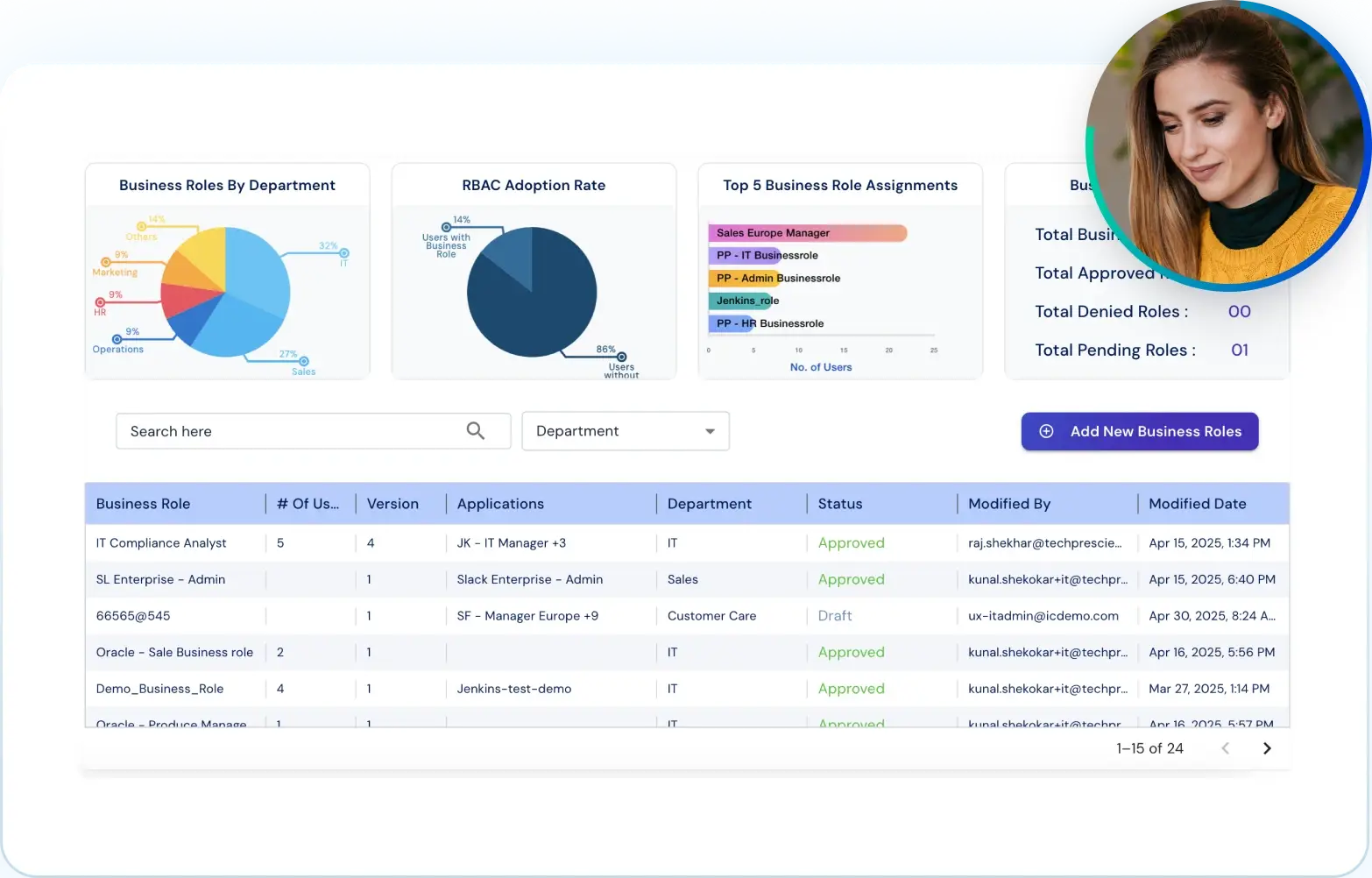
Solutions like Identity Confluence by Tech Prescient help support these requirements by centralizing governance, automating access reviews, and providing continuous visibility, enabling more efficient alignment with FedRAMP controls.
1. Access Certifications
Identity governance enables periodic access certifications, allowing organizations to review and validate user access rights. This ensures that only authorized users retain access to sensitive federal data, supporting audit requirements and reducing the risk of privilege creep.
2. Role-Based Access Control (RBAC)
With role-based access control, access is assigned based on predefined roles rather than individual users. This aligns with FedRAMP’s emphasis on structured access control by simplifying permission management and ensuring consistent enforcement of least-privilege policies across cloud environments.
3. Segregation of Duties (SoD)
Segregation of Duties (SoD) prevents conflicting access rights by ensuring that no single user has excessive control over critical systems. This reduces the risk of misuse, fraud, or unauthorized changes, which is essential for maintaining compliance with federal security standards.
4. Automated Provisioning & Deprovisioning
Automated identity lifecycle management ensures that user access is granted, modified, or revoked in real time based on role changes. This reduces manual errors and ensures that access is always aligned with current responsibilities, which is critical in a continuously monitored FedRAMP environment.
5. Continuous Compliance Reporting
FedRAMP requires ongoing validation of security controls through continuous monitoring. Identity governance platforms support this by generating real-time reports on access, policy violations, and user activity, helping organizations demonstrate compliance and quickly respond to emerging risks.
Expert Insight
Build your SSP alongside control implementation to speed up review and avoid last-minute documentation gaps.
Final Thoughts
FedRAMP compliance provides a standardized framework for securing cloud services used by federal agencies through rigorous requirements, authorization, and continuous monitoring. Built on NIST SP 800-53 controls, it ensures consistent security across access control, data protection, and risk management. As cloud adoption grows across government and regulated sectors, achieving and maintaining FedRAMP compliance becomes essential for reducing risk, building trust, and unlocking federal business opportunities.
Tech Prescient helps organizations strengthen identity security and access governance with scalable, modern solutions.
Planning FedRAMP authorization?
Evaluate controls, documentation, and readiness with this practical assessment framework.
FAQs
To become FedRAMP compliant, a cloud service provider needs to implement NIST SP 800-53 security controls and prepare key documents like the System Security Plan (SSP). The system is then assessed by an accredited 3PAO, followed by remediation and submission for authorization. Once approved (ATO), the provider must maintain continuous monitoring to stay compliant.
FedRAMP is primarily designed for U.S. federal agencies and is mandatory for cloud providers selling to them. Private companies don’t need it unless they handle federal data or offer services to government customers. In such cases, FedRAMP becomes a requirement to meet federal security standards.
FedRAMP defines three impact levels based on data sensitivity and risk. Low is for public or non-sensitive data, Moderate covers sensitive but not critical systems, and High is for highly sensitive data like defense or law enforcement. The level determines the number and rigor of required security controls.
FedRAMP is a U.S. government-specific framework focused on securing cloud services for federal use. ISO 27001, on the other hand, is a global standard for information security management across industries. While both emphasize risk management, FedRAMP has stricter, federally mandated controls and authorization requirements.
FedRAMP authorization typically takes between 12 to 24 months from preparation to approval. The timeline depends on factors like impact level, system complexity, and readiness of controls and documentation. Ongoing continuous monitoring is required even after authorization is achieved.
FedRAMP authorization is the formal approval that allows a cloud service provider to offer services to U.S. federal agencies. It can be granted through an Agency Authorization to Operate (ATO) or a Joint Authorization Board (JAB) Provisional ATO after completing assessment and documentation requirements.
FedRAMP compliance typically costs between $250,000 and $750,000 or more depending on system complexity, impact level, and assessment scope. Costs include 3PAO assessment, documentation, security implementation, and continuous monitoring.


GET A PERSONALIZED DEMO
See Identity Confluence in Action
“One platform to govern identities, automate access decisions, and prove compliance; across every app, user, and system in your environment.”



Murli Ramsunder
Senior Architect, Vonage