
Granular Access Control: Definition, Architecture & Enterprise Strategy
Last Updated date: July 12, 2026
On this page
See Tech Prescient in Action
Automate access, reduce risk, and stay audit-ready
Granular access control gives employees precise access to only the systems and processes they need to do their job, based on predefined conditions. The goal is to strengthen security by removing unnecessary access and enforcing the principle of least privilege at every step.
As organizations adopt cloud platforms, SaaS applications, and distributed IT environments, managing access at a detailed level has become essential. Granular access control enables fine grained permissions, ensuring users can only perform the actions required for their roles while reducing the risk of unauthorized access, misuse, or accidental exposure of critical data.
The need for tighter access control is rising. According to the 2024 Insider Threat Report by Cybersecurity Insiders, 83% of organizations experienced at least one insider attack, highlighting the risks of misused legitimate access. Let's explore further how granular access control is now essential to modern identity security, playing a key role in identity governance, Zero Trust, and regulatory compliance.
Key Takeaways:
- Granular access control enables precise, least-privilege access to systems, data, and resources.
- It builds on access models such as [RBAC and ABAC](/blogs/rbac-vs-abac-access-control/) to enforce fine-grained permissions.
- It supports Zero Trust by enabling contextual and continuously verified access decisions.
- Integration with [identity governance](/identity-security/identity-governance-framework/) helps automate access reviews and enforce segregation of duties.
- Implementing granular access control reduces risk while improving security and compliance.
What Is Granular Access Control (GSC)?
Granular access control (GSC) is a security model that defines permissions at a highly detailed level, ensuring users can access only the resources and actions required for their role.
Instead of granting broad access to entire systems or datasets, granular access control allows administrators to define precise permissions across users, roles, attributes, and resources. Permissions can be limited to specific actions such as viewing, editing, approving, or deleting on defined data or services.
By restricting access to the exact level required, organizations enforce least privilege policies, reduce unnecessary permissions, and strengthen control over how systems and data are accessed.
Key aspects of granular access control include:
- Fine-grained permissions: Access rights can be defined at a detailed level, such as specific files, database records, application features, or system functions.
- Difference from broad access: Unlike traditional access models that grant full access to applications or systems, granular control limits permissions to specific tasks or resources.
- Least privilege enforcement: Granular policies support the least privilege principle, ensuring users receive only the minimum level of access needed to perform their responsibilities.
- Role and attribute-based control: Permissions can be assigned based on roles, user attributes, or contextual factors such as department, device, or location.
- Stronger cybersecurity posture: By restricting unnecessary privileges, granular access control reduces the risk of insider threats, credential misuse, and unauthorized data exposure.

Pro Tip:
Start implementing granular access control with high-risk systems such as financial platforms, customer databases, or cloud admin consoles. Prioritizing sensitive environments first helps organizations reduce security exposure while refining access policies gradually.
Granular vs Broad Access Control: What Sets Them Apart?
Access control models differ in how precisely they define and enforce permissions. While some approaches are designed for simplicity and speed, others focus on tighter security, contextual decision-making, and scalability. Choosing the right model plays a key role in building a secure and efficient identity framework.
| Sr No | Aspect | Granular Access Control (Fine-Grained) | Broad Access Control (Coarse-Grained) |
|---|---|---|---|
| 1 | Permission Scope | Defines access at a highly detailed level such as specific files, fields, or actions. | Grants access at a broader level, often covering entire systems or modules. |
| 2 | Decision Basis | Considers multiple factors such as role, department, device, time, and location. | Primarily based on static roles or group memberships. |
| 3 | Security Strength | Aligns with least-privilege principles, reducing unnecessary access. | Tends to over-assign permissions, increasing risk if accounts are compromised. |
| 4 | Monitoring & Auditing | Enables detailed tracking of user actions for better visibility and alerts. | Provides limited insights into specific user activities. |
| 5 | Flexibility | Supports dynamic access, including temporary or context-based permissions. | Requires manual updates, often leading to rigid structures over time. |
| 6 | Administrative Overhead | Requires initial planning but becomes efficient with automation. | Simple to deploy early on but harder to manage as complexity grows. |
From a risk standpoint, fine-grained access control limits how far an attacker can move within a system by tightly restricting user permissions.
For example, a support user may only be allowed to view basic user records under specific conditions, with no access to sensitive data or control actions, which helps prevent deeper system exposure and reduces the overall impact of a breach.
Types of Access Control
Granular access control evolved from early static access models like DAC and MAC to dynamic, policy-driven models such as RBAC and ABAC used in modern cloud environments.
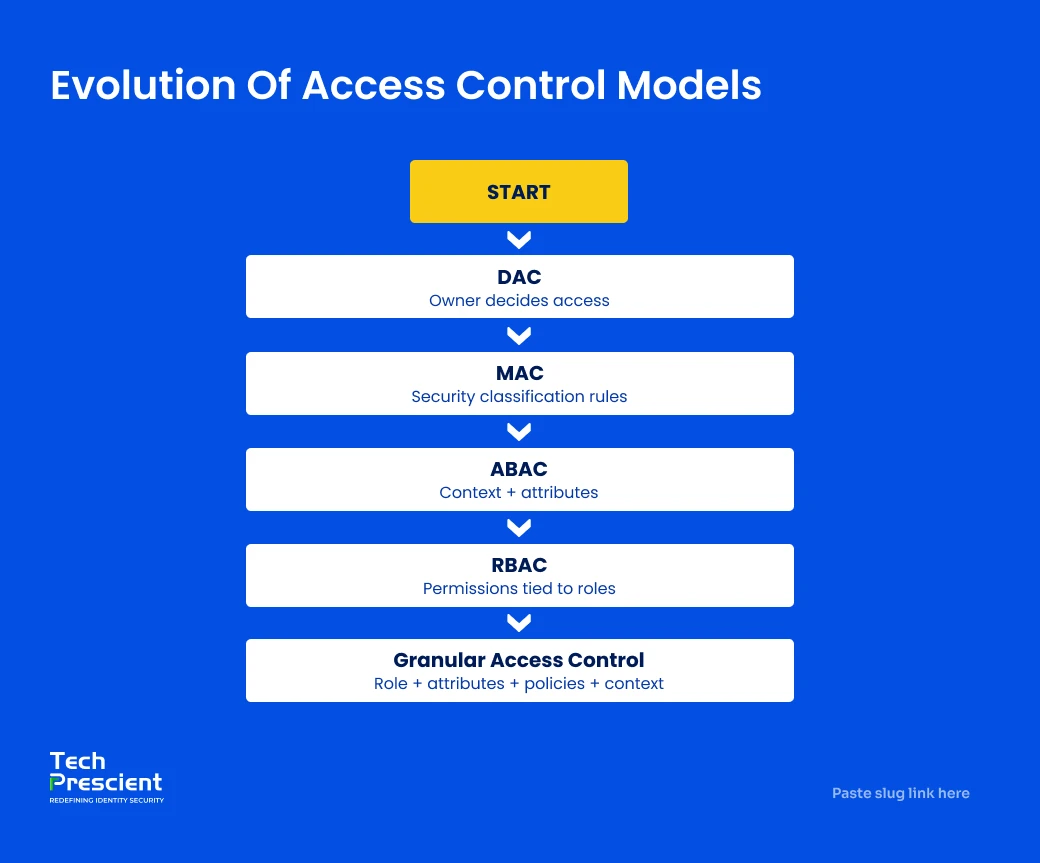
As organizations began managing larger volumes of users, systems, and sensitive data, access control models evolved to provide stronger governance and more precise permission management. Early models focused on ownership or classification rules, while modern approaches incorporate roles, attributes, and policies to support scalable security. Together, these models represent the progression toward fine-grained access control, where permissions can be enforced at a highly detailed level.
Discretionary Access Control (DAC)
Discretionary Access Control (DAC) is an owner-based access model in which the creator or owner of a resource decides who can access it. The resource owner has the discretion to grant, modify, or revoke permissions for other users or groups. This model is commonly used in operating systems and file-sharing environments where users manage their own data access.
While DAC provides flexibility, it can also introduce security risks if permissions are shared too broadly or not properly maintained. Because individual users control access decisions, governance and enforcement can become inconsistent in large enterprise environments.
Mandatory Access Control (MAC)
Mandatory Access Control (MAC) is a centralized, policy-driven access control model where access decisions are enforced by the system based on security classifications and user clearance levels. In this model, users cannot modify access permissions themselves; instead, a central authority defines and enforces strict policies.
MAC is typically used in high-security environments such as government, defense, and military systems, where sensitive information must be protected based on classification levels.
Key characteristics of MAC include:
- Access decisions based on security labels and classifications
- Centralized administrative control over permissions
- Strict enforcement of policies with minimal user discretion
Role-Based Access Control (RBAC)
Role-Based Access Control (RBAC) assigns permissions based on a user's role within an organization. Instead of assigning permissions directly to individuals, administrators define roles such as administrator, developer, analyst, or auditor, and associate specific privileges with each role. Users are then granted access according to the role they hold.
RBAC simplifies access management by grouping permissions into roles that align with job functions. This makes it easier for organizations to manage access across large numbers of users and systems.
Key aspects of RBAC include:
- Role-based permission assignment aligned with job responsibilities
- Simplified administration by managing roles instead of individual users
- Widely used in enterprise IAM and identity governance systems
Attribute-Based Access Control (ABAC)
Attribute-Based Access Control (ABAC) is a dynamic access control model that evaluates multiple attributes associated with users, resources, and the environment before granting access. Unlike RBAC, which relies mainly on predefined roles, ABAC allows access policies to consider contextual information such as location, time, device type, or data sensitivity.
This flexibility makes ABAC particularly useful in cloud environments and distributed systems where access conditions frequently change.
Attributes commonly evaluated in ABAC policies include:
- User attributes such as department, job title, or security clearance
- Resource attributes such as classification or sensitivity level
- Environmental attributes including location, device, or time of access
- Action attributes defining the requested operation such as read, write, or modify
Fine-Grained / Policy-Based Access
Fine-grained access control, also referred to as policy-based access control, represents the most advanced stage in the evolution of access models. It combines elements of RBAC, ABAC, and centralized policy engines to enforce highly detailed permissions across systems, applications, APIs, and data resources.
In this model, access decisions are made in real time based on multiple policies and contextual attributes, allowing organizations to enforce precise controls aligned with modern security frameworks such as Zero Trust and identity governance.
Fine-grained access control enables organizations to:
- Define permissions at the level of specific actions, data fields, APIs, or services
- Enforce least privilege access across complex environments
- Implement dynamic policy enforcement based on real-time context
- Strengthen governance across cloud, SaaS, and microservices architectures
How Granular Access Control Works
Granular access control works by evaluating multiple conditions before granting access. Each request is assessed through key checkpoints to ensure permissions are precise, secure, and aligned with business requirements.
1. Who is requesting access?
This identifies the individual, role, or group requesting access and evaluates their attributes such as department, job function, or clearance level. By clearly defining who can request access, organizations ensure that only authorized users are considered.
2. What actions are permitted?
This determines the exact actions a user can perform once access is granted, such as viewing, editing, or deleting specific resources. Clearly defined permissions help reduce the risk of misuse and ensure users only have the access they truly need.
3. How is access validated?
This defines the authentication methods and security checks required before granting access, such as multi-factor authentication or device verification. Strong validation ensures that access is granted only after confirming the user's identity and trustworthiness.
4. Where is access being requested from?
This evaluates the location, device, or network from which access is requested and allows access only from trusted environments. Restricting access based on context helps prevent unauthorized attempts from unfamiliar or risky sources.
5. When can access be used?
This applies time-based conditions to control when access is allowed, such as during business hours or for a limited duration. Time restrictions help reduce exposure and prevent misuse outside approved periods.
6. Why is access required?
This ensures that every access request is supported by a valid business justification, aligning permissions with specific tasks or responsibilities. Having a clear purpose for access helps prevent unnecessary privileges and simplifies audits.
Granular Access Control vs RBAC vs ABAC
RBAC assigns permissions by role, ABAC uses contextual attributes, and granular access control combines these models for precise enforcement.
Organizations use different access control models to regulate how users interact with systems, applications, and data. Role-Based Access Control (RBAC) simplifies permission management by assigning access based on job roles, while Attribute-Based Access Control (ABAC) evaluates contextual attributes such as user identity, location, device, or time of access. Granular access control builds on these models by combining roles, attributes, and policy rules to enforce highly specific permissions across resources and actions.
In practice, these models differ in how access decisions are made, how flexible they are, and how effectively they support governance and compliance requirements.
| Sr. No | Model | Access Basis | Flexibility | Governance Strength |
|---|---|---|---|---|
| 1 | RBAC | Role | Moderate | Structured |
| 2 | ABAC | Attributes | High | Dynamic |
| 3 | Granular Access Control | Role + Attributes + Policies | Very High | Enterprise-grade |
RBAC: Access permissions are tied to predefined organizational roles such as administrator, manager, or analyst. This simplifies management but may become rigid in complex environments.
ABAC: Access decisions are based on multiple contextual attributes including user characteristics, resource sensitivity, and environmental conditions. This provides greater flexibility and dynamic policy enforcement.
Granular Access Control: Combines roles, attributes, and policy logic to define fine-grained permissions at the level of specific actions, resources, and contexts, making it suitable for modern identity governance and Zero Trust architectures.
Plan your granular access architecture with a structured implementation framework.
Granular Access Control & Zero Trust Architecture
Granular access control enables Zero Trust by enforcing least privilege and evaluating access decisions using identity and contextual signals.
Zero Trust architecture operates on the principle that no user, device, or system should be trusted automatically, even within internal networks. Every access request must be verified using identity, device posture, and contextual risk signals before permissions are granted.
Granular access control supports this model by defining precise permissions for specific users, systems, and data. Instead of granting broad access after authentication, organizations evaluate multiple security factors before allowing actions on resources. This approach reduces excessive privileges, limits unauthorized access, and helps prevent lateral movement within enterprise environments.
Core Zero Trust principles enabled by this approach include:
- Verify explicitly: Every access request is authenticated and authorized using identity signals such as user credentials, device status, location, and other contextual attributes before granting access.
- Least privilege enforcement: Detailed permission policies ensure users only receive the minimum permissions required for their tasks, reducing unnecessary privileges and lowering the risk of credential misuse or insider threats.
- Context-aware decisions: Access decisions can incorporate real-time factors such as time of access, device type, or resource sensitivity, enabling dynamic authorization across cloud and distributed environments.
- Continuous authentication: Zero Trust requires ongoing validation of users and sessions rather than one-time login verification, ensuring that access remains compliant with security policies throughout the session.
Did You Know?
Many security breaches occur after attackers gain legitimate credentials rather than exploiting software vulnerabilities. Granular access control limits the damage attackers can do even if credentials are compromised.
Why Granular Access Control Is Critical for Identity Governance
Granular access control becomes enterprise-ready when integrated with identity governance platforms that automate policy enforcement and compliance monitoring.
Modern enterprises manage thousands of identities across cloud platforms, SaaS applications, and internal systems, making it difficult to manually track who has access to what resources. Identity Governance and Administration (IGA) addresses this challenge by providing centralized oversight of digital identities and access rights, ensuring that the right users receive the right permissions at the right time. By combining detailed permission models with governance workflows, IGA platforms help organizations enforce least privilege, reduce access risks, and maintain compliance with regulatory requirements.
Key governance capabilities enabled by granular permission frameworks include:
- Access certification workflows: Periodic access reviews allow managers and application owners to validate whether users still require the permissions they hold, helping organizations remove outdated or excessive privileges.
- Segregation of Duties (SoD): Governance controls ensure that users do not receive conflicting permissions that could enable fraud or policy violations, such as the ability to both approve and execute financial transactions.
- Risk-based access scoring: Advanced governance platforms analyze user roles, access patterns, and privilege levels to identify high-risk entitlements and prioritize remediation.
- Automated provisioning and deprovisioning: Identity lifecycle automation ensures users receive the appropriate access when they join, change roles, or leave the organization, reducing manual errors and preventing orphan accounts and stale access risks.
- Audit trail generation: Comprehensive logging and reporting provide visibility into who accessed what resources, when, and why, enabling organizations to demonstrate compliance during security audits.
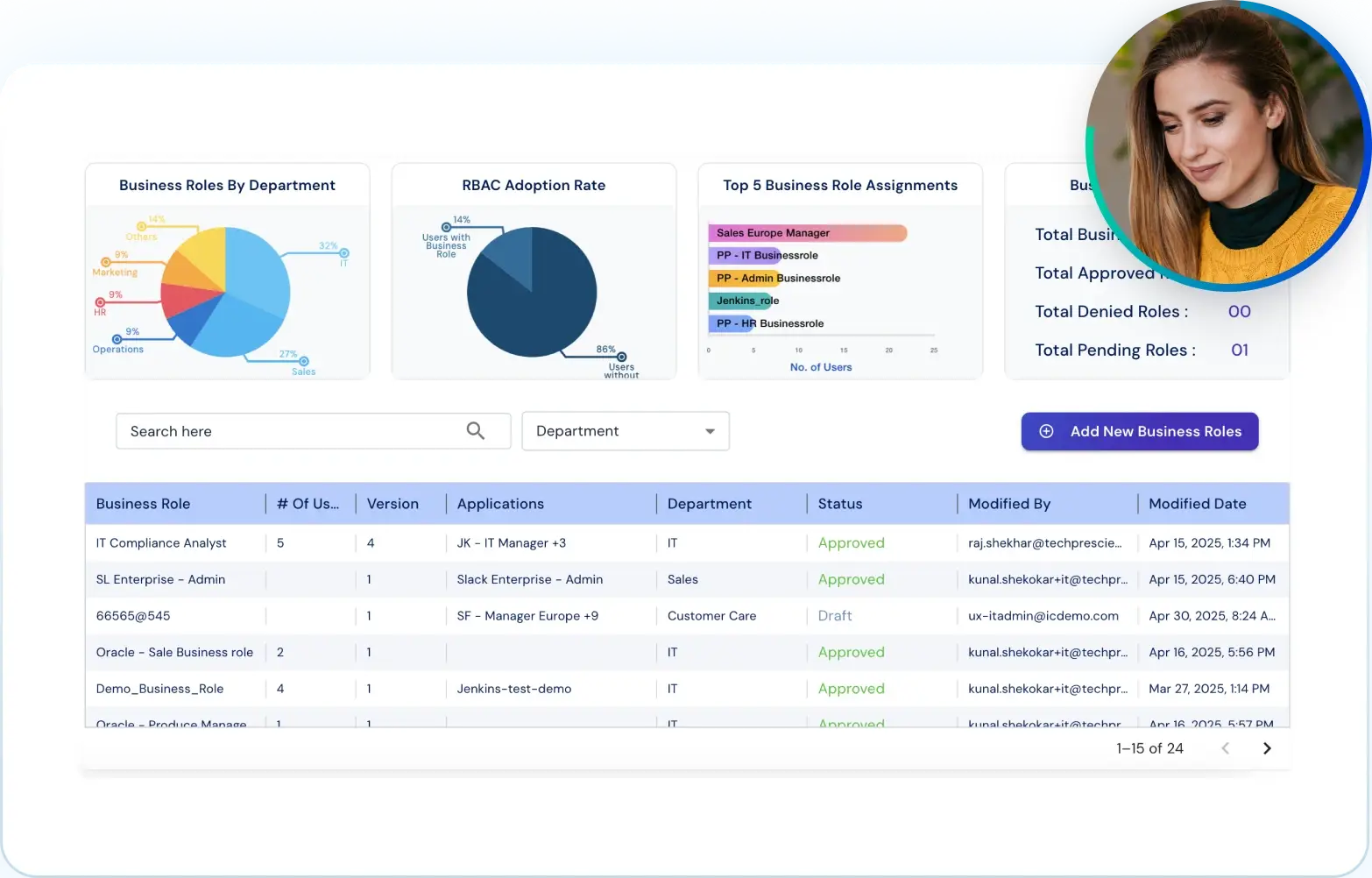
Modern platforms such as Identity Confluence from Tech Prescient bring these capabilities together in a unified governance framework. The platform automates identity lifecycle management, access reviews, and policy enforcement while providing centralized visibility across enterprise systems. By replacing manual access management with intelligent automation and real-time governance controls, Identity Confluence helps organizations strengthen security, reduce operational overhead, and maintain continuous compliance across cloud and hybrid environments.
Still managing user access manually across multiple systems and apps?
Strengthen identity governance with automated access control and smarter compliance management.
Regulatory & Compliance Mapping
Granular access control directly supports compliance frameworks by enforcing strict data access boundaries and providing clear audit visibility.
Organizations operating in regulated industries must demonstrate strong controls over who can access sensitive systems and data. Regulations and security standards require companies to implement strict access governance, enforce least-privilege permissions, and maintain detailed audit trails. Detailed permission frameworks help organizations meet these requirements by clearly defining who can access specific resources, what actions they can perform, and how those permissions are reviewed and monitored over time. Strong access controls also reduce the risk of unauthorized data exposure and help organizations pass security audits more easily.
| Sr No | Regulation | Why Granular Access Is Required |
|---|---|---|
| 1 | SOX (Sarbanes–Oxley Act) | Requires strict internal controls over financial reporting systems, including role-based permissions and segregation of duties to prevent unauthorized financial data changes. |
| 2 | HIPAA | Mandates controlled access to Protected Health Information (PHI), ensuring only authorized healthcare personnel can view or modify patient records. |
| 3 | GDPR | Enforces data minimization and purpose limitation, requiring organizations to restrict access to personal data based on legitimate need and documented policies. |
| 4 | ISO 27001 | Establishes information security management standards that require organizations to implement structured access control policies and risk-based security practices. |
By implementing precise access governance and maintaining detailed records of user permissions and activity, organizations can demonstrate compliance with these frameworks while reducing the risk of insider threats, data breaches, and regulatory penalties.
Industry-Specific Use Cases
Granular access control adapts across industries to secure sensitive systems and regulatory-heavy environments.
Organizations across different sectors rely on detailed permission models to protect sensitive information and maintain regulatory compliance. By limiting access to specific resources, actions, or data sets, businesses can ensure users only interact with systems relevant to their responsibilities. This approach not only reduces the risk of unauthorized access but also strengthens operational governance across regulated and high-risk environments.
Healthcare
Healthcare organizations handle highly sensitive patient information, making precise permission management essential. Access to Electronic Medical Records (EMR) is typically restricted based on the role of medical staff.
- EMR access restriction: Doctors may have full access to patient medical histories, while nurses can only view records related to the patients they are currently treating. Administrative staff may only access billing or demographic data.
- HIPAA audits: Controlled access helps healthcare providers maintain compliance with HIPAA regulations by ensuring only authorized personnel can view or modify Protected Health Information (PHI).
BFSI (Banking, Financial Services, and Insurance)
Financial institutions manage critical transaction systems and confidential financial data, making access governance a priority.
- Transaction system access: Bank tellers may be able to process withdrawals or deposits but cannot approve loans or credit decisions, which are typically restricted to managers or loan officers.
- Segregation of Duties (SoD) enforcement: Access controls ensure that critical financial tasks such as transaction processing and approval are separated across roles to prevent fraud and policy violations.
SaaS
Software platforms often require detailed permission models to manage how different users interact with applications and data.
- Feature-level permissions: Administrators can control access to specific features within the platform, such as analytics dashboards, configuration settings, or billing modules.
- API-level access control: Permissions can also be applied to APIs, ensuring that developers, partners, or third-party applications can only access specific endpoints or data resources.
Enterprise IT
Large enterprises operate complex infrastructure environments that include cloud services, internal applications, and microservices architectures.
- Cloud entitlements: Access to cloud resources such as storage buckets, databases, or virtual machines can be restricted based on user roles, projects, or departments.
- Microservices permissions: In modern architectures, services communicate through APIs, and detailed policies ensure that only authorized services or users can access specific microservices or system components.
These industry examples demonstrate how precise permission management allows organizations to balance security, operational efficiency, and regulatory compliance across diverse environments.
Benefits of Granular Access Control
Granular access control strengthens security, reduces insider risk, and supports compliance by limiting permissions to only what users and systems require.
By defining precise permissions across users, applications, and resources, organizations can reduce unnecessary access and maintain clearer visibility into how systems and data are used. Restricting permissions to specific roles and actions helps limit the attack surface and reduces the likelihood of unauthorized activity.
The following benefits explain how granular access control improves security posture, operational visibility, and compliance readiness across modern IT environments.
1. Reduced Blast Radius
Granular access control enforces the principle of least privilege, ensuring users only receive the permissions required to perform their responsibilities. By minimizing unnecessary privileges, organizations can significantly reduce the potential impact of compromised accounts. Even if credentials are misused, attackers are limited to a small set of resources rather than gaining broad access across systems.
2. Better Audit Readiness
Precise permission structures make it easier for organizations to maintain detailed access records and activity logs. Security teams can quickly review who accessed specific resources, what actions were performed, and when those actions occurred. This visibility simplifies compliance audits, access certifications, and internal security investigations.
3. Stronger Third-Party Controls
Many organizations rely on vendors, contractors, and external partners who require temporary access to internal systems. Granular access policies allow organizations to restrict these users to specific applications, datasets, or workflows, ensuring that external accounts do not receive unnecessary privileges. This helps reduce risks associated with third-party access.
4. Automated Compliance Reporting
Granular permission frameworks support regulatory compliance by providing clear documentation of access policies and user permissions. Many modern identity governance platforms can automatically generate compliance reports aligned with frameworks such as SOC 2, ISO 27001, GDPR, and HIPAA, making it easier for organizations to demonstrate adherence to regulatory requirements.
5. Improved Operational Visibility
Detailed access monitoring and logging provide security teams with better insight into how users interact with systems and data. This visibility helps identify unusual access patterns, detect potential insider threats, and strengthen governance across enterprise environments. By understanding who accesses what resources and when, organizations can make more informed security decisions.
Quick Insight:
In many enterprises, users accumulate permissions over time as they change roles, join projects, or move departments. Granular access control helps prevent this "privilege creep" by restricting permissions to clearly defined tasks and resources.
Best Practices for Implementing Granular Access Control
Effective implementation requires clear policies, structured role design, and continuous monitoring. Organizations should align permissions with business roles, automate identity lifecycle processes, and regularly review access to ensure it remains accurate, secure, and up to date.
1. Define Least Privilege Baseline
Organizations should begin by establishing a least privilege baseline, ensuring users receive only the minimum permissions required to perform their tasks. Access policies should be aligned with job roles, responsibilities, and data sensitivity levels. Clearly defined role structures help prevent excessive privileges and reduce the risk of unauthorized access.
2. Automate Provisioning
Manual permission management often leads to delays, configuration errors, and over-provisioned accounts. Implementing automated provisioning workflows ensures users receive appropriate access when they are onboarded or when their roles change. Automation also helps enforce consistent access policies across systems and reduces administrative overhead.
3. Integrate with HR Systems
Integrating access management systems with HR platforms allows organizations to manage identity lifecycle events more effectively. When employees join, transfer departments, or leave the organization, access permissions can automatically be updated or revoked. This integration helps prevent orphaned accounts and ensures permissions remain aligned with current roles.
4. Conduct Quarterly Access Reviews
Regular access certification reviews help organizations verify whether users still require the permissions they hold. Managers and application owners can review user entitlements and remove outdated or unnecessary privileges. Conducting these reviews periodically ensures access policies remain accurate as organizational structures and responsibilities evolve.
5. Implement Policy Simulation Testing
Before deploying new access policies, organizations should perform policy simulation testing to evaluate how rules will affect users and systems. Simulating policy outcomes helps security teams identify conflicts, unintended restrictions, or excessive permissions before changes are implemented in production environments.
6. Monitor Cloud Entitlements
As organizations adopt cloud services and distributed applications, monitoring cloud entitlements becomes critical. Security teams should continuously track user permissions across cloud platforms, SaaS applications, and infrastructure resources. Ongoing monitoring helps detect excessive privileges, unusual access patterns, and potential security risks before they escalate.
Turn best practices into a structured deployment plan for granular access control.
Common Mistakes to Avoid
While detailed permission models strengthen security, improper implementation can create operational complexity or leave gaps in governance. Organizations should avoid common pitfalls that undermine the effectiveness of granular access control and increase the risk of misconfigured permissions or unmanaged identities.
1. Overcomplicated Role Structures
Creating too many highly specific roles can make access management difficult to maintain. When roles become overly fragmented, administrators struggle to track permissions and users may accumulate unnecessary access across multiple roles. Organizations should design balanced role structures that are detailed enough to enforce security while remaining manageable.
2. Ignoring Access Reviews
Access permissions often change as employees switch roles, join new projects, or leave the organization. Without regular access certification reviews, outdated privileges can remain active and create security risks. Periodic reviews help ensure permissions remain aligned with current responsibilities.
3. Treating IAM as Governance
Identity and Access Management (IAM) focuses primarily on authentication and authorization, but it does not provide full identity governance capabilities on its own. Organizations that rely only on IAM tools without governance processes may lack visibility into entitlement risks, segregation of duties conflicts, or policy compliance.
4. Manual Provisioning Workflows
Manually assigning permissions increases the likelihood of errors, inconsistent policies, and delayed access management. Without automated provisioning and deprovisioning, organizations may struggle to enforce consistent policies across applications and systems.
5. Lack of Policy Documentation
Access policies should be clearly documented and standardized across the organization. When policies are informal or undocumented, administrators may apply permissions inconsistently, leading to governance gaps and audit challenges.
Future of Granular Access Control (AI & Cloud Era)
The future of granular access control lies in AI-driven risk scoring, contextual policy enforcement, and cloud-native identity stacks.
As organizations continue to adopt cloud platforms, distributed applications, and microservices architectures, access control models are evolving to support more dynamic and intelligent security frameworks. Emerging identity technologies are combining automation, machine learning, and contextual policy enforcement to improve how access decisions are made across modern IT environments.
1. AI-Based Access Recommendations
Artificial intelligence and machine learning are increasingly being used to analyze user behavior, access patterns, and role structures. These insights help security teams identify excessive permissions and recommend more appropriate access rights, improving enforcement of least privilege policies.
2. CIEM (Cloud Infrastructure Entitlement Management)
Cloud Infrastructure Entitlement Management (CIEM) solutions focus on managing and monitoring permissions across complex cloud environments. These platforms help organizations detect excessive cloud privileges, enforce least privilege policies, and maintain visibility across multi-cloud infrastructure.
3. Continuous Authentication
Future access control systems are moving beyond single login verification to continuous authentication models. These systems continuously evaluate identity signals, device posture, and behavioral patterns throughout a session to ensure that users remain authorized to access resources.
4. API-Level and Microservice Controls
As organizations increasingly adopt API-driven architectures and microservices, access control must extend beyond traditional applications. Fine-grained policies will increasingly govern how services interact with APIs, ensuring only authorized services or users can access specific endpoints or system components.
Final Thoughts
Granular access control is no longer just a technical feature within identity systems. It has become a critical security capability that helps organizations manage permissions with far greater precision and accountability.
As enterprises expand across cloud platforms, SaaS applications, and hybrid infrastructures, the number of systems, users, and access permissions continues to grow. Without fine-grained controls, broad access rights can easily lead to over-permissioning, compliance gaps, and increased insider risk.
By implementing granular access control alongside identity governance frameworks, organizations can enforce least privilege, automate access reviews, and maintain stronger visibility into who can access critical systems and data.
Turn best practices into a structured deployment plan for granular access control.
FAQs
Granular access control is a security approach where permissions are defined at a very detailed level. Instead of granting broad system access, users receive only the specific permissions required to perform their tasks. This helps enforce the least privilege principle and reduces the risk of unauthorized access.
Role-based access control (RBAC) assigns permissions to predefined roles, and users inherit access based on the role they belong to. Granular access goes a step further by defining permissions at the individual action, resource, or attribute level. This allows organizations to apply much more precise and flexible access policies.
Granular access control helps organizations meet regulatory requirements by tightly controlling who can access sensitive data and systems. It supports critical compliance practices such as access reviews, audit trails, and segregation of duties (SoD). These controls make it easier to demonstrate accountability during security audits.
In cybersecurity, a granular approach means applying highly detailed access restrictions rather than broad permissions. Instead of granting blanket access, policies define exactly what a user can view, modify, or execute. This reduces the attack surface and limits the potential impact of compromised accounts.
Yes, granular access control is a key component of a Zero Trust architecture. Zero Trust requires continuous verification and strict enforcement of the least privilege principle. Granular control enables organizations to enforce contextual, fine-grained access decisions across users, devices, and applications.


GET A PERSONALIZED DEMO
See Identity Confluence in Action
“One platform to govern identities, automate access decisions, and prove compliance; across every app, user, and system in your environment.”



Murli Ramsunder
Senior Architect, Vonage