
SAMA Compliance: Complete Guide to the Saudi Cybersecurity Framework (CSF)
Last Updated date: July 12, 2026
On this page
See Tech Prescient in Action
Automate access, reduce risk, and stay audit-ready
The SAMA Cybersecurity Framework (CSF) is designed to protect Saudi Arabia's financial sector from rising cyber threats. As digital adoption grows across banks, insurance, and fintech, SAMA compliance has become a regulatory mandate. The framework standardizes cybersecurity practices across governance, risk, and operational controls. It ensures financial institutions safeguard sensitive data and maintain secure, resilient services.
Launched in 2017 and aligned with ISO 27001, NIST, and PCI DSS, SAMA CSF enforces structured cybersecurity programs. It covers key areas such as identity and access management (IAM), third-party risk, incident response, and business continuity. SAMA also actively monitors compliance, holding leadership accountable for cybersecurity posture. This strengthens trust across customers, regulators, and stakeholders.
Cyber risks continue to grow in scale and cost. According to IBM's Cost of a Data Breach Report 2024, the global average data breach cost reached $4.45 million, with financial services among the most impacted sectors. The World Economic Forum also ranks cybersecurity among the top global risks to financial stability. This makes SAMA compliance critical for organizations operating in Saudi Arabia. Let's explore how it works and how to achieve it effectively.
Key Takeaways
- Understand the fundamentals of SAMA Compliance, its purpose, scope, and regulatory requirements.
- Explore the SAMA Cybersecurity Framework, including its control domains and maturity model.
- Learn the step-by-step process for implementing and maintaining SAMA compliance.
- Discover how Identity and Access Management (IAM) supports SAMA compliance and audit readiness.
- Understand the benefits, risks, and common challenges of achieving SAMA compliance.
What Is SAMA Compliance in Saudi Arabia?
SAMA compliance is a cybersecurity regulatory framework mandated by the Saudi Central Bank to ensure financial institutions follow standardized security, risk, and governance controls. It aims to safeguard customer information, prevent cyberattacks, and ensure organizations have structured plans to protect their systems.
The framework also emphasizes operational resilience by helping institutions prepare for and recover from incidents such as data breaches or hacking attempts. As digital banking, fintech, and online financial services expand, SAMA compliance plays a critical role in maintaining trust and stability in the Kingdom's financial ecosystem.
It applies to all financial institutions operating in Saudi Arabia, making adherence essential for regulatory alignment and secure operations. To understand SAMA compliance more clearly, it's important to look at the regulatory authority behind it, who it applies to, and how it differs from other forms of compliance.
1. What Is SAMA (Saudi Central Bank)?
SAMA, formerly known as the Saudi Arabian Monetary Authority, is the central bank of Saudi Arabia, established in 1952. It is responsible for regulating and supervising the country's financial sector, including banking, insurance, and financing activities.
In addition to monetary stability, SAMA enforces cybersecurity regulations through frameworks like the SAMA CSF. It sets policies, conducts audits, and ensures that financial institutions operate securely and in line with national regulations.
2. Who Needs to Comply With SAMA?
SAMA compliance is mandatory for all financial entities regulated by the Saudi Central Bank. This includes:
- Banks and financial institutions
- Insurance and reinsurance companies
- Fintech firms and payment providers
- Credit bureaus and financing companies
- Financial market infrastructure providers
Any organization operating within this ecosystem must implement SAMA CSF controls to remain compliant and maintain its license to operate.
3. SAMA Compliance vs Shariah Compliance
SAMA compliance is often confused with Shariah compliance, but they serve entirely different purposes.
- Shariah compliance focuses on ensuring financial products and services align with Islamic law.
- SAMA compliance focuses on cybersecurity, risk management, and regulatory controls for financial institutions.
While both may apply to the same organization, SAMA CSF specifically addresses cyber resilience and operational security in a digital-first financial environment.
4. Regulatory Authority and Enforcement
SAMA has strong regulatory and enforcement powers to ensure compliance across the financial sector. It conducts regular audits, assesses cybersecurity maturity, and requires organizations to address identified gaps.
Non-compliance can lead to regulatory penalties, operational restrictions, or even license suspension. This makes SAMA compliance not just a best practice but also a critical business requirement for operating in Saudi Arabia's financial market.
Overview of the SAMA Cybersecurity Framework (CSF)
The SAMA CSF, introduced in 2017, is a maturity-based cybersecurity framework that standardizes security practices across Saudi Arabia's financial sector, aligned with ISO 27001 and NIST. It was designed to address rising cyber threats such as phishing, ransomware, and system breaches in an increasingly digital ecosystem.
Unlike a one-time checklist, the CSF promotes continuous improvement through defined domains, objectives, and controls, helping organizations strengthen security posture and ensure long-term resilience.
1. Framework Objectives
The SAMA CSF is designed to achieve three key objectives across the financial sector:
- Protect financial sector integrity by securing critical systems, customer data, and financial transactions from cyber threats
- Standardize cybersecurity controls by establishing a consistent set of policies and practices across all regulated institutions
- Improve cyber resilience by enabling organizations to detect, respond to, and recover from security incidents effectively
2. Alignment With Global Standards
The SAMA CSF is closely aligned with internationally recognized cybersecurity frameworks, allowing organizations to leverage existing security investments and best practices.
- ISO 27001: Provides a foundation for information security management systems (ISMS)
- NIST Cybersecurity Framework: Guides risk-based cybersecurity practices and controls
- PCI DSS: Ensures secure handling of payment and cardholder data
- Basel Principles: Supports risk management and governance in financial institutions
This alignment makes it easier for organizations already following global standards to adapt to SAMA requirements without starting from scratch, while still meeting region-specific regulatory expectations.
3. Unified Cybersecurity Controls Across Financial Institutions
The SAMA CSF establishes a unified set of cybersecurity controls applicable to all financial institutions operating under SAMA's supervision. This includes banks, insurance providers, credit bureaus, finance companies, and payment service providers.
By standardizing security expectations across the ecosystem, the framework ensures that every entity involved in handling money online adheres to consistent cybersecurity practices. This reduces systemic risk, strengthens trust across interconnected financial services, and creates a more secure digital financial environment.
SAMA CSF vs Global Frameworks (Quick Comparison)
| Sr No | Framework | Focus | Region |
|---|---|---|---|
| 1 | SAMA CSF | Cybersecurity governance, risk management, and compliance for financial institutions | Saudi Arabia |
| 2 | ISO 27001 | Information Security Management System (ISMS) standard | Global |
| 3 | NIST CSF | Risk-based cybersecurity framework for identifying, protecting, detecting, responding, and recovering | US / Global |
| 4 | PCI DSS | Security standards for protecting payment card data | Global |
Core Control Domains of SAMA CSF
The SAMA CSF is structured into key domains covering governance, defense, third-party risk, and resilience to ensure a consistent security posture. It follows a layered approach of domains, objectives, and controls, enabling organizations to systematically manage cyber risk and embed security across people, processes, and technology.
Cybersecurity Governance
This domain establishes the foundation of an organization's cybersecurity strategy. It defines leadership accountability, policy frameworks, and decision-making structures required to manage cyber risk effectively. Senior management and boards are expected to actively oversee cybersecurity initiatives, approve policies, and ensure alignment with regulatory expectations. Strong governance ensures that cybersecurity is treated as a business priority, not just an IT function.
Risk Management
Risk management focuses on identifying, assessing, and mitigating cybersecurity risks across the organization. It requires maintaining a risk register, conducting regular assessments, and implementing controls to reduce exposure to threats. This domain also emphasizes continuous evaluation to adapt to evolving risks, ensuring that organizations remain proactive rather than reactive in their security approach.
Asset & Access Management
Organizations must maintain a comprehensive inventory of all assets, including systems, applications, and data. This domain ensures that access to these assets is controlled, monitored, and aligned with business needs. Proper asset classification and access control mechanisms help reduce unauthorized access and limit potential attack surfaces.
Identity and Access Management (IAM)
Identity and access management is a critical component of SAMA compliance, focusing on ensuring that the right users have the right access at the right time. This includes role-based access control (RBAC), multi-factor authentication (MFA), and least privilege principles. Organizations are required to enforce strong authentication, manage user identities, and regularly review access rights to prevent privilege misuse and unauthorized access to sensitive systems.
Incident Management
This domain requires organizations to establish structured processes for detecting, responding to, and recovering from cybersecurity incidents. It includes incident response planning, escalation procedures, and post-incident analysis. Effective incident management minimizes the impact of cyberattacks and ensures rapid recovery of operations.
Party Security
Third-party risk is a major focus of the SAMA CSF. Organizations must assess and monitor the cybersecurity posture of vendors, partners, and service providers. This includes due diligence, contractual security requirements, and ongoing risk assessments. Since external partners often have access to critical systems or data, their security posture directly impacts the organization.
Business Continuity & Operational Resilience
This domain ensures that organizations can maintain operations during and after a cyber incident. It includes business continuity planning, disaster recovery strategies, and system backups. The goal is to minimize downtime, protect critical services, and ensure rapid restoration of operations in the event of disruptions.
SAMA CSF Maturity Levels Explained
The SAMA CSF follows a maturity-based model to evaluate how well organizations manage cybersecurity. Instead of a checklist approach, it focuses on progression, moving from basic, reactive controls to advanced, proactive security practices.
Maturity Levels Breakdown
- Level 0: Non-existent — No documentation. No awareness or attention for certain cyber security controls. Controls are not in place at all.
- 1. Level 1: Initial — Cybersecurity practices are informal and inconsistent, with limited documentation and high dependence on individual efforts. Controls may exist, but they are not standardized or reliably enforced, leading to increased risk exposure.
- 2. Level 2: Developing — Basic policies and controls are implemented, but their application is uneven across systems and teams. Processes are partially defined, and organizations are still transitioning from reactive to more structured security practices. Basic practices repeat sometimes, but they're not written down or officially approved.
- 3. Level 3: Defined — Cybersecurity policies, procedures, and controls are formally documented and consistently applied across the organization. Roles and responsibilities are clearly established, making this the minimum expected level for regulatory compliance. Policies, standards, procedures established. Compliance monitored (preferably via GRC tool). KPIs defined, monitored, reported.
- 4. Level 4: Managed — Security processes are actively monitored, measured, and reviewed using defined metrics. Organizations enforce accountability, track performance, and continuously assess risks to ensure controls remain effective.
- 5. Level 5: Optimized — Cybersecurity is fully integrated into business operations with a focus on continuous improvement. Organizations leverage automation, threat intelligence, and advanced analytics to proactively identify and mitigate risks.
Controls subject to continuous improvement plan. Enterprise-wide program for continuous compliance/effectiveness/improvement. Integrated with enterprise risk management. Performance evaluated using peer/sector data.
Quick Insight
Maturity levels help organizations benchmark their cybersecurity posture and identify gaps. SAMA expects regulated entities to achieve at least Level 3, where controls are standardized and consistently implemented. Continuous improvement beyond this level strengthens resilience, reduces risk, and ensures long-term compliance.
SAMA Compliance Checklist (Practical Implementation)
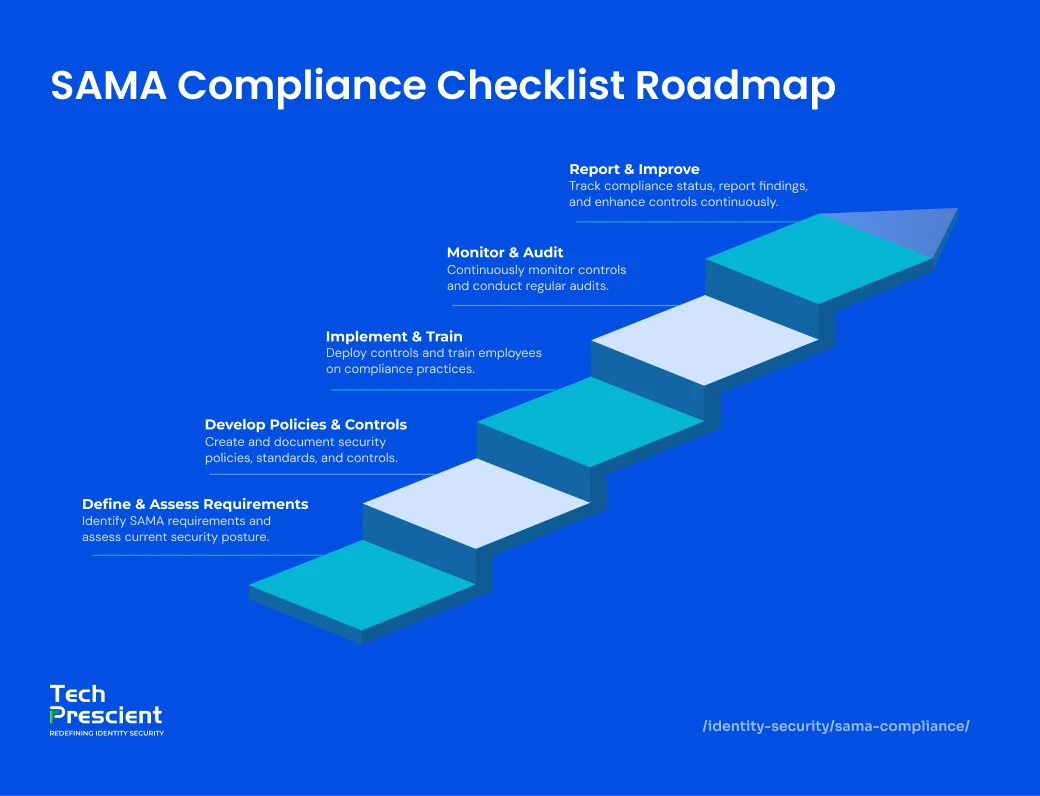
SAMA compliance is a structured process that involves assessing your current security posture, implementing required controls, and continuously improving them over time. Rather than treating it as a one time project, organizations should approach it as an ongoing program aligned with risk management and regulatory expectations.
Conduct a Gap Analysis
Start by evaluating your current cybersecurity posture against SAMA CSF requirements. Identify missing controls, policy gaps, and areas of non-compliance across governance, risk management, and technical domains. This assessment provides a clear roadmap of what needs to be implemented or improved.
Establish Governance and Accountability
Define a clear governance structure with assigned roles and responsibilities. Appoint a compliance owner or team responsible for driving SAMA initiatives. Ensure leadership involvement, policy approval, and accountability for each control area to maintain alignment with regulatory expectations.
Implement IAM and Access Controls
Move beyond an IAM-centric approach by emphasizing clear ownership of systems and access decisions across the organization. Implement RBAC, multi-factor authentication, and least privilege while ensuring accountability at every level. Conduct periodic user access reviews (UAR) to validate and certify access rights. Maintain strong auditability through detailed audit trails to ensure traceability and continuous SAMA compliance.

Pro Tip
Start with high-risk access like privileged accounts instead of trying to fix everything at once. This delivers faster risk reduction and shows immediate progress during audits.
Conduct Penetration Testing
Perform regular penetration testing and vulnerability assessments to identify weaknesses in systems and applications. Simulating real-world attack scenarios helps organizations detect security gaps early and remediate them before they can be exploited.
Continuous Monitoring and Reporting
Establish continuous monitoring mechanisms to track security events, control performance, and potential threats. Implement logging, alerting, and reporting systems to ensure visibility across the IT environment. Regular internal audits and performance reviews help maintain ongoing compliance.
Prepare for Regulatory Audit
Maintain comprehensive documentation of policies, controls, and implementation evidence. Conduct internal audits and mock assessments to validate readiness. Being well prepared ensures smoother regulatory audits and demonstrates compliance maturity to SAMA.
Don't implement IAM blindly. Validate it against SAMA requirements.
Use a ready-to-use template to identify gaps and prepare audit-ready access controls.
Role of Identity Governance & Access Management in SAMA Compliance
Identity governance and access management form a core part of SAMA compliance by ensuring that only authorized users can access critical systems and data. Organizations must also establish clear ownership of systems, data, and access decisions to strengthen accountability. Financial institutions must enforce strict IAM controls across the identity lifecycle, including onboarding, role changes, and offboarding. This reduces the risk of unauthorized access, supports regulatory audits, and strengthens overall cybersecurity posture.
1. Access Reviews
Organizations must conduct periodic access reviews (UAR) to validate that user permissions remain appropriate for their current roles. This process helps identify and remove excessive or outdated access, ensuring adherence to least privilege principles and reducing the risk of misuse.
2. Segregation of Duties SoD
Segregation of Duties ensures that no single individual has control over critical processes end to end. By dividing responsibilities across multiple roles, organizations can prevent fraud, reduce operational risk, and maintain stronger internal controls.
3. Role-Based Access Control
Role-based access control allows organizations to assign permissions based on job roles rather than individuals. This ensures consistency in access management, simplifies administration, and aligns user access with defined responsibilities.
4. Privileged Access Governance
Privileged access governance focuses on securing accounts with elevated permissions. Organizations must strictly control, monitor, and audit privileged activities to prevent misuse and ensure accountability for sensitive operations.
5. Audit Trails
Organizations are required to maintain detailed audit logs of all access related activities, including requests, approvals, changes, and revocations. This strengthens auditability by ensuring complete traceability and visibility for compliance audits and risk monitoring.
Struggling to identify IAM gaps before your SAMA audit?
Download a structured template to assess access controls and validate compliance readiness.
Risks of Non-Compliance With SAMA
SAMA compliance is a regulatory requirement, and failure to meet its standards can expose financial institutions to serious business, legal, and security risks. Since the framework is enforced by the Saudi Central Bank, non-compliance is treated as a violation of regulatory obligations and can directly impact an organization's ability to operate. Beyond penalties, it also weakens an organization's cybersecurity posture, increasing exposure to threats and long-term financial loss.
1. Regulatory fines
Organizations that fail to comply with SAMA requirements may face significant financial penalties imposed by regulators. In some cases, penalties can escalate depending on the severity and recurrence of violations, making non-compliance financially damaging.
2. Audit findings
During regulatory assessments, gaps in cybersecurity controls can lead to negative audit findings and mandatory remediation actions. Continuous non-compliance may result in increased scrutiny, corrective directives, and operational restrictions imposed by SAMA.
3. Data breach exposure
Weak or incomplete implementation of SAMA controls increases the likelihood of cyber incidents such as data breaches, ransomware attacks, and unauthorized access. These incidents can result in financial losses, legal consequences, and regulatory action under Saudi cybersecurity laws.
4. Loss of market trust
Non-compliance can damage an organization's reputation, especially if it leads to security incidents or public disclosure of violations. Loss of customer confidence, investor trust, and business partnerships can have long lasting impacts on market position and growth.
Benefits of Achieving SAMA Compliance
Achieving SAMA compliance goes beyond meeting regulatory requirements. It helps organizations build a strong security foundation, improve internal processes, and gain a competitive edge in a highly regulated financial environment. When implemented effectively, the SAMA CSF not only reduces risk but also supports long term business growth and trust.
Risk reduction
Implementing SAMA CSF controls significantly reduces exposure to cyber threats such as data breaches, ransomware, and unauthorized access. A structured approach to risk management, IAM, and incident response helps organizations proactively identify and mitigate vulnerabilities.
Competitive differentiation
Being SAMA compliant demonstrates a high level of cybersecurity maturity, which can set organizations apart in the market. It strengthens credibility during client evaluations, vendor assessments, and regulatory reviews, helping businesses close deals faster and stand out from competitors.
Investor confidence
Strong compliance and cybersecurity practices signal stability and reliability to investors and stakeholders. Organizations that align with SAMA requirements are better positioned to attract investment by showcasing reduced risk and regulatory alignment.
Operational resilience
SAMA compliance enforces structured processes, clear governance, and continuous monitoring. This improves an organization's ability to respond to incidents, maintain business continuity, and recover quickly from disruptions, ensuring long term operational stability.
Achieving SAMA compliance is not just about avoiding penalties. It is a strategic investment that strengthens security, builds trust, and prepares organizations for sustainable growth in Saudi Arabia's evolving financial landscape.
Common Challenges in SAMA Compliance
SAMA compliance requires organizations to implement comprehensive cybersecurity controls across systems, users, and third parties. However, many financial institutions face practical challenges when aligning their existing environments with SAMA CSF requirements. These challenges often stem from legacy infrastructure, fragmented systems, and limited visibility across the IT landscape.
Common Mistake
Many organizations focus heavily on tools but overlook governance and ownership. Without clear accountability, even the best security controls fail during audits.
1. Legacy Systems
Many organizations still rely on outdated systems that were not designed to support modern cybersecurity controls. Integrating these legacy environments with SAMA requirements such as advanced authentication, logging, and monitoring can be complex and time-consuming.
2. Third Party Risk Visibility
Financial institutions often depend on vendors, partners, and service providers, but lack full visibility into their security posture. Ensuring that third parties meet SAMA cybersecurity standards requires continuous assessment, monitoring, and enforcement of security controls.
3. Manual Access Review Processes
In many organizations, access reviews and certifications are still handled manually using spreadsheets or disconnected tools. This leads to inefficiencies, errors, and delays, making it difficult to enforce least privilege and maintain audit readiness.
4. Lack of Centralized Identity Governance
Without a centralized identity governance framework, organizations struggle to manage user access consistently across multiple systems. This results in fragmented visibility, access inconsistencies, and increased risk of unauthorized or excessive permissions.
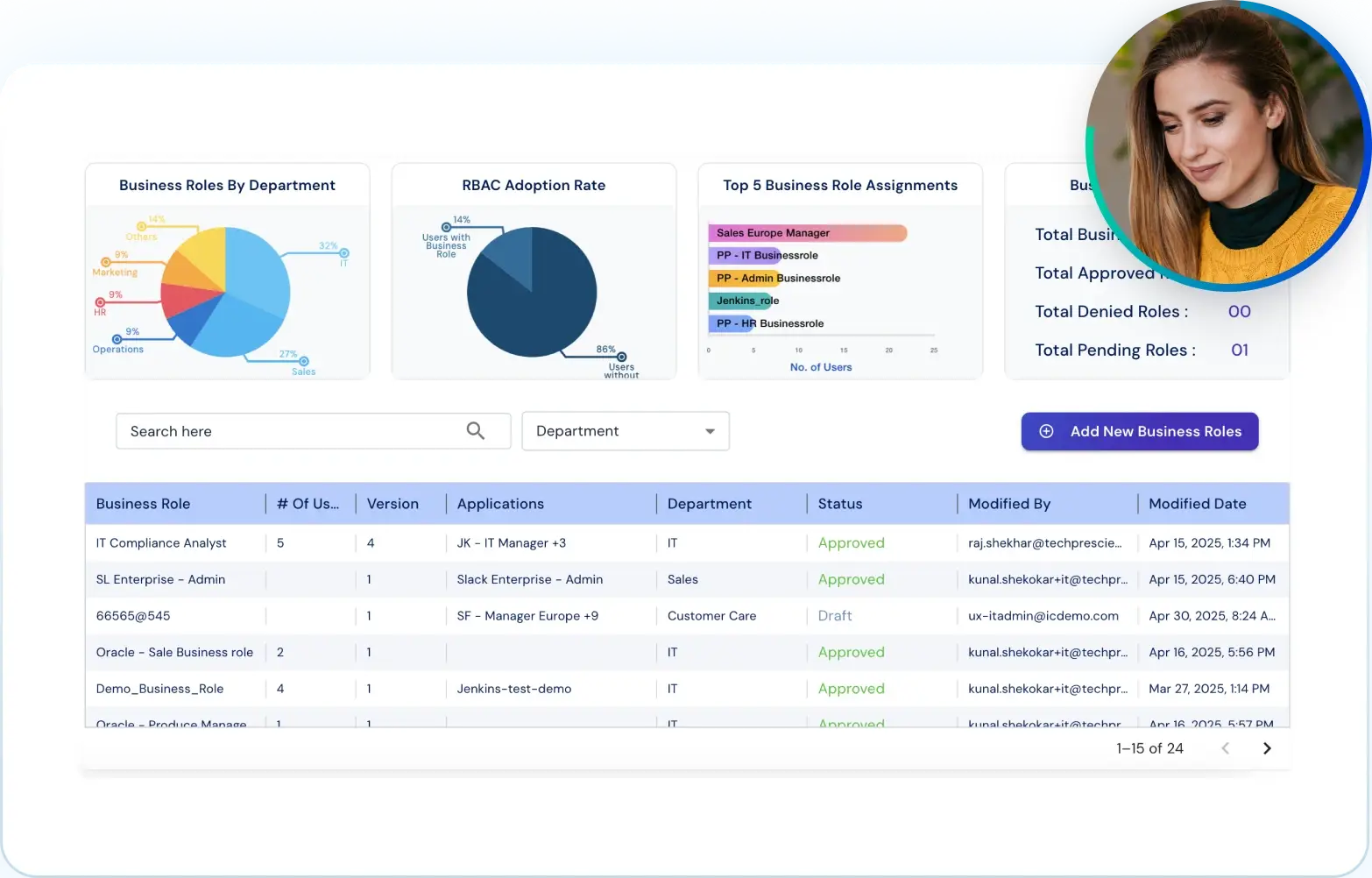
Adopting a unified governance approach with Tech Prescient's Identity Confluence helps centralize control, improve visibility, and enforce consistent access policies across the enterprise.
5. Multi Cloud Complexity
The adoption of multi-cloud environments introduces additional complexity in managing security controls and compliance. Organizations must ensure consistent policies, monitoring, and access controls across different cloud platforms, which can be challenging without unified governance.
Addressing these challenges requires a combination of strong governance, skilled resources, and the use of automation and identity security solutions to streamline compliance efforts and reduce operational burden.
Final Thoughts
SAMA compliance provides a structured approach for financial institutions in Saudi Arabia to strengthen cybersecurity through governance, risk management, identity controls, and operational resilience. As financial ecosystems grow more complex with cloud adoption, third-party integrations, and evolving threats, aligning with the SAMA Cybersecurity Framework becomes essential to reducing risks, ensuring regulatory readiness, and maintaining trust. By following a clear compliance roadmap and continuously improving maturity levels, organizations can build a resilient and secure foundation.
Tech Prescient helps organizations strengthen identity security and access governance with scalable, modern solutions aligned to regulatory frameworks like SAMA CSF.
Struggling to identify IAM gaps before your SAMA audit?
Download a structured template to assess access controls and validate compliance readiness.
FAQs
SAMA compliance is a cybersecurity framework mandated by the Saudi Central Bank to ensure financial institutions follow standardized security, risk, and governance controls.
All financial institutions regulated by the Saudi Central Bank, including banks, insurance companies, fintech firms, and credit bureaus, must comply with SAMA CSF.
SAMA CSF requires organizations to implement controls across governance, risk management, IAM, third-party security, and incident response to ensure cybersecurity and compliance.
Yes, SAMA CSF aligns with global standards like ISO 27001, NIST, and PCI DSS, making it easier to integrate with existing security frameworks.
Non-compliance can result in regulatory fines, audit findings, operational restrictions, and increased risk of cyber incidents.


GET A PERSONALIZED DEMO
See Identity Confluence in Action
“One platform to govern identities, automate access decisions, and prove compliance; across every app, user, and system in your environment.”



Murli Ramsunder
Senior Architect, Vonage