
What Is Identity Security? A Complete Guide for 2026
Last Updated date: July 23, 2026
On this page
See Tech Prescient in Action
Automate access, reduce risk, and stay audit-ready
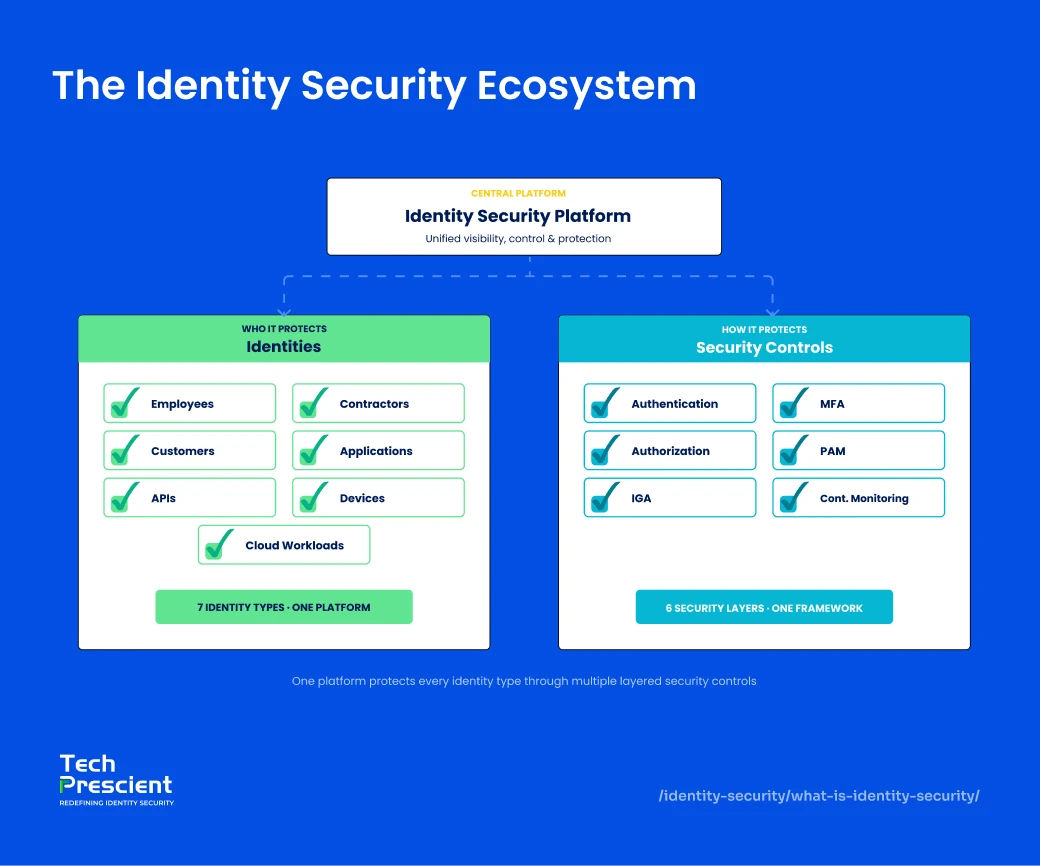
Identity security is a cybersecurity framework that protects digital identities, including users, devices, applications, and machine accounts, from unauthorized access through authentication, authorization, and continuous monitoring. As organizations adopt cloud platforms, SaaS applications, and remote work environments, identity has become the new security perimeter.
In this blog, we'll explain what identity security is, why it matters, its core components, common threats, best practices, and how modern organizations use identity-centric security to reduce cyber risk and strengthen compliance.
Key Takeaways:
- Identity is now the primary security perimeter in modern environments
- Identity security focuses on controlling who can access systems and data
- It combines IAM, PAM, MFA, IGA, and continuous monitoring
- Identity-centric security is critical for cloud, SaaS, and remote work environments
- Strong identity governance reduces breach risk and improves compliance posture
What Is Identity Security? (Definition + Meaning)
Identity security ensures that only the right identities can access the right resources at the right time through authentication, authorization, and continuous monitoring.
If you're asking what is identity security, it is the practice of protecting digital identities and controlling access across users, systems, applications, devices, and cloud environments. Modern identity security combines technologies, policies, and monitoring capabilities to verify identities, manage permissions, and detect suspicious access activity before it becomes a security incident.
As organizations move toward cloud-first and remote work environments, identity has become the new security perimeter. Traditional network boundaries are no longer sufficient because users, applications, and devices now access systems from multiple locations, platforms, and unmanaged environments.
What Is an Identity in Cybersecurity?
In cybersecurity, an identity is any entity that interacts with systems, applications, or data.
This includes:
- Human users such as employees, contractors, partners, and customers
- Machine identities such as servers, APIs, bots, and workloads
- Application identities used by software and cloud services
- Device identities for laptops, mobile devices, and IoT systems
Every identity requires some level of authentication and authorization before gaining access to organizational resources. As digital ecosystems expand, the number of non-human identities often grows faster than human users, making identity governance significantly more complex.
Identity Is the New Security Perimeter
Historically, organizations relied heavily on firewalls and network security to protect internal systems. That model assumed users and devices inside the network could generally be trusted. Today, that assumption no longer works.
Cloud computing, SaaS applications, remote access, third-party integrations, and hybrid work environments have dissolved traditional network boundaries. Instead of protecting a fixed network perimeter, organizations now focus on securing identities because identity has become the primary control point for accessing systems and sensitive data.
This shift is one of the core principles behind Zero Trust security models, where every identity, device, and access request must be continuously verified regardless of location.
Identity vs Credentials
Identity and credentials are closely related, but they are not the same thing. An identity refers to the actual entity requesting access, such as a user or application. Credentials are the methods used to prove identity.
Common credentials include:
- Passwords
- Multi-factor authentication (MFA) tokens
- Biometrics
- Certificates
- Security keys
For example:
- An employee account is the identity
- The password and MFA token are the credentials used to authenticate that identity
Understanding this distinction is important because attackers often target credentials to compromise identities and gain unauthorized access.
What Identity Security Protects Against
Identity security helps organizations reduce risks associated with:
- Credential theft
- Account takeover attacks
- Excessive access permissions
- Insider threats
- Privileged account abuse
- Unauthorized cloud access
- Identity-based lateral movement
By continuously validating identities and monitoring behavior, organizations improve both cybersecurity resilience and compliance readiness.
Why Identity Security Matters Today
Modern organizations operate in highly distributed digital environments where users, systems, and applications constantly interact across cloud platforms and remote networks.
Without strong identity security, organizations struggle to:
- Control who has access to sensitive systems
- Detect compromised accounts
- Enforce least-privilege access
- Govern privileged identities
- Maintain compliance across cloud environments
This is why identity security has become one of the most critical foundations of modern cybersecurity strategy.
Why Identity Security Is Important in Modern Cybersecurity
Identity-based attacks have become one of the leading causes of security breaches, making identity security critical for preventing unauthorized access, data compromise, and operational disruption.
Modern cyberattacks increasingly target identities instead of infrastructure because identities provide direct access to systems, applications, cloud environments, and sensitive data. Attackers no longer need to bypass complex network defenses if they can simply compromise valid user credentials or exploit excessive access privileges. This shift is one of the main reasons identity security has become a foundational component of modern cybersecurity strategy.
1. The Rise of Credential-Based Attacks
Most modern attacks begin with compromised credentials.
Cybercriminals commonly use techniques such as:
- Phishing attacks
- Credential stuffing
- Password spraying
- MFA fatigue attacks
- Session hijacking
- Social engineering
These methods allow attackers to impersonate legitimate users and move through environments without immediately triggering traditional security defenses. Industry research consistently shows that compromised credentials remain one of the most common initial access vectors in data breaches. Once attackers gain identity access, they can often escalate privileges, move laterally across systems, and access sensitive resources. This makes protecting identities just as important as protecting endpoints, networks, or applications.
2. Cloud and Remote Work Changed the Security Model
The growth of cloud computing, SaaS applications, hybrid work, and remote access has fundamentally changed how organizations manage security.
Users now access systems from:
- Personal devices
- Remote locations
- Cloud platforms
- Third-party networks
- Mobile environments
As a result, organizations can no longer rely solely on network-based security models. Identity has become the primary control layer for determining who can access what resources and under what conditions. In cloud-first environments, identity security often becomes the main enforcement mechanism for protecting sensitive data and business-critical systems.
3. Identity Security Reduces Breach Risk
Strong identity security significantly reduces the likelihood and impact of cyberattacks by controlling and continuously validating access.
Effective identity security helps organizations:
- Prevent account takeover attacks
- Detect unusual authentication behavior
- Limit excessive privileges
- Reduce insider threat exposure
- Control privileged access
- Block unauthorized lateral movement
Continuous monitoring and identity analytics also help security teams identify suspicious activity earlier, before attackers can expand access across the environment.
4. Identity Security Supports Compliance
Many regulatory and compliance frameworks now require stronger identity and access governance controls.
Identity security helps organizations support compliance requirements related to:
- GDPR
- HIPAA
- SOX
- PCI DSS
- ISO 27001
- NIST frameworks
Capabilities such as access reviews, MFA enforcement, privileged access management, and audit logging are often critical for demonstrating regulatory compliance and reducing audit risk.
5. Identity Security Enables Zero Trust
Identity security is a core foundation of Zero Trust architecture. Zero Trust operates on the principle that no identity, device, or access request should be trusted automatically, even if the request originates from inside the corporate network.
Instead, organizations continuously verify:
- User identity
- Device posture
- Access context
- Risk signals
- Behavioral patterns
Identity-centric controls such as MFA, adaptive authentication, least-privilege access, and continuous monitoring make Zero Trust implementation possible. Without strong identity security, Zero Trust cannot function effectively.
Why Organizations Prioritize Identity Security
| Identity Security Benefit | Business Impact |
|---|---|
| Prevents account takeover | Reduces breach risk |
| Controls privileged access | Limits lateral movement |
| Supports compliance | Improves audit readiness |
| Enables Zero Trust | Strengthens modern security architecture |
| Detects suspicious behavior | Improves threat response |
Core Components of Identity Security
Identity security combines technologies such as MFA, IAM, PAM, IGA, and continuous monitoring to protect identities, manage access, and reduce unauthorized activity across modern environments.
Modern identity and security strategies rely on multiple interconnected controls working together. No single tool can fully secure identities across cloud platforms, SaaS applications, hybrid environments, and privileged systems. Instead, organizations build layered identity security frameworks that continuously verify users, govern access, monitor behavior, and reduce risk exposure.
These components collectively help organizations establish a more secure identity posture across both human and machine identities.
1. Authentication (AuthN)
Authentication verifies whether a user or system is genuinely who they claim to be before access is granted.
Traditional authentication relied heavily on passwords, but modern environments increasingly use stronger methods such as:
- Multi-factor authentication (MFA)
- Biometrics
- Hardware security keys
- Passwordless authentication
MFA has become especially important because compromised credentials remain one of the most common attack vectors. By requiring additional verification factors, organizations reduce the risk of account takeover and unauthorized access. Many organizations are also moving toward passwordless authentication models that rely on biometrics, device trust, or cryptographic authentication to improve both security and user experience.
2. Authorization (AuthZ)
Authorization determines what an authenticated identity is allowed to access. Once a user successfully logs in, authorization controls enforce access permissions based on business roles, policies, and risk context.
Most organizations use Role-Based Access Control (RBAC) to assign permissions according to job responsibilities. Identity security frameworks also rely heavily on the least privilege principle, where users receive only the minimum level of access required to perform their tasks. Strong authorization controls help reduce insider risk, privilege misuse, and lateral movement across systems.
3. Identity & Access Management (IAM)
Identity & Access Management (IAM) provides the foundation for managing digital identities and controlling access across systems and applications.
IAM platforms typically handle:
- User provisioning and deprovisioning
- Single Sign-On (SSO)
- Access requests and approvals
- Authentication policies
- Centralized access management
IAM helps organizations improve operational efficiency while maintaining consistent access control across cloud, SaaS, and on-premises environments. As organizations scale, IAM becomes essential for maintaining visibility into who has access to what resources.
4. Privileged Access Management (PAM)
Privileged Access Management (PAM) focuses on securing highly privileged accounts such as administrators, root accounts, and service accounts. Because privileged accounts can access critical systems and sensitive data, they are often primary targets for attackers.
PAM solutions help organizations:
- Protect administrator credentials
- Enforce privileged session controls
- Limit standing privileges
- Implement just-in-time access
- Record and monitor privileged activity
Reducing excessive privileged access is one of the most effective ways to lower identity-related breach risk.
5. Identity Governance (IGA)
Identity Governance & Administration (IGA) adds governance, compliance, and lifecycle management capabilities to identity security programs.
IGA platforms help organizations manage:
- Access reviews and certifications
- Segregation of duties (SoD)
- Identity lifecycle management
- Compliance reporting
- Role governance and policy enforcement
IGA becomes especially important in large enterprises where users frequently change roles, departments, or access requirements. Strong governance controls help organizations reduce identity sprawl, eliminate orphaned accounts, and improve audit readiness.
6. Continuous Monitoring (ITDR)
Modern identity security does not stop after authentication and authorization. Organizations also need continuous monitoring to detect suspicious behavior and identity-based attacks in real time.
Identity Threat Detection & Response (ITDR) solutions analyze:
- Login behavior
- Access patterns
- Privilege escalation attempts
- Impossible travel events
- Unusual authentication activity
- Compromised credential indicators
By using behavior analytics and risk-based alerts, organizations can identify suspicious identity activity earlier and respond before attackers escalate access or compromise critical systems. Continuous monitoring is especially important in Zero Trust environments where access verification is ongoing rather than one-time.
Expert Insight:
Most identity breaches occur not because authentication fails, but because access remains overly permissive after login. Strong identity security requires continuous governance, not just initial verification.
How Identity Security Works (Step-by-Step Flow)
Identity security works by creating identities, verifying users, granting appropriate access, continuously monitoring activity, and removing access when it is no longer needed. Modern identity security is not a one-time login process. It is a continuous lifecycle that governs how identities are created, authenticated, authorized, monitored, and eventually removed across systems and applications. This lifecycle helps organizations maintain secure access control while reducing the risk of unauthorized access, excessive privileges, and orphaned accounts.
Identity Creation (Onboarding)
The process begins when a new identity is created within the organization.
This could include:
- Employees joining the company
- Contractors requiring temporary access
- Partners accessing shared systems
- Applications and service accounts
- Devices connecting to enterprise environments
During onboarding, identity systems assign attributes such as department, role, location, and access permissions. Many organizations automate this process using Identity & Access Management (IAM) and Identity Governance (IGA) platforms to reduce manual provisioning errors. Proper onboarding is critical because incorrect role assignment or excessive permissions at this stage can introduce long-term security risk.
Authentication (Login + MFA)
Once an identity is created, the next step is authentication—verifying that the user or system is genuinely who it claims to be.
Authentication commonly involves:
- Passwords
- Multi-factor authentication (MFA)
- Biometrics
- Security tokens
- Passwordless authentication methods
MFA has become especially important because stolen credentials are one of the most common attack vectors. By requiring multiple verification factors, organizations reduce the likelihood of unauthorized access even if passwords are compromised. Modern identity platforms may also use adaptive authentication, where login risk is evaluated based on location, device posture, or unusual behavior.
Authorization (Role-Based Access)
After authentication, authorization controls determine what resources the identity is allowed to access.
Organizations typically use:
- Role-Based Access Control (RBAC)
- Least privilege principles
- Policy-based access controls
- Conditional access rules
For example, a finance employee may gain access to accounting systems but not engineering environments. Privileged administrators may receive elevated permissions only for approved tasks and limited durations. Strong authorization controls help reduce insider threats, privilege abuse, and lateral movement across systems.
Continuous Monitoring (Behavior Tracking)
Identity security continues even after access is granted.
Modern identity security frameworks continuously monitor:
- Login patterns
- Privileged activity
- Access behavior
- Geographic anomalies
- Impossible travel events
- Unusual authentication attempts
Identity Threat Detection & Response (ITDR) solutions analyze behavioral signals and generate risk-based alerts when suspicious activity is detected. This continuous monitoring approach is a core principle of Zero Trust security, where trust is never assumed permanently, and access behavior is constantly evaluated.
Deprovisioning (Offboarding)
When a user changes roles or leaves the organization, access must be removed promptly.
Deprovisioning typically includes:
- Disabling accounts
- Revoking application access
- Removing privileged permissions
- Rotating credentials and keys
- Archiving audit logs
Failure to properly deprovision identities can create orphaned accounts and unnecessary attack surfaces that attackers may later exploit. Automated lifecycle management helps organizations reduce access sprawl and maintain stronger long-term identity governance.
Why the Identity Lifecycle Matters
Identity security works effectively only when every stage of the identity lifecycle is governed consistently. Weaknesses in onboarding, authentication, authorization, monitoring, or offboarding can create opportunities for:
- Account compromise
- Excessive access accumulation
- Insider threats
- Compliance violations
- Unauthorized lateral movement
This is why modern organizations increasingly treat identity lifecycle management as a core cybersecurity discipline rather than simply an IT administration task.
Common Identity Security Threats
Identity security protects organizations against attacks that target credentials, privileged access, and misuse of digital identities across systems and cloud environments.
Modern cyberattacks increasingly focus on identities because compromising a legitimate account often provides attackers with direct access to business-critical systems, applications, and sensitive data. Instead of attacking infrastructure directly, attackers frequently exploit weak authentication, excessive permissions, and compromised credentials to bypass traditional defenses.
Understanding these threats is essential for building stronger ID security strategies and reducing identity-related breach risk.
1. Phishing & Credential Theft
Phishing remains one of the most common identity-based attack methods.
Attackers use fraudulent emails, fake login pages, social engineering messages, or malicious links to trick users into revealing credentials or authentication tokens. Once credentials are stolen, attackers can impersonate legitimate users and gain unauthorized access to systems and applications.
Modern phishing attacks increasingly target:
- Cloud application logins
- MFA approval prompts
- SaaS platforms
- Business email accounts
- Privileged administrator credentials
Credential theft is particularly dangerous because compromised accounts often appear legitimate within security systems, making detection more difficult.
2. Credential Stuffing & Brute Force Attacks
Credential stuffing attacks occur when attackers use previously leaked usernames and passwords from other breaches to attempt automated logins across multiple services. Because many users reuse passwords across platforms, attackers can often gain access without needing sophisticated hacking techniques. Brute force attacks, password spraying, and automated login attempts are also commonly used to compromise weak or poorly protected accounts. Organizations without strong password policies, MFA enforcement, or adaptive authentication controls face significantly higher risk from these attacks.
3. Privilege Escalation
Privilege escalation occurs when attackers gain higher levels of access than originally intended. An attacker may initially compromise a low-level account and then exploit excessive permissions, weak access controls, or misconfigured systems to gain administrative privileges.
Once privileged access is obtained, attackers can:
- Access sensitive systems and data
- Disable security controls
- Create additional accounts
- Move laterally across environments
- Deploy ransomware or malware
This is why least-privilege access and privileged access management (PAM) are critical components of modern identity security frameworks.
4. Insider Threats
Not all identity threats originate externally. Insider threats involve employees, contractors, or privileged users who misuse legitimate access intentionally or accidentally.
Insider risks may include:
- Unauthorized data access
- Excessive permissions misuse
- Accidental data exposure
- Credential sharing
- Privileged account abuse
Insider threats are especially difficult to detect because the users involved already possess legitimate access credentials. Continuous monitoring, access reviews, and behavior analytics help organizations identify suspicious activity and reduce insider risk exposure.
How Mature Is Your Identity Security?
Benchmark IAM, PAM, IGA, and Zero Trust maturity gaps
Identity Security Threats Table
| Threat | Description | Potential Impact |
|---|---|---|
| Phishing & Credential Theft | Users are tricked into revealing credentials or MFA approvals | Account compromise and unauthorized access |
| Credential Stuffing & Brute Force | Automated login attempts using stolen or weak passwords | Large-scale account takeover |
| Privilege Escalation | Attackers gain elevated access permissions | Lateral movement and critical system compromise |
| Insider Threats | Authorized users misuse legitimate access | Data leakage, fraud, or operational disruption |
Why Identity Threats Are Increasing
Identity attacks continue to rise because modern organizations operate across highly distributed cloud and SaaS environments where identities control access to nearly everything. As organizations adopt remote work, cloud infrastructure, third-party integrations, SaaS ecosystems, machine identities and APIs, the identity attack surface expands significantly. This is why identity-centric security controls such as MFA, PAM, IGA, ITDR, and continuous monitoring have become critical for modern cybersecurity programs.
Identity Security vs IAM vs Zero Trust
IAM manages user access, identity security adds protection and threat detection around identities, and Zero Trust enforces continuous verification for every access request. These terms are often used interchangeably, but they serve different purposes within modern cybersecurity architectures. While they are closely connected, each plays a distinct role in protecting systems, applications, and data across cloud and hybrid environments. Understanding the difference between Identity & Access Management (IAM), identity security, and Zero Trust helps organizations build stronger and more layered security strategies.
What IAM Does
Identity & Access Management (IAM) focuses primarily on managing identities and controlling access to systems and applications.
IAM platforms typically handle:
- User provisioning and deprovisioning
- Authentication and Single Sign-On (SSO)
- Access requests and approvals
- Role-based access control (RBAC)
- Access policy enforcement
IAM acts as the operational foundation for access management. It helps organizations determine who should have access and how that access is granted. However, IAM alone does not fully protect against identity-based threats such as compromised credentials, privilege abuse, or suspicious access behavior.
What Identity Security Adds
Identity security expands beyond access management by adding protection, governance, monitoring, and threat detection capabilities around identities.
In addition to IAM functionality, identity security focuses on:
- Multi-factor authentication (MFA)
- Privileged access protection
- Identity governance and administration (IGA)
- Continuous monitoring and ITDR
- Risk-based access decisions
- Behavioral analytics and anomaly detection
Identity security assumes that identities themselves can become attack vectors and therefore, require continuous protection and monitoring. This is especially important in cloud-first environments where attackers increasingly target credentials and privileged accounts instead of infrastructure vulnerabilities.
How Zero Trust Fits In
Zero Trust is not a single technology; it is a security model based on continuous verification. Traditional security models often assumed users inside the corporate network could generally be trusted. Zero Trust removes that assumption entirely.
Instead, Zero Trust continuously validates:
- User identity
- Device posture
- Access context
- Behavioral risk signals
- Session activity
Under a Zero Trust model, no identity or device is trusted automatically, even after successful authentication. Identity security technologies play a major role in enabling Zero Trust because continuous verification depends heavily on strong authentication, access governance, monitoring, and adaptive risk analysis.
Key Difference in Simple Terms
A useful way to understand the relationship is: IAM builds access. Identity security protects it. Zero Trust continuously verifies it.
These approaches are complementary rather than competing. Most modern organizations use all three together as part of a broader cybersecurity architecture.
IAM vs Identity Security vs Zero Trust
| Feature | IAM | Identity Security | Zero Trust |
|---|---|---|---|
| Primary Purpose | Manage access | Protect identities and access | Continuously verify trust |
| Focus Area | Authentication and authorization | Threat prevention and governance | Continuous validation |
| Core Capabilities | SSO, provisioning, RBAC | MFA, PAM, IGA, ITDR | Adaptive access and verification |
| Threat Detection | Limited | Strong identity-focused monitoring | Continuous risk evaluation |
| Privileged Access Protection | Basic | Advanced PAM controls | Context-aware privileged validation |
| Governance & Compliance | Moderate | Strong governance and audit capabilities | Policy-driven enforcement |
| Access Philosophy | Grant access | Protect and monitor access | Never trust, always verify |
| Best Fit | Operational access management | Identity-centric cybersecurity | Enterprise-wide security architecture |
Why Organizations Need All Three
Modern organizations cannot rely on a single identity-related technology category anymore. IAM provides the operational framework for access management, identity security protects against identity-centric attacks, and Zero Trust creates a continuous verification model for modern distributed environments.
Together, they help organizations:
- Reduce credential-based attack risk
- Improve privileged access governance
- Detect suspicious identity behavior
- Secure cloud and SaaS access
- Strengthen compliance and audit readiness
As identity becomes the primary security perimeter, these technologies increasingly work together rather than operate independently.
Real-World Identity Security Use Cases
Identity security is used across industries to secure access, enforce compliance requirements, and reduce the risk of unauthorized access and identity-based cyberattacks. As organizations adopt cloud platforms, SaaS applications, hybrid work environments, and third-party integrations, identity security has become a critical operational requirement rather than just an IT function. Different industries use identity security in different ways, but the goal remains the same: ensuring the right users have the right access at the right time.
1. Enterprise: Employee Access Control
Large enterprises use identity security to manage employee access across thousands of applications, systems, and cloud environments. As employees join, change roles, or leave the organization, identity platforms help automate:
- User provisioning and deprovisioning
- Role-based access assignments
- Access approvals and certifications
- Single Sign-On (SSO) access
- Privileged access governance
Without centralized identity security, enterprises often struggle with excessive permissions, orphaned accounts, and inconsistent access controls across departments and business units. Identity security also helps organizations improve audit readiness by maintaining visibility into who has access to sensitive systems and why that access exists.
2. Finance: Segregation of Duties and Risk Reduction
Financial institutions rely heavily on identity security to enforce segregation of duties (SoD), protect privileged accounts, and reduce fraud risk. For example, the same employee should not be able to both approve payments and modify financial records without oversight. Identity governance controls help organizations enforce these separation policies automatically.
Banks and financial firms also use identity security to:
- Protect trading systems and financial data
- Monitor privileged administrator activity
- Enforce MFA for high-risk transactions
- Detect suspicious login behavior
- Maintain regulatory compliance
Because financial environments contain highly sensitive data and privileged systems, identity-centric controls are often tightly integrated with Zero Trust and continuous monitoring frameworks.
3. Healthcare: Patient Data Protection
Healthcare organizations use identity security to protect electronic health records (EHRs), clinical applications, and sensitive patient information. Doctors, nurses, administrators, contractors, and third-party providers often require different levels of access depending on their roles and responsibilities. Identity security helps healthcare providers enforce least-privilege access while maintaining operational efficiency.
Healthcare identity security programs commonly focus on:
- Secure clinician authentication
- MFA for remote access
- Privileged access management
- Access logging and monitoring
- HIPAA compliance support
Strong identity governance also helps reduce insider threats and unauthorized access to sensitive patient records.
4. SaaS: Onboarding and Offboarding Automation
SaaS companies often manage highly dynamic environments where employees, contractors, vendors, and customers require rapid access to changes. Identity security platforms help automate onboarding and offboarding workflows, so users receive appropriate access quickly while reducing manual administration effort.
Automation is especially important for:
- Provisioning SaaS applications
- Managing developer access
- Removing stale accounts
- Controlling cloud permissions
- Supporting remote workforce environments
SaaS organizations also use identity analytics and continuous monitoring to identify risky behavior, excessive privileges, and compromised accounts before they lead to security incidents.
Why Identity Security Use Cases Continue to Grow
Identity security is no longer limited to traditional enterprise IT environments. As organizations adopt cloud-native architectures, APIs, machine identities, and distributed workforces, identity becomes central to nearly every security decision.
This is why industries increasingly treat identity security as:
- A cybersecurity requirement
- A compliance necessity
- A governance function
- A business risk management capability
Modern organizations now secure identities across employees, applications, cloud workloads, third-party users, and automated systems simultaneously.
Identity Security Best Practices
Strong identity security requires layered controls, continuous monitoring, least-privilege access, and consistent identity governance across users, devices, and applications. As organizations adopt cloud services, remote work, SaaS platforms, and machine identities, identity security must move beyond basic password protection. Modern identity threats target credentials, privileged accounts, excessive permissions, and weak lifecycle governance, which means organizations need a more proactive and continuous security approach.
The following best practices help organizations strengthen identity protection while reducing operational and compliance risk.
1. Enable MFA Everywhere
Multi-factor authentication (MFA) is one of the most effective controls for reducing identity-based attacks. Even if credentials are stolen through phishing or credential stuffing attacks, MFA adds a verification layer that makes unauthorized access significantly more difficult.
Organizations should prioritize MFA for:
- Privileged accounts
- Remote access
- Cloud applications
- VPN access
- Administrative systems
- High-risk user groups
As identity attacks evolve, many organizations are also adopting passwordless authentication methods using biometrics, device trust, or security keys to further strengthen authentication security.
2. Enforce Least-Privilege Access
Users should only have access to the systems, applications, and data necessary for their specific role.
Excessive permissions increase the risk of:
- Insider threats
- Privilege escalation
- Lateral movement
- Unauthorized data exposure
Least-privilege access helps limit the potential impact of compromised accounts and reduces unnecessary access sprawl across environments. Organizations should also apply just-in-time privileged access wherever possible so administrative permissions are granted temporarily rather than permanently.
3. Conduct Regular Access Reviews
Access rights should be reviewed continuously rather than assigned indefinitely. As employees change roles, departments, or projects, organizations often accumulate outdated or unnecessary permissions that increase security and compliance risk.
Regular access reviews help organizations:
- Identify excessive access
- Remove orphaned accounts
- Validate privileged permissions
- Improve compliance readiness
- Reduce identity sprawl
Identity Governance & Administration (IGA) platforms often automate these certification and review processes at scale.
4. Monitor Identity Behavior and Anomalies
Identity security does not end after login. Organizations must continuously monitor authentication activity and user behavior to detect suspicious access patterns early. Modern Identity Threat Detection & Response (ITDR) solutions help identify:
- Impossible travel events
- Unusual login locations
- Excessive failed authentication attempts
- Privilege escalation activity
- Abnormal access behavior
- Compromised account indicators
Continuous monitoring is especially important in Zero Trust environments where access decisions are based on ongoing risk evaluation instead of one-time verification.
5. Automate Provisioning and Deprovisioning
Manual identity management processes often create delays, inconsistencies, and security gaps. Automation helps organizations provision and remove access consistently across cloud, SaaS, and hybrid environments.
Automated lifecycle management improves:
- User onboarding speed
- Access accuracy
- Offboarding efficiency
- Compliance tracking
- Audit visibility
Fast deprovisioning is especially important because stale accounts and delayed access removal remain common causes of unauthorized access exposure.
Why Identity Security Best Practices Matter
Identity has become the primary security control layer for modern organizations. As attackers increasingly target credentials and privileged access instead of infrastructure vulnerabilities, identity-centric security practices are now critical for reducing breach risk.
Organizations that combine strong authentication, governance, continuous monitoring, and automated lifecycle management are better positioned to:
- Reduce identity-based attack exposure
- Strengthen Zero Trust initiatives
- Improve compliance posture
- Protect cloud and SaaS environments
- Scale secure access management efficiently
Identity security is no longer just about controlling access, it is about continuously validating and governing trust across the organization.
Future of Identity Security (AI + Zero Trust)
Identity security is rapidly evolving with AI-driven analytics, passwordless authentication, machine identity governance, and Zero Trust architectures that continuously validate access and risk. As organizations become more cloud-native and digitally distributed, traditional identity controls are no longer sufficient. Modern identity security is shifting from static authentication and access management toward continuous, intelligent, and risk-adaptive security models.
The future of identity security will focus heavily on real-time risk analysis, behavioral monitoring, automation, and identity-centric Zero Trust enforcement.
Identity Threat Detection & Response (ITDR)
Identity Threat Detection & Response (ITDR) is emerging as one of the most important areas within modern cybersecurity. Traditional security tools often focus on endpoints, networks, or malware detection. ITDR specifically focuses on detecting attacks targeting identities, authentication systems, privileged accounts, and access behavior.
Modern ITDR platforms analyze:
- Authentication anomalies
- Suspicious privilege escalation
- Impossible travel activity
- MFA bypass attempts
- Lateral movement patterns
- Compromised credential indicators
As attackers increasingly target identities rather than infrastructure, organizations are investing more heavily in identity-centric threat detection capabilities.
AI-Based Risk Scoring and Adaptive Access
Artificial intelligence is transforming how organizations evaluate identity risk. Instead of relying solely on static authentication rules, modern identity platforms increasingly use AI-driven risk analysis to evaluate:
- Login behavior
- Device trust
- User activity patterns
- Geographic anomalies
- Access timing
- Privilege usage
This allows organizations to make adaptive access decisions dynamically.
For example:
- Low-risk activity may allow seamless authentication
- High-risk activity may trigger MFA challenges or session restrictions
- Suspicious behavior may result in automated access blocking or investigation workflows
AI-driven identity analytics also improve threat detection speed and reduce alert fatigue by prioritizing genuinely risky identity events.
The Shift Toward Passwordless Authentication
Passwords continue to be one of the weakest parts of modern cybersecurity.
As a result, organizations are increasingly moving toward passwordless authentication models using:
- Biometrics
- Security keys
- Device-based authentication
- Passkeys
- Cryptographic authentication standards
Passwordless approaches improve both security and user experience by reducing credential theft risk, password reuse issues, and phishing exposure. Major cloud providers and identity platforms are already accelerating adoption of passkey-based and FIDO2-based authentication models across enterprise environments.
The Growing Importance of Machine Identities
Machine identities are growing faster than human identities in many organizations. APIs, containers, workloads, bots, cloud services, and automated systems all require identities and credentials to communicate securely. However, many organizations still lack centralized governance and visibility into these non-human identities.
Future identity security strategies will increasingly focus on:
- Machine identity lifecycle management
- Certificate and secret management
- API identity governance
- Workload authentication
- Automated credential rotation
As cloud-native infrastructure expands, machine identity security will become just as important as securing human users.
Identity Security and Zero Trust Will Converge
Zero Trust security models are increasingly becoming identity-centric.
Future Zero Trust architectures will rely heavily on:
- Continuous identity verification
- Context-aware authentication
- Real-time risk scoring
- Adaptive authorization
- Behavioral analytics
- Continuous session monitoring
Instead of granting broad persistent access, organizations will continuously evaluate trust throughout every session and access request. This shift moves identity security from a one-time login event to a continuous trust evaluation model.
Why the Future of Identity Security Matters
The identity attack surface is expanding rapidly across:
- Cloud platforms
- SaaS ecosystems
- Remote work environments
- Third-party integrations
- AI-driven systems
- Machine-to-machine communication
Organizations that fail to modernize identity security may struggle to detect identity-based attacks, govern access consistently, and maintain Zero Trust enforcement across distributed environments. Identity security is increasingly becoming the operational foundation of modern cybersecurity architecture.
Final Thoughts
Identity security has become the foundation of modern cybersecurity as organizations move toward cloud-first, SaaS-driven, and remote work environments. By combining authentication, access governance, privileged access protection, and continuous monitoring, organizations can reduce breach risk while enabling secure and scalable digital access.
Build Continuous Identity Governance
Move from fragmented access control to Zero Trust maturity
FAQs
Identity security protects digital identities from unauthorized access using authentication, authorization, governance, and continuous monitoring.
Examples include MFA, IAM platforms, PAM tools, Single Sign-On (SSO), identity governance solutions, and ITDR platforms.
IAM manages user access, while identity security adds protection, governance, and threat detection around identities and access activity.
Identity security helps prevent breaches caused by compromised credentials, excessive access, and unauthorized account activity while supporting compliance and Zero Trust initiatives.
Key components include authentication, authorization, IAM, PAM, IGA, MFA, and continuous identity monitoring through ITDR.


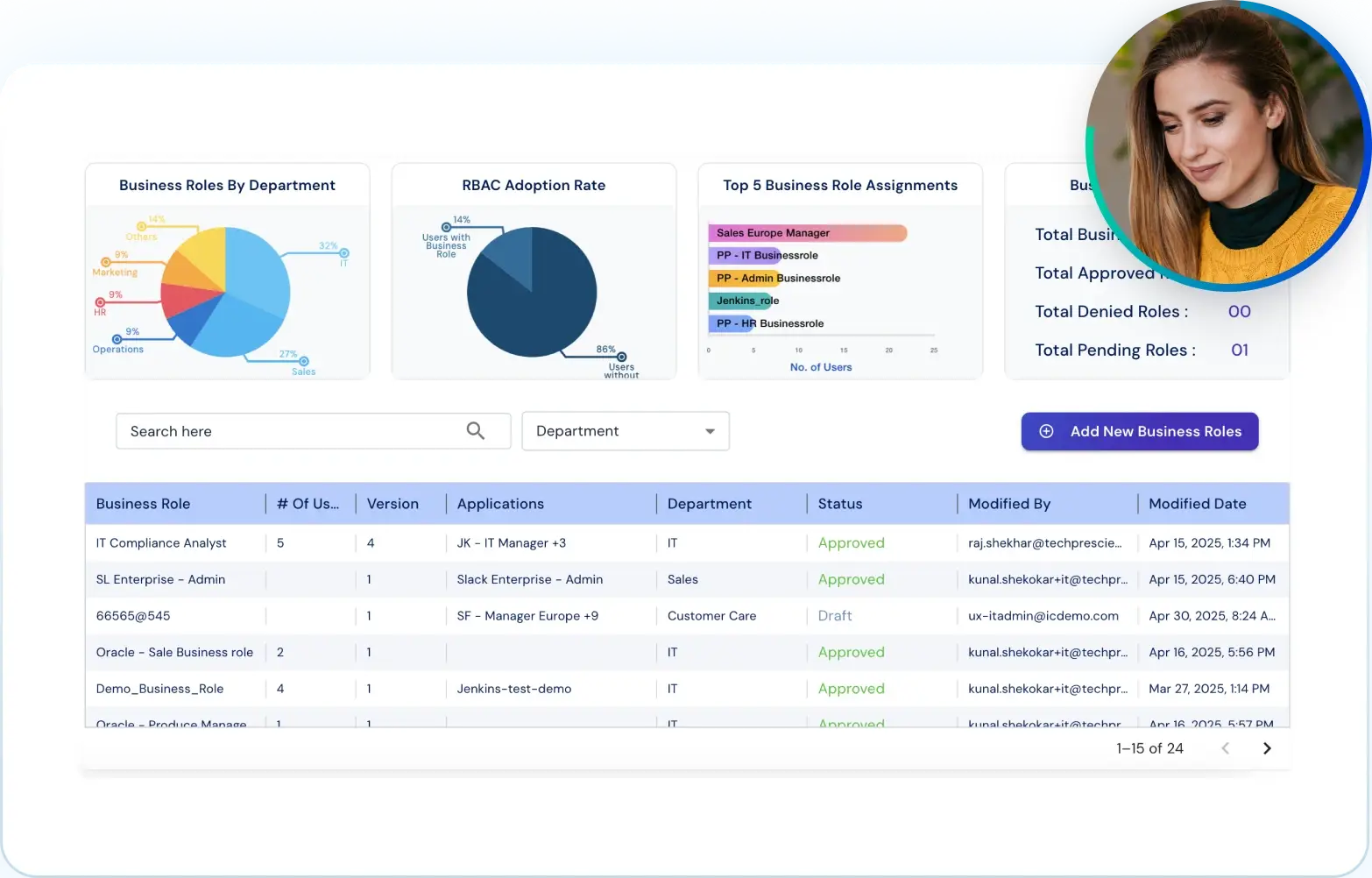
GET A PERSONALIZED DEMO
See Identity Confluence in Action
“One platform to govern identities, automate access decisions, and prove compliance; across every app, user, and system in your environment.”



Murli Ramsunder
Senior Architect, Vonage