




On this page
See Tech Prescient in Action
Automate access, reduce risk, and stay audit-ready
Lateral movement in cybersecurity is the set of techniques attackers use to move across systems within a compromised network after gaining initial access. The objective is to escalate privileges, access sensitive assets, and expand operational control.
After an initial foothold, commonly through a compromised endpoint or credential, attackers pivot to additional systems to extend their access. This movement enables them to identify privileged accounts, locate high-value assets, and establish persistence. The initial breach creates entry; lateral movement enables expansion.
In many incidents, the primary damage does not occur at the point of entry. It occurs during the post-compromise phase, when attackers remain undetected inside the environment and progressively increase control. Dwell time can extend for weeks, allowing attackers to move between systems, elevate permissions, and prepare for data exfiltration or disruptive actions.
Lateral movement is a core component of modern attack campaigns, including advanced persistent threats (APTs) and ransomware operations. It represents a critical stage in the attack lifecycle because it is difficult to detect using perimeter-focused controls. Activity often blends with legitimate internal traffic, particularly in east-west network communications.
This article examines how lateral movement operates and outlines technical controls, including identity governance, network segmentation, and Zero Trust architecture, that reduce attacker mobility and limit blast radius.
Key Takeaways
- Lateral movement occurs following an initial compromise and allows an attacker to gain increasing control within internal systems.
- Often used for privilege escalation and accessing sensitive assets, lateral movement is often seen prior to data theft or deploying ransomware.
- Techniques that employ lateral movement include, but are not limited to: Pass-the-Hash, RDP abuse, and Credential Dumping.
- It can be detected early utilizing EDR, SIEM, or behavioral analytics that reveal anomalies in east-west network traffic.
- Preventing lateral movement generally involves applying least-privilege access, Zero Trust segmentation, and access control based on identity governance and administration (IGA).
Understanding Lateral Movement
Lateral movement occurs after an attacker gains initial access to a network. Instead of immediately targeting a single high-value asset, the attacker moves across systems, applications, and accounts to identify privileged credentials, sensitive data, and additional access paths.
This internal movement, often referred to as east-west traffic, can closely resemble legitimate administrative or user activity. Because it operates within established trust boundaries, it is significantly harder to detect than perimeter-based intrusion attempts.
Lateral movement has its purpose and is contrasted to vertical movement, where the attacker escalates their privileges on a specific system (for example, from standard user to admin). In this situation, lateral movement is spreading across systems, using existing trust relationships, weak credentials, or misconfigured permissions, to get further access.
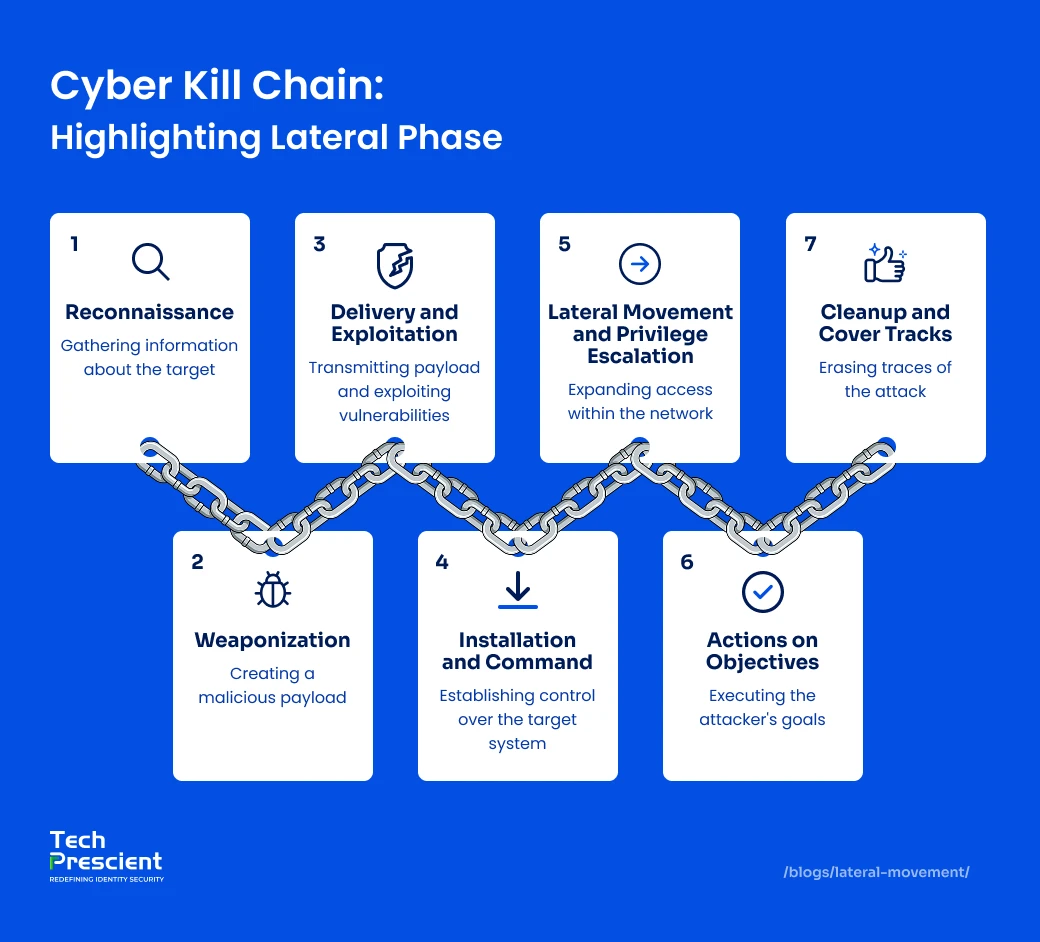
In the cyber kill chain, lateral movement occurs between initial access and data exfiltration. This is the point in an attack when the attacker begins to consolidate control to prepare for the endgame, whether that means exfiltrating data, deploying ransomware, or building a persistence capability within the environment.
Reality Check
If an attacker breached one endpoint today, how far could they move inside your network? The answer depends on your internal access controls, not your firewall.
Lateral Movement vs Vertical Movement in Cybersecurity
Lateral movement and vertical movement are post-compromise techniques that serve distinct functions within the attack lifecycle. Both occur after initial access, but they differ in scope and objective.
| Lateral Movement | Vertical Movement |
|---|---|
| Moves across systems | Escalates privileges |
| Expands network reach | Gains higher access on one machine |
| Uses stolen credentials | Exploits vulnerabilities |
| Often precedes ransomware deployment | Often precedes lateral spread |
Vertical movement increases the level of control on a specific asset. Lateral movement increases the breadth of control across the environment.
Understanding the distinction is critical for detection strategy: privilege escalation controls address vertical movement, while identity governance, segmentation, and east-west traffic monitoring reduce lateral mobility.
How Lateral Movement Works (Attack Stages)
After gaining access to your environment, the next step for attackers is lateral movement to locate high-value systems, collect better credentials and escalate privileges. This usually takes place in three stages: internal reconnaissance, credential harvesting and lateral movement.
Internal Reconnaissance
Internal reconnaissance begins after an attacker gains initial access and seeks to assess the compromised environment. The objective is to identify viable paths for expansion, privilege escalation, and asset targeting.
During this stage, attackers analyze system configurations, trust relationships, network segmentation boundaries, and identity structures to understand how resources are interconnected. They identify accessible systems, enumerate permissions, and evaluate which accounts or services provide opportunities for further movement.
Common reconnaissance activities include:
- Scanning internal IP ranges to identify reachable hosts
- Enumerating directory services such as Active Directory objects and user groups
- Identifying privileged accounts and service accounts
- Discovering open ports, services, and listening endpoints
- Mapping accessible network segments
This phase enables attackers to determine the most efficient path to higher-value assets. Effective detection at this stage depends on monitoring abnormal enumeration activity, unusual directory queries, and anomalous east-west scanning behavior.
Common tools like Nmap, BloodHound and AD enumeration scripts help adversaries to locate misconfigured systems, exposed services and the path of least resistance to domain control.
Credential Harvesting & Privilege Escalation
When reconnaissance has been completed, the next move is to steal credentials and escalate their access. This is the footprint from identity-based attacks becoming dangerous, because once an adversary can impersonate a legitimate user, bypassing many traditional defenses becomes easier.
Common techniques related to credential theft, credential dumping from LSASS, Mimikatz, Pass-the-Hash, Pass-the-Ticket, and Kerberoasting, enable credential stealing and credential abuse or misuse.
Reconnaissance will elevate access; it's only a first step into moving across the network, meaning the adversary can now do higher-impact actions without restriction. They can alter system configurations, view sensitive data, create accounts, mitigate defenses, plus prepare to act on larger objectives that meet the adversary's goals, like data theft or deploying ransomware.
Lateral Spread & Access Expansion
As attacks achieve higher privileges, they will begin pivoting and travelling deeper into the network, often to fully access new systems, applications, or sensitive data.
Attackers will typically spread laterally using RDP, SMB, PsExec, WinRM and PowerShell, often disguising themselves as legitimate users, are even use admin shares to remain hidden.
One of the most notable examples is the SolarWinds compromise in 2020, where attackers were able to move and expand access across multiple internal systems through the use of stolen credentials and their identity-based lateral movement behavior.
Where Does Lateral Movement Occur in the Cyber Kill Chain?
Within the Cyber Kill Chain framework, lateral movement typically occurs after initial access and credential compromise, and before data exfiltration or impact actions. At this stage, attackers transition from foothold establishment to expanding operational control across the environment.
A common attack progression includes:
- Initial access
- Internal reconnaissance
- Credential harvesting
- Lateral movement
- Data exfiltration or ransomware deployment
Lateral movement represents the operational expansion phase of an intrusion. It enables attackers to access additional systems, escalate privileges across domains, and position themselves for objective execution.
Disrupting the attack lifecycle at the lateral movement stage limits the attacker's ability to scale access, reducing the risk of widespread compromise and high-impact outcomes.

Pro Tip
Stopping initial access is important, but containing internal spread is critical. Design your controls assuming compromise has already occurred.
Common Lateral Movement Techniques
Malicious actors utilize trusted tools, legitimate protocols, and built-in capabilities of the system to progress laterally without notice. Much like legitimate administrators operate, these tactics blend into the normal use of identity and network activity, making these undesirable behaviors that much harder to identify.
Pass-the-Hash / Pass-the-Ticket
Attackers acquire a hashed version of a user's password or a Kerberos ticket from a compromised system. Rather than going through the trouble of cracking it, they simply take the hash or ticket and log in as that user without the password verification process and MFA. This allows them to surreptitiously jump from system to system without raising typical alerts for authenticating. Pass-the-Hash attacks depend heavily on the presence of active, outdated, unmonitored, or unnecessary accounts.
Exploiting Remote Services (RDP, SSH, SMB)
With acquired or weak credentials, attackers can access remote services, often referred to by their protocol name, such as RDP (remote Windows login), SSH (remote login for Linux systems), and SMB (file sharing protocol). These protocols will be commonly used in an enterprise environment and use cases like IT jobs, and become similar to normal expected behavior, allowing attackers the comfort to pivot and move laterally across systems and services.
Taking Advantage of Trust Relationships
Attackers capitalize on the implicit trust relationships present between systems - such as domain trusts in Active Directory, shared service accounts, or overly permissive API/VM permissions. Once trust is compromised on one of the trusted systems, attackers can leap through environments (for example, parent-child AD domains or cloud workloads) without needing new credentials.
Living-off-the-Land (PowerShell, WMI, PsExec)
Rather than utilizing malware, attackers use built-in administrative tools - PowerShell, WMI, and PsExec - to execute commands, move files, or take control of endpoints. Due to the legitimacy and pre-installation of these tools, the activity appears normal, and this is why they are also referred to as "LOTL" - Living off the Land. The capture of the behavior from these tools can be exceptionally difficult to detect.
Credential Replay & Kerberoasting
Credential replay is when an attacker uses previously stolen username/password pairs to access other systems without any modifications, rather than trying the same username/password as a set of credentials on another system or platform. Kerberoasting occurs against a Kerberos service for service accounts; the attacker extracts a service ticket, cracks the encryption offline, seizing elevated privileges and, in many cases, total domain compromise.
Real-World Examples of Lateral Movement Attacks
The most notable cyberattacks in the past ten years indicate that lateral movement is often the most significant phase of a breach. When attackers gain entry to a single endpoint or application, they employ identity-based techniques to expand their access, elevate privileges, and penetrate mission-critical systems. It is this internal proliferation that converts a contained event into an enterprise-wide breach.
Here is a summary of three prominent cases of lateral movement that greatly expanded the scope and scale of the attack.
1. SolarWinds (2020):
The SolarWinds event is perhaps the clearest example of how lateral movement can weaponize trusted relationships. Attackers compromised the Orion build server, inserted a malicious backdoor (Sunburst) into bona fide updates that propagated to SolarWinds customers, and expanded its footprint.
Once inside the SolarWinds customer environments, attackers did the following:
- Conducted AD enumeration to understand the domain structures
- Conducted Pass-the-Ticket and Golden SAML attacks to impersonate privileged accounts
- Engaged in lateral movement across cloud and on-prem systems in an effort to reach mail servers, identity platforms, and sensitive data
Since Orion was a trusted system with extensive privileges, the lateral spread was stealthy, quick, and extraordinarily difficult to detect, affecting more than 18,000 organizations.
2. WannaCry (2017):
In May of 2017, the WannaCry ransomware attack constituted a worldwide epidemic, targeting systems based on Microsoft Windows. After infecting a system, WannaCry encrypted users' files and demanded a ransom in Bitcoin for decrypting the files. The impact of WannaCry was amplified for two main reasons: many organizations were still using outdated Windows systems, and had little to no understanding of how critical security patches work to mitigate important vulnerabilities (which allowed WannaCry to spread much faster than it should have).
WannaCry even demonstrated a highly dangerous form of lateral movement: automated worm-like propagation. Once a single device was infected, it utilized the EternalBlue SMB exploit to efficiently intrude upon internal networks without the intervention of the attacker.
Some attacking attributes of internal spread are:
- No identity or credentials required (purely exploit-driven movement)
- The ability for rapid "east-west" movement across Windows systems
- Within minutes, encryption of files across the network
This type of lateral spread resulted in outages in hospitals, manufacturers, telecoms, and others, turning one compromised endpoint into thousands.
3. Contemporary Ransomware Operations:
Modern ransom groups (Conti, LockBit, BlackCat, etc.) are fully reliant on these lateral capabilities within networks for maximum operational impact. An attacker that has been granted initial access to a network typically:
- Harvest Active Directory credentials from the LSASS dump or Mimikatz, or take tokens.
- Move laterally using PsExec, WMI, or RDP options.
- Escalate privileges in AD or become a Domain Admin.
- Deploy ransomware across servers and endpoints during a single event.
By weaponizing Active Directory privileges, a single coordinated push can encrypt entire organizations very quickly, making recovery costly and slow.
See how Identity Confluence by Tech Prescient stops internal spread
How to Detect and Prevent Cloud Lateral Movement Attacks
Cloud lateral movement occurs when attackers pivot across workloads, SaaS applications, or identities by exploiting misconfigured IAM roles, exposed API tokens, or over-permissioned service accounts.
Unlike traditional network-based movement, cloud lateral expansion is primarily identity-driven. Attackers leverage excessive entitlements, federated trust relationships, and token-based authentication mechanisms to access additional resources across accounts or services.
Common cloud lateral movement techniques include:
- Abusing excessive IAM permissions
- Assuming cross-account roles
- Reusing OAuth tokens or API tokens across services
- Exploiting unmanaged or over-privileged service principals
Detection Strategies
Effective detection requires visibility into identity activity and entitlement changes:
- Monitor abnormal or high-risk API activity
- Track cross-account authentication and role assumption events
- Identify privilege escalation patterns in cloud IAM logs
- Deploy Cloud Infrastructure Entitlement Management (CIEM) solutions to detect excessive or toxic combinations of permissions
Prevention Strategies
Prevention focuses on reducing identity-based attack paths:
- Enforce least-privilege IAM policies
- Rotate API keys and service credentials on a defined schedule
- Implement just-in-time (JIT) access for privileged roles
- Continuously audit and remediate excessive cloud entitlements
In cloud architectures, access control is enforced through identity and entitlement governance. Limiting permissions and continuously validating access paths reduces the ability of attackers to move between cloud resources.
How to Detect Lateral Movement Early
Early detection of lateral movement depends on identifying abnormal identity behavior, privilege escalation patterns, and anomalous east-west traffic within the network. Attackers often operate quietly for extended periods before executing observable impact actions, making behavioral visibility critical.
Effective detection relies on behavioral analytics, log correlation, and anomaly detection to establish baselines for normal identity and network activity. Deviations from those baselines, such as unusual authentication sequences, unexpected privilege changes, or abnormal internal traffic flows, indicate potential lateral expansion.
Even subtle attacker activity generates signals across endpoints, directory services, authentication logs, and east-west network communications. The objective is to surface these indicators before the attacker consolidates control or progresses to data exfiltration or disruptive actions.
1. Monitor for Abnormal East–West Traffic
Lateral movement is composed mainly as an internal (east-west) activity, not traffic into or out of your network. Internal spikes in communication, especially between systems that do not usually communicate, may indicate reconnaissance or credential reuse.
Examples include the following:
- Workstations attempting to connect to multiple servers unexpectedly
- Uninvited upticks in SMB/RDP traffic from non-admin machines
- Repeated attempts on unauthorized network segments
2. Employ EDR, UEBA, and SIEM for Pattern Detection
Modern detection is increasingly dependent on correlating activity across tools:
- EDR (Endpoint Detection & Response): Flagged suspicious processes (e.g. Mimikatz, LSASS memory access).
- UEBA (User & Entity Behavior Analytics): Identified identity anomalies such as logins at strange times, unusual privilege usage, or abnormal device access.
- SIEM (Security Information & Event Management): Correlated logs from AD, endpoints, and network tools to identify patterns that signified lateral movement across systems.
Each of these tools can signal lateral movement involving the legitimate credentials of the victim, or while using legitimate tools associated with "living-off-the-land."
3. Look for Privilege Escalation Attempts
Privilege escalation is a common precursor to lateral movement. Things to look for:
- Sudden implementation of admin-level role assignments
- Service accounts gaining access to new applications
- Dumping LSASS memory or retrieving Kerberos tickets
- Unusual PowerShell or WMI activity
A spike in privileged access and/or sudden movement to new privileges is a red flag that must be investigated for a legitimate process or an attacker attempting to expand their foothold.
4. Correlate Lateral Authentication Attempts
Follow authentication patterns to detect credential abuse:
- Several bad logins followed by a single successful login
- Logins from new or abnormal IPs
- Use of the same credentials on different machines in succession
- Service account logins outside of their normal login patterns
When authentication logs are correlated across endpoints, Active Directory, and cloud apps, the paths for lateral movement become much more apparent.
How to Prevent Lateral Movement in Your Network
Preventing lateral movement requires limiting identity-based access paths, enforcing least privilege, and segmenting network communication to restrict east-west traffic. The objective is to reduce exploitable pathways after an initial compromise.
Network segmentation and least-privilege access create structural constraints that limit how far an attacker can move, even if one system is breached. Segmentation reduces unnecessary system-to-system communication, while least privilege restricts user, service, and administrative permissions to only what is required.
When combined with identity-centric controls such as multi-factor authentication (MFA), credential hygiene, and continuous access reviews, organizations can contain unauthorized access before it expands to enable ransomware deployment or large-scale data exfiltration.
Quick Security Test
Do your service accounts have more permissions than they actually need? Over-permissioned identities are the fastest highways for lateral movement.
1. Implement Least Privilege and MFA
Limiting every user, service account, and machine identity to just the fully needed permissions limits each user, service, and identity's lateral movement options.
- Using least privilege makes it very difficult for a compromised account to access any additional systems or sensitive data.
- Role-based and attribute-based access can further restrict privileges based on department, device posture, location, and risk level.
- Multi-Factor Authentication (MFA) would be another level of validation to prevent the reuse of stolen passwords or hashes (especially in Pass-the-Hash scenarios).
- Conditional access rules would force re-validation for flagged actions and make unauthorized lateral movements more visible.
If privileges are well-scoped, it will be much more difficult for an attacker to get elevation, and without elevation, lateral movement is much less effective.
2. Network Segmentation & Zero Trust
Network segmentation divides your environment into smaller, isolated zones to prevent attackers from moving freely across your systems.
- Micro-segmentation limits east-west communication, such that even if one endpoint is compromised, it cannot talk to every server.
- Zero trust architecture operates under the "never trust, always verify" principle; every access request is authenticated and authorized continuously.
- Service isolation ensures sensitive assets (e.g., domain controllers, AD servers, production workloads) each have their own boundaries.
- Application-level segmentation ensures applications have tightly defined communication paths that are not unnecessarily interconnected when exploitation is occurring by the attacker.
Segmentation transforms the lateral movement process into a maze of barriers, forcing attackers to expose themselves either with abnormal traffic patterns or authentication attempts.
3. Regularly Audit and Rotate Credentials
Inadequate credential hygiene is one of the most frequent facilitators of lateral spread. Regular audits prevent hackers from reusing or cracking stale authentication codes.
- Password rotation will make stolen credentials meaningless after a certain time.
- Reviewing dormant, orphaned, or unnecessary accounts will eliminate hidden access points.
- Rotating service account credentials and keys will limit any long-term exploitation (which is most threatening with excessive privileges).
- Auditing privileged accounts ensures access is appropriate, bound to a specific time frame, and least-privilege compliant.
- Strong password control policies, and NtLanm disabled (if possible), are an avenue to reduce the chances of a pass-the-hash or kerberoasting situation.
Regular credential rotation closes off many of the silent security gaps that attackers depend on.
4. Keep an Eye on Identity Logs (IGA Integration):
Identity logs provide a reliable indicator of anomalous access activity, which is key to the detection of lateral movement. Integrating identity governance (IGA) solutions increases visibility and control.
- IGA solutions such as Identity Confluence by Tech Prescient correlate identity changes, entitlements, and approvals to identify suspicious privilege escalations.
- Monitoring authentication patterns across applications and systems can help to identify odd login sequences and credential reuse.
- Access certification campaigns capture users who may have unnecessary privileges over time.
- Automated remediation workflows (e.g., session termination or temporary access suspension) can be utilized for disrupting an attack from getting further into the network.
- Cross-system log correlation (IGA + SIEM + EDR) offers end-to-end visibility from identity actions to endpoint actions.
With identity being the focal point of the detection, organizations provide themselves the opportunity to disrupt attack chains before lateral movement can reach critical assets.
The Role of Identity Governance (IGA) in Stopping Lateral Movement
Identity Governance and Administration (IGA) reduces lateral movement by ensuring users, service accounts, and machine identities are granted only the access required for their roles. Limiting excess privileges directly reduces the access paths attackers can exploit.
Because lateral movement commonly depends on over-permissioned accounts, orphaned identities, and unmanaged access sprawl, a mature IGA program constrains the number of viable pivot points available after an initial compromise. By continuously governing entitlements and enforcing least-privilege access, IGA reduces the ability of attackers to expand control beyond the initially compromised identity or system.
1. Eliminates Over-Provisioned Access
IGA is typically based on the concept of least privilege and contains an ongoing review and refinement of entitlements. Over time, users typically collect an arbitrary amount of unnecessary permissions (often referred to as "privilege creep"), which are targets of opportunity during an attack. IGA functionality can help systematically reduce access and unused permissions, therefore reducing the attack surface area.
2. Strengthens Access Certifications
Regular certification campaigns enable managers and application owners to verify who should have access to what. This process usually reveals:
- Dormant or unused accounts
- Access based on excessive entitlement
- Risky combinations that violate Segregation of Duties (SoD)
Once we eradicate these weak points, we have reduced how far an attacker can move into your environment.
3. Detects Unusual Access Paths Through Correlation
The integration of IGA with IAM and security tools helps uncover suspicious behavior, such as:
- A user engaging in activity outside of their role, e.g. accessing a highly privileged system.
- Privileged escalation that is inconsistent with past behavior, or not matching historical patterns.
- Access changes are occurring at an unexpectedly high rate in Active Directory.
- The user attempts to access many different systems simultaneously over a short period of time.
Identity-level anomaly detection is critical because understanding lateral movement at the endpoint or network layer typically looks "normal", but not at the identity layer.
4. Support a Zero Trust Strategy by Continuously Governing Entitlements
Zero Trust suggests we have to verify everything every time. IGA supports the governance layer to ensure entitlements are aligned to specific business needs so that access is:
- Business appropriate
- Time-bound
- Risk aware
- Continuously verified
This level of alignment will prevent an attacker from exploiting the granularity of entitlements that are either too long-lived or for which the access is no longer needed (east-west movement).
5. Automates Remediation to Break the Attack Chain
Modern IGA platforms can initiate automated workflows upon detecting suspicious identity changes, such as disabling an account, revoking a high-risk entitlement, or alerting your security teams. Organizations can thus respond before lateral movement results in an event that impacts critical business assets.
IGA + IAM = A Unified Defense
IAM manages access and authorization, but IGA controls who should have access in the first place. Combined, they offer true visibility across identity lifecycles, and can work to identify abnormal access pathways that may show early attempts at lateral movement.
For deeper context on how governance complements identity access, check out IGA vs IAM explained.
Final Thoughts
Lateral movement is frequently the silent activator behind big cyberattacks. Most breaches are not catastrophic after an attacker gets in; they are catastrophic when the attacker can move laterally, escalate privileges, and access the target systems of value undetected. This is why preventing lateral movement is not just a best practice for security; it is a requirement for modern cyber resilience.
By improving identity governance, limiting excessive privileges, segmenting networks, and monitoring for abnormal behavior, organizations can greatly limit an attacker's ability to spread. Good security hygiene does not just make a breach hard; it makes a breach manageable, from being organization-wide to isolated and contained.
FAQs
Lateral movement is when attackers move across systems inside a network after gaining initial access, typically using stolen credentials to escalate privileges or reach sensitive assets.
Lateral movement allows attackers to expand control quietly, escalate privileges, and prepare for ransomware or data theft before detection.
Organizations detect lateral movement using EDR, SIEM, UEBA, and identity monitoring tools that flag abnormal east–west traffic, unusual login patterns, and privilege escalation attempts.
Attackers use tools like Mimikatz, PsExec, PowerShell, RDP, and Cobalt Strike to move across systems using legitimate credentials and administrative functions.
Prevent lateral movement by enforcing least privilege, enabling MFA, segmenting networks, rotating credentials, and continuously governing access through IGA solutions.
Share



Rashmi Ogennavar
Content Strategist
A content strategist translating complex Tech and SaaS concepts into compelling narratives for business and technical audiences. With a strategic, data-informed approach, the work bridges content and product storytelling, crafting messaging that resonates and drives decisions across the buyer journey.
Most Popular Blogs
Identity Security· 21 min read
Data Access Governance Solutions: How to Secure Sensitive Data at Scale
Compare data access governance solutions for 2026: how DAG platforms discover sensitive data, run access reviews, automate remediation, and prove compliance.
Brinda Bhatt· September 7, 2026
Identity Security· 24 min read
What Is Zero Trust Network Access (ZTNA)?
Learn what Zero Trust Network Access (ZTNA) is, how it works, and why it’s replacing VPNs for secure, identity-based access control.
Yatin Laygude· August 14, 2026
Identity Security· 24 min read
Cyber Essentials Certification: Complete Guide
Learn Cyber Essentials certification, cost, requirements, and steps. Compare Cyber Essentials vs Plus and get certified faster.
Yatin Laygude· August 10, 2026