




On this page
See Tech Prescient in Action
Automate access, reduce risk, and stay audit-ready
Cyber Essentials Plus is a UK government-backed cybersecurity certification that validates an organization's security controls through independent technical testing. Unlike the standard Cyber Essentials certification, the Plus version requires hands-on verification to prove that security measures are properly implemented and functioning effectively.
In this blog, we'll explain what Cyber Essentials Plus is, certification requirements, audit steps, cost breakdown, preparation checklist, and how organizations can successfully achieve certification.
Key Takeaways:
- Cyber Essentials certification is required before pursuing Cyber Essentials Plus
- The certification includes an independent technical audit and vulnerability testing
- It validates five core cybersecurity controls
- Certification remains valid for 12 months
- Cyber Essentials Plus is often required for UK government and public sector contracts
What Is Cyber Essentials Plus?
Cyber Essentials Plus is an advanced cybersecurity certification that independently verifies an organization's security controls through hands-on technical testing rather than self-assessment alone.
It is essentially the audited version of the standard Cyber Essentials certification. While the basic certification relies on organizations confirming that security controls are in place, Cyber Essentials Plus requires accredited assessors to test and validate those controls directly.
The certification is backed by the UK government and focuses on protecting organizations against common cyber threats such as malware attacks, phishing, credential compromise, insecure configurations, and unpatched vulnerabilities.
How Cyber Essentials Plus Differs from Basic Certification
The standard Cyber Essentials certification is based on a self-assessment questionnaire where organizations declare that the required security controls are implemented. Cyber Essentials Plus goes a step further by introducing an independent technical audit. Certified assessors actively test systems, devices, and configurations to verify whether the organization's controls actually work in practice.
This is often summarized as:
- Cyber Essentials: "We say our controls are implemented."
- Cyber Essentials Plus: "Independent experts verify the controls work."
Because of this additional validation layer, Cyber Essentials Plus provides a significantly higher level of assurance for customers, regulators, partners, and government agencies.
What Does Cyber Essentials Plus Validate?
The certification evaluates whether an organization has effectively implemented five core cybersecurity controls:
- Firewalls and internet gateways
- Secure configuration
- User access control
- Malware protection
- Patch management
Assessors also perform vulnerability scanning, device testing, malware protection validation, and configuration reviews to identify weaknesses that could expose systems to cyber threats. Unlike purely documentation-based compliance programs, Cyber Essentials Plus focuses heavily on operational security effectiveness.
Why Organizations Pursue Cyber Essentials Plus
Many organizations pursue Cyber Essentials Plus to demonstrate stronger cybersecurity maturity and improve trust with customers and partners.
The certification is especially important for:
- Businesses handling sensitive data
- Organizations working with the UK government
- Companies bidding for public sector contracts
- Security-conscious SaaS providers
- Organizations seeking cyber insurance eligibility
Because the certification includes independent testing, it is often viewed as more credible and rigorous than self-attested security frameworks.
Cyber Essentials vs Cyber Essentials Plus
| Feature | Cyber Essentials | Cyber Essentials Plus |
|---|---|---|
| Assessment Type | Self-assessment | Independent technical audit |
| Validation Method | Questionnaire | Hands-on testing |
| Assurance Level | Basic | Higher |
| Vulnerability Testing | Limited | Required |
| External Verification | No | Yes |
Cyber Essentials Plus Requirements
To achieve Cyber Essentials Plus certification, organizations must implement five core security controls, meet technical scope requirements, and successfully pass an independent security audit. The requirements are designed to ensure that cybersecurity controls are not only documented, but also properly configured and functioning effectively across the organization's environment. Unlike basic certification, it includes hands-on validation through vulnerability testing and system assessment performed by accredited certification bodies.
Prerequisite: Cyber Essentials Certification
Before pursuing Cyber Essentials Plus, organizations must first complete the standard Cyber Essentials certification.
The Plus assessment is typically conducted within approximately three months of the initial certification because the organization's security posture and technical environment should still reflect the controls declared during self-assessment. This prerequisite ensures that organizations establish baseline cybersecurity controls before moving to independent technical verification.
The 5 Core Security Controls
Cyber Essentials Plus focuses on five core technical control areas designed to protect against the most common cyber threats.
1. Firewalls and Internet Gateways
Organizations must properly configure firewalls and boundary security controls to restrict unauthorized access to systems and internet-facing services.
Assessors typically verify:
- Secure firewall rules
- Restricted administrative access
- Network segmentation practices
- Removal of unnecessary open ports and services
2. Secure Configuration
Systems, applications, and devices must be securely configured to minimize attack surfaces.
This includes:
- Removing unused software and services
- Disabling default accounts
- Applying secure configuration baselines
- Limiting unnecessary functionality
Poor configuration management is one of the most common reasons organizations fail technical assessments.
3. User Access Control
Organizations must implement strong access governance practices to ensure users only have access appropriate to their role.
Assessors evaluate:
- Privileged account management
- Least privilege access
- Strong password enforcement
- Multi-factor authentication (MFA) usage
- Access control consistency across systems
This control area is especially important for reducing identity-based attack risk.
4. Malware Protection
Organizations must deploy and maintain effective malware protection mechanisms across in-scope devices and systems.
This may include:
- Endpoint protection platforms
- Antivirus solutions
- Threat detection controls
- Application allowlisting
- Email and web filtering protections
Assessors often validate whether malware protection tools are active, updated, and functioning correctly.
5. Patch Management
All supported software and operating systems must be patched against known vulnerabilities within required timelines.
Assessors typically review:
- Operating system patch levels
- Third-party software updates
- Vulnerability remediation practices
- Unsupported software usage
Unpatched vulnerabilities remain one of the most common causes of certification failure.
Technical Scope Requirements
Cyber Essentials Plus only evaluates systems that fall within the defined certification scope.
Organizations must clearly identify:
- In-scope devices and endpoints
- Internet-facing systems
- Cloud-hosted services
- Remote access infrastructure
- Supported operating systems and software
Unsupported or end-of-life software generally fails certification requirements because it no longer receives security updates. The audit also focuses heavily on systems exposed to the internet because these environments present a higher external attack risk.
Cyber Essentials Plus Audit Process
The Cyber Essentials Plus audit includes hands-on technical testing such as vulnerability scanning, malware protection validation, device testing, and configuration assessment to verify that security controls are functioning effectively.
Unlike the standard Cyber Essentials certification, which relies primarily on self-assessment, the Plus certification requires independent assessors to actively test systems and security controls in real-world conditions. The audit focuses on validating whether organizations can defend against common cyber threats rather than simply proving that policies exist.
What Happens During the Audit?
The Cyber Essentials Plus assessment includes several technical validation activities designed to evaluate operational cybersecurity effectiveness.
1. External Vulnerability Scans
Assessors perform external vulnerability scans on internet-facing systems to identify exposed weaknesses, insecure configurations, outdated software, or known exploitable vulnerabilities. This helps verify whether externally accessible infrastructure is properly secured against common attack vectors.
2. Internal Device Testing
A sample of internal user devices and systems is tested to assess whether security controls are consistently applied across the environment.
Assessors typically review:
- Patch levels
- Administrative privileges
- Endpoint security configuration
- Password and MFA enforcement
- Secure system configuration
The goal is to ensure that security practices are operational across real production environments, not just documented centrally.
3. Malware Simulation Tests
Assessors validate whether malware protection controls can effectively detect or block malicious files and unsafe execution behavior.
This may include controlled malware simulation testing or verification of:
- Antivirus effectiveness
- Endpoint detection tools
- File execution controls
- Threat prevention configuration
Organizations must demonstrate that malware defenses are active, updated, and functioning correctly.
4. Configuration Validation
The audit also includes validation of firewall rules, system hardening settings, account configurations, and internet gateway protections.
Assessors look for:
- Default or weak configurations
- Excessive administrative access
- Unnecessary services or ports
- Insecure remote access settings
- Unsupported software or operating systems
Misconfigurations remain one of the most common causes of audit failure.
Who Conducts the Audit?
The Cyber Essentials Plus audit must be performed by accredited certification bodies approved under the UK government-backed certification scheme.
These assessors are responsible for:
- Conducting technical testing
- Reviewing in-scope systems
- Validating security controls
- Identifying remediation requirements
- Issuing certification upon successful completion
Organizations cannot self-certify for the Plus assessment because the framework is specifically designed around independent technical verification.
Common Reasons for Failure
Many organizations fail the Cyber Essentials Plus audit because of operational inconsistencies rather than missing security tools entirely.
Common failure causes include:
- Unpatched operating systems or applications
- Weak or excessive user access permissions
- Misconfigured firewalls or remote access settings
- Unsupported software still in scope
- Missing MFA enforcement
- Inconsistent endpoint security configuration
Even a single vulnerable endpoint within the audit scope can result in certification failure.

Pro Tip
Organizations should test a sample of endpoints internally before the audit. One outdated device or unsupported application inside the certification scope can cause the entire assessment to fail.
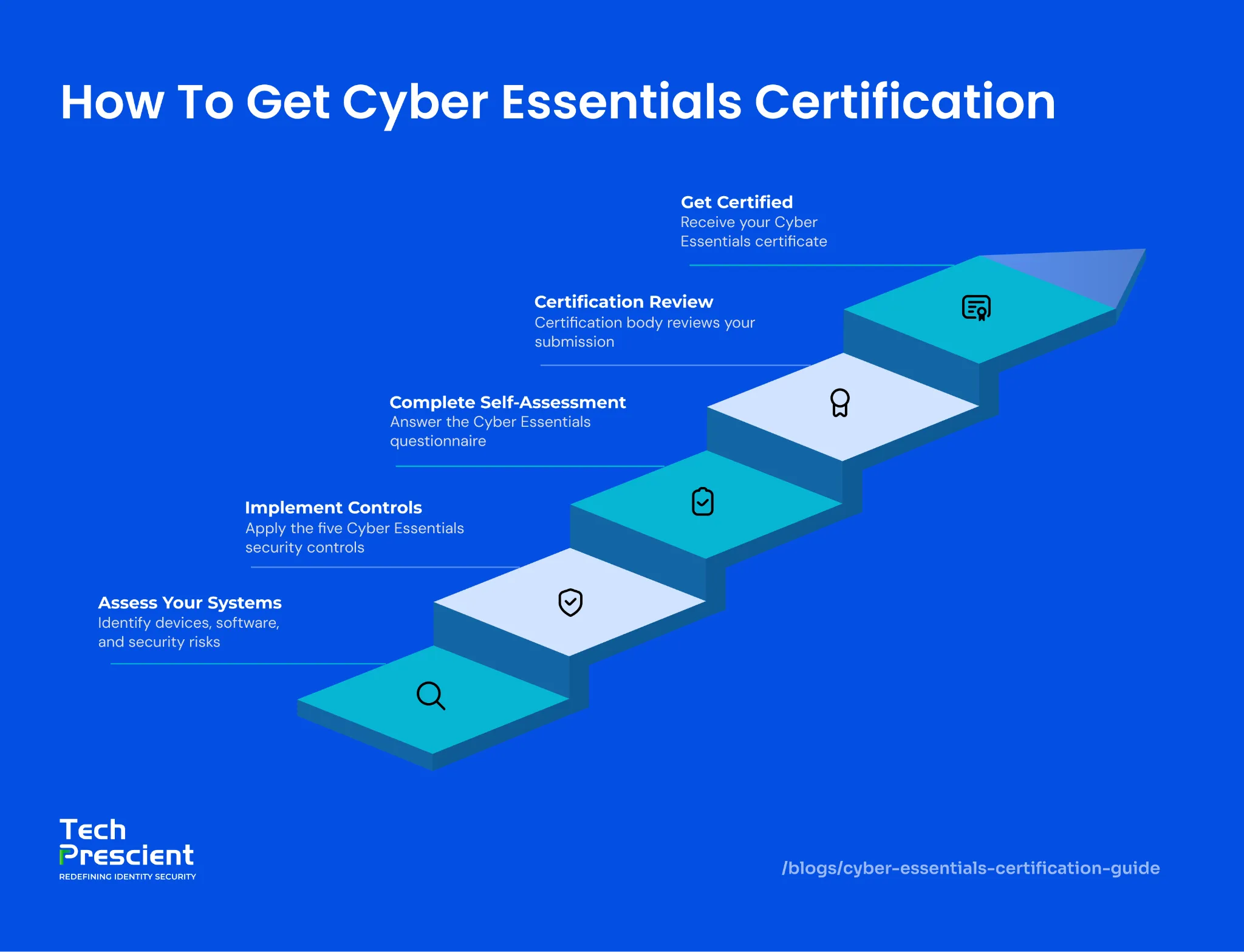
Cyber Essentials Plus Certification Process (Step-by-Step)
Organizations pursuing Cyber Essentials Plus certification must first complete Cyber Essentials, prepare their environment, undergo an independent audit, remediate issues, and successfully pass technical validation. The certification process is designed to validate that an organization's cybersecurity controls are not only implemented but also functioning effectively in real-world environments. Because the assessment includes hands-on technical testing, preparation and consistency across systems are critical.
Get Cyber Essentials Certification
Organizations must first obtain the standard Cyber Essentials certification before moving to the Plus assessment. This initial stage involves a self-assessment questionnaire covering the five core security controls required by the framework. The Plus audit is typically completed within about three months of the standard certification to ensure the environment still reflects the declared controls.
Define the Certification Scope
The organization must clearly identify which systems, users, devices, and environments fall within the audit scope.
This usually includes:
- End-user devices
- Internet-facing systems
- Cloud services
- Remote access infrastructure
- Supported operating systems and applications
Proper scoping is important because all in-scope assets may be subject to technical testing during the audit.
Conduct a Gap Analysis
Before the formal audit, organizations typically review their environment to identify weaknesses or non-compliance issues.
This includes evaluating:
- Patch status
- Firewall configurations
- MFA enforcement
- Endpoint protection coverage
- User access controls
- Unsupported software usage
A gap analysis helps reduce audit failure risk and improves remediation readiness.
Implement and Strengthen Security Controls
Organizations must remediate identified gaps and ensure controls are consistently enforced across all in-scope systems. This often involves improving patch management, strengthening endpoint protection, hardening device configurations, removing unsupported software, and tightening privileged access controls. Consistency across endpoints is especially important because assessors test real production environments rather than reviewing policies alone.
Schedule the Audit
Once the environment is ready, the organization schedules the Cyber Essentials Plus audit with an accredited certification body.
The assessment typically includes:
- External vulnerability scanning
- Internal device testing
- Malware protection validation
- Access control testing
- Configuration reviews
The goal is to verify whether systems can effectively defend against common cyber threats.
Fix Non-Compliance Issues
If issues are identified during the audit, organizations are usually given time to remediate the findings before reassessment. Common remediation areas include unpatched systems, firewall misconfigurations, unsupported software, weak access controls, or inconsistent endpoint security settings. Organizations that perform thorough internal preparation generally reduce remediation effort significantly.
Get Certified
Once all audit requirements are successfully met, the organization receives the Cyber Essentials Plus certificate. The certification remains valid for 12 months and must be renewed annually to maintain compliance status and demonstrate continued cybersecurity maturity.
Cyber Essentials Plus Controls Matrix
Map every control to practical security and governance actions.
Cyber Essentials Plus Cost Breakdown
The Cyber Essentials Plus cost varies based on organization size, technical complexity, endpoint count, and remediation effort required before the audit. For most businesses, the cost of Cyber Essentials Plus typically ranges between £1,500 and £5,000+, although larger or more complex environments may incur significantly higher expenses. The total investment depends not only on the audit itself, but also on preparation, remediation, tooling, and operational readiness.
Organizations with mature security controls and well-managed environments generally complete certification at a lower overall cost.
Audit and Certification Costs
The primary cost component is the independent technical assessment conducted by an accredited certification body.
Audit pricing is influenced by:
- Number of endpoints and users
- Internet-facing systems
- Cloud and remote infrastructure
- Complexity of the IT environment
- Geographic distribution of systems
Small organizations with limited infrastructure often fall near the lower end of the pricing range, while larger enterprises or distributed environments may exceed £5,000 depending on audit scope.
Infrastructure Complexity and Endpoint Count
One of the biggest cost drivers is the number of systems included within certification scope. Organizations with large endpoint fleets, hybrid cloud environments, remote workforce infrastructure, multiple offices or networks, and legacy systems typically require more extensive testing and remediation efforts. Complex environments also increase the likelihood of inconsistent configurations or unsupported software, which can extend audit preparation timelines.
Remediation and Preparation Costs
Many organizations underestimate the cost of remediation before certification.
Common remediation expenses include:
- Patching outdated systems
- Replacing unsupported software
- Improving endpoint protection
- Enforcing MFA
- Hardening firewall configurations
- Correcting access control weaknesses
If significant security gaps are identified during preparation or audit testing, organizations may need additional internal effort or external consulting support before certification can be completed successfully.
Hidden Costs Organizations Often Miss
Beyond the certification fee itself, organizations frequently encounter additional operational and compliance-related costs.
These may include:
- Vulnerability scanning tools
- Endpoint protection platforms
- Compliance consulting
- Internal IT resource allocation
- Device replacement or upgrades
- Annual renewal and reassessment costs
For organizations with immature cybersecurity processes, these hidden costs can sometimes exceed the audit fee itself.
How Organizations Reduce Certification Costs
Organizations that prepare proactively usually reduce overall certification expenses significantly.
Strong cost optimization practices include:
- Conducting internal gap assessments early
- Reducing unnecessary audit scope
- Standardizing endpoint configurations
- Automating patch management
- Removing unsupported systems before testing
Businesses with mature security governance and centralized endpoint management often complete certification faster and with lower remediation effort.
Typical Cyber Essentials Plus Cost Ranges
| Organization Type | Typical Cost Range |
|---|---|
| Small Business | £1,500 – £3,000 |
| Mid-Sized Organization | £3,000 – £5,000 |
| Large / Complex Environment | £5,000+ |
Cyber Essentials Plus Checklist (Preparation Guide)
A structured Cyber Essentials Plus checklist helps organizations identify gaps, strengthen security controls, and improve audit readiness before certification testing begins. Preparation is one of the most important parts of the certification process because Cyber Essentials Plus includes hands-on technical validation. Even a single vulnerable or unsupported system within scope can lead to audit failure. Before scheduling the assessment, organizations should ensure all systems, applications, and security controls are consistently configured across the environment.
1. Patch All Systems
All operating systems, applications, and internet-facing services should be updated with the latest security patches. Assessors actively check for known vulnerabilities and unsupported versions during testing. Organizations should also verify that automated patch management processes are functioning correctly and that no high-risk vulnerabilities remain unresolved.
2. Remove Unsupported Software
Unsupported or end-of-life software is one of the most common reasons organizations fail Cyber Essentials Plus assessments. Any software or operating system that no longer receives vendor security updates should either be upgraded, isolated, or removed from the certification scope before the audit.
3. Enforce MFA and Strong Access Controls
Strong access governance is essential for passing Cyber Essentials Plus.
Organizations should verify that:
- Multi-factor authentication (MFA) is enabled where required
- Administrative privileges are restricted
- Shared accounts are minimized
- Password policies are enforced
- Least privilege access principles are applied consistently
Assessors often review both technical controls and real-world implementation consistency across user environments.
4. Configure Firewalls Securely
Firewalls and Internet gateway protections should be reviewed carefully before the audit. Organizations should remove unnecessary open ports, restrict administrative access, disable insecure services, and confirm that firewall rules align with current operational requirements. Misconfigured firewalls are frequently identified during vulnerability testing.
5. Install and Validate Malware Protection
All in-scope devices should have active malware protection configured correctly and updated regularly.
Organizations should verify that:
- Endpoint protection tools are operational
- Malware signatures are current
- Threat detection features are enabled
- Security alerts are monitored properly
The audit may include malware protection validation and simulated testing scenarios.
Benefits of Cyber Essentials Plus Certification
Cyber Essentials Plus certification strengthens cybersecurity posture, improves customer trust, and helps organizations demonstrate independently verified security controls.
One of the biggest advantages of Cyber Essentials Plus is that it validates operational cybersecurity effectiveness through independent testing rather than self-attestation alone. This gives customers, partners, regulators, and insurers greater confidence that the organization can defend against common cyber threats in real-world environments. UK government guidance often states that implementing the Cyber Essentials control set can help organizations protect against a large percentage of common internet-based attacks.
1. Stronger Security Posture
Cyber Essentials Plus helps organizations improve baseline cybersecurity maturity by enforcing consistent implementation of core security controls across systems and endpoints.
The certification encourages stronger operational practices around:
- Patch management
- Endpoint protection
- Firewall security
- Access governance
- Secure system configuration
Because the framework includes technical validation, organizations are often required to identify and remediate security weaknesses that may otherwise remain unnoticed. This results in improved visibility into vulnerabilities, better endpoint security hygiene, and stronger overall cyber resilience.
2. Increased Customer and Partner Trust
Cyber Essentials Plus also acts as a strong trust signal for customers, vendors, and business partners. The independent audit component demonstrates that security controls have been externally verified rather than simply declared internally. This is especially valuable for organizations handling sensitive customer information, providing SaaS services, or operating within regulated industries.
Organizations often use Cyber Essentials Plus certification to strengthen:
- Vendor trust
- Procurement credibility
- Security assurance during sales cycles
- Competitive differentiation
This becomes increasingly important as customers place greater emphasis on cybersecurity governance when selecting vendors and service providers.
3. Government Contract Eligibility
Cyber Essentials Plus is frequently required for organizations bidding on UK government and public sector contracts involving sensitive information or operational systems. Many government procurement frameworks require suppliers to demonstrate compliance with recognized cybersecurity standards before contract approval.
As a result, certification can directly influence revenue opportunities and market access for organizations working within:
- Government supply chains
- Public sector procurement
- Defense and regulated environments
- Critical infrastructure ecosystems
For some organizations, Cyber Essentials Plus becomes not just a security initiative, but a commercial requirement.
4. Cyber Insurance and Compliance Benefits
Cyber insurers increasingly evaluate cybersecurity maturity before issuing or renewing cyber insurance coverage.
Organizations with independently validated security controls may benefit from:
- Improved insurability
- Lower perceived cyber risk
- Stronger underwriting outcomes
- Better compliance readiness
The certification can also support broader security and compliance initiatives by strengthening governance around access management, endpoint security, vulnerability management, and operational cybersecurity controls.
5. Business and Revenue Impact
Cyber Essentials Plus often delivers value beyond technical security improvements.
Organizations frequently use the certification to:
- Accelerate enterprise sales conversations
- Improve customer confidence
- Reduce procurement friction
- Demonstrate operational maturity
- Strengthen cybersecurity governance
For CROs, sales leaders, and executive teams, the certification can become a business enablement tool that supports both trust and revenue growth. As cybersecurity increasingly influences purchasing decisions, independently validated security assurance has become an important competitive advantage.
Cyber Essentials vs Cyber Essentials Plus
The main difference between Cyber Essentials and Cyber Essentials Plus is that the standard certification relies on self-assessment, while Plus includes independently verified technical testing and hands-on security validation.
Both certifications are part of the UK government-backed Cyber Essentials scheme and focus on the same five core security controls. However, Cyber Essentials Plus provides a significantly higher level of assurance because accredited assessors actively test systems, endpoints, and security configurations to confirm they are functioning correctly.
Organizations often start with Cyber Essentials as a baseline certification and then move to Cyber Essentials Plus when stronger trust, compliance validation, or government contract eligibility is required.
Cyber Essentials vs Cyber Essentials Plus Comparison
| Feature | Cyber Essentials | Cyber Essentials Plus |
|---|---|---|
| Assessment Method | Self-assessment questionnaire | Independent technical audit |
| Validation Type | Organization-declared controls | Hands-on security testing |
| Assurance Level | Basic cybersecurity assurance | Higher independently verified assurance |
| Vulnerability Testing | Limited or none | External and internal vulnerability testing |
| Malware Protection Validation | Self-confirmed | Technically tested and validated |
| Endpoint Testing | Not required | Required on sampled devices |
| Audit Involvement | No formal audit | Accredited assessor conducts audit |
| Cost | Lower | Higher due to technical assessment |
| Preparation Complexity | Relatively simple | More operationally intensive |
| Best Suited For | Basic compliance needs | Organizations requiring stronger trust and security validation |
Which One Should Organizations Choose?
Cyber Essentials is often sufficient for organizations seeking baseline cybersecurity certification or initial compliance alignment.
Cyber Essentials Plus is generally preferred when organizations:
- Handle sensitive customer or operational data
- Work with government contracts
- Need stronger vendor trust
- Want independently verified cybersecurity assurance
- Require higher security maturity validation
Because the Plus certification includes technical testing, it provides greater confidence to customers, regulators, procurement teams, and insurers.
Is Cyber Essentials Plus Worth It?
Cyber Essentials Plus is often worth the investment for organizations that need stronger customer trust, independently verified security controls, and improved compliance readiness.
Whether the certification is necessary depends on the organization's industry, customer expectations, regulatory requirements, and cybersecurity maturity goals. While not every business is required to obtain Cyber Essentials Plus, the certification delivers significant value for organizations operating in security-sensitive environments.
For SMEs, Cyber Essentials Plus is usually optional but highly valuable. Smaller businesses often use the certification to demonstrate stronger cybersecurity credibility, improve customer confidence, and compete more effectively during vendor evaluations. It can also help strengthen foundational security practices that many growing organizations lack.
For companies working with UK government contracts or public sector supply chains, it is frequently required. Many procurement frameworks mandate certification before organizations can bid on projects involving sensitive information or operational systems. In these cases, the certification becomes both a compliance and a business requirement.
Security-conscious organizations also benefit significantly from the independent validation aspect of the framework. Unlike self-attested certifications, Cyber Essentials Plus proves that controls are functioning effectively through hands-on technical testing. This higher level of assurance is often important for customers, partners, insurers, and enterprise procurement teams.
The certification also provides practical cybersecurity value. By enforcing stronger patch management, access control, secure configuration, and endpoint protection practices, organizations reduce exposure to common cyber threats such as ransomware, phishing, malware, and credential-based attacks.
For many organizations, the long-term value extends beyond compliance. It can improve:
- Customer trust and procurement confidence
- Cyber insurance readiness
- Security governance maturity
- Enterprise sales enablement
- Operational cyber resilience
Ultimately, organizations that handle sensitive data, operate in regulated sectors, or want independently validated cybersecurity assurance often find it well worth the investment.
Final Thoughts
Cyber Essentials Plus helps organizations move from self-declared cybersecurity to independently verified security assurance. By validating real-world security controls through technical testing, the certification strengthens trust, improves compliance readiness, and reduces exposure to common cyber threats.
Prepare for Cyber Essentials Plus Faster
Reduce audit gaps with structured control and access governance.
FAQs
Cyber Essentials Plus is an advanced UK government-backed cybersecurity certification that includes independent technical testing of an organization's security controls, endpoints, and configurations.
The Cyber Essentials Plus cost typically ranges from £1,500 to £5,000 or more depending on organization size, infrastructure complexity, endpoint count, and remediation requirements.
Yes. Cyber Essentials Plus is especially valuable for organizations handling sensitive data, working with UK government contracts, or seeking stronger customer trust through independently verified cybersecurity controls.
Cyber Essentials Plus certification remains valid for 12 months and must be renewed annually through reassessment and compliance verification.
Organizations can verify a company's certification status through official Cyber Essentials certification directories or by requesting a valid Cyber Essentials Plus certificate directly from the organization.
Share



Rashmi Ogennavar
Content Strategist
A content strategist translating complex Tech and SaaS concepts into compelling narratives for business and technical audiences. With a strategic, data-informed approach, the work bridges content and product storytelling, crafting messaging that resonates and drives decisions across the buyer journey.
Most Popular Blogs
Identity Security· 21 min read
Data Access Governance Solutions: How to Secure Sensitive Data at Scale
Compare data access governance solutions for 2026: how DAG platforms discover sensitive data, run access reviews, automate remediation, and prove compliance.
Brinda Bhatt· September 7, 2026
Identity Security· 24 min read
What Is Zero Trust Network Access (ZTNA)?
Learn what Zero Trust Network Access (ZTNA) is, how it works, and why it’s replacing VPNs for secure, identity-based access control.
Yatin Laygude· August 14, 2026
Identity Security· 24 min read
Cyber Essentials Certification: Complete Guide
Learn Cyber Essentials certification, cost, requirements, and steps. Compare Cyber Essentials vs Plus and get certified faster.
Yatin Laygude· August 10, 2026