




On this page
See Tech Prescient in Action
Automate access, reduce risk, and stay audit-ready
The HIPAA Security Rule plays a critical role in protecting electronic protected health information (ePHI) in today's digital healthcare ecosystem. It establishes how healthcare organizations secure sensitive data, reduce risks, and maintain compliance through administrative, physical, and technical safeguards that ensure confidentiality, integrity, and availability.
As healthcare systems increasingly rely on EHRs and connected technologies, even small security gaps can lead to serious risks. From access control and encryption to audit logging and incident response, organizations must adopt a proactive and evolving security approach. Compliance today is essential not just for regulation but also for operational resilience and patient trust.
According to the U.S. Department of Health and Human Services, over 133 million healthcare records were exposed in data breaches in 2023 alone, highlighting the growing scale of cyber threats in healthcare. Let's explore how the HIPAA Security Rule works, who it applies to, and the practical steps organizations can take to strengthen ePHI protection and stay compliant.
Key Takeaways:
- The HIPAA Security Rule defines how organizations protect electronic protected health information (ePHI).
- It is built on three core safeguards: administrative, physical, and technical controls.
- Healthcare organizations and business associates must comply with strict security requirements.
- Risk assessments, access controls, encryption, and audit logging are essential for compliance.
- Identity governance and continuous monitoring play a key role in strengthening security and audit readiness.
What Is the HIPAA Security Rule?
The HIPAA Security Rule is a federal regulation under the Health Insurance Portability and Accountability Act (HIPAA), enforced in 2003, that establishes national standards for protecting electronic protected health information (ePHI). It defines how healthcare organizations secure digital health data across modern IT environments, ensuring the confidentiality, integrity, and availability of sensitive patient information while supporting safe and efficient healthcare operations.
To understand what the HIPAA Security Rule covers, it can be broken down into the following key aspects:
1. Purpose and Scope
The HIPAA Security Rule focuses on protecting ePHI from unauthorized access, breaches, and misuse. It applies to any organization that creates, receives, maintains, or transmits electronic health data, ensuring consistent security practices across healthcare systems.
2. Core Principles
The rule is built around three foundational objectives: confidentiality, integrity, and availability. These principles ensure that ePHI is accessed only by authorized users, remains accurate and unaltered, and is available when needed for patient care and operations.
3. Applicability in Healthcare IT
The HIPAA Security Rule applies across modern healthcare IT environments, including electronic health records (EHRs), cloud platforms, and connected medical systems. It ensures that as healthcare becomes more digital, data protection standards remain strong and consistent.
4. Regulatory Foundation
Introduced under HIPAA and enforced in 2003, the Security Rule provides a structured yet flexible framework. It allows organizations to implement security measures based on their size, complexity, and risk exposure while still meeting compliance requirements.
Quick Insight
Focus on how ePHI flows across your systems, not just where it is stored. Understanding data flow across EHRs, cloud platforms, and connected systems helps you identify hidden exposure points. This makes it easier to apply the right controls and strengthen overall HIPAA Security Rule compliance.
Who Must Comply With the HIPAA Security Rule?
The HIPAA Security Rule applies to any organization that creates, receives, stores, or transmits electronic protected health information (ePHI). These HIPAA cybersecurity requirements extend across the entire healthcare ecosystem, ensuring that every entity handling sensitive patient data follows standardized security practices. Compliance is not limited to direct healthcare providers but includes all parties that interact with ePHI in any capacity.
1. Covered Entities
Covered entities form the core group regulated under HIPAA. These are organizations directly involved in delivering healthcare services or managing health-related data and transactions.
This includes hospitals, clinics, individual healthcare providers, and health insurance companies. Covered entities are responsible for establishing secure environments for ePHI by implementing policies, managing access, and ensuring that patient data is protected throughout its lifecycle.
2. Business Associates
Business associates are third-party organizations that handle ePHI on behalf of covered entities. Even if they do not provide healthcare services directly, they must comply with the same HIPAA security standards when they access or process sensitive data.
Examples include SaaS healthcare platforms, cloud service providers, and IT vendors handling patient data. These entities are required to follow strict security practices, enter into Business Associate Agreements (BAAs), and ensure that any systems or processes involving ePHI meet compliance requirements.
In addition, subcontractors or external partners working under business associates who have access to ePHI are also subject to the same regulations. As healthcare operations become more interconnected, ensuring compliance across all third-party relationships is essential for maintaining data security and reducing risk.
The Three HIPAA Security Rule Safeguards
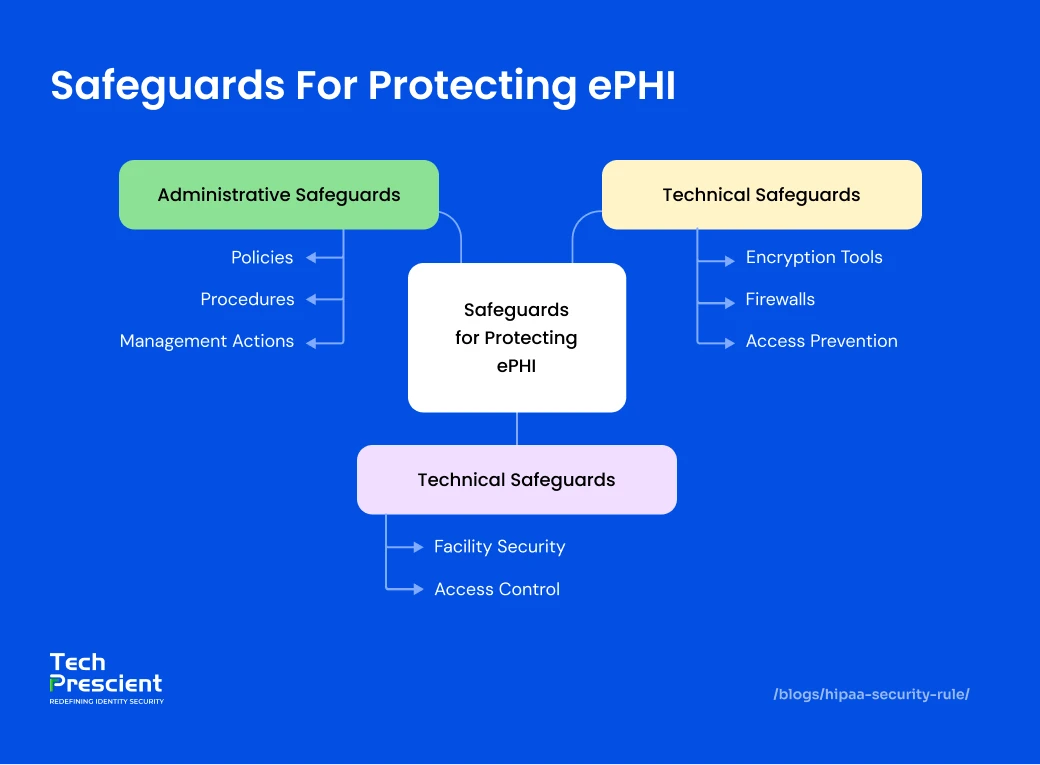
The HIPAA Security Rule organizes protection measures into three core safeguard categories: administrative, physical, and technical controls to secure electronic protected health information (ePHI). Together, these safeguards create a comprehensive framework that helps healthcare organizations manage risk, prevent unauthorized access, and maintain the confidentiality, integrity, and availability of sensitive data.
1. Administrative Safeguards
Administrative safeguards focus on the policies, processes, and governance practices that guide how organizations manage ePHI security. They form the foundation of HIPAA security standards, ensuring that risks are identified, responsibilities are defined, and the workforce is trained to handle sensitive data securely.
- Conducting risk analysis and implementing risk management strategies
- Establishing and maintaining security policies and procedures
- Providing ongoing workforce training and awareness programs
- Enforcing access authorization and role-based access controls
- Defining incident response planning and security oversight
2. Physical Safeguards
Physical safeguards are designed to protect the environments and hardware where ePHI is stored or accessed. These controls help prevent unauthorized physical access, theft, or damage to systems and ensure that devices handling sensitive data are properly managed throughout their lifecycle.
- Implementing facility access control to restrict entry to authorized personnel
- Securing workstations to prevent unauthorized viewing or misuse
- Managing device and media control, including tracking and handling of hardware
- Ensuring secure disposal of hardware and storage media containing ePHI
3. Technical Safeguards
Technical safeguards involve the technologies and system-level controls used to protect ePHI from digital threats. These safeguards enable organizations to implement effective HIPAA security solutions that control access, monitor activity, and secure data during storage and transmission.
- Applying access control systems and authentication mechanisms such as unique IDs and MFA
- Using encryption to protect data at rest and in transit
- Maintaining audit logs to track and monitor system activity
- Enforcing transmission security to safeguard data across networks
HIPAA Security Rule Requirements
The HIPAA Security Rule requires healthcare organizations to implement safeguards, conduct risk assessments, enforce access controls, and maintain audit logs to protect electronic protected health information (ePHI). These HIPAA security rule requirements are designed to ensure the confidentiality, integrity, and availability of sensitive data while enabling organizations to proactively manage risks and maintain compliance across their environments.
To meet these requirements, organizations must focus on the following key areas:
Risk assessment program
Organizations must conduct regular and comprehensive risk assessments to identify vulnerabilities, evaluate potential threats, and determine the impact on ePHI. This process should be continuous, forming the basis for all security and risk management decisions.
Access control systems
Access to ePHI must be restricted to authorized users only. This includes implementing role-based access control (RBAC), unique user IDs, multi-factor authentication (MFA), and automatic session timeouts to enforce least privilege and prevent unauthorized access.
Example: In a hospital setting, role-based access control (RBAC) ensures that a nurse can only access patient records relevant to their assigned department, reducing the risk of unauthorized exposure.
Data encryption
ePHI should be protected using encryption both at rest and in transit. Encryption helps safeguard sensitive data from interception, unauthorized disclosure, or theft, especially when data is stored in cloud systems or transmitted across networks.
Audit logging
Organizations must maintain detailed audit logs that track user activity, access events, and system changes involving ePHI. These logs should be regularly reviewed to detect anomalies, support investigations, and demonstrate compliance during audits.
Security monitoring
Continuous monitoring of systems and networks is essential to identify suspicious behavior and emerging threats. This includes using security tools and processes to detect, analyze, and respond to potential risks in real time.
Incident response procedures
A documented incident response plan is required to quickly detect, report, and mitigate security incidents. Organizations should also establish contingency plans for data backup, disaster recovery, and emergency operations to ensure business continuity and data availability.
In addition to these technical and operational measures, organizations must maintain proper documentation of policies, procedures, risk assessments, and training activities. This ensures audit readiness and demonstrates adherence to HIPAA compliance standards across the entire workforce and ecosystem.
HIPAA Security Risk Assessment Explained
A HIPAA security risk assessment identifies vulnerabilities, evaluates threats, and implements controls to protect ePHI and maintain compliance.
It involves conducting an accurate and thorough evaluation of risks to the confidentiality, integrity, and availability of ePHI, forming the basis for effective risk management and compliance. To conduct a HIPAA security risk assessment effectively, organizations typically follow these key steps:
1. Identify ePHI locations
Determine where ePHI is created, received, stored, or transmitted across systems, devices, and environments, including cloud platforms and physical infrastructure.
2. Analyze vulnerabilities
Assess potential weaknesses in systems, processes, and controls that could be exploited, such as outdated software, weak access controls, or lack of encryption.
3. Evaluate threat likelihood
Identify possible threats such as cyberattacks, human error, or system failures, and evaluate the likelihood and potential impact of each risk on ePHI.
4. Implement mitigation controls
Apply appropriate safeguards such as access controls, encryption, monitoring, and policy updates to reduce identified risks to an acceptable level.
5. Document and review annually
Maintain detailed documentation of findings, decisions, and actions taken, and review the risk assessment regularly typically annually or when significant changes occur.
A HIPAA security risk assessment is not a one-time activity but an ongoing process. By continuously evaluating risks and updating controls, organizations can strengthen their security posture, maintain compliance, and better protect sensitive patient data in an evolving threat landscape.
HIPAA Security Rule Compliance Checklist
The HIPAA Security Rule compliance checklist includes risk assessments, access controls, encryption, audit logging, and continuous monitoring to ensure ePHI protection and audit readiness.
Conduct annual risk assessments
Perform a thorough evaluation of systems, workflows, and environments to identify risks to ePHI. This is a core requirement under the Security Rule and forms the foundation for all security controls.
Implement access controls
Restrict access to ePHI using role-based access control (RBAC), unique user IDs, and authentication measures. This ensures only authorized individuals can interact with sensitive data.
Encrypt ePHI data
Protect ePHI using encryption both at rest and in transit to reduce the risk of unauthorized exposure, especially during data transfers or storage in shared environments.
Train workforce on security policies
Provide ongoing training to employees on handling ePHI, recognizing threats, and following security protocols, as workforce awareness is critical to preventing breaches.
Maintain audit logs
Track and monitor all access and activity related to ePHI through audit logs, enabling organizations to detect anomalies, ensure accountability, and support investigations.
Create incident response plans
Establish clear procedures to detect, report, and respond to security incidents quickly, minimizing impact and ensuring compliance with breach response requirements.
Monitor third-party vendors
Assess and manage the security posture of business associates and vendors handling ePHI, ensuring they meet HIPAA requirements and maintain proper agreements and controls.
Following this checklist helps organizations move beyond basic compliance to build a resilient security posture. By regularly reviewing and updating these measures, healthcare organizations can reduce risk, strengthen data protection, and maintain trust in an increasingly complex digital environment.
HIPAA Security Rule vs HIPAA Privacy Rule
The key difference within HIPAA how does security differ from privacy comes down to purpose and scope. The HIPAA Security Rule focuses on protecting electronic protected health information (ePHI) through safeguards and security controls, while the HIPAA Privacy Rule defines how all forms of protected health information (PHI) can be used, accessed, and disclosed.
Both rules work together to protect patient data, but they address different aspects of healthcare data governance. The Privacy Rule sets boundaries around data usage and patient rights, while the Security Rule ensures that electronic data is technically and operationally secured.
| Sr. No | Feature | Security Rule | Privacy Rule |
|---|---|---|---|
| 1 | Focus | ePHI security and protection through safeguards | Patient data privacy and control over information use |
| 2 | Controls | Administrative, physical, and technical safeguards | Policies governing use, access, and disclosure of PHI |
| 3 | Scope | Applies only to digital records (ePHI) | Applies to all PHI including electronic, paper, and oral |
While the Security Rule is more technical and focuses on cybersecurity measures like encryption, access control, and audit logging, the Privacy Rule is broader and centers on who can access patient information and under what conditions.
In practice, organizations must comply with both rules simultaneously. The Privacy Rule defines what should be protected and how it can be shared, while the Security Rule ensures that the necessary controls are in place to protect that information in digital environments.
Best Practices for HIPAA Security Compliance
Best practices for HIPAA compliance include identity governance, least privilege access, automation, and continuous monitoring to reduce risk and strengthen security.
The following best practices help translate compliance requirements into effective, real-world security operations.
1. Implement identity governance
Establish centralized identity governance to manage user identities, roles, and access across systems handling ePHI. This ensures visibility into who has access to what data and helps enforce consistent security policies across the organization.
2. Enforce least privilege access
Limit access to ePHI strictly based on job roles and responsibilities. Applying least privilege and strong authentication mechanisms reduces the risk of unauthorized access and insider threats.
3. Automate access reviews
Regularly reviewing user access is critical, but manual processes can be inefficient and error-prone. Automating access reviews and certifications helps ensure that permissions remain accurate as roles change, supporting ongoing compliance.
4. Enable continuous monitoring
Compliance is not a one-time effort. Organizations should continuously monitor systems, audit logs, and user activity to detect anomalies, respond to threats quickly, and maintain a strong security posture.
5. Integrate cybersecurity tools
Use a combination of security technologies such as encryption, endpoint protection, and threat detection systems to strengthen defenses. Integrating these tools ensures that ePHI is protected across storage, access, and transmission points.
By adopting these best practices, healthcare organizations can move beyond checkbox compliance and build a resilient security framework that adapts to evolving threats while maintaining regulatory alignment.
Best Practice
Treat HIPAA compliance as an ongoing process, not a one-time effort. As systems, users, and threats evolve, your security controls must evolve too. Regular access reviews, continuous monitoring, and periodic updates are essential to stay compliant and reduce risk over time.
How Identity Governance Helps Meet HIPAA Security Requirements
Identity governance helps meet HIPAA requirements by enforcing access control, automating reviews, and ensuring continuous audit readiness.
It provides centralized visibility and control across systems handling electronic protected health information (ePHI), helping reduce risk and maintain continuous compliance.
It supports HIPAA requirements in the following ways:
1. Access certification
Regular access reviews help organizations verify that users have appropriate permissions to ePHI. This ensures that outdated or excessive access is identified and removed, reducing the risk of data exposure and supporting compliance audits.
2. Role-based access control (RBAC)
Identity governance enables structured access control by assigning permissions based on roles and responsibilities. This enforces least privilege access, ensuring users only access the data necessary for their job functions.
3. Privileged access governance
High-risk accounts with elevated permissions require stricter oversight. Identity governance helps monitor, control, and limit privileged access to critical systems, reducing the likelihood of misuse or insider threats.
4. Automated compliance reporting
Manual compliance tracking is time-consuming and error-prone. Identity governance solutions automate reporting, providing real-time visibility into access controls, policy enforcement, and compliance status, which simplifies audit processes.
5. Audit readiness
Maintaining detailed records of access, changes, and policy enforcement ensures organizations are always prepared for audits. Identity governance creates a clear audit trail, making it easier to demonstrate compliance with HIPAA Security Rule requirements.
By integrating identity governance into their security strategy, healthcare organizations can move from reactive compliance to a more proactive and scalable approach. This not only strengthens security posture but also improves operational efficiency and builds long-term trust in handling sensitive patient data.
Final Thoughts
The HIPAA Security Rule establishes a clear framework for protecting electronic protected health information (ePHI) through administrative, physical, and technical safeguards. By defining security standards, risk assessment requirements, and access control measures, it helps healthcare organizations strengthen data protection, reduce vulnerabilities, and ensure consistent compliance across digital environments.
Tech Prescient helps organizations enhance identity governance, enforce least-privilege access, and operationalize HIPAA Security Rule compliance across complex healthcare systems.
FAQs
The HIPAA Security Rule is built around three key safeguards: administrative, physical, and technical. Together, they help protect electronic protected health information (ePHI) across people, processes, and technology. Each layer plays a role in reducing risk and securing sensitive healthcare data.
The main purpose of the HIPAA Security Rule is to ensure the confidentiality, integrity, and availability of electronic health information. In simple terms, it keeps ePHI secure, accurate, and accessible when needed. This helps healthcare organizations deliver care without compromising data security.
The HIPAA Security Rule is enforced by the U.S. Department of Health and Human Services (HHS). Specifically, the Office for Civil Rights (OCR) handles investigations, audits, and penalties. They ensure organizations follow compliance standards and take action when violations occur.
HIPAA requires organizations to conduct risk assessments regularly, not just once. Most organizations do this annually or whenever there are major system or process changes. Keeping assessments ongoing helps identify new risks and maintain strong protection for ePHI.
Violating the HIPAA Security Rule can lead to serious consequences, including financial penalties and compliance audits. In some cases, organizations may also face legal action and reputational damage. More importantly, it can put sensitive patient data at risk, which is the biggest concern.
Share



Yatin Laygude
Content Writer
A content writer with 6 years of experience turning complex topics into clear, engaging, and meaningful content. From blogs and web pages to whitepapers and thought pieces, he creates content that not only explains but also connects with both the audience and business goals.
Most Popular Blogs
Identity Security· 21 min read
Data Access Governance Solutions: How to Secure Sensitive Data at Scale
Compare data access governance solutions for 2026: how DAG platforms discover sensitive data, run access reviews, automate remediation, and prove compliance.
Brinda Bhatt· September 7, 2026
Identity Security· 24 min read
What Is Zero Trust Network Access (ZTNA)?
Learn what Zero Trust Network Access (ZTNA) is, how it works, and why it’s replacing VPNs for secure, identity-based access control.
Yatin Laygude· August 14, 2026
Identity Security· 24 min read
Cyber Essentials Certification: Complete Guide
Learn Cyber Essentials certification, cost, requirements, and steps. Compare Cyber Essentials vs Plus and get certified faster.
Yatin Laygude· August 10, 2026