




On this page
See Tech Prescient in Action
Automate access, reduce risk, and stay audit-ready
HIPAA Privacy Rule vs Security Rule is a critical comparison for healthcare organizations handling sensitive patient information. While both rules are designed to protect Protected Health Information (PHI), they focus on different aspects of HIPAA compliance. The Privacy Rule governs how PHI is used and disclosed, while the Security Rule focuses on protecting electronic PHI (ePHI) through administrative, physical, and technical safeguards.
Together, these rules form the foundation of healthcare data privacy and cybersecurity. The Privacy Rule emphasizes patient rights, consent, and appropriate data sharing, whereas the Security Rule ensures the confidentiality, integrity, and availability of electronic health data. Healthcare providers, insurers, business associates, and third-party vendors must understand how these regulations work together to maintain compliance and reduce security risks.
According to the U.S. Department of Health and Human Services (HHS), healthcare data breaches continue to impact millions of patient records every year, making healthcare one of the most targeted industries for cyberattacks. You can explore current breach statistics through the HHS Office for Civil Rights Breach Portal. Understanding the differences between these HIPAA rules is essential for strengthening PHI protection, ePHI security, and overall compliance readiness.
In this blog, we'll explore the key differences between the HIPAA Privacy Rule and Security Rule, explain their scope and safeguards, and show how both rules work together to protect patient information in modern healthcare environments.
Key Takeaways:
- The HIPAA Privacy Rule controls how Protected Health Information (PHI) can be accessed, used, and disclosed.
- The HIPAA Security Rule protects electronic PHI (ePHI) through administrative, physical, and technical safeguards.
- Privacy focuses on patient rights and data-sharing policies, while security focuses on preventing breaches and unauthorized access.
- Both rules work together to strengthen healthcare data privacy, cybersecurity, and overall HIPAA compliance.
- Healthcare organizations can improve compliance with measures like encryption, RBAC, identity governance, risk assessments, and audit monitoring.
What Is the HIPAA Privacy Rule?
The HIPAA Privacy Rule establishes national standards for protecting Protected Health Information (PHI) and governs how patient data can be accessed, used, and disclosed. Its primary purpose is to protect patient confidentiality while allowing the secure flow of healthcare information required for treatment, payment, and healthcare operations. Unlike the Security Rule, the Privacy Rule applies to PHI in all forms, including electronic, paper, and oral communication.
Here's a closer look at the core purpose, scope, and key provisions of the HIPAA Privacy Rule:
Who Does the HIPAA Privacy Rule Apply To?
The Privacy Rule applies to covered entities such as healthcare providers, health plans, healthcare clearinghouses, and business associates that handle PHI. Business associates may include IT vendors, cloud service providers, billing companies, consultants, and third-party contractors with access to patient information.
1. Patient Rights Under HIPAA
One of the main objectives of the Privacy Rule is to strengthen patient rights under HIPAA. Patients have the right to access, inspect, and request copies of their medical records. They can also request corrections to inaccurate information and obtain details about how their PHI has been disclosed or shared.
2. Minimum Necessary Rule
The Minimum Necessary Standard requires organizations to limit the use, disclosure, and request of PHI to only the information necessary for a specific task or purpose. This helps reduce unnecessary exposure of sensitive healthcare data and strengthens PHI protection practices.
3. Consent and Restrictions on Disclosures
The Privacy Rule defines when PHI can be shared and when patient authorization is required. PHI may generally be used for treatment, payment, and healthcare operations without additional consent, but disclosures outside these purposes usually require written authorization from the patient.
4. Privacy Policies and Compliance Requirements
To maintain HIPAA compliance requirements, organizations must implement privacy policies, train employees on handling PHI, designate a privacy officer, and provide patients with a Notice of Privacy Practices (NPP). These measures help healthcare organizations improve healthcare data privacy and maintain patient trust.
What Is the HIPAA Security Rule?
The HIPAA Security Rule establishes a framework of safeguards designed to protect electronic Protected Health Information (ePHI) from unauthorized access, cyber threats, data breaches, and accidental loss. Its primary purpose is to ensure the confidentiality, integrity, and availability of ePHI while helping healthcare organizations securely manage and transmit digital patient data. Unlike the HIPAA Privacy Rule, which applies to PHI in all formats, the Security Rule applies exclusively to electronic PHI.
To achieve this, the HIPAA Security Rule requires covered entities and business associates to implement administrative, physical, and technical safeguards that reduce security risks and strengthen healthcare cybersecurity.
1. Administrative Safeguards
Administrative safeguards focus on the policies, procedures, and workforce practices required to manage ePHI security. Organizations must conduct regular risk assessments, establish security policies, assign security responsibilities, and provide employee training to reduce the risk of unauthorized access or misuse of patient information.
These safeguards also include contingency planning, incident response procedures, and ongoing risk management efforts to help organizations maintain HIPAA compliance requirements and improve operational security.
2. Physical Safeguards
Physical safeguards are designed to protect the facilities, systems, and devices that store or access ePHI. This includes implementing facility access controls, workstation security policies, and device management procedures to prevent theft, tampering, or unauthorized physical access to healthcare systems.
Healthcare organizations must also secure laptops, servers, storage devices, and other equipment that may contain sensitive patient data.
3. Technical Safeguards
Technical safeguards involve the technology and security controls used to protect ePHI from cyber threats and unauthorized access. These safeguards include encryption, user authentication, audit logs, access control mechanisms, and secure transmission methods for protecting healthcare data across systems and networks.
For example, healthcare providers may encrypt patient information before sending it through email or secure communication platforms to reduce the risk of data exposure during transmission.
Together, these safeguards help organizations maintain the confidentiality, integrity, and availability of ePHI while strengthening overall healthcare data security and HIPAA compliance.
Key Differences Between the HIPAA Privacy Rule and Security Rule
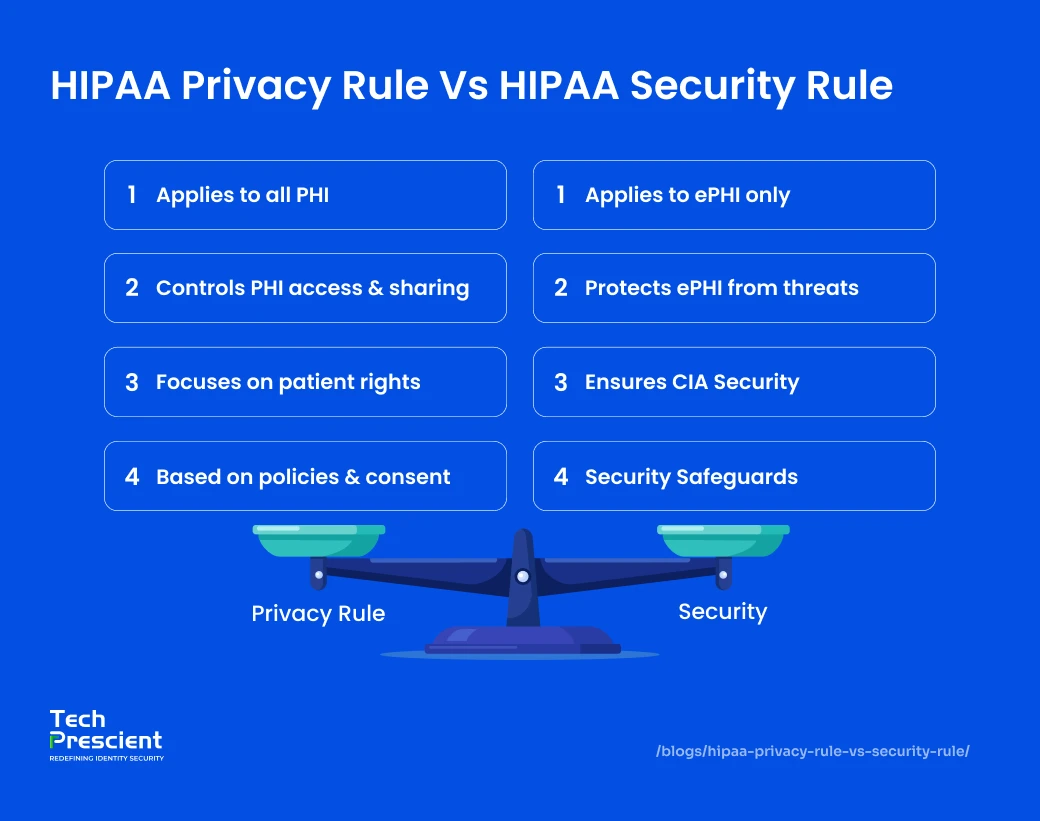
The HIPAA Privacy Rule and Security Rule are both designed to protect healthcare data, but they address different aspects of HIPAA compliance. The Privacy Rule focuses on how Protected Health Information (PHI) can be accessed, used, and disclosed, while the Security Rule focuses on protecting electronic Protected Health Information (ePHI) through administrative, physical, and technical safeguards.
Understanding these differences is important for healthcare organizations looking to strengthen PHI protection, maintain compliance, and reduce cybersecurity risks.
Difference in Scope
One of the biggest differences between the two rules is the scope of information they cover. The HIPAA Privacy Rule applies to all forms of PHI, including paper records, verbal communication, and electronic data. This means printed medical files, patient conversations, and digital health records are all covered under the Privacy Rule.
The HIPAA Security Rule has a narrower focus and applies only to electronic Protected Health Information (ePHI). Its purpose is to secure digital healthcare data stored, transmitted, or maintained electronically.
Difference in Focus
The Privacy Rule primarily focuses on patient rights and permissions. It establishes rules around the uses and disclosures of PHI and gives patients greater control over how their healthcare information is shared and accessed.
The Security Rule focuses on protecting ePHI from cyber threats, unauthorized access, and data breaches. To achieve this, organizations must implement safeguards such as encryption, authentication, audit logs, and access controls.
Difference in Purpose
The main goal of the Privacy Rule is to protect patient confidentiality and regulate how healthcare organizations handle sensitive information. It ensures PHI is only shared for authorized purposes such as treatment, payment, and healthcare operations.
The Security Rule is designed to protect the confidentiality, integrity, and availability of ePHI. It helps healthcare organizations reduce cyber risks and strengthen healthcare cybersecurity practices.
Difference in Data Protection Measures
The Privacy Rule emphasizes policies, consent requirements, and restrictions on sharing PHI. It outlines when patient authorization is required and enforces standards like the Minimum Necessary Rule.
The Security Rule requires organizations to implement administrative safeguards, physical safeguards, and technical safeguards to secure electronic healthcare systems and patient data.
The table below provides a clear comparison of the HIPAA Privacy Rule vs Security Rule differences across scope, purpose, focus, and data protection requirements.
| Sr. No | Aspect | HIPAA Privacy Rule | HIPAA Security Rule |
|---|---|---|---|
| 1 | Scope | Applies to all forms of Protected Health Information (PHI) | Applies only to electronic Protected Health Information (ePHI) |
| 2 | Focus | Focuses on patient rights, consent, and permitted uses and disclosures of PHI | Focuses on protecting ePHI through administrative, physical, and technical safeguards |
| 3 | Purpose | Controls how healthcare information is accessed, used, and shared | Prevents data breaches, cyber threats, and unauthorized access to ePHI |
| 4 | Data Types Covered | Covers paper records, oral communication, and electronic data | Covers only electronically stored or transmitted health information |
| 5 | Examples | Authorization to share patient records and restrictions on disclosures | Encryption, firewalls, authentication, audit logs, and access controls |
How the Privacy Rule and Security Rule Work Together
The HIPAA Privacy Rule and Security Rule are designed to work together to create a complete framework for protecting healthcare information. While the Privacy Rule establishes how Protected Health Information (PHI) can be accessed, used, and disclosed, the Security Rule provides the administrative, physical, and technical safeguards needed to protect electronic PHI (ePHI) from cyber threats, unauthorized access, and data breaches.
Together, these rules help healthcare organizations maintain patient confidentiality, strengthen healthcare cybersecurity, and support overall HIPAA compliance requirements.
1. Privacy Rules Define Access and Usage
The Privacy Rule sets the foundation for how healthcare organizations handle PHI. It establishes patient rights under HIPAA and defines who can access patient information, when it can be shared, and the permitted uses and disclosures of PHI.
For example, a healthcare organization may create privacy policies that restrict access to patient records based on job responsibilities or require authorization before sharing sensitive information with third parties.
2. Security Controls Enforce Protection
The Security Rule supports these privacy requirements by implementing safeguards that protect electronic healthcare data. Organizations must use administrative safeguards, physical safeguards, and technical safeguards to secure ePHI and prevent unauthorized access.
These safeguards may include access controls, encryption, multi-factor authentication, audit logs, employee training, and secure communication systems that help enforce the privacy policies established under the Privacy Rule.
Shared Compliance Responsibilities
Although each rule has a different focus, there are several overlapping HIPAA compliance requirements that organizations must follow under both rules.
- Workforce Training: Healthcare organizations must train employees on proper PHI handling practices, privacy policies, and ePHI security procedures. This helps reduce human error and strengthens both privacy and security compliance.
- Access Controls: Both rules emphasize restricting access to sensitive healthcare information. Organizations must ensure that only authorized users can access PHI and ePHI through role-based permissions and secure authentication methods.
- Risk Management and Incident Response: Covered entities and business associates are required to identify risks, respond to security incidents, and document potential breaches or improper disclosures of PHI. This supports stronger PHI protection and improves regulatory readiness.
- Business Associate Compliance: Healthcare organizations must ensure business associates handling PHI or ePHI comply with HIPAA requirements through Business Associate Agreements (BAAs). These agreements define responsibilities related to PHI protection, permitted disclosures, and ePHI security.
Example of How Both Rules Work Together
A hospital may use the Privacy Rule to define which employees are allowed to access patient records based on their job role. The Security Rule then enforces those policies using technical safeguards such as access controls, authentication systems, encryption, and audit monitoring to prevent unauthorized access.
By working together, the HIPAA Privacy Rule and Security Rule create a unified approach to healthcare data privacy, cybersecurity, and patient information protection.
Assess Your HIPAA Risks Before Compliance Gaps Become Audit Findings
Identify ePHI security gaps and measure HIPAA compliance readiness with a structured assessment framework.
Real-World Examples of Privacy vs Security Rule Violations
Understanding the difference between the HIPAA Privacy Rule and Security Rule becomes easier when viewed through real-world healthcare scenarios. While the Privacy Rule focuses on improper uses and disclosures of PHI, the Security Rule addresses failures to protect electronic Protected Health Information (ePHI) from cyber threats, unauthorized access, and security vulnerabilities.
The following examples show how privacy violations, security failures, or a combination of both can impact healthcare organizations and patient trust.
Example 1: Privacy Rule Violation
A hospital employee discusses a patient's medical condition with an unauthorized individual or shares patient records without proper consent. Even if no systems are hacked or breached, this is considered a HIPAA Privacy Rule violation because the organization failed to protect patient confidentiality and violated rules around the uses and disclosures of PHI.
This type of incident directly impacts patient rights under HIPAA and can lead to compliance penalties, reputational damage, and loss of patient trust.
Example 2: Security Rule Violation
A cyberattacker gains access to a hospital database because the organization failed to implement strong authentication controls or secure access management policies. In this case, the issue is not improper sharing of information by staff, but weak ePHI security measures that allowed unauthorized access to electronic healthcare data.
This is a HIPAA Security Rule violation because the organization failed to implement appropriate technical safeguards such as multi-factor authentication, encryption, audit logs, or access controls required to protect ePHI.
Example 3: Combined Privacy and Security Rule Violation
A healthcare organization lacks proper role-based access control (RBAC), allowing employees to access patient records unrelated to their job responsibilities. If sensitive ePHI is exposed to unauthorized staff members, the organization may violate both the Privacy Rule and Security Rule.
The Privacy Rule is violated because PHI was improperly accessed or disclosed, while the Security Rule is violated because the organization failed to implement adequate administrative and technical safeguards to restrict access.
Quick Reality Check
If your organization cannot quickly identify who has access to sensitive ePHI systems, HIPAA compliance gaps may already exist without visibility.
Why These Violations Matter
These examples highlight how the HIPAA Privacy Rule and Security Rule address different risks within healthcare environments. The Privacy Rule focuses on protecting patient rights and controlling access to PHI, while the Security Rule focuses on securing electronic healthcare data against breaches and cyber threats.
Together, both rules help healthcare organizations strengthen PHI protection, improve ePHI security, and maintain overall HIPAA compliance.
Why Healthcare Organizations Must Comply With Both Rules
Full HIPAA compliance requires healthcare organizations to implement both privacy policies and security safeguards to protect patient data from unauthorized disclosures, misuse, cyber threats, and data breaches. The HIPAA Privacy Rule and Security Rule work together to create a complete framework for PHI protection and ePHI security across healthcare environments.
Organizations that focus on only one rule may leave critical compliance and security gaps that increase operational, legal, and reputational risks.
1. Preventing Regulatory Penalties and Compliance Violations
Failure to comply with HIPAA regulations can result in significant financial penalties, legal consequences, and regulatory investigations. Violations involving improper uses and disclosures of PHI or weak ePHI security controls can trigger audits and enforcement actions from the U.S. Department of Health and Human Services (HHS).
By implementing strong privacy policies and security safeguards, healthcare organizations can improve HIPAA compliance readiness and reduce the risk of non-compliance.
2. Reducing the Risk of Data Breaches
Healthcare organizations are frequent targets for cyberattacks because medical records contain highly sensitive information. Weak authentication, poor access management, unencrypted systems, or excessive user permissions can expose electronic Protected Health Information (ePHI) to unauthorized access.
The Security Rule helps reduce these risks by requiring administrative, physical, and technical safeguards such as encryption, audit logs, access controls, and risk assessments.
3. Protecting Patient Trust and Confidentiality
Patients expect healthcare providers to protect their personal and medical information. Strong compliance with the Privacy Rule ensures patient rights under HIPAA are respected, while the Security Rule helps secure healthcare systems against breaches and cyber threats.
Maintaining confidentiality and protecting PHI strengthens patient trust, improves transparency, and supports long-term relationships between healthcare organizations and patients.
4. Supporting Compliance Audits and Risk Management
Healthcare organizations must regularly assess their privacy and security practices to remain compliant with HIPAA requirements. Conducting risk assessments, maintaining audit logs, documenting policies, and monitoring user activity help organizations prepare for compliance audits and identify vulnerabilities before they become major security incidents.
Continuous monitoring and governance also improve operational efficiency and incident response readiness.
The Role of Identity Governance and Access Control
Identity governance and access control play a critical role in enforcing HIPAA Security Rule compliance. Healthcare organizations must ensure that only authorized users can access PHI and ePHI based on their job responsibilities.
Technologies such as role-based access control (RBAC), multi-factor authentication (MFA), privileged access management (PAM), and automated access reviews help organizations strengthen PHI protection and reduce insider threats.
By combining privacy policies with strong cybersecurity controls, healthcare organizations can better protect patient information, maintain regulatory compliance, and improve overall healthcare data security.
Compliance Insight
Many HIPAA violations are caused by excessive or outdated user access, not external cyberattacks. Regular access reviews and least-privilege enforcement are critical for reducing ePHI exposure risks.
Best Practices for HIPAA Privacy and Security Compliance
Strong HIPAA compliance requires a combination of privacy policies, cybersecurity controls, and continuous monitoring to protect PHI and ePHI.
Enforce Role-Based Access Control (RBAC)
Role-Based Access Control (RBAC) helps organizations limit access to PHI and ePHI based on employee responsibilities. Instead of giving broad access to healthcare systems, organizations should ensure users can only access the information necessary for their specific role.
Implementing least-privilege access reduces insider threats, minimizes unauthorized disclosures of PHI, and strengthens HIPAA access control compliance. Strong identity and access management practices are considered a critical part of Security Rule safeguards.
Implement Identity Governance and Access Management
Identity governance helps healthcare organizations manage user identities, monitor permissions, and automate access reviews across healthcare systems. This ensures former employees, contractors, or third-party vendors do not retain unnecessary access to sensitive patient data.
Combining identity governance with multi-factor authentication (MFA), privileged access management (PAM), and automated provisioning improves ePHI security and supports stronger compliance controls. Recent HIPAA cybersecurity discussions have also emphasized the growing importance of stronger access governance and authentication requirements.
Encrypt ePHI Across Systems and Communications
Encryption is one of the most effective ways to protect electronic Protected Health Information during storage and transmission. Healthcare organizations should encrypt ePHI stored in databases, cloud environments, laptops, mobile devices, and email communications to reduce the risk of exposure during cyber incidents or device theft.
Although the HIPAA Security Rule is technology-neutral, encryption is widely recommended as a best practice for strengthening healthcare cybersecurity and reducing breach risks associated with unencrypted systems.
Conduct Regular Risk Assessments
Risk analysis is a core requirement under the HIPAA Security Rule. Organizations should regularly evaluate potential threats, vulnerabilities, and gaps in their administrative, physical, and technical safeguards.
Periodic risk assessments help healthcare organizations identify security weaknesses, prioritize remediation efforts, and improve compliance readiness. Effective risk management also strengthens incident response planning and breach prevention strategies.
Best Practice Reminder
HIPAA compliance is not a one-time audit activity. Continuous monitoring, access reviews, and risk assessments are essential for maintaining long-term ePHI security.
Monitor User Access Logs and System Activity
Continuous monitoring is essential for detecting suspicious activity, unauthorized access attempts, and potential insider threats. Healthcare organizations should maintain audit logs, review user activity regularly, and monitor system behavior to identify unusual access patterns involving PHI or ePHI.
Audit controls and monitoring systems not only improve healthcare cybersecurity but also provide critical evidence during compliance audits and security investigations.
Automate Compliance Audits and Reporting
Manual compliance processes can create operational inefficiencies and increase the risk of human error. Automating HIPAA compliance audits, access reviews, risk tracking, and policy documentation helps organizations improve accuracy and maintain continuous compliance visibility.
Automation also helps healthcare organizations streamline reporting, simplify audit preparation, and respond more effectively to evolving HIPAA compliance requirements and cybersecurity risks.
Identify ePHI Security Gaps and Measure HIPAA Compliance Readiness
Use a structured assessment framework to identify ePHI security gaps and measure HIPAA compliance readiness.
Final Thoughts
The HIPAA Privacy Rule and Security Rule help healthcare organizations protect patient information through privacy controls, access management, and security safeguards. While the Privacy Rule governs how PHI is accessed and shared, the Security Rule focuses on protecting electronic PHI (ePHI) from cyber threats, breaches, and unauthorized access.
Tech Prescient helps organizations strengthen healthcare cybersecurity, improve identity governance, and implement secure access controls aligned with HIPAA compliance requirements.
FAQs
The HIPAA Privacy Rule focuses on how Protected Health Information (PHI) can be accessed, used, and shared. The HIPAA Security Rule, on the other hand, focuses specifically on protecting electronic PHI (ePHI) through administrative, physical, and technical safeguards. Together, both rules help healthcare organizations maintain privacy, security, and HIPAA compliance.
Yes. The HIPAA Privacy Rule applies to PHI in all formats, including electronic records, paper documents, and oral communication. This means any patient information that can identify an individual is protected under the Privacy Rule, regardless of how it is stored or shared.
The HIPAA Security Rule establishes safeguards to protect electronic Protected Health Information (ePHI) from unauthorized access, cyber threats, and data breaches. It requires healthcare organizations to implement administrative, physical, and technical safeguards such as encryption, access controls, and audit monitoring to secure electronic healthcare data.
Yes. For example, if an employee shares patient information without proper authorization, it may violate the HIPAA Privacy Rule even if no electronic systems were compromised. In this case, the issue involves improper disclosure of PHI rather than a failure of ePHI security controls.
No. The HIPAA Security Rule applies only to electronic Protected Health Information (ePHI). Paper records and verbal communication are covered under the HIPAA Privacy Rule, not the Security Rule.
Share



Yatin Laygude
Content Writer
A content writer with 6 years of experience turning complex topics into clear, engaging, and meaningful content. From blogs and web pages to whitepapers and thought pieces, he creates content that not only explains but also connects with both the audience and business goals.
Most Popular Blogs

Identity Security· 21 min read
Data Access Governance Solutions: How to Secure Sensitive Data at Scale
Compare data access governance solutions for 2026: how DAG platforms discover sensitive data, run access reviews, automate remediation, and prove compliance.
Brinda Bhatt· September 7, 2026
Identity Security· 24 min read
What Is Zero Trust Network Access (ZTNA)?
Learn what Zero Trust Network Access (ZTNA) is, how it works, and why it’s replacing VPNs for secure, identity-based access control.
Yatin Laygude· August 14, 2026
Identity Security· 24 min read
Cyber Essentials Certification: Complete Guide
Learn Cyber Essentials certification, cost, requirements, and steps. Compare Cyber Essentials vs Plus and get certified faster.
Yatin Laygude· August 10, 2026