




On this page
See Tech Prescient in Action
Automate access, reduce risk, and stay audit-ready
HIPAA violations can happen through both intentional misuse and simple human error, making compliance a constant challenge for healthcare organizations. From unauthorized access to medical records to accidental disclosure of Protected Health Information (PHI), even small mistakes can lead to serious legal, financial, and reputational consequences. As healthcare systems increasingly rely on digital tools and cloud-based platforms, protecting patient data has become more critical than ever.
Healthcare providers, employees, and business associates must understand what qualifies as a HIPAA violation and how these incidents occur in real-world environments. Common issues such as employee snooping, social media disclosures, lost devices, weak cybersecurity controls, and improper record disposal continue to expose organizations to costly penalties and lawsuits. Strong access controls, employee awareness, and identity governance practices are essential to reducing these risks and maintaining patient trust.
According to the HIPAA Journal, hundreds of healthcare data breaches are reported every year, impacting millions of individuals and exposing sensitive patient information. A significant number of these breaches are linked to compromised accounts, unauthorized access, and preventable security gaps within healthcare systems. In this blog, we'll explore real HIPAA violation examples in healthcare and workplaces, and practical ways organizations can strengthen compliance and protect PHI.
Key Takeaways:
- Learn the most common HIPAA violation examples in healthcare and workplaces.
- Understand how unauthorized access, social media sharing, and PHI exposure lead to violations.
- Explore real HIPAA violation cases, lawsuits, penalties, and healthcare data breaches.
- Discover how employee errors and weak security controls increase compliance risks.
- Find practical ways to prevent HIPAA violations with stronger security and access controls.
What Is Considered a HIPAA Violation?
A HIPAA violation occurs when Protected Health Information (PHI) is accessed, shared, disclosed, or stored without proper authorization or security safeguards. HIPAA regulations are designed to protect patient privacy and ensure healthcare organizations handle sensitive medical data securely. Violations can result from intentional misuse, employee negligence, weak cybersecurity controls, or failure to comply with the HIPAA Privacy Rule and HIPAA Security Rule. Depending on the severity of the incident, organizations may face investigations, financial penalties, lawsuits, and reputational damage.
To better understand what qualifies as a HIPAA violation, it's important to look at the key components of HIPAA compliance and the most common causes of violations.
1. Protected Health Information (PHI)
PHI refers to any information that can identify a patient and is related to their health condition, treatment, or payment records. This includes medical reports, insurance details, prescriptions, lab results, and billing information. HIPAA requires organizations to protect PHI from unauthorized access or disclosure.
2. HIPAA Privacy Rule
The HIPAA Privacy Rule defines how patient information can be used and shared. It limits access to PHI and ensures only authorized individuals can view or disclose patient data for treatment, payment, or healthcare operations.
3. HIPAA Security Rule
The HIPAA Security Rule focuses on protecting electronic Protected Health Information (ePHI). Organizations must implement administrative, physical, and technical safeguards such as encryption, access controls, multi-factor authentication, and employee training to secure healthcare data.
4. Covered Entities and Business Associates
HIPAA applies to covered entities, including hospitals, healthcare providers, insurers, and healthcare clearinghouses. It also applies to business associates, such as third-party vendors or cloud service providers that handle PHI on behalf of healthcare organizations.
5. Common Causes of HIPAA Violations
Some of the most common HIPAA violation examples include:
- Unauthorized access to medical records
- Sharing PHI with the wrong recipient
- Posting patient details on social media
- Weak cybersecurity controls or poor password management
- Lost or stolen devices containing PHI
- Improper disposal of patient records
- Missing Business Associate Agreements (BAAs)
- Failure to encrypt sensitive healthcare data
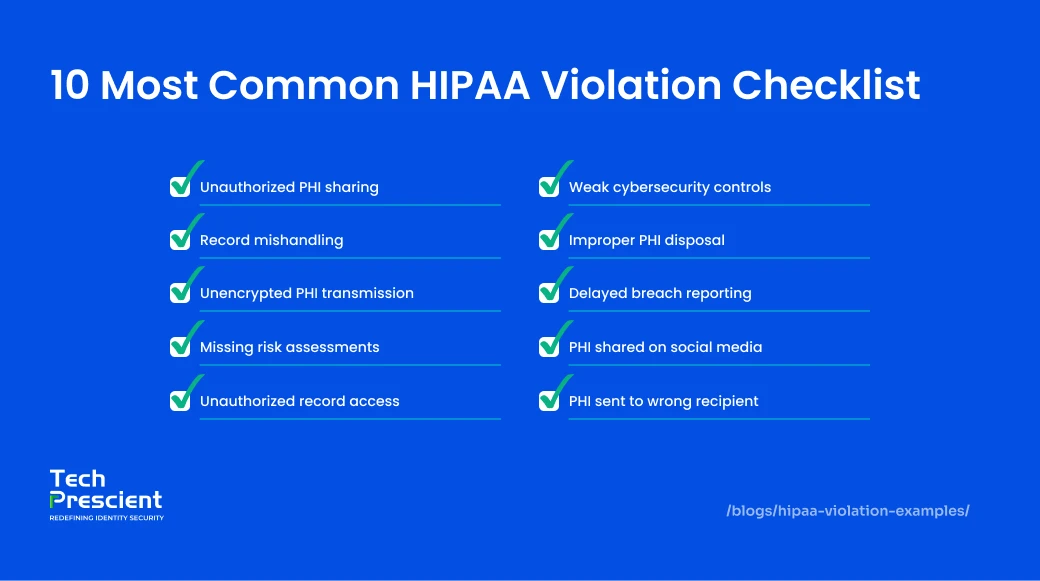
10 Most Common HIPAA Violation Examples
HIPAA violations are often caused by human error, lack of employee awareness, weak cybersecurity controls, or improper handling of Protected Health Information (PHI). While some violations are accidental, they can still expose healthcare organizations to penalties, lawsuits, and reputational damage. Below are some of the most common HIPAA violation examples seen across healthcare environments.
Employee Snooping (Unauthorized Access)
One of the most common employee HIPAA violation examples involves staff members accessing patient records without a valid medical or operational reason. This often happens when employees look up the records of celebrities, coworkers, family members, or acquaintances out of curiosity. Even if the information is not shared externally, unauthorized access alone violates HIPAA privacy rules.
Pro Tip:
Many healthcare organizations discover unauthorized PHI access only during audits or investigations. Regular access reviews and RBAC enforcement help detect risky permissions before they become compliance violations.
Posting Patient Information on Social Media
Social media HIPAA violation examples frequently involve healthcare workers posting patient photos, medical stories, or screenshots online without properly removing identifiable information. Even accidental exposure of names, faces, prescriptions, or medical charts on platforms like Instagram, Facebook, or TikTok can lead to serious compliance issues.
Discussing Patients in Public Areas
Conversations about patients in elevators, cafeterias, hallways, waiting rooms, or public spaces can unintentionally expose PHI to unauthorized individuals. These workplace gossip HIPAA violation examples are common in busy healthcare environments where employees may overlook privacy safeguards during casual discussions.
Lost or Stolen Devices With PHI
Healthcare organizations often store patient data on laptops, tablets, smartphones, or USB drives. If these devices are lost, stolen, or left unattended without encryption, patient information may become exposed. Many major HIPAA violation examples in healthcare are linked to unsecured devices containing electronic PHI (ePHI).
Sending PHI to the Wrong Recipient
Misdirected emails, faxes, text messages, or mailed documents can easily result in unauthorized disclosure of patient information. For example, sending lab reports or billing records to the wrong patient or provider is considered a HIPAA violation, even if the mistake was accidental.
Improper Disposal of Patient Records
Patient files, prescription labels, billing statements, and medical forms must be securely destroyed before disposal. Throwing sensitive documents into regular trash bins without shredding or secure disposal methods can expose PHI and create significant compliance risks.
Lack of Encryption for Patient Data
Failing to encrypt sensitive healthcare information increases the risk of unauthorized access during cyberattacks, device theft, or data transfers. Storing PHI on unprotected servers, personal devices, or removable storage media without encryption is a common security-related HIPAA violation.
Unauthorized Disclosure to Employers
Employer HIPAA violation examples occur when healthcare providers share an employee's medical condition, diagnosis, or treatment details with their workplace without proper consent. Unless legally permitted, disclosing patient health information to employers violates HIPAA privacy requirements.
Failing to Provide Patient Access to Records
Under HIPAA, patients have the right to access their medical records within a required timeframe. Delaying requests, refusing access without justification, or creating unnecessary barriers for patients can result in compliance violations and regulatory action.
Missing Business Associate Agreements (BAAs)
Healthcare organizations often work with third-party vendors that process or store PHI, such as cloud providers, billing companies, or IT service vendors. Sharing patient data without a signed Business Associate Agreement (BAA) is a major HIPAA compliance failure because the vendor may not be contractually obligated to protect PHI.
HIPAA Violation Examples in the Workplace
Many HIPAA violation examples in the workplace are caused by employee negligence, lack of privacy awareness, or poor access management practices. In fast-paced healthcare environments, even small mistakes such as discussing patient details openly or leaving records unattended can expose Protected Health Information (PHI) to unauthorized individuals. These incidents not only violate HIPAA regulations but can also lead to disciplinary action, lawsuits, financial penalties, and loss of patient trust.
1. Coworkers Accessing Medical Files Without Authorization
One of the most common workplace HIPAA violations occurs when employees access patient records without a legitimate job-related reason. Staff members may look up the records of coworkers, family members, or high-profile patients out of curiosity, even though they are not involved in the patient's treatment or care. Unauthorized access to electronic health records (EHRs) is considered a direct violation of the HIPAA Privacy Rule.
2. Office Gossip About Patients
Casual conversations about patient conditions in break rooms, hallways, elevators, or waiting areas can unintentionally expose PHI. Workplace gossip HIPAA violation examples often involve employees discussing diagnoses, treatments, or patient situations where unauthorized individuals may overhear sensitive information. Even if the disclosure is accidental, it may still violate HIPAA privacy requirements.
3. Sharing Login Credentials
Sharing usernames, passwords, or system access credentials between employees is another serious HIPAA compliance issue. For example, an employee may allow a coworker to use their login to access systems quickly or bypass IT delays. This weakens accountability, increases unauthorized access risks, and makes it difficult to track who viewed or modified PHI within healthcare systems.
Identify hidden PHI access risks before they become compliance violations.
4. Leaving Patient Files or Devices Unattended
Patient records left on printers, unlocked computer screens, unattended workstations, or exposed paperwork can easily result in unauthorized disclosure of PHI. Similarly, leaving laptops or mobile devices unsecured in shared workspaces creates significant data privacy risks. Healthcare organizations are expected to implement safeguards such as automatic screen locks, secure printing policies, and restricted workstation access to reduce these violations.
5. Poor Employee Training and Weak Security Awareness
Many workplace HIPAA violations stem from inadequate employee training and lack of awareness about privacy policies. Employees who are unfamiliar with HIPAA requirements may unintentionally mishandle patient data, fall for phishing attacks, or fail to follow secure communication practices. Regular HIPAA training, access reviews, and identity governance controls help organizations reduce these risks and strengthen compliance efforts.
Quick Reality Check:
Shared credentials may seem operationally convenient, but they eliminate accountability and make PHI access tracking significantly more difficult during HIPAA audits or breach investigations.
HIPAA Violation Examples in Healthcare Settings
Healthcare organizations handle large volumes of Protected Health Information (PHI), making hospitals, clinics, pharmacies, and EMS providers highly vulnerable to HIPAA violations. Many incidents occur because of poor communication practices, weak security controls, or accidental exposure of patient data.
1. Nurses Sharing Patient Updates Without Authorization
Nurses frequently communicate with colleagues during patient care, but sharing unnecessary patient details with unauthorized staff, friends, or family members can violate HIPAA rules. Even casual conversations about patient conditions outside clinical responsibilities may expose PHI and compromise patient confidentiality.
2. Doctors Texting Patient Details Through Unsecured Channels
Many healthcare professionals rely on text messaging for faster communication, but sending patient names, diagnoses, lab reports, or treatment details through unsecured messaging apps can create serious compliance issues. HIPAA requires organizations to use secure, encrypted communication platforms when transmitting electronic Protected Health Information (ePHI).
3. Pharmacy Record Exposure
Pharmacy HIPAA violation examples often involve prescription labels, medication records, or billing information being visible to unauthorized individuals. This can happen when printed prescriptions are left unattended, customer records are displayed openly, or pharmacy staff discuss medications where others can overhear sensitive information.
4. EMS Accidentally Revealing Patient Identities
EMS HIPAA violation examples commonly occur during emergency response situations where patient details may be discussed over public radio channels, shared in crowded environments, or unintentionally disclosed during transport. Even in emergency care settings, healthcare workers must take reasonable precautions to protect patient privacy whenever possible.
5. Unsecured Devices and Electronic Health Records
Healthcare workers often access Electronic Health Records (EHRs) through laptops, tablets, or mobile devices during treatment and patient rounds. If these devices are lost, stolen, or left unlocked, unauthorized individuals may gain access to sensitive healthcare information. Weak password practices and lack of encryption significantly increase the risk of healthcare data breaches.
6. Weak Access Controls in Healthcare Systems
Poor identity and access management practices are another major contributor to HIPAA violations in healthcare organizations. Employees with excessive access privileges, inactive user accounts, or shared login credentials can expose PHI to unauthorized access. Implementing role-based access control (RBAC), multi-factor authentication (MFA), and regular access reviews helps healthcare providers strengthen HIPAA compliance and reduce insider threats.
Real HIPAA Violation Lawsuit Examples
Several healthcare organizations have faced millions in fines and settlements due to serious HIPAA violations, weak cybersecurity controls, and large-scale healthcare data breaches. These real-life HIPAA violation cases highlight the financial, legal, and reputational impact of failing to properly protect Protected Health Information (PHI).
Anthem Data Breach
The Anthem data breach is one of the most significant HIPAA violation lawsuit examples in healthcare history. Cybercriminals gained unauthorized access to Anthem's systems, exposing the personal and medical information of nearly 79 million individuals. The compromised data included names, Social Security numbers, addresses, medical identification numbers, and employment details.
Following an investigation by the U.S. Department of Health and Human Services (HHS), Anthem agreed to pay a record $16 million settlement for failing to implement adequate security safeguards to protect electronic Protected Health Information (ePHI). The case highlighted the importance of strong cybersecurity practices, access controls, risk assessments, and continuous monitoring in preventing healthcare data breaches.
Children's Medical Center Dallas
Children's Medical Center Dallas faced significant HIPAA penalties after the loss of an unencrypted mobile device containing electronic Protected Health Information (ePHI). Investigators found that the organization failed to properly encrypt devices and implement adequate security measures despite known risks associated with portable devices storing patient data.
As part of the enforcement action, the organization agreed to pay a $3.2 million penalty. The case became a major example of how lost or stolen unencrypted devices can lead to serious HIPAA violations, regulatory investigations, and financial consequences for healthcare providers.
Pharmacy Disposal Case
In another notable HIPAA violation case example, a pharmacy organization faced penalties after improperly disposing of patient records containing sensitive health information. Documents with prescription details and personal patient data were reportedly discarded without secure shredding or disposal procedures, exposing PHI to unauthorized access.
The incident resulted in a $125,000 settlement and highlighted the importance of secure document destruction policies in healthcare environments. This case demonstrated that even paper records must be properly protected and disposed of under HIPAA privacy requirements.
HIPAA Violation Penalties and Fines
HIPAA violations can lead to significant financial penalties, regulatory action, and even criminal charges depending on the severity of the incident and whether the violation was intentional. The Office for Civil Rights (OCR) determines penalties based on factors such as negligence, corrective action taken, and the level of harm caused to patients.
| Tier | Violation Type | Description | Fine Range |
|---|---|---|---|
| Tier 1 | Unknowing Violation | The organization was unaware of the violation and could not reasonably have avoided it. | $100 – $50,000 per violation |
| Tier 2 | Reasonable Cause | The violation occurred due to reasonable cause but not willful neglect. | $1,000 – $50,000 per violation |
| Tier 3 | Willful Neglect (Corrected) | The organization willfully neglected HIPAA rules but corrected the issue within the required timeframe. | $10,000 – $50,000 per violation |
| Tier 4 | Willful Neglect (Not Corrected) | The organization knowingly failed to comply and did not correct the violation. | Up to $1.5 million annually |
In addition to civil penalties, certain HIPAA violations can result in criminal penalties when Protected Health Information (PHI) is intentionally accessed, disclosed, or misused. Individuals found guilty of knowingly obtaining or sharing PHI without authorization may face substantial fines and imprisonment.
- Knowingly disclosing PHI can result in fines up to $50,000 and up to 1 year in prison.
- Violations committed under false pretenses may lead to fines up to $100,000 and up to 5 years in prison.
- Misusing PHI for personal gain, fraud, or malicious intent can result in fines up to $250,000 and imprisonment of up to 10 years.
How Organizations Can Prevent HIPAA Violations
Strong governance policies, identity security controls, and employee awareness are essential for reducing HIPAA risks and protecting Protected Health Information (PHI). Organizations can significantly lower the chances of data breaches and compliance failures by implementing proactive security and access management practices.
Access Control Policies
Healthcare organizations should ensure employees only have access to the PHI required for their specific job responsibilities. Restricting Electronic Health Record (EHR) access based on user roles helps minimize unauthorized access and limits insider threats. Strong password policies, multi-factor authentication (MFA), and regular credential updates further improve account security.
Identity Governance Tools
Identity governance and administration (IGA) solutions help organizations manage and monitor user access to sensitive healthcare systems. These tools improve visibility into who can access PHI, automate provisioning and deprovisioning, and reduce the risk of excessive permissions or inactive accounts remaining active.
IGA solutions help organizations:
- Monitor access to PHI across systems
- Conduct periodic access reviews and audits
- Enforce least privilege access policies
- Detect unauthorized or risky account activity
- Improve compliance reporting and governance
Assess PHI access gaps and strengthen HIPAA-ready access governance controls.
Role-Based Access Control (RBAC)
Role-Based Access Control (RBAC) limits system access based on an employee's job role and responsibilities. For example, billing teams should not have access to clinical records unless required for their work. Implementing RBAC reduces unnecessary exposure to patient information and helps healthcare organizations maintain HIPAA compliance.
Encryption of PHI
Encryption is essential for protecting electronic Protected Health Information (ePHI) both at rest and in transit. Healthcare organizations should encrypt laptops, mobile devices, cloud storage, email communications, and file-sharing platforms to reduce the risk of data exposure from cyberattacks, lost devices, or unauthorized access.
Employee Security Training
Employee awareness plays a major role in preventing HIPAA violations. Regular HIPAA and cybersecurity training helps staff understand how to safely handle PHI, identify phishing attempts, follow secure communication practices, and report suspicious activity quickly. Ongoing education also helps reduce accidental disclosures and workplace-related compliance violations.
Continuous Monitoring and Security Assessments
Organizations should regularly perform HIPAA risk assessments, monitor audit logs, and review vendor security practices to identify vulnerabilities before they become compliance issues. Working with vendors that follow recognized healthcare security frameworks and maintaining signed Business Associate Agreements (BAAs) also helps strengthen overall HIPAA compliance.
Security Insight:
Most HIPAA access risks are not caused by external attackers alone. Excessive permissions, inactive accounts, and weak identity governance often create the largest PHI exposure gaps inside healthcare environments.
Final Thoughts
HIPAA violations can occur through employee mistakes, weak cybersecurity controls, improper access management, or poor handling of Protected Health Information (PHI). From unauthorized access and social media disclosures to healthcare data breaches and compliance failures, even minor oversights can lead to significant financial and reputational consequences.
Tech Prescient helps healthcare organizations strengthen identity governance, secure PHI access, and improve healthcare cybersecurity through modern access controls, compliance monitoring, and least-privilege security practices aligned with HIPAA requirements.
Identify hidden PHI access risks before they become compliance violations.
FAQs
Some of the most common HIPAA violations include unauthorized access to patient records, social media disclosures, lost or stolen devices containing Protected Health Information (PHI), and improper disposal of medical records. Violations also frequently occur due to weak passwords, unsecured communication methods, and employee negligence. Even accidental exposure of PHI can lead to HIPAA compliance issues and penalties.
One of the most well-known HIPAA violation case examples involved Anthem, where cybercriminals gained unauthorized access to the personal and medical information of nearly 79 million individuals. The breach exposed sensitive data such as Social Security numbers and medical IDs. Anthem later agreed to a $16 million settlement following a regulatory investigation.
Yes, employees can be terminated for violating HIPAA rules, especially if they intentionally access, disclose, or misuse patient information without authorization. Healthcare organizations often enforce strict disciplinary policies to protect patient privacy and maintain compliance. In severe cases, HIPAA violations may also lead to legal action or criminal penalties.
The five main HIPAA rules are the Privacy Rule, Security Rule, Breach Notification Rule, Enforcement Rule, and Omnibus Rule. Together, these regulations define how Protected Health Information (PHI) should be accessed, stored, shared, and secured. They also establish breach reporting requirements and penalties for noncompliance.
Yes, discussing patient information in areas where unauthorized individuals can overhear the conversation may violate HIPAA privacy requirements. Common workplace HIPAA violations include conversations in elevators, hallways, waiting rooms, or cafeterias. Healthcare employees should only discuss PHI in secure and appropriate settings.
Share



Yatin Laygude
Content Writer
A content writer with 6 years of experience turning complex topics into clear, engaging, and meaningful content. From blogs and web pages to whitepapers and thought pieces, he creates content that not only explains but also connects with both the audience and business goals.
Most Popular Blogs
Identity Security· 21 min read
Data Access Governance Solutions: How to Secure Sensitive Data at Scale
Compare data access governance solutions for 2026: how DAG platforms discover sensitive data, run access reviews, automate remediation, and prove compliance.
Brinda Bhatt· September 7, 2026
Identity Security· 24 min read
What Is Zero Trust Network Access (ZTNA)?
Learn what Zero Trust Network Access (ZTNA) is, how it works, and why it’s replacing VPNs for secure, identity-based access control.
Yatin Laygude· August 14, 2026
Identity Security· 24 min read
Cyber Essentials Certification: Complete Guide
Learn Cyber Essentials certification, cost, requirements, and steps. Compare Cyber Essentials vs Plus and get certified faster.
Yatin Laygude· August 10, 2026