




On this page
See Tech Prescient in Action
Automate access, reduce risk, and stay audit-ready
FedRAMP compliance is a mandatory security framework for cloud service providers working with U.S. federal agencies. Built around NIST 800-53 controls, it standardizes how cloud systems are assessed, authorized, and continuously monitored to meet federal cybersecurity requirements.
As federal cloud adoption continues to grow, FedRAMP has become essential for SaaS, PaaS, and IaaS providers entering the government market. However, the FedRAMP compliance process can be lengthy and resource-intensive, often requiring extensive documentation, third-party assessments, and ongoing monitoring. Automation and identity governance tools are now helping organizations streamline compliance, reduce costs, and improve audit readiness.
According to the official FedRAMP Marketplace, there are more than 500 FedRAMP-authorized cloud services currently approved for federal use, reflecting the increasing demand for secure cloud platforms across government agencies. In this guide, we'll explore the FedRAMP compliance process, security requirements, authorization steps, checklist, timelines, and best practices to help cloud providers prepare for successful authorization.
Key Takeaways:
- Understand what FedRAMP compliance is and why it is required for cloud providers working with federal agencies.
- Learn the complete FedRAMP compliance process, including assessments, documentation, authorization, and monitoring.
- Explore FedRAMP impact levels, NIST 800-53 security controls, and federal cloud security requirements.
- Review a practical FedRAMP compliance checklist covering SSPs, 3PAO audits, and continuous monitoring.
- Discover how automation and identity governance help streamline FedRAMP compliance management and reporting.
What Is FedRAMP Compliance?
FedRAMP compliance is a U.S. government cloud security framework that standardizes how cloud services are assessed, authorized, and continuously monitored before federal agencies can use them. Built on NIST SP 800-53 controls, the framework provides a consistent approach to cloud security, risk management, and compliance for SaaS, PaaS, and IaaS providers handling federal data.
In simple terms, FedRAMP helps ensure that cloud platforms meet strict federal cloud security requirements before they are approved for government use. To better understand what FedRAMP compliance is, it's important to explore why the program was introduced, how it relates to FISMA, and how it standardizes cloud security across agencies.
1. Why the U.S. Government Created FedRAMP
Before FedRAMP, federal agencies often conducted separate security assessments for each cloud provider, leading to duplicated audits, inconsistent security standards, and slower cloud adoption. FedRAMP was introduced to create a unified cloud security framework that streamlines the authorization process while improving consistency and transparency across federal agencies.
2. Relationship Between FedRAMP and FISMA
FedRAMP is closely connected to the Federal Information Security Modernization Act (FISMA). While FISMA establishes the broader cybersecurity requirements for federal information systems, FedRAMP applies those standards specifically to cloud environments using NIST 800-53 security controls along with additional cloud-focused assessment and monitoring requirements.
3. Standardization Across Federal Agencies
One of the biggest advantages of the FedRAMP cloud security framework is authorization reuse. Once a cloud provider achieves FedRAMP authorization, multiple federal agencies can leverage the same security assessment package instead of conducting separate reviews. This standardized approach helps agencies adopt secure cloud services faster while reducing compliance duplication for vendors.
Who Needs FedRAMP Compliance?
FedRAMP compliance applies to cloud service providers (CSPs) that store, process, or manage U.S. federal government data in cloud environments. Any organization offering cloud-based services to federal agencies must meet FedRAMP security requirements before its solutions can be adopted for government use. This includes SaaS, PaaS, and IaaS providers, along with contractors and technology vendors supporting federal operations.
The following organizations typically require FedRAMP compliance.
1. Cloud Providers Serving Federal Agencies
Cloud providers delivering infrastructure, platforms, or software solutions to federal agencies must obtain FedRAMP authorization. Federal agencies are required to use authorized cloud services when handling government data, making compliance essential for vendors entering the federal market.
2. SaaS Vendors Managing Government Data
SaaS companies that manage federal workloads, employee information, operational records, or sensitive agency data often fall within the scope of the FedRAMP compliance process. Collaboration platforms, cybersecurity tools, CRM systems, and workflow applications commonly require authorization when used by government agencies.
3. Government Contractors and Technology Partners
Technology contractors, managed service providers, and third-party vendors working with federal agencies may also need FedRAMP compliance if their cloud systems interact with government environments. Many agencies and prime contractors now expect vendors across the supply chain to follow standardized federal cloud security requirements.
FedRAMP Security Impact Levels Explained
FedRAMP classifies cloud systems into different security impact levels based on the sensitivity of the data they handle and the potential damage a security incident could cause. These impact levels are defined using FIPS 199 standards and help determine the number and rigor of security controls a cloud service provider must implement. The three primary FedRAMP impact levels are Low, Moderate, and High.
The impact level assigned to a system directly affects the FedRAMP authorization process, compliance scope, and continuous monitoring requirements.
1. Low Impact Systems
FedRAMP Low applies to cloud systems handling public or low-sensitivity information where a security breach would have limited impact on agency operations, assets, or individuals. These environments generally support low-risk workloads and require fewer security controls compared to Moderate and High baselines.
Low-impact systems are commonly used for public-facing websites, collaboration tools with non-sensitive data, and basic informational services. Since the potential consequences of compromise are minimal, the authorization process is usually less complex and faster to complete.
2. Moderate Impact Systems
FedRAMP Moderate is the most widely used authorization level and applies to systems processing sensitive but unclassified federal information. A compromise at this level could result in serious adverse effects on agency operations, financial assets, or individuals.
Most federal cloud workloads fall under the Moderate baseline, including business applications, internal operational systems, and platforms handling Controlled Unclassified Information (CUI). Because of the broader risk exposure, Moderate systems require significantly more NIST 800-53 security controls and ongoing compliance monitoring.
3. High Impact Systems
FedRAMP High is designed for highly sensitive federal systems where a security incident could cause severe or catastrophic damage to government operations, public trust, or national interests. These environments require the highest level of security controls, monitoring, and risk management.
High-impact systems are commonly associated with law enforcement, emergency services, healthcare, financial systems, and mission-critical government operations. Due to the sensitivity of the data involved, organizations pursuing FedRAMP High authorization must implement extensive security safeguards and rigorous continuous monitoring processes.
The FedRAMP Compliance Process (Step-by-Step)
The FedRAMP compliance process is a structured framework that cloud service providers must follow to achieve authorization for federal use. The process includes readiness assessment, security documentation, independent testing, authorization review, and ongoing continuous monitoring. Each phase is designed to verify that cloud environments meet federal cloud security requirements and maintain long-term compliance.
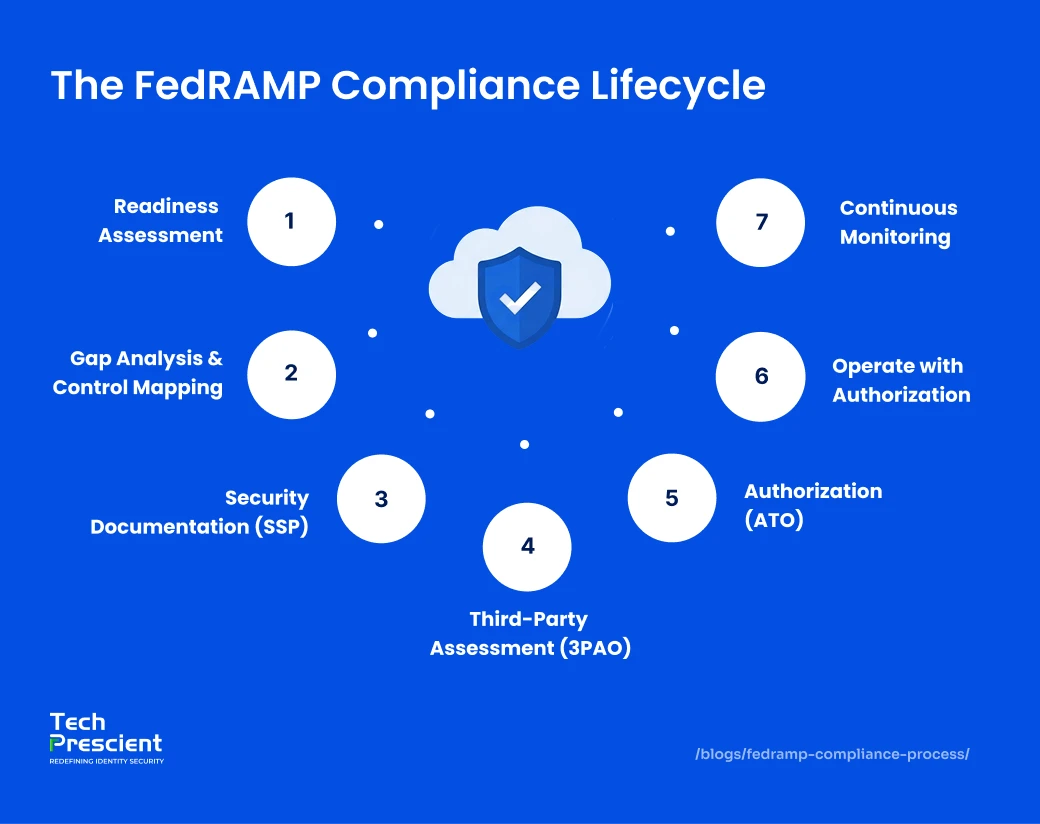
Below is a step-by-step breakdown of the FedRAMP authorization process.
Preparation & Gap Analysis
The first stage of the FedRAMP process focuses on evaluating the organization's current security posture and identifying gaps against FedRAMP requirements. During this phase, organizations determine the appropriate impact level, assess existing controls, and map security practices to NIST 800-53 controls.
A FedRAMP readiness assessment typically includes infrastructure reviews, policy evaluations, risk assessments, and compliance gap analysis. The goal is to build a clear remediation and compliance roadmap before moving into formal documentation and testing.
Security Documentation (SSP)
Once the initial assessment is complete, organizations must prepare detailed FedRAMP documentation that describes how security controls are implemented and managed. The most important document is the System Security Plan (SSP), which outlines the system environment, security architecture, operational controls, and risk management practices.
Additional documentation may include security policies, incident response procedures, access control policies, contingency plans, and system architecture diagrams. Accurate and comprehensive documentation is critical because it serves as the foundation for the formal security assessment process.

Pro Tip
Most FedRAMP delays happen because SSP documentation is incomplete or inconsistent. Standardizing evidence collection early can significantly reduce remediation cycles later.
Third-Party Assessment (3PAO)
After documentation is prepared, an accredited Third-Party Assessment Organization (3PAO) conducts an independent security evaluation. This assessment validates whether the implemented controls meet FedRAMP security requirements and identifies any vulnerabilities or compliance gaps.
The assessment process generally includes technical testing, vulnerability scanning, penetration testing, configuration reviews, and control validation. The findings are documented in a Security Assessment Report (SAR), which becomes part of the FedRAMP authorization package submitted for review.
Authorization (ATO)
In the authorization phase, the completed assessment package is reviewed by a federal agency sponsor or the Joint Authorization Board (JAB). The review evaluates the organization's security posture, identified risks, remediation plans, and overall compliance readiness.
If the cloud environment meets the required standards, the provider receives an Authorization to Operate (ATO) or a JAB Provisional Authorization (P-ATO). This authorization allows federal agencies to use the cloud service while relying on the standardized FedRAMP assessment process.
Continuous Monitoring
FedRAMP compliance does not end after authorization. Cloud providers are required to maintain continuous monitoring to ensure security controls remain effective over time. This ongoing process helps agencies identify risks, track vulnerabilities, and maintain compliance with evolving federal security requirements.
Continuous monitoring activities typically include monthly vulnerability scans, annual security assessments, POA&M updates, incident reporting, and regular control reviews. Maintaining strong FedRAMP continuous monitoring practices is essential for preserving authorization and supporting long-term compliance management.
Assess your FedRAMP readiness and uncover compliance gaps before audits.
Measure control maturity across documentation, monitoring, and security processes.
FedRAMP Compliance Checklist
Preparing for FedRAMP authorization requires organizations to complete several technical, operational, and documentation-related tasks before undergoing formal assessment. A structured FedRAMP compliance checklist helps cloud service providers identify gaps early, align with federal security requirements, and streamline the overall authorization process.
Below are some of the key steps organizations should complete before pursuing FedRAMP authorization.
1. Conduct FIPS 199 Categorization
The first step is determining the appropriate system impact level based on the sensitivity of the data being processed. Using FIPS 199 categorization, organizations classify systems as Low, Moderate, or High impact, which defines the baseline security controls required for compliance.
2. Implement NIST 800-53 Security Controls
Organizations must implement the required NIST 800-53 controls across their cloud environment. These controls cover areas such as identity and access management, encryption, vulnerability management, logging, and continuous monitoring to meet federal cloud security requirements.
3. Create a System Security Plan (SSP)
The System Security Plan (SSP) is one of the most important FedRAMP documents. It provides a detailed overview of the cloud environment, security architecture, implemented controls, policies, and operational procedures used to protect federal data.
4. Engage an Accredited 3PAO Assessor
Before authorization, organizations must work with an accredited Third-Party Assessment Organization (3PAO) to perform an independent security assessment. The 3PAO validates security controls, conducts technical testing, and identifies compliance gaps that need remediation.
5. Submit the Authorization Package
Once testing and documentation are completed, the organization submits its authorization package for review. This package typically includes the SSP, Security Assessment Report (SAR), POA&M documentation, and supporting evidence required for FedRAMP authorization.
6. Establish Continuous Monitoring Processes
FedRAMP compliance is an ongoing process, not a one-time certification. Organizations must establish continuous monitoring practices such as monthly vulnerability scans, annual assessments, incident reporting, and regular POA&M updates to maintain authorization status and support long-term compliance management.
How Long Does FedRAMP Compliance Take?
The FedRAMP compliance process typically takes between 6 and 18 months, although timelines can vary depending on the organization's security maturity, infrastructure complexity, and authorization readiness. For companies starting from scratch, the process may take even longer due to the extensive documentation, technical remediation, and assessment requirements involved in achieving authorization.
Several factors can directly influence how quickly an organization moves through the FedRAMP authorization process.
1. Infrastructure Complexity
Organizations with large, distributed, or highly customized cloud environments generally require more time for security implementation, documentation, and testing. Complex architectures often involve additional integrations, access controls, and risk management processes that increase assessment scope and remediation efforts.
2. Security Maturity
Companies with mature cybersecurity programs and existing compliance frameworks such as SOC 2, ISO 27001, or NIST-aligned controls are usually able to accelerate the FedRAMP process. Organizations that already follow structured security and governance practices often require fewer remediation activities during readiness assessments.
3. Documentation Readiness
FedRAMP requires extensive documentation, including the System Security Plan (SSP), security policies, architecture diagrams, incident response procedures, and POA&M records. Delays in preparing accurate and complete documentation are one of the most common reasons authorization timelines extend beyond initial estimates.
4. 3PAO Assessment Scheduling
The availability of accredited Third-Party Assessment Organizations (3PAOs) can also impact timelines. Since the FedRAMP assessment process involves in-depth testing, vulnerability reviews, and remediation cycles, scheduling delays or unresolved findings during the audit phase can significantly slow down authorization progress.
Modern compliance automation and continuous monitoring tools are helping many organizations reduce manual effort, streamline evidence collection, and improve readiness throughout the FedRAMP compliance journey.
FedRAMP is rarely just a security project. It often requires coordination across compliance, engineering, DevOps, IAM, and leadership teams to maintain long-term authorization readiness.
Common Challenges in the FedRAMP Process
Achieving FedRAMP compliance can be a complex and resource-intensive process for many cloud service providers. From extensive documentation requirements to ongoing monitoring obligations, organizations often face operational, technical, and financial challenges throughout the authorization journey. The complexity increases further for providers pursuing Moderate or High impact authorizations due to the larger number of security controls and stricter assessment requirements.
Below are some of the most common challenges organizations encounter during the FedRAMP compliance process.
1. Complex Documentation Requirements
FedRAMP requires detailed and highly structured documentation covering security controls, policies, procedures, system architecture, incident response, risk management, and operational processes. Preparing and maintaining documents such as the System Security Plan (SSP), POA&M, and security assessment reports can be time-consuming, especially for organizations without mature compliance programs.
2. Managing Hundreds of Security Controls
Organizations must implement and maintain a large set of NIST 800-53 security controls based on their assigned impact level. These controls span multiple areas including identity and access management, encryption, logging, vulnerability management, configuration management, and incident response. Coordinating these controls across complex cloud environments can significantly increase compliance workload.
3. Resource-Intensive Assessments
The FedRAMP assessment process requires extensive technical validation, vulnerability testing, penetration testing, and independent audits conducted by accredited 3PAOs. Many organizations struggle with the internal resources, technical expertise, and remediation efforts needed to prepare for and successfully complete these assessments.
4. Ongoing Continuous Monitoring Obligations
FedRAMP compliance is not a one-time effort. After authorization, cloud providers must continuously monitor their environments through monthly vulnerability scans, annual assessments, incident reporting, and POA&M updates. Maintaining long-term compliance readiness while managing evolving security threats can create significant operational overhead for security and compliance teams.
To address these challenges, many organizations are adopting compliance automation and identity governance solutions to simplify evidence collection, improve visibility, and reduce the manual effort involved in FedRAMP compliance management.
Identify gaps across NIST controls, SSP readiness, and continuous monitoring.
Build measurable, audit-ready visibility into your FedRAMP compliance posture.
How Identity Governance Helps with FedRAMP Compliance
Managing identities, access permissions, and audit visibility is a critical part of the FedRAMP compliance process. Since many FedRAMP security controls focus on access management, authentication, accountability, and continuous monitoring, organizations need strong governance processes to maintain compliance at scale. Identity Governance and Administration (IGA) platforms help automate these processes, reduce manual effort, and improve overall security posture across cloud environments.
By centralizing identity governance and access control, organizations can simplify compliance management while strengthening their ability to meet federal cloud security requirements.
1. Automating Access Reviews
FedRAMP requires organizations to regularly review and validate user access to sensitive systems and data. IGA platforms automate periodic access certifications, helping security teams identify unnecessary privileges, inactive accounts, and policy violations more efficiently. Automated reviews also improve audit readiness by maintaining detailed records of approval workflows and access decisions.
2. Enforcing Least Privilege Access
Least privilege is a core principle within many NIST 800-53 controls. Identity governance solutions help enforce role-based access policies so users only receive the permissions necessary for their responsibilities. This reduces the risk of excessive access, insider threats, and unauthorized exposure of federal data.
3. Supporting Identity Lifecycle Management
Managing user identities across onboarding, role changes, and offboarding is essential for maintaining FedRAMP compliance. IGA platforms automate identity lifecycle management by provisioning and deprovisioning access based on user roles and organizational policies. This helps organizations reduce orphaned accounts, improve operational efficiency, and maintain stronger access control governance.
4. Improving Audit Reporting and Compliance Visibility
FedRAMP assessments require organizations to provide evidence of access governance, policy enforcement, and security monitoring activities. Identity governance platforms simplify audit preparation by generating centralized reports, access histories, compliance dashboards, and policy tracking records. Improved visibility helps security and compliance teams respond faster to audits and ongoing continuous monitoring requirements.
As organizations scale their cloud environments, identity governance becomes increasingly important for maintaining consistent access control, reducing compliance gaps, and streamlining FedRAMP compliance management.
Compliance Insight
Excessive access permissions are one of the most common audit findings in cloud environments. Automated identity governance helps reduce risk while improving continuous monitoring visibility.
Final Thoughts
FedRAMP compliance provides a standardized framework for securing cloud services used by U.S. federal agencies. By implementing NIST 800-53 controls, continuous monitoring practices, and structured authorization processes, organizations can strengthen cloud security, reduce compliance risks, and build trust across federal environments.
Tech Prescient helps organizations streamline FedRAMP compliance management through identity governance, automated access controls, compliance monitoring, and audit-ready reporting across complex cloud infrastructures.
FAQs
To achieve FedRAMP compliance, organizations must implement the required NIST 800-53 security controls across their cloud environment and document those controls in detail. They also need to undergo an independent assessment by a Third-Party Assessment Organization (3PAO) and address any identified security gaps. The final step involves obtaining an Authorization to Operate (ATO) from a federal agency or a JAB Provisional Authorization (P-ATO).
FedRAMP is a U.S. government cybersecurity program designed to ensure cloud services are secure before federal agencies can use them. It provides a standardized framework for assessing, authorizing, and continuously monitoring cloud environments. In simple terms, it acts as a security benchmark for cloud providers handling federal data.
The FedRAMP compliance process usually takes between 6 and 18 months, depending on the organization's security maturity and infrastructure complexity. Timelines can also vary based on documentation readiness, remediation efforts, and 3PAO assessment scheduling. Organizations with existing compliance programs and automation tools often move through the process faster.
FedRAMP compliance costs can range from approximately $250,000 to well over $1 million based on the scope of the environment and the required impact level. Expenses typically include security implementation, documentation, third-party assessments, penetration testing, remediation, and continuous monitoring activities. More complex cloud infrastructures generally require higher investment and longer assessment cycles.
A FedRAMP compliance checklist outlines the key steps organizations must complete before authorization. This typically includes conducting a readiness assessment, implementing NIST 800-53 controls, preparing the System Security Plan (SSP), completing a 3PAO assessment, and establishing continuous monitoring processes. The checklist helps organizations stay organized and maintain compliance throughout the authorization lifecycle.
Share



Yatin Laygude
Content Writer
A content writer with 6 years of experience turning complex topics into clear, engaging, and meaningful content. From blogs and web pages to whitepapers and thought pieces, he creates content that not only explains but also connects with both the audience and business goals.
Most Popular Blogs
Identity Security· 21 min read
Data Access Governance Solutions: How to Secure Sensitive Data at Scale
Compare data access governance solutions for 2026: how DAG platforms discover sensitive data, run access reviews, automate remediation, and prove compliance.
Brinda Bhatt· September 7, 2026
Identity Security· 24 min read
What Is Zero Trust Network Access (ZTNA)?
Learn what Zero Trust Network Access (ZTNA) is, how it works, and why it’s replacing VPNs for secure, identity-based access control.
Yatin Laygude· August 14, 2026
Identity Security· 24 min read
Cyber Essentials Certification: Complete Guide
Learn Cyber Essentials certification, cost, requirements, and steps. Compare Cyber Essentials vs Plus and get certified faster.
Yatin Laygude· August 10, 2026