




On this page
See Tech Prescient in Action
Automate access, reduce risk, and stay audit-ready
ISO 27001 certification process can feel overwhelming for organizations pursuing certification for the first time. From defining the scope of your ISMS and identifying risks to implementing controls and preparing for audits, many teams struggle to understand where to begin and how to stay on track throughout the journey.
Achieving ISO 27001 certification involves more than meeting compliance requirements. Organizations must establish an effective Information Security Management System (ISMS), conduct risk assessments, document policies and procedures, implement Annex A controls, and demonstrate continuous improvement through audits and ongoing monitoring.
According to the 2025 Thales Cloud Security Study, 54% of enterprise data stored in the cloud is classified as sensitive, underscoring the growing importance of structured security frameworks and globally recognized standards like ISO 27001 in protecting critical information assets. In this guide, we break down the ISO 27001 certification process, covering key steps, audit stages, timelines, requirements, and what startups, SaaS companies, and enterprises need to prepare for certification success.
Key Takeaways:
- Learn the ISO 27001 certification process from ISMS implementation to certification and continuous compliance.
- Understand the key certification steps, including scoping, risk assessment, controls, documentation, and audits.
- Explore the ISO 27001 certification audit process, including Stage 1, Stage 2, and nonconformity handling.
- Discover certification timelines, requirements, and considerations for startups, SaaS companies, and enterprises.
- Gain best practices to streamline certification, overcome challenges, and maintain long-term compliance.
What Is the ISO 27001 Certification Process?
The ISO 27001 certification process is a structured framework for managing information security risks, strengthening cybersecurity practices, and demonstrating compliance with a globally recognized standard. It centers around building an Information Security Management System (ISMS), implementing appropriate controls, and validating their effectiveness through audits and continuous improvement.
To understand how the process works, let's break down its core components.
1. Information Security Management System (ISMS) and Its Role
An Information Security Management System (ISMS) is the foundation of ISO 27001 certification. It brings together policies, procedures, people, and security controls to help organizations protect sensitive information, manage cyber risks, and maintain business continuity across systems, data, and operations.
2. Risk-Based Approach to Security
ISO 27001 uses a risk-driven approach rather than a one-size-fits-all model. Organizations must identify potential threats, assess risk levels, and apply suitable controls based on their security needs, business context, and compliance objectives. This ensures security efforts are practical, measurable, and aligned with real-world risks.
3. Compliance Outcomes and Business Value
Achieving ISO 27001 certification offers benefits beyond audit readiness. It can improve customer and stakeholder trust, support regulatory alignment, strengthen security governance, and provide a clear framework for maintaining ongoing compliance and resilience.
ISO 27001 Certification Process Steps (End-to-End)
ISO 27001 certification is not a single audit or documentation exercise. It is a phased process that guides organizations from establishing security foundations to proving that their controls and governance practices work effectively in real-world environments.
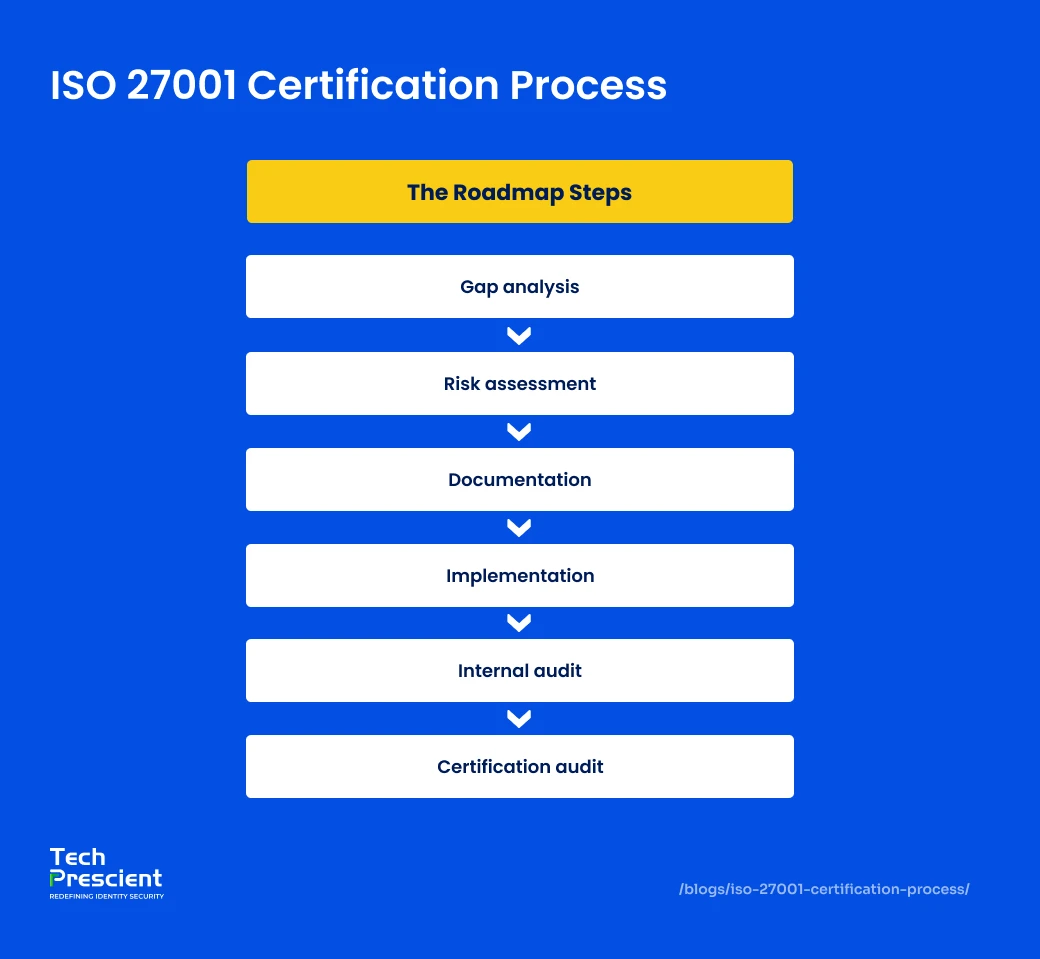
Let's walk through the key steps involved in the end-to-end certification journey.
Define the ISMS Scope
The first step is determining what the ISMS will cover within your organization. This includes identifying business units, systems, applications, data, people, locations, and third parties that fall under the certification boundary. A clearly defined scope is one of the core ISO 27001 certification process requirements and influences everything from risk assessments to audit preparation.

Pro Tip
Don't start with an overly broad certification scope. Many first-time ISO 27001 projects move faster when they begin with a focused environment and expand maturity over time.
Conduct a Gap Analysis
Before implementing changes, organizations typically assess their current security posture against ISO 27001 requirements. A gap analysis helps identify missing controls, weak processes, documentation gaps, and areas requiring improvement. This creates a practical roadmap for achieving compliance.
Perform Risk Assessment and Treatment
Risk management sits at the center of ISO 27001. Organizations must identify information security threats, evaluate their potential likelihood and business impact, and decide how those risks will be addressed. The outcome is a risk treatment plan that defines mitigation strategies, accepted risks, and selected security controls.
Implement Annex A Controls
Once risks are evaluated, organizations deploy appropriate controls to reduce or manage them. Depending on the environment and risk profile, this may include access controls, encryption measures, incident response practices, vendor risk management, logging, monitoring, and asset protection controls aligned with ISO 27001 Annex A.
Prepare Documentation and Statement of Applicability (SoA)
ISO 27001 requires organizations to maintain clear and accurate documentation supporting their ISMS. This often includes policies, procedures, risk records, and operational evidence. A key document in this phase is the Statement of Applicability (SoA), which explains which Annex A controls are implemented, excluded, and why.
Build Employee Awareness and Training
Security compliance depends on people as much as technology. Organizations must ensure employees understand security responsibilities, internal policies, and safe practices relevant to their roles. Training and awareness initiatives help build a stronger security culture and improve audit readiness.
Conduct Internal Audit and Management Review
Before pursuing certification, organizations should validate their readiness through internal audits and management reviews. Internal audits test whether controls and processes are operating as intended, while leadership reviews evaluate ISMS performance, risks, findings, and opportunities for improvement.
Complete the Certification Audit (Stage 1 & Stage 2)
The final step is the external certification audit conducted by an accredited certification body. This typically takes place in two phases: Stage 1, which reviews ISMS documentation and preparedness, and Stage 2, which evaluates operational effectiveness, implementation evidence, and control performance. We'll explore the audit process in more detail in the next section.
ISO 27001 Certification Audit Process Explained
The ISO 27001 certification audit process is the formal evaluation that determines whether an organization's Information Security Management System (ISMS) meets the requirements of the standard. Conducted by an accredited certification body, the audit goes beyond reviewing documents to assess how security controls and processes function in practice.
Here's how the audit process typically unfolds.
Stage 1 Audit (Documentation Review)
The Stage 1 audit focuses on evaluating whether your organization is prepared for full certification assessment. Auditors review the ISMS scope, policies, risk assessment methodology, Statement of Applicability (SoA), and key supporting documentation to confirm alignment with ISO 27001 requirements.
This stage is designed to identify missing information, incomplete processes, or readiness gaps before the main audit begins. Addressing these findings early can help streamline the next phase of the certification process.
Stage 2 Audit (Main Audit)
The Stage 2 audit is the primary certification assessment, where auditors examine how effectively the ISMS has been implemented across the organization. This usually involves employee interviews, walkthroughs of security processes, review of operational records, and testing of selected controls.
Auditors may evaluate areas such as access management, incident response, risk treatment activities, vendor oversight, monitoring practices, and employee awareness to verify that documented controls are functioning as intended.
Non-Conformities and Certification Outcome
After the audit, the certification body documents any non-conformities, which are gaps between organizational practices and ISO 27001 requirements. These findings are generally classified as minor or major, depending on their severity and impact on the effectiveness of the ISMS.
Minor findings typically require corrective action within a defined timeframe, while major issues may need to be resolved before certification can proceed. Once findings are addressed and audit requirements are satisfied, the organization can be issued an ISO 27001 certification, followed by ongoing surveillance audits to maintain compliance.
ISO 27001 Certification Process Timeline
There is no fixed timeline for achieving ISO 27001 certification. The duration varies based on factors such as the size of the organization, the scope of the ISMS, existing security practices, and the resources available to support implementation and audit preparation.
Below is a general view of how certification timelines often differ across organizations.
1. Startups: Typically 3–6 Months
Startups can often move through the certification process faster due to leaner operations, smaller teams, and a narrower certification scope. If foundational security controls, cloud infrastructure practices, and documentation are already in place, implementation and audit readiness can be achieved within a relatively shorter timeframe.
2. SaaS Companies: Typically 6–9 Months
For SaaS organizations, the timeline may be influenced by cloud environments, customer security requirements, vendor dependencies, and the need to demonstrate strong access controls and data protection measures. Building a mature ISMS and collecting sufficient operational evidence can extend implementation efforts.
3. Enterprises: Typically 9–12 Months
Large enterprises generally face longer certification timelines because of broader organizational scope, multiple departments or locations, legacy systems, and complex governance structures. Coordinating risk assessments, control implementation, documentation, and stakeholder alignment across teams often requires additional planning and execution time.
4. Factors That Influence the Certification Timeline
Several variables can accelerate or slow down the ISO 27001 certification process timeline. Organizations with established security policies, existing compliance experience, and dedicated internal resources may progress faster than those starting from scratch.
Key factors that commonly impact timelines include:
- Existing security maturity: Organizations with mature controls and governance frameworks usually require fewer remediation efforts.
- Team size and ownership: Dedicated security, compliance, and leadership involvement can improve execution speed.
- Use of automation tools: Compliance automation, centralized evidence collection, and workflow management tools can simplify implementation and audit preparation.
Certification timelines are rarely delayed by audits alone. Documentation readiness, stakeholder alignment, and evidence collection usually take longer than organizations expect.
ISO 27001 Certification Process Requirements
The ISO 27001 certification process requirements extend beyond implementing technical safeguards. Organizations must establish a structured Information Security Management System (ISMS) that defines how information security risks are identified, managed, monitored, and improved across the business.
To meet certification requirements, organizations need to align with the core elements of the ISO 27001 standard.
1. Clauses 4–10: Core ISMS Requirements
The main requirements of ISO 27001 are defined within Clauses 4 through 10, which outline how an organization should build, operate, and maintain its ISMS.
These clauses cover key areas such as:
- Organizational context and scope to define what the ISMS includes and the business environment it supports
- Leadership and governance to establish roles, responsibilities, and management commitment
- Planning and risk management to identify security risks, opportunities, and treatment strategies
- Support and operational controls covering resources, competence, communication, and day-to-day security activities
- Performance evaluation and continual improvement through monitoring, internal audits, corrective actions, and management reviews
Together, these requirements create a governance framework that supports long-term security and compliance maturity.
2. Annex A Controls
In addition to the management system requirements, ISO 27001 includes Annex A controls, which provide a catalog of security measures organizations can apply based on their risk profile.
Control selection is not one-size-fits-all. Organizations choose relevant controls according to identified risks, business needs, and compliance objectives. Depending on the environment, controls may address areas such as access management, asset protection, encryption, incident handling, supplier security, logging, monitoring, and physical security safeguards.
The selected controls and their justification are typically documented within the Statement of Applicability (SoA).
3. Mandatory Documentation Requirements
Documentation plays a central role in the certification process because organizations must demonstrate not only that controls exist, but also that processes are defined, followed, and reviewed.
Commonly required ISMS documentation may include:
- ISMS scope statement
- Information security policy
- Risk assessment and risk treatment methodology
- Risk treatment plan and risk register
- Statement of Applicability (SoA)
- Internal audit records and management review outputs
- Evidence of corrective actions, training, and operational security activities
Maintaining accurate and up-to-date documentation is essential for audit readiness, traceability, and ongoing compliance management.
Struggling with ISO 27001 documentation?
Get a practical toolkit for audit-ready ISMS compliance.
ISO 27001 Certification for SaaS, Startups, and Enterprises
While the core requirements of ISO 27001 remain consistent, the path to certification can look very different for startups, SaaS providers, and large enterprises. Factors such as organizational scope, technology environment, internal resources, and compliance priorities often shape how the certification process is approached.
1. For Startups
Startups often benefit from a simpler certification scope and leaner operations, which can make implementation more manageable. Smaller teams, fewer systems, and cloud-native environments may allow organizations to establish an ISMS and implement controls more quickly.
However, startups may face challenges around limited compliance expertise, resource constraints, or immature security processes. Starting with a clearly defined scope and prioritizing high-impact controls can help accelerate readiness without creating unnecessary complexity.
2. For SaaS Companies
For SaaS businesses, ISO 27001 certification is frequently driven by customer trust, sales requirements, and cloud security expectations. The certification process typically places strong emphasis on protecting customer data, managing user access, securing cloud infrastructure, and monitoring third-party vendors and service providers.
SaaS organizations may also need to demonstrate mature operational practices around incident response, logging, vulnerability management, and continuous monitoring to satisfy customer and audit expectations.
3. For Enterprises
Enterprise organizations generally navigate a more complex certification landscape due to larger operational footprints, multiple business units, distributed teams, and varied technology ecosystems.
Defining the ISMS scope, coordinating risk assessments, aligning stakeholders, and maintaining consistent controls across departments or locations can require substantial planning and governance. Enterprises often need a structured approach to documentation, audit coordination, and ongoing compliance management to support certification at scale.
ISO 27001 vs SOC 2 Certification Process
ISO 27001 and SOC 2 both strengthen security and compliance, but they differ in scope, audit methodology, and the types of assurance they provide.
Organizations evaluating security compliance frameworks often compare ISO 27001 and SOC 2 because both are widely recognized in cybersecurity and customer assurance programs. While they share common themes such as risk management, controls, and governance, the certification process, reporting structure, and business use cases are not identical.
Understanding these differences can help organizations choose the right framework or determine whether pursuing both makes strategic sense.
1. Key Differences in Audit Structure
The ISO 27001 certification process is centered on establishing and certifying an Information Security Management System (ISMS). Organizations are audited against the ISO 27001 standard to demonstrate that security risks are systematically managed through documented processes, governance practices, and selected controls.
By contrast, SOC 2 evaluates controls against the Trust Services Criteria, which include security, availability, processing integrity, confidentiality, and privacy. Rather than issuing a certification, SOC 2 results in an attestation report prepared by an auditor based on the organization's control environment and operational evidence.
The audit approach also differs. ISO 27001 typically involves a two-stage certification audit followed by surveillance audits, while SOC 2 assessments focus on evaluating control design and, in the case of SOC 2 Type II, testing operational effectiveness over a defined review period.
2. When to Choose ISO 27001 or SOC 2
The right framework often depends on business goals, market expectations, and customer requirements.
Organizations operating across international markets or seeking a globally recognized security framework may prioritize ISO 27001. Businesses selling primarily to North American customers, especially in technology and SaaS sectors, may encounter stronger demand for SOC 2 reports during vendor reviews and procurement processes.
Factors such as customer expectations, regulatory considerations, geographic reach, and existing compliance investments can influence the decision.
3. Using a Dual Compliance Strategy
Many organizations choose not to view ISO 27001 and SOC 2 as competing frameworks. Because both share overlapping security principles, businesses can often map controls, evidence, and governance processes across both initiatives.
A dual compliance strategy can help reduce duplicated effort while expanding customer assurance coverage. Organizations that align documentation, risk management practices, and control testing across both frameworks may improve efficiency while meeting broader security and compliance objectives.
Post-Certification: Surveillance & Recertification
Achieving ISO 27001 certification is not the end of the journey. Organizations are expected to maintain, review, and continuously improve their Information Security Management System (ISMS) to ensure it remains effective as risks, technologies, and business environments evolve.
Maintaining certification requires sustained governance, operational oversight, and periodic external assessments.
1. Surveillance Audits and Continuous Monitoring
After certification is issued, organizations typically undergo annual surveillance audits conducted by the certification body. These reviews are designed to confirm that the ISMS is still functioning effectively and continues to meet ISO 27001 requirements.
Between audits, organizations should maintain continuous monitoring practices such as tracking security incidents, reviewing control performance, monitoring risks, and updating policies or procedures when business or threat conditions change.
2. Internal Audits and Management Oversight
Regular internal audits play an important role in post-certification compliance. They help organizations identify control gaps, validate security processes, and uncover areas that may require corrective action before external audits occur.
Management reviews are equally important, providing leadership with visibility into ISMS performance, emerging risks, audit findings, compliance status, and opportunities for improvement.
3. Continual Improvement and Recertification
ISO 27001 follows a mindset of continual improvement rather than static compliance. Organizations are expected to refine controls, strengthen processes, and adapt their security programs as operational needs and risk landscapes change.
In most cases, a full recertification audit takes place every three years. This assessment re-evaluates the ISMS in depth to confirm that the organization continues to meet the requirements of the standard and remains eligible to retain certification.
Common Challenges in ISO 27001 Certification
The ISO 27001 certification process can be demanding, particularly for organizations navigating formal security compliance for the first time. Beyond implementing controls, teams must coordinate people, processes, documentation, and ongoing governance across the organization. Understanding common roadblocks can help organizations prepare more effectively and avoid delays during certification.
1. Limited Leadership Involvement
Strong executive sponsorship is essential for a successful ISO 27001 program. Without clear management support, organizations may struggle to secure resources, define ownership, enforce policies, or maintain momentum throughout implementation.
Leadership involvement is particularly important when establishing the ISMS scope, approving risk decisions, and driving a culture of accountability and continuous improvement.
2. Overly Complex Documentation
Documentation is a critical part of ISO 27001 compliance, but many organizations create policies, procedures, and records that are unnecessarily detailed or difficult to maintain.
Overcomplicated documentation can create confusion, increase administrative effort, and make audits more challenging. The goal is not to produce excessive paperwork, but to maintain clear, practical documentation that accurately reflects how security processes operate within the business.
3. Managing Risk Assessments Effectively
Risk assessment is a foundational requirement of ISO 27001, yet many organizations find it difficult to define consistent methodologies, prioritize risks, or connect identified risks to appropriate controls.
An unclear or inconsistent risk management approach can affect control selection, treatment planning, and overall audit preparedness.
4. Challenges With Manual Compliance Management
Organizations relying heavily on spreadsheets, emails, and disconnected tracking methods may find it difficult to manage evidence collection, policy updates, audit records, and ongoing monitoring activities.
Manual compliance processes can slow implementation, increase the likelihood of missed tasks, and create operational friction during audits. As certification programs mature, many organizations look for more centralized and scalable approaches to managing compliance activities.
Documentation gaps often surface when audits are already underway.
Strengthen ISO 27001 readiness with structured templates for audit preparation, and evidence tracking.
Best Practices to Accelerate ISO 27001 Certification
The ISO 27001 certification process can become significantly more efficient when organizations take a structured and practical approach from the outset. Rather than treating certification as a one-time compliance project, successful organizations often focus on building scalable processes, reducing manual effort, and strengthening security governance early in the journey.
Below are a few best practices that can help accelerate implementation and improve audit readiness.
1. Start With a Well-Defined Scope
One of the most effective ways to avoid delays is to establish a clear and realistic ISMS scope at the beginning of the project. Defining which systems, business units, data, applications, and processes are included helps reduce ambiguity and keeps implementation efforts focused.
A phased or targeted scope can also help organizations manage complexity, especially when pursuing certification for the first time.
2. Leverage Compliance Automation Tools
Managing policies, evidence collection, risk tracking, and audit preparation manually can slow down certification efforts. Many organizations use compliance automation platforms to centralize documentation, streamline workflows, and simplify recurring compliance tasks.
Automation can improve visibility, reduce administrative overhead, and help teams maintain organized audit evidence throughout the certification lifecycle.
3. Align Certification With Identity Governance Practices
Identity and access management play an important role in many ISO 27001 control areas. Aligning certification efforts with identity governance and administration (IGA) practices can strengthen user access controls, role management, provisioning workflows, and access review processes.
Integrating governance-driven access management into the ISMS can support stronger security controls while improving operational consistency and audit preparedness.
4. Maintain Continuous Monitoring and Improvement
Organizations that embed continuous monitoring into their security programs are often better positioned for certification and long-term compliance. Ongoing monitoring of risks, controls, incidents, policy changes, and operational performance helps identify issues early and supports a stronger security posture.
Instead of preparing for audits at the last minute, continuous oversight enables organizations to maintain readiness throughout the certification cycle.
Expert Insight
Organizations that treat ISO 27001 as an operational security program rather than a one-time compliance project often achieve smoother audits and stronger long-term compliance outcomes.
Final Thoughts
The ISO 27001 certification process is more than a compliance exercise. It is a strategic framework for strengthening information security, improving risk management, and building long-term audit readiness. From unclear scoping and documentation challenges to weak access governance and manual compliance efforts, overlooked gaps can delay certification and increase security risk.
Tech Prescient helps organizations accelerate ISO 27001 readiness with stronger identity governance, access visibility, and continuous security controls. Through automated access reviews, least-privilege enforcement, and governance-driven compliance practices, organizations can simplify ISMS implementation and improve audit readiness.
FAQs
The ISO 27001 certification process is a structured approach to building and validating an Information Security Management System (ISMS). It typically involves defining scope, conducting risk assessments, implementing controls, performing internal audits, and completing a two-stage external certification audit.
The ISO 27001 certification process timeline usually ranges from 3 to 12 months, depending on the organization's size, security maturity, and implementation scope. Startups may move faster, while SaaS companies and enterprises often require more time for documentation, controls, and audit readiness.
The six common stages of ISO 27001 certification include planning, ISMS scoping, risk assessment and treatment, control implementation, auditing, and certification. Each stage builds toward establishing a compliant, operational, and audit-ready information security framework.
To achieve ISO 27001 certification, organizations need an implemented ISMS, documented policies and procedures, completed risk assessments, internal audits, and evidence that controls are working effectively. A successful outcome in the external certification audit is also required.
ISO 27001 certification can be challenging, especially for organizations managing compliance for the first time. Factors such as unclear scope, complex documentation, limited resources, or weak governance can add complexity, but proper planning, tools, and expertise can make the process more manageable.
Share



Yatin Laygude
Content Writer
A content writer with 6 years of experience turning complex topics into clear, engaging, and meaningful content. From blogs and web pages to whitepapers and thought pieces, he creates content that not only explains but also connects with both the audience and business goals.
Most Popular Blogs
Identity Security· 21 min read
Data Access Governance Solutions: How to Secure Sensitive Data at Scale
Compare data access governance solutions for 2026: how DAG platforms discover sensitive data, run access reviews, automate remediation, and prove compliance.
Brinda Bhatt· September 7, 2026
Identity Security· 24 min read
What Is Zero Trust Network Access (ZTNA)?
Learn what Zero Trust Network Access (ZTNA) is, how it works, and why it’s replacing VPNs for secure, identity-based access control.
Yatin Laygude· August 14, 2026
Identity Security· 24 min read
Cyber Essentials Certification: Complete Guide
Learn Cyber Essentials certification, cost, requirements, and steps. Compare Cyber Essentials vs Plus and get certified faster.
Yatin Laygude· August 10, 2026