




On this page
See Tech Prescient in Action
Automate access, reduce risk, and stay audit-ready
ISO 27001 vs SOC 2 is one of the most common comparisons for organizations looking to strengthen security and meet customer compliance requirements. Both frameworks help businesses protect sensitive data, demonstrate security maturity, and build trust with customers. However, they differ significantly in their purpose, approach, and outcomes.
While ISO 27001 focuses on establishing and maintaining a structured Information Security Management System (ISMS), SOC 2 evaluates whether security controls are effectively designed and operating over time. Understanding these distinctions is especially important for SaaS companies, cloud providers, and organizations pursuing enterprise customers.
A recent survey by Vanta found that 84% of organizations say security and compliance are important factors in purchasing decisions. This highlights why frameworks like ISO 27001 and SOC 2 have become critical for building trust, winning enterprise customers, and accelerating growth. Let's explore the key differences, similarities, and use cases of both frameworks.
Key Takeaways:
- Learn what ISO 27001 and SOC 2 are, how they work, and the security goals each framework is designed to achieve.
- Understand the key differences between ISO 27001 and SOC 2, including scope, audits, certifications, and reporting.
- Explore how SOC 2 Type 2 compares to ISO 27001 in terms of control testing, compliance, and ongoing assurance.
- Discover the overlap between ISO 27001 and SOC 2 controls and how organizations can streamline dual compliance efforts.
- Find out whether ISO 27001, SOC 2, or both frameworks are the right choice based on your business needs and growth plans.
What is ISO 27001?
ISO 27001 is an internationally recognized standard that helps organizations establish, implement, maintain, and continuously improve an Information Security Management System (ISMS). It provides a risk-based framework for identifying security threats, implementing appropriate controls, and protecting sensitive information across people, processes, and technology. As a result, organizations can strengthen security governance, reduce risk, and demonstrate compliance with customer and regulatory expectations.
To better understand how ISO 27001 works, let's explore its lifecycle, certification process, and ongoing compliance requirements.
1. ISMS Lifecycle
The foundation of ISO 27001 is the Information Security Management System (ISMS), which follows a continuous improvement cycle. Organizations begin by identifying and assessing information security risks, determine appropriate risk treatment measures, implement controls, and continuously monitor their effectiveness. As new threats and business requirements emerge, the ISMS is reviewed and refined to ensure ongoing protection of critical information assets.
2. ISO 27001 Certification Process
To achieve ISO 27001 certification, organizations must undergo an independent audit conducted by an accredited certification body. The process typically consists of two stages. The Stage 1 Audit evaluates the organization's ISMS documentation, policies, risk assessments, and readiness for certification. The Stage 2 Audit assesses whether the ISMS has been effectively implemented and is operating as intended across the organization. Successful completion of both stages results in ISO 27001 certification.
3. Certification Validity
ISO 27001 certification remains valid for three years, demonstrating an organization's commitment to maintaining effective information security practices. During this period, annual surveillance audits are conducted to verify ongoing compliance and continuous improvement. At the end of the certification cycle, organizations must complete a recertification audit to retain their certification status.
What is SOC 2?
SOC 2 is a security auditing framework developed by the AICPA to help organizations demonstrate that their systems and controls effectively protect customer data. Rather than certifying a security program, SOC 2 assesses how well security controls are designed and operated against defined trust and security requirements. It is widely used by SaaS providers, cloud companies, and technology organizations to build customer trust and meet vendor security expectations.
To understand how SOC 2 works, let's examine its Trust Services Criteria, audit types, reporting structure, and primary use cases.
1. Trust Services Criteria (TSC)
SOC 2 is built around five Trust Services Criteria that serve as the foundation for evaluating security controls. These include Security, Availability, Processing Integrity, Confidentiality, and Privacy. While Security is mandatory for every SOC 2 audit, organizations can choose additional criteria based on their services, business model, and customer requirements.
2. SOC 2 Type 1 vs Type 2
SOC 2 reports are available in two forms. SOC 2 Type 1 evaluates whether security controls are appropriately designed at a specific point in time. SOC 2 Type 2 goes a step further by assessing how effectively those controls operate over a defined observation period, typically several months. This distinction is often central to the SOC 2 Type 2 vs ISO 27001 discussion, as Type 2 provides evidence of ongoing control performance rather than a snapshot assessment.
3. SOC 2 Audit Report Structure
A SOC 2 audit is conducted by an independent CPA firm and results in a detailed attestation report. The report typically includes the auditor's opinion, a description of the organization's systems and controls, the Trust Services Criteria being evaluated, and the results of control testing. Unlike ISO 27001, which results in a certification, SOC 2 produces a report that customers can review as part of their vendor risk assessment process.
4. Who Needs SOC 2?
SOC 2 is particularly relevant for SaaS companies, cloud service providers, managed service providers, and other organizations that store, process, or transmit customer data. In the SOC 2 compliance vs ISO 27001 debate, SOC 2 is often preferred by organizations serving the North American market, where enterprise customers frequently request SOC 2 reports as part of procurement and security due diligence requirements.
ISO 27001 vs SOC 2: Key Differences
Although ISO 27001 and SOC 2 share the goal of protecting sensitive information, they differ in scope, assessment methodology, and reporting outcomes. Understanding these differences can help organizations select the right framework based on customer expectations, compliance requirements, and business objectives.
1. Certification vs Attestation
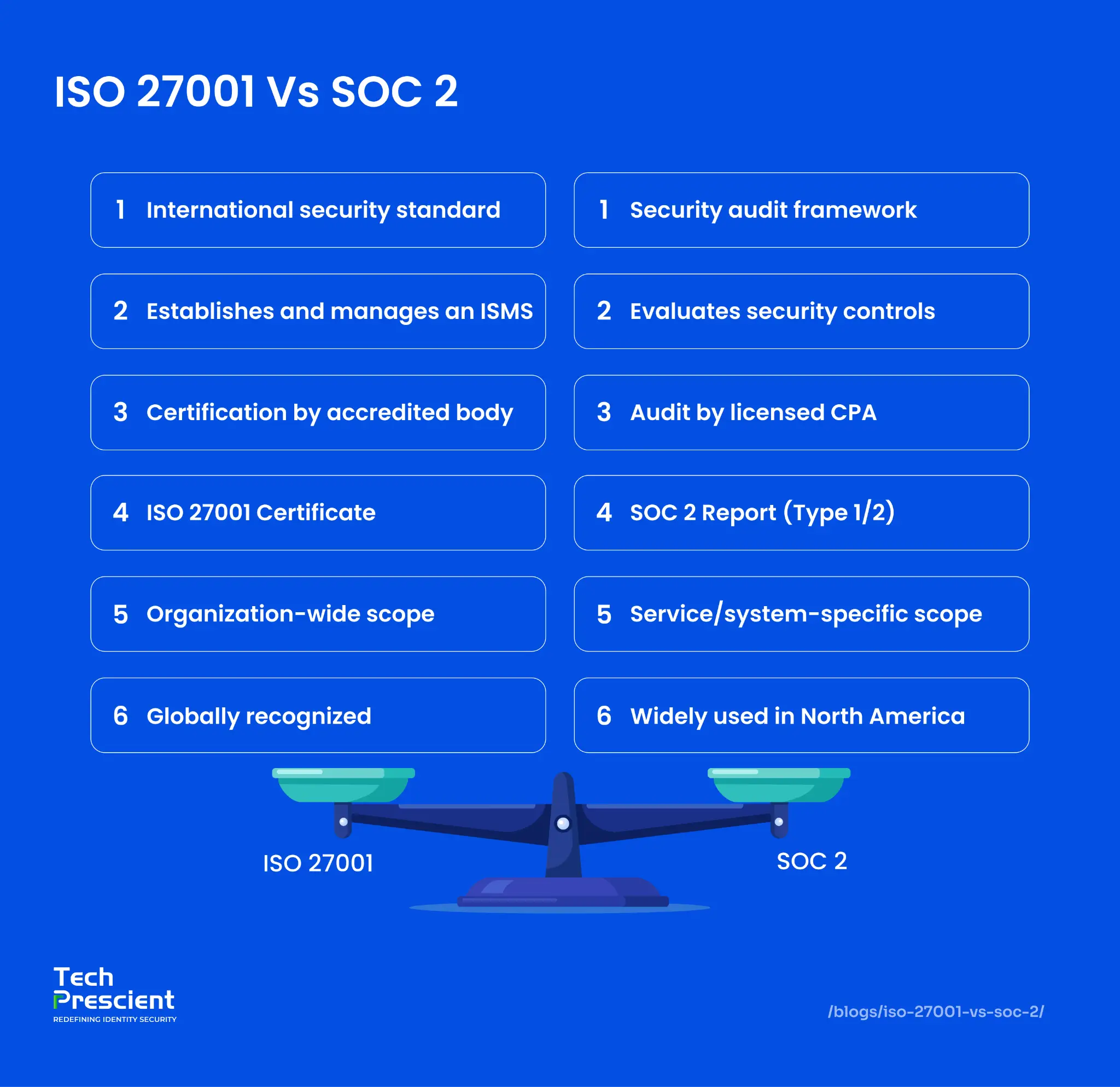
One of the biggest differences between ISO 27001 and SOC 2 is the outcome of the assessment process. ISO 27001 results in a formal certification issued by an accredited certification body, confirming that an organization has implemented and maintains an effective Information Security Management System (ISMS). SOC 2, on the other hand, produces an independent auditor's attestation report that provides an opinion on the design and effectiveness of security controls rather than granting a certification.
2. Global vs US Focus
ISO 27001 is an internationally recognized standard adopted by organizations across industries and regions worldwide. Its global acceptance makes it particularly valuable for businesses serving customers in multiple countries. SOC 2 originated in the United States and remains especially popular among North American technology companies, where enterprise customers frequently request SOC 2 reports as part of vendor risk and procurement evaluations.
3. Risk-Based vs Control-Based Approach
ISO 27001 follows a risk-driven methodology that requires organizations to identify, assess, and mitigate information security risks based on their specific business environment. SOC 2 takes a control-focused approach by evaluating whether security controls meet the Trust Services Criteria and operate effectively over time. While ISO 27001 emphasizes building a comprehensive security management framework, SOC 2 focuses on validating the effectiveness of implemented controls.
The table below provides a side-by-side ISO 27001 vs SOC 2 comparison, highlighting the most important differences in scope, methodology, outcomes, and compliance requirements.
| Sr No | Feature | ISO 27001 | SOC 2 |
|---|---|---|---|
| 1 | Type | Internationally recognized certification standard | Independent audit and attestation framework |
| 2 | Scope | Information Security Management System across the defined organizational scope | Specific services, systems, or environments that process customer data |
| 3 | Approach | Risk-based framework focused on identifying and managing information security risks | Criteria-based framework focused on evaluating security control effectiveness |
| 4 | Output | ISO 27001 certification issued by an accredited certification body | Detailed SOC 2 audit report issued by an independent CPA firm |
| 5 | Validity | Valid for three years with annual surveillance audits | Typically renewed annually through a new audit engagement |
Expert Insight
Don't choose a framework based solely on compliance requirements. Start by understanding what your customers and prospects actually request during vendor assessments and security reviews.
ISO 27001 vs SOC 2 Requirements for SaaS Firms
For SaaS organizations, security compliance is no longer just a regulatory requirement. It has become a critical factor in customer acquisition, vendor assessments, and enterprise sales. Whether pursuing ISO 27001, SOC 2, or both, the right choice often depends on where your customers are located, the type of data you handle, and the maturity of your security program.
As SaaS businesses scale, compliance requirements typically evolve alongside customer demands, security risks, and market opportunities.
SaaS-Specific Compliance Needs
SaaS companies manage large volumes of customer data across cloud environments, making security governance a business necessity. As organizations grow, they need formal processes for risk management, access control, incident response, vendor management, and data protection. Both ISO 27001 and SOC 2 help establish trust, but the most suitable framework often depends on the company's operational and compliance priorities.
Enterprise Buyer Expectations
Many enterprise customers evaluate a vendor's security posture before signing a contract. In North America, SOC 2 reports are commonly requested during procurement and security reviews. For organizations serving global markets, ISO 27001 certification is often viewed as a strong indicator of a mature and well-managed security program. Meeting these expectations can help reduce sales friction and accelerate deal cycles.
Data Handling and Cloud Security
Modern SaaS platforms rely heavily on cloud infrastructure and continuously process sensitive customer information. As a result, organizations must demonstrate that they can securely manage data, control access, monitor systems, and respond to security incidents. Both frameworks support these objectives, but they do so through different approaches, making it important to align compliance efforts with business and customer requirements.
Building a SaaS Compliance Roadmap
For many growing SaaS companies, compliance is a journey rather than a one-time project. Early-stage organizations often pursue the framework most commonly requested by customers, while more mature businesses may adopt both ISO 27001 and SOC 2 to strengthen security assurance and support global expansion. A well-defined SaaS compliance roadmap helps organizations prioritize investments, streamline audits, and build long-term customer trust.
Many SaaS companies begin their compliance journey because a major prospect asks for proof of security, not because of a regulatory mandate.
Not Sure Which Framework to Pursue?
Assess your compliance readiness and determine whether ISO 27001, SOC 2, or both are right for your organization.
SOC 2 Type 2 vs ISO 27001
When comparing ISO 27001 vs SOC 2 Type 2, it is important to understand that these frameworks evaluate different aspects of security and compliance. SOC 2 Type 2 is designed to verify the operational effectiveness of security controls over a defined period, whereas ISO 27001 focuses on building, managing, and continuously improving a structured security management system.
The distinction becomes clearer when comparing how each framework measures security over time.
1. Timeline and Assessment Period
SOC 2 Type 2 audits assess the effectiveness of controls over an observation period, typically ranging from three to twelve months. During this time, auditors collect evidence to determine whether controls consistently operate as intended. ISO 27001 does not follow a fixed observation window. Instead, it evaluates whether an organization has established an effective ISMS and maintains it through ongoing risk management, monitoring, and continuous improvement activities.
2. Audit Focus and Depth
SOC 2 Type 2 places a strong emphasis on control testing. Auditors review specific controls related to security, availability, confidentiality, processing integrity, or privacy and verify their effectiveness over time. ISO 27001 takes a broader approach by assessing governance, risk management practices, policies, procedures, employee responsibilities, and security controls as part of an organization's overall security framework.
3. Which Framework Provides More Value?
The answer depends on the objective. SOC 2 Type 2 provides customers with assurance that controls are functioning effectively in real-world operations, making it valuable during vendor evaluations and enterprise procurement processes. ISO 27001 demonstrates that an organization has implemented a structured, risk-based approach to managing information security, helping build long-term security maturity and governance.
Both frameworks provide strong security assurance, but they do so from different perspectives. Many organizations choose to pursue both because together they offer a more comprehensive view of security effectiveness and compliance maturity.
ISO 27001 vs SOC 2 Mapping (Overlap Explained)
While ISO 27001 and SOC 2 differ in structure and assessment methodology, many of their security requirements address the same core objectives. This overlap allows organizations to reuse controls, policies, and evidence across both frameworks, reducing the effort required to achieve dual compliance.
A closer look at the control mapping highlights why many organizations pursue both frameworks together.
1. Annex A Controls vs Trust Services Criteria
The overlap primarily exists between ISO 27001 Annex A controls and the SOC 2 Trust Services Criteria (TSC). Areas such as access management, risk assessment, incident response, vendor management, and security monitoring are common across both frameworks. Although the requirements are structured differently, they often support similar security outcomes.
2. Benefits of Dual Compliance
Organizations pursuing both ISO 27001 and SOC 2 can reduce duplicated effort by leveraging existing controls, documentation, and audit evidence. This approach streamlines compliance initiatives, improves audit readiness, and helps demonstrate a stronger security posture to customers and stakeholders.
3. ISO 27001 vs SOC 2 Mapping XLS
An ISO 27001 vs SOC 2 mapping XLS can help compliance teams identify overlapping controls and gaps between the two frameworks. This mapping exercise simplifies planning, prioritizes remediation efforts, and accelerates the path to dual compliance.
By leveraging the significant overlap between ISO 27001 and SOC 2, organizations can build a more efficient compliance program while maximizing the return on their security investments.
Pro Tip
If you're planning to achieve both ISO 27001 and SOC 2, map overlapping controls early in the project.
Which One Should You Choose?
There is no universal answer in the ISO 27001 vs SOC 2 debate. The best framework depends on who your customers are, where you operate, and how you plan to grow. While some organizations can meet their requirements with a single framework, others may benefit from adopting both to strengthen trust and expand market opportunities.
Consider the following scenarios to determine which approach best aligns with your business needs.
1. Choose ISO 27001 If
ISO 27001 may be the better option if your organization serves customers across multiple regions and requires a globally recognized security certification. It is also well suited for businesses looking to establish a structured, long-term approach to information security through a formal Information Security Management System (ISMS). Organizations focused on strengthening governance, risk management, and compliance often view ISO 27001 as a strategic foundation for security maturity.
2. Choose SOC 2 If
SOC 2 is often the preferred choice for SaaS companies targeting the North American market, where enterprise customers frequently request SOC 2 reports during vendor evaluations. If your primary objective is to demonstrate that security controls are operating effectively and provide assurance to prospective customers, SOC 2 can help address those requirements while supporting sales and procurement processes.
3. Choose Both If
Pursuing both frameworks may be the best approach for organizations expanding into global markets, serving large enterprise customers, or building a mature security and compliance program. Combining ISO 27001 certification with a SOC 2 report provides broader assurance, satisfies a wider range of customer requirements, and demonstrates both security governance and operational control effectiveness. For many growing SaaS companies, adopting both frameworks becomes a natural step as compliance demands and business complexity increase.
Choose the Right Compliance Path
Identify readiness gaps and get a clear recommendation based on your business goals and security maturity.
Can You Get ISO 27001 and SOC 2 Together?
Yes, many organizations pursue ISO 27001 and SOC 2 together to strengthen security assurance and meet a wider range of customer requirements. The key is choosing the right implementation strategy based on your resources, timelines, and business objectives.
1. Parallel vs Sequential Approach
Organizations can pursue ISO 27001 and SOC 2 either simultaneously or one after the other. A parallel approach can reduce overall project timelines by leveraging shared controls, policies, and documentation across both frameworks. Alternatively, some organizations choose a sequential approach, achieving one framework first and then using that foundation to simplify compliance with the second.
2. Optimizing Time and Resources
Since many requirements overlap, organizations can often reuse risk assessments, access controls, incident response processes, security policies, and monitoring practices. This reduces duplicate effort, lowers compliance costs, and minimizes the operational burden associated with managing multiple audits and assessments.
3. Leveraging Automation and Compliance Tools
Modern compliance platforms can help streamline evidence collection, control monitoring, policy management, and audit preparation for both frameworks. By automating repetitive compliance tasks, organizations can improve efficiency, maintain continuous readiness, and accelerate the path to both ISO 27001 certification and SOC 2 reporting.
For growing SaaS companies and cloud service providers, pursuing both frameworks can be a practical way to expand compliance coverage while maximizing the value of existing security investments.
Cost & Timeline Comparison
Cost and implementation timelines are important considerations when evaluating ISO 27001 vs SOC 2. While both frameworks require investments in security controls, documentation, and audit preparation, the overall effort can vary based on organizational size, existing security maturity, and compliance objectives.
Understanding the resources, timelines, and ongoing commitments involved can help organizations plan their compliance journey more effectively.
1. ISO 27001 Cost vs SOC 2 Cost
ISO 27001 often involves broader organizational changes because it requires the establishment and maintenance of a formal Information Security Management System (ISMS). Costs typically include risk assessments, policy development, employee training, certification audits, and ongoing surveillance audits. SOC 2 costs are generally tied to readiness activities, evidence collection, and the independent audit itself, with expenses varying based on the scope and complexity of the environment being assessed.
2. Audit Timelines
SOC 2 timelines depend largely on the type of report being pursued. A SOC 2 Type 1 assessment can often be completed relatively quickly because it evaluates controls at a specific point in time. SOC 2 Type 2 requires a longer observation period to assess control effectiveness over several months. ISO 27001 timelines are typically driven by the time needed to establish, implement, and mature an ISMS before undergoing certification audits.
3. Internal Effort and Resource Commitment
Both frameworks require involvement from security, IT, compliance, and business stakeholders. However, ISO 27001 generally demands greater organizational participation because of its focus on governance, risk management, and continuous improvement. SOC 2 efforts are often more concentrated on demonstrating and documenting the effectiveness of existing controls. Organizations with mature security programs may find it easier to achieve either framework, particularly when leveraging shared controls and compliance automation tools.
Ultimately, the total cost and timeline for ISO 27001 or SOC 2 will depend on your current security posture, audit readiness, and long-term compliance goals. Many organizations view the investment as worthwhile due to the increased trust, market access, and competitive advantage these frameworks can provide.
Final Thoughts
ISO 27001 and SOC 2 serve different but complementary purposes in a modern security program. ISO 27001 helps organizations build a structured Information Security Management System (ISMS), while SOC 2 validates that security controls are operating effectively. Together, they help strengthen security governance, improve customer trust, and support long-term business growth.
Tech Prescient helps organizations simplify ISO 27001 and SOC 2 compliance through identity governance, automated access reviews, policy enforcement, compliance monitoring, and audit-ready reporting. By streamlining security and compliance processes, organizations can reduce manual effort and accelerate certification and audit readiness.
Choose the Right Compliance Path
Identify readiness gaps and get a clear recommendation based on your business goals and security maturity.
FAQs
ISO 27001 is an international certification standard that helps organizations build and manage an Information Security Management System (ISMS). SOC 2 is an audit framework that evaluates whether security controls are properly designed and operating effectively. In simple terms, ISO 27001 focuses on building the security program, while SOC 2 focuses on validating its performance.
No, ISO 27001 and SOC 2 are not equivalent, as they have different objectives and assessment methods. ISO 27001 certifies an organization's security management system, whereas SOC 2 provides an auditor's attestation on security controls. However, the two frameworks share significant control overlap and are often implemented together.
ISO 27001 demonstrates that an organization has established a structured and risk-based security program, but some customers require additional assurance. Many enterprise buyers, particularly in North America, request SOC 2 reports to verify that security controls are operating effectively in practice. As a result, organizations may need both frameworks to satisfy customer and compliance requirements.
SOC 2 Type 2 evaluates how effectively security controls operate over a defined period, typically several months. ISO 27001 assesses whether an organization has implemented and maintains an effective Information Security Management System (ISMS). While SOC 2 Type 2 focuses on operational control effectiveness, ISO 27001 emphasizes security governance and continuous improvement.
Yes, many SaaS companies pursue both ISO 27001 and SOC 2 to strengthen security assurance and meet diverse customer expectations. ISO 27001 provides a globally recognized certification, while SOC 2 offers independent validation of security controls. Together, they help support enterprise sales, global expansion, and long-term compliance goals.
Share



Yatin Laygude
Content Writer
A content writer with 6 years of experience turning complex topics into clear, engaging, and meaningful content. From blogs and web pages to whitepapers and thought pieces, he creates content that not only explains but also connects with both the audience and business goals.
Most Popular Blogs
Identity Security· 21 min read
Data Access Governance Solutions: How to Secure Sensitive Data at Scale
Compare data access governance solutions for 2026: how DAG platforms discover sensitive data, run access reviews, automate remediation, and prove compliance.
Brinda Bhatt· September 7, 2026
Identity Security· 24 min read
What Is Zero Trust Network Access (ZTNA)?
Learn what Zero Trust Network Access (ZTNA) is, how it works, and why it’s replacing VPNs for secure, identity-based access control.
Yatin Laygude· August 14, 2026
Identity Security· 24 min read
Cyber Essentials Certification: Complete Guide
Learn Cyber Essentials certification, cost, requirements, and steps. Compare Cyber Essentials vs Plus and get certified faster.
Yatin Laygude· August 10, 2026