




On this page
See Tech Prescient in Action
Automate access, reduce risk, and stay audit-ready
PCI DSS compliance is essential for any organization that stores, processes, or transmits cardholder data. With cyber threats continuing to evolve, businesses must implement strong security controls to protect payment information, reduce risk, and meet regulatory requirements.
A PCI DSS compliance checklist helps organizations translate the standard's requirements into actionable steps. From securing networks and encrypting cardholder data to enforcing access controls and maintaining audit readiness, the checklist provides a structured path toward achieving and maintaining compliance.
The importance of compliance has never been greater. According to IBM's Cost of a Data Breach Report 2024, the average global cost of a data breach reached USD 4.88 million, the highest level recorded to date. Organizations that fail to protect sensitive data face significant financial, operational, and reputational consequences.
In this guide, we'll break down the PCI DSS 4.0 compliance checklist, explain all 12 requirements, and outline the steps needed to achieve and maintain compliance with confidence.
Key Takeaways:
- Learn what a PCI DSS compliance checklist is and how it supports audit readiness.
- Understand all 12 PCI DSS 4.0 requirements and the controls needed to meet them.
- Review a practical PCI DSS compliance audit checklist and required documentation.
- Follow a step-by-step process to prepare for and maintain PCI DSS compliance.
- Discover how Identity Governance strengthens access control, compliance, and reporting.
What Is a PCI DSS Compliance Checklist?
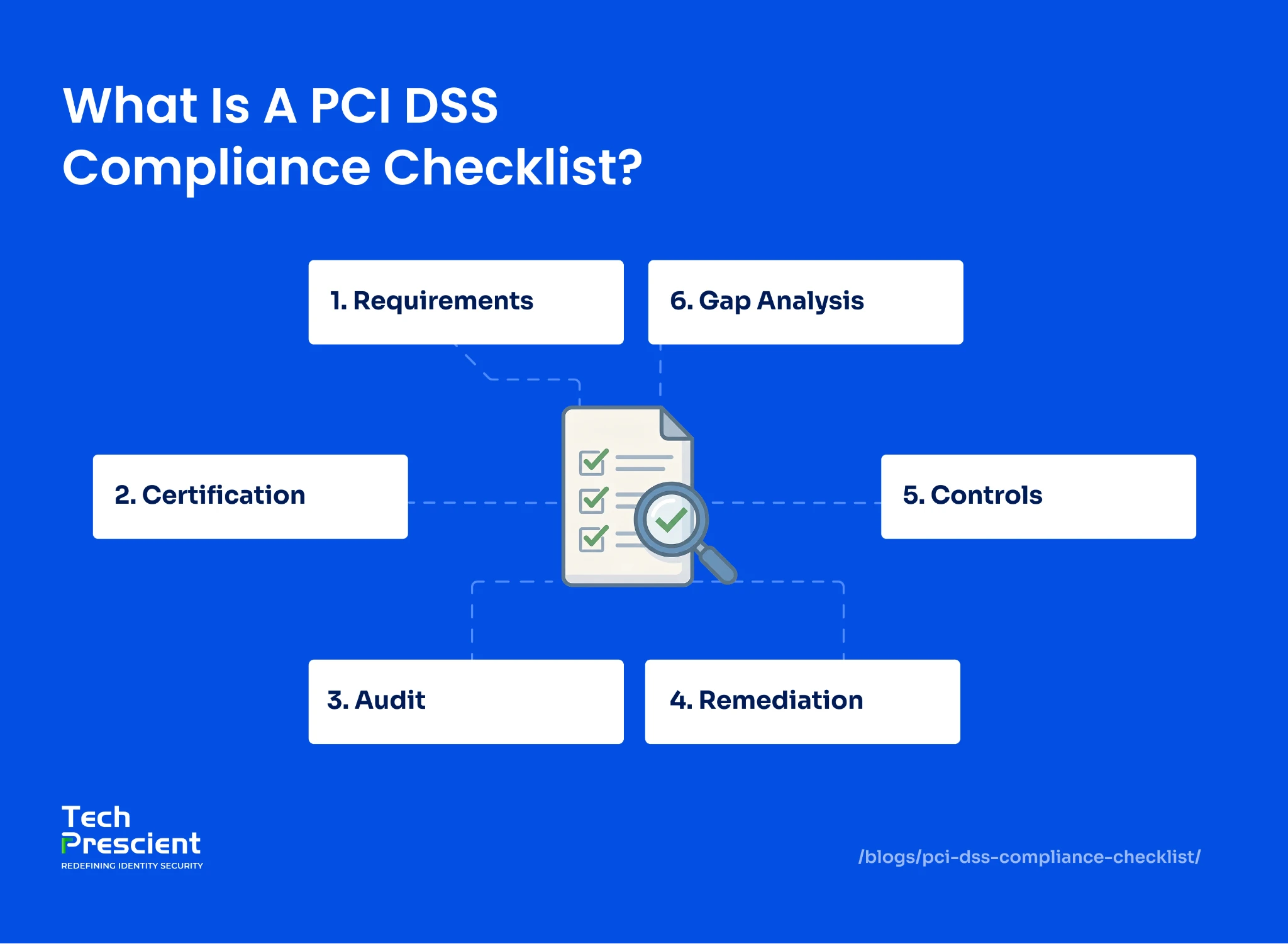
A PCI DSS compliance checklist is a structured list of the technical and administrative controls required to protect cardholder data under the Payment Card Industry Data Security Standard. It translates the formal standard into specific, auditable actions that merchants and service providers can track.0
Knowing what the checklist covers matters less than knowing who has to use it and why. The points below clarify both before the article moves into the 12 requirements themselves.
1. What It Actually Covers
The checklist maps to PCI DSS's six control objectives: secure networks, protected cardholder data, vulnerability management, strong access control, monitoring, and a documented security policy. Each objective breaks down into specific requirements, and each requirement breaks down into testable controls. A complete checklist lists every control an assessor will ask about.
2. Who Needs One
Any merchant, payment processor, or service provider that stores, processes, or transmits cardholder data falls under PCI DSS. This includes traditional retailers, SaaS platforms with embedded payments, and fintech companies handling card-not-present transactions. Scope, not industry, determines whether the standard applies.
3. Its Role in Audits and Certification
During a formal assessment, a Qualified Security Assessor (QSA) walks through the same controls the checklist tracks. Smaller merchants validate through a Self-Assessment Questionnaire (SAQ) instead of a full audit. Either way, the checklist becomes the working document that ties evidence to each requirement.
A checklist is only useful if non-compliance carries real consequences, which is exactly what determines how seriously most organizations treat it. The next section covers what happens when the controls on that checklist are not actually in place.
Pro Tip
Start by identifying where cardholder data actually lives before reviewing controls. Reducing PCI DSS scope through proper network segmentation can significantly lower compliance effort and audit complexity.
PCI DSS 4.0 Checklist: The 12 Core Requirements
PCI DSS 4.0 consists of 12 security requirements grouped into six control objectives that help organizations protect cardholder data and maintain a secure cardholder data environment (CDE). Together, these requirements establish a framework for reducing risk, strengthening security controls, and achieving audit readiness.
1–2. Build and Maintain Secure Networks
The first two requirements focus on creating a secure network foundation. Organizations must implement and maintain firewalls to control traffic entering and leaving the network while ensuring that default passwords and vendor-supplied security settings are replaced before systems go live. PCI DSS also encourages network segmentation to isolate the cardholder data environment from the rest of the network, reducing both risk and compliance scope.
3–4. Protect Cardholder Data
Protecting cardholder data is at the heart of PCI DSS compliance. Businesses must secure sensitive payment information through encryption, masking, and data minimization practices. Whether data is stored in databases or transmitted across networks, appropriate safeguards should be in place to prevent unauthorized access. Effective encryption key management is equally important to ensure data remains protected throughout its lifecycle.
5–6. Maintain a Vulnerability Management Program
Organizations must continuously identify and address security weaknesses that could expose cardholder data. This includes deploying anti-malware solutions, applying security patches promptly, and following secure software development practices. Regular vulnerability assessments help organizations detect risks early and remediate them before they can be exploited by attackers.
7–9. Implement Strong Access Control Measures
Access to cardholder data should be limited to individuals with a legitimate business need. PCI DSS requires organizations to enforce least-privilege access, assign unique user IDs, and implement multi-factor authentication (MFA) for sensitive systems. Physical access to systems and storage locations must also be restricted and monitored.
Identity Governance plays an important role in meeting these requirements by automating access reviews, enforcing role-based access controls, and providing audit-ready reports. These capabilities help organizations demonstrate compliance while reducing the risk of excessive or inappropriate access.
10–11. Monitor and Test Networks
PCI DSS emphasizes continuous visibility into systems and network activity. Organizations should collect and retain audit logs, monitor security events, and integrate logging with SIEM platforms where appropriate. Security controls must also be validated through regular vulnerability scans, annual penetration testing, and file integrity monitoring to ensure they remain effective against evolving threats.
Key activities include:
- Performing quarterly vulnerability scans
- Conducting annual penetration tests
- Reviewing logs and security events regularly
- Monitoring critical files for unauthorized changes
12. Maintain an Information Security Policy
The final requirement focuses on governance and security culture. Organizations must establish and maintain comprehensive information security policies that define roles, responsibilities, and security expectations. Regular security awareness training, incident response planning, and risk assessments help ensure employees understand their responsibilities and that the organization remains prepared to respond to emerging threats.
Together, these 12 requirements form the foundation of a strong PCI DSS 4.0 compliance checklist, helping organizations protect cardholder data, strengthen security controls, and maintain continuous compliance.
Not sure how your organization measures up against all 12 PCI DSS requirements?
Assess your compliance readiness identify control gaps and prioritize remediation before your next audit.
PCI DSS Compliance Audit Checklist (Practical View)
A PCI DSS compliance audit checklist helps organizations verify that their security controls align with PCI DSS requirements before an official assessment. It provides a structured way to review controls, identify compliance gaps, and ensure audit readiness.
1. Pre-Audit Checklist
Before an audit, organizations should review their cardholder data environment (CDE), validate security controls, and confirm that required evidence is available. This helps streamline the assessment process and reduces the likelihood of compliance issues.
2. Internal vs. External Audit
Internal audits are conducted by in-house teams to evaluate compliance readiness and address gaps proactively. External audits are performed by independent assessors to validate whether PCI DSS requirements have been properly implemented and maintained.
3. Required Documentation
A PCI DSS compliance audit checklist should include key documentation that demonstrates compliance and supports audit activities, such as:
- Network diagrams
- Data flow diagrams
- Access logs
- Risk assessments
Keeping these records accurate and up to date makes audits more efficient and helps organizations maintain continuous compliance.
Downloadable PCI DSS Checklist (Excel, PDF Templates)
Many organizations use downloadable templates to organize compliance activities, track progress, and prepare for PCI DSS assessments. Whether you're managing compliance internally or working with external auditors, a structured checklist can help ensure that key requirements are reviewed and documented consistently.
1. PCI DSS Compliance Checklist XLS/Excel
A PCI DSS compliance checklist XLS or Excel template is useful for tracking control implementation, assigning ownership, monitoring remediation activities, and recording compliance status across the 12 PCI DSS requirements. Excel-based checklists are often preferred by organizations looking for a flexible and customizable way to manage compliance tasks.
2. PCI DSS Compliance Checklist PDF
A PCI DSS compliance checklist PDF provides a standardized format for audits, assessments, and stakeholder reviews. PDF checklists are easy to share, archive, and reference during compliance reviews, making them a popular choice for maintaining audit documentation.
3. Why Organizations Are Moving Beyond Spreadsheets
While Excel and PDF templates can help manage compliance efforts, they often require significant manual effort to maintain. As PCI DSS requirements become more complex, many organizations are adopting compliance automation tools to streamline evidence collection, control monitoring, and reporting.
Benefits of automated compliance tools include:
- Real-time visibility into compliance status
- Centralized documentation and evidence management
- Automated reminders for assessments and reviews
- Faster audit preparation and reporting
Using a combination of templates and automation can help organizations improve audit readiness while reducing the administrative burden of PCI DSS compliance.
Not sure how your organization measures up against all 12 PCI DSS requirements?
Assess your compliance readiness identify control gaps and prioritize remediation before your next audit.
PCI DSS Compliance Levels & Validation
PCI DSS compliance requirements are determined by the number of payment card transactions an organization processes annually. These compliance levels help define the validation method required, ranging from self-assessments to formal audits conducted by qualified assessors.
1. PCI DSS Compliance Levels
Organizations are generally categorized into four merchant levels based on transaction volume:
- Level 1: Organizations processing the highest volume of card transactions annually. These entities typically require a formal assessment by a Qualified Security Assessor (QSA).
- Level 2: Mid-sized organizations with lower transaction volumes that may be eligible for self-assessment, depending on payment brand requirements.
- Level 3: Businesses processing a moderate number of e-commerce transactions each year.
- Level 4: Smaller merchants with relatively low annual transaction volumes.
Specific thresholds may vary by card brand, but higher transaction volumes generally result in stricter validation requirements.
2. SAQ vs. ROC
PCI DSS validation is commonly completed through either a Self-Assessment Questionnaire (SAQ) or a Report on Compliance (ROC).
- SAQ: A self-attestation document used by eligible organizations to evaluate and confirm their compliance with PCI DSS requirements.
- ROC: A detailed assessment report prepared by a Qualified Security Assessor that validates compliance through an in-depth review of controls, processes, and evidence.
The appropriate validation method depends on an organization's compliance level, transaction volume, and payment processing environment.
3. The Role of ASV Scans
Approved Scanning Vendor (ASV) scans are an important component of PCI DSS validation. These external vulnerability scans help identify security weaknesses in internet-facing systems that could expose cardholder data to risk. Regular ASV scans provide evidence that organizations are actively monitoring their environment and addressing vulnerabilities as part of their ongoing compliance efforts.
Understanding your PCI DSS compliance level and validation requirements is essential for selecting the right assessment approach and maintaining a compliant cardholder data environment.
How to Prepare for PCI DSS Compliance (Step-by-Step)
Achieving PCI DSS compliance requires more than implementing security controls just before an audit. Organizations should take a structured approach that begins with understanding where cardholder data exists and extends to continuous monitoring and improvement. Following a PCI DSS compliance requirements checklist can help simplify the process and ensure no critical controls are overlooked.
Map Cardholder Data Flows
Start by identifying how cardholder data enters, moves through, and exits your environment. Understanding data flows helps uncover systems, applications, and processes that interact with payment information and may fall within PCI DSS scope.
Define the Cardholder Data Environment (CDE)
Once data flows are documented, determine which systems store, process, or transmit cardholder data. Clearly defining the cardholder data environment (CDE) helps organizations focus compliance efforts on the assets that require protection.
Conduct a Gap Assessment
Compare your current security controls against PCI DSS requirements to identify areas that need improvement. A gap assessment provides a clear view of compliance deficiencies and helps prioritize remediation efforts.
Implement Required Controls
Address identified gaps by deploying the necessary technical, administrative, and operational controls. This may include strengthening access controls, improving encryption practices, enhancing monitoring capabilities, and updating security policies.
Establish Continuous Monitoring
PCI DSS compliance is an ongoing process. Organizations should continuously monitor systems, review access privileges, assess vulnerabilities, and maintain documentation to ensure controls remain effective and audit-ready throughout the year.
By following these steps, organizations can build a strong foundation for PCI DSS compliance while reducing risk and improving overall security posture.
Move beyond spreadsheets and manual checklists with a structured PCI DSS readiness framework.
Measure compliance maturity track audit readiness and build a clear remediation roadmap.
Common PCI DSS Compliance Gaps to Avoid
Even organizations with mature security programs can struggle with PCI DSS compliance if critical controls are overlooked. Most compliance issues arise from misconfigured systems, inconsistent monitoring practices, and inadequate access management. Identifying these common gaps early can help reduce audit findings and strengthen your overall security posture.
1. Reliance on Default Credentials
Leaving vendor-supplied usernames, passwords, or system configurations unchanged creates unnecessary security risks. Default settings are widely known and are often targeted by attackers looking for easy entry points into critical systems.
2. Inadequate Data Encryption
Cardholder data should be protected both when stored and when transmitted across networks. Weak encryption practices or failure to encrypt sensitive information can expose organizations to data breaches and compliance violations.
3. Insufficient Logging and Monitoring
Without comprehensive logging, organizations may struggle to detect suspicious activity or provide evidence during an audit. Security logs should be collected, retained, and reviewed regularly to support both compliance and incident investigations.
4. Lack of Multi-Factor Authentication (MFA)
Relying solely on passwords increases the risk of unauthorized access. PCI DSS 4.0 places greater emphasis on MFA to strengthen authentication and reduce the likelihood of compromised accounts being used to access sensitive systems.
5. Excessive User Permissions
Users often accumulate access rights over time as roles change within the organization. Without regular access reviews, excessive permissions can violate the principle of least privilege and increase the risk of unauthorized access to cardholder data.
Addressing these common compliance gaps proactively can improve audit readiness, reduce security risks, and help organizations maintain continuous PCI DSS compliance.
How Identity Governance Helps with PCI DSS Compliance
PCI DSS places significant emphasis on controlling and monitoring access to systems that store, process, or transmit cardholder data. Identity Governance and Administration (IGA) helps organizations meet these requirements by providing greater visibility into user access, enforcing security policies, and maintaining audit-ready records of access-related activities.
1. Access Certifications
Regular access reviews are essential for ensuring that users retain only the permissions necessary for their current responsibilities. IGA solutions automate access certification campaigns, making it easier to validate user access, remove unnecessary privileges, and demonstrate compliance during audits.
2. Role-Based Access Control (RBAC)
Managing access through predefined roles helps organizations apply the principle of least privilege consistently. By assigning permissions based on job functions rather than individual requests, RBAC reduces the risk of excessive access and simplifies user access management across the environment.
3. Audit Logs and Compliance Reporting
PCI DSS requires organizations to maintain evidence of access-related activities and security controls. IGA platforms centralize audit trails, access records, and compliance reports, enabling security teams to quickly provide the documentation auditors need during assessments.
4. Joiner-Mover-Leaver (JML) Lifecycle Management
User access should evolve as employees join, change roles, or leave the organization. Automated joiner-mover-leaver workflows help ensure that access is provisioned appropriately, modified when responsibilities change, and revoked promptly when no longer required. This reduces security risks while supporting ongoing compliance efforts.
By automating access governance processes and strengthening access controls, Identity Governance helps organizations maintain PCI DSS compliance, reduce manual effort, and improve audit readiness across the cardholder data environment.
Expert Insight
Auditors often focus on who has access to cardholder data rather than just how the data is protected. Demonstrating least-privilege access and regular access reviews can significantly strengthen audit outcomes.
Final Thoughts
A PCI DSS compliance checklist provides a practical framework for protecting cardholder data through security controls, access management, continuous monitoring, and governance. By translating PCI DSS requirements into structured actions, organizations can reduce compliance gaps, strengthen their security posture, and maintain ongoing audit readiness.
Tech Prescient helps organizations implement identity governance, enforce least-privilege access, automate access reviews, and streamline compliance reporting to support PCI DSS requirements across complex enterprise environments.
FAQs
A PCI DSS compliance checklist is a structured guide that helps organizations verify whether they have implemented the security controls required by the Payment Card Industry Data Security Standard (PCI DSS). It covers areas such as network security, encryption, access control, monitoring, and policy management. Using a checklist makes it easier to track compliance progress, prepare for audits, and reduce security gaps.
The 12 PCI DSS requirements are grouped into six control objectives focused on securing cardholder data. They cover key areas such as firewall configuration, data encryption, vulnerability management, access control, security monitoring, and information security policies. Together, these requirements create a comprehensive framework for protecting payment card information.
It depends on your organization's transaction volume and compliance level. Many small businesses can validate compliance using a Self-Assessment Questionnaire (SAQ), while larger organizations often require a formal assessment conducted by a Qualified Security Assessor (QSA). Regardless of the validation method, organizations are still responsible for implementing and maintaining all applicable PCI DSS controls.
Yes, many organizations use PCI DSS compliance checklist Excel and PDF templates to organize compliance activities and track progress against the 12 requirements. These templates can help document controls, assign ownership, and prepare evidence for audits. However, larger organizations often complement templates with compliance automation tools for ongoing monitoring and reporting.
PCI DSS 4.0 places greater emphasis on continuous security practices rather than point-in-time compliance. The standard introduces enhanced authentication requirements, expanded multi-factor authentication (MFA) coverage, customized implementation approaches, and stronger validation of security controls. These updates are designed to help organizations address evolving threats while maintaining greater flexibility in how compliance is achieved.
Share



Yatin Laygude
Content Writer
A content writer with 6 years of experience turning complex topics into clear, engaging, and meaningful content. From blogs and web pages to whitepapers and thought pieces, he creates content that not only explains but also connects with both the audience and business goals.
Most Popular Blogs
Identity Security· 21 min read
Data Access Governance Solutions: How to Secure Sensitive Data at Scale
Compare data access governance solutions for 2026: how DAG platforms discover sensitive data, run access reviews, automate remediation, and prove compliance.
Brinda Bhatt· September 7, 2026
Identity Security· 24 min read
What Is Zero Trust Network Access (ZTNA)?
Learn what Zero Trust Network Access (ZTNA) is, how it works, and why it’s replacing VPNs for secure, identity-based access control.
Yatin Laygude· August 14, 2026
Identity Security· 24 min read
Cyber Essentials Certification: Complete Guide
Learn Cyber Essentials certification, cost, requirements, and steps. Compare Cyber Essentials vs Plus and get certified faster.
Yatin Laygude· August 10, 2026