




On this page
See Tech Prescient in Action
Automate access, reduce risk, and stay audit-ready
Human and non-human identity management refers to securing both people (employees, contractors) and machines (APIs, service accounts, workloads) under a unified governance framework. Traditional IAM models focused primarily on authenticating human users. Modern identity security must also monitor, govern, and control non-human identities (NHIs), which frequently outnumber human users by as much as 20:1.
As cloud and SaaS adoption accelerate, managing human and machine identities separately creates visibility gaps, unmanaged credentials, and compliance exposure. Organizations require integrated IAM and IGA strategies that enforce authentication, lifecycle management, monitoring, and least privilege consistently across both identity types.
Human identities remain central to access control. At the same time, automation, APIs, containers, and interconnected applications have driven rapid growth in non-human identities. Many organizations still manage these identities in separate systems, a model that reflected traditional data center environments but does not align with cloud-native infrastructure. This fragmented approach reduces visibility and weakens governance consistency.
Non-human identities operate without direct human interaction yet hold credentials capable of accessing sensitive systems and data. Their lifecycle is often indirectly tied to human users who create or manage them. When those users change roles or leave the organization, associated machine identities frequently persist without clear ownership, leading to excessive permissions and unmanaged access.
According to research from Enterprise Strategy Group, non-human identities outnumber human identities by approximately 20:1, and 72% of organizations either know or suspect that NHIs have been compromised within the past 12 months. The scale of machine identity growth, combined with documented compromise rates, makes unified governance a security requirement rather than an operational preference.
Separate policy frameworks for human and non-human identities are no longer sustainable. Both must be governed under a consistent model that enforces ownership accountability, credential management, continuous monitoring, and least privilege across hybrid and cloud environments.
Key Takeaways:
- Learn what sets human and non-human identities apart in modern cloud environments.
- Understand how each type of identity is authenticated, managed, and secured.
- Uncover the hidden risks of unmanaged non-human identities and key sprawl.
- Explore best practices to secure and govern non-human identities effectively.
- See how AI and automation are shaping the future of unified identity management.
What Are Human Identities?
Human identities represent individual users who access enterprise systems through IAM controls such as MFA, SSO, and role-based access policies. In cloud environments, a human identity is a unique digital profile assigned to a specific person and used to authenticate, authorize, and monitor system access.
These identities include identifiers (e.g., usernames) and authentication credentials (e.g., passwords, tokens, or biometric factors). They define how an individual interacts with corporate systems, SaaS applications, and cloud infrastructure. Proper governance ensures that access aligns with role requirements and organizational policy.
Human identities support access enforcement, activity auditing, and accountability. Continuous monitoring enables organizations to detect anomalous behavior, investigate policy violations, and reduce unauthorized access risk. Governance consistency across IAM systems is required to maintain compliance and operational integrity.
Managed Through IAM Systems
Human identities are created, verified, and maintained through IAM platforms that govern authentication, authorization, and access policies. These systems help organizations strike the right balance between security and usability.
Active Directory (AD)
Active Directory serves as a centralized directory service that stores user profiles, roles, and access permissions. It allows administrators to manage who can access specific systems and resources while maintaining consistent security policies across departments and applications.
Multi-Factor Authentication (MFA)
Multi-factor authentication strengthens account security by requiring users to verify their identity using two or more methods, such as a password, mobile token, or biometric factor. Phishing-resistant options like Okta FastPass provide additional protection against credential-based attacks.
Single Sign-On (SSO)
Single sign-on enables users to access multiple applications using a single set of credentials. This reduces password fatigue, improves the user experience, and helps maintain centralized control over authentication processes.
Behavioral Monitoring
Continuous monitoring of user activity helps detect unusual behavior such as logins from unfamiliar devices or locations. This allows organizations to identify and respond to potential threats before they escalate into breaches.
Lifecycle of a Human Identity
Every human identity follows a defined lifecycle that determines how access is provisioned, modified, and eventually revoked. Managing this lifecycle properly helps prevent unauthorized access and ensures that permissions remain aligned with business needs.
Joiner
When a new employee, partner, or customer joins the organization, an identity is created within the IAM system. This profile is linked to their role and assigned the necessary access rights to perform their tasks efficiently and securely.
Mover
As the person changes roles, projects, or departments, their permissions are updated to reflect new responsibilities. This ensures that users retain only the access required for their current role, reducing the likelihood of privilege misuse.
Leaver
When an individual leaves the organization, their access must be revoked immediately to avoid security gaps. Prompt offboarding helps prevent former employees or third parties from retaining access to sensitive systems or data.
Deprovision
Finally, the user's identity and credentials are completely removed from all systems. Automated deprovisioning workflows help identify and eliminate inactive or dormant accounts, reducing the overall attack surface and ensuring compliance with internal and regulatory security policies.
What Are Non-Human Identities (NHIs)?
Non-human identities (NHIs) are machine-based credentials, such as API keys, service accounts, tokens, and certificates, used to authenticate automated system access. Unlike human identities, NHIs are assigned to applications, workloads, services, or bots rather than individuals.
These identities enable systems to authenticate, communicate, and exchange data without direct human interaction. In cloud and hybrid environments, they support application integration, infrastructure orchestration, and service-to-service communication. As automation expands, the volume and complexity of NHIs increase accordingly.
How NHIs Work in the Digital Ecosystem
Unlike human identities that are created and managed through HR processes, NHIs are typically generated by systems, developers, or automation tools. They are essential for enabling seamless communication between software components, cloud workloads, and infrastructure services.
Service Accounts
These special-purpose accounts are used by applications and services to perform automated tasks such as database updates, file transfers, or system backups. They operate without human input but still require strict access control to prevent misuse.
API Keys
These unique alphanumeric strings authenticate applications or developers when interacting with APIs. They define which resources an application can access and help track usage. If exposed, they can provide unauthorized access to sensitive systems.
Certificates
Digital certificates verify the identity of services and encrypt the data exchanged between them. They help establish trust in machine-to-machine communications by ensuring that only legitimate services can connect.
Tokens
Commonly used in OAuth and similar frameworks, tokens are temporary digital credentials that grant limited access to specific resources. Their time-bound nature helps minimize risk if they are compromised.
Bots
Automated agents, often integrated into platforms like Slack or Microsoft Teams, perform repetitive tasks, process data, or respond to user requests. Many of these bots use AI to enhance automation and improve decision-making.
Why NHIs Require Careful Management
Managing non-human identities is often more challenging than managing human ones. NHIs are created outside traditional HR processes, which means they frequently lack clear ownership, visibility, or accountability. As organizations expand their digital infrastructure, the number of these identities can grow into the thousands, and many may remain unnoticed or unmanaged.
Lack of Lifecycle Control
Unlike employee accounts that are deactivated when someone leaves, NHIs can remain active long after their associated workload or service has been decommissioned. This leaves behind unused credentials that attackers can exploit.
Static Credentials and Secrets
Many NHIs rely on static credentials such as hardcoded API keys, SSH keys, or tokens that remain active for long periods. Without rotation or expiration policies, these credentials can become a major security risk.
Over-Permissioned Accounts
Service accounts and APIs are often granted broader access than necessary. Over-permissioning increases the potential impact if a single NHI is compromised.
Visibility Gaps
Traditional security tools focus on human identity monitoring, leaving NHIs outside their scope. This makes it difficult for teams to detect unusual activity or potential misuse of automated credentials.
To address these challenges, organizations are adopting identity-based security models that apply the principle of least privilege and enable just-in-time access for machine identities. By continuously discovering, monitoring, and rotating NHI credentials, enterprises can reduce risk exposure and strengthen their overall identity security posture.
Key Differences Between Human and Non-Human Identities
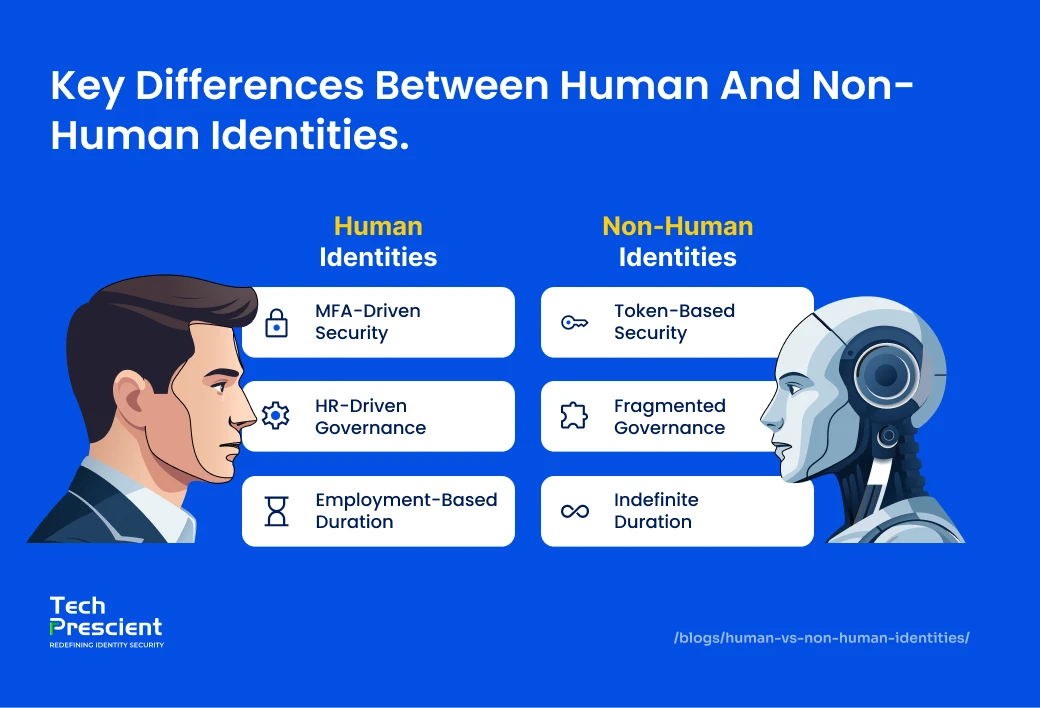
The core difference lies in ownership, lifecycle control, and monitoring: humans follow structured IAM governance, while NHIs often lack centralized visibility.
As organizations expand their digital ecosystems, managing both human and non-human identities has become increasingly complex. While human identities are tied to real people who log in and perform defined roles, non-human identities (NHIs) represent automated entities like applications, bots, and cloud workloads that connect and operate without human intervention. Understanding their distinctions is critical for implementing the right security controls and maintaining visibility across systems.
The following table highlights the major differences between human and non-human identities across their core attributes, management processes, and associated security risks.
Human vs. Non-Human Identities: A Closer Comparison
| Sr. No | Feature | Human Identity | Non-Human Identity |
|---|---|---|---|
| 1 | Entity Type | Represents a real person, such as an employee, partner, or customer, who interacts directly with systems. | Represents an application, device, or service that operates autonomously to perform automated tasks. |
| 2 | Authentication | Uses authentication methods like passwords, multi-factor authentication (MFA), or single sign-on (SSO) to verify user identity. | Uses API keys, access tokens, SSH keys, or digital certificates to enable secure communication between systems or services. |
| 3 | Source of Truth | Managed through centralized systems such as HR databases or Identity and Access Management (IAM) platforms that define and control access. | Typically spread across multiple environments and tools, often lacking a single authoritative source for management. |
| 4 | Lifecycle | Follows a structured employment-based lifecycle from onboarding to deprovisioning when the person leaves the organization. | Has an indefinite or unmanaged lifecycle where identities are created for specific tasks and may persist long after use. |
| 5 | Security Risk | Faces risks like password reuse, phishing, or credential theft that target individuals directly. | Faces risks such as key sprawl, token misuse, and over-permissioned access that can expose systems to large-scale breaches. |
| 6 | Behavior Pattern | Exhibits predictable and structured behavior, typically logging in during work hours and accessing approved applications aligned with defined roles. | Operates autonomously and continuously without human intervention, often running scripts or processes that make behavior patterns harder to track. |
| 7 | Monitoring and Oversight | Regularly reviewed through IT and HR systems that manage access permissions and ensure accountability. | Often lacks consistent visibility or oversight, increasing the chance of unnoticed activities or credential misuse. |
Human & Non-Human Identity Management vs Traditional IAM
Traditional IAM was designed primarily to authenticate human users and enforce role-based access control. Modern enterprises must govern both human and non-human identities within a unified framework to reduce credential sprawl, improve visibility, and maintain compliance.
Where Traditional IAM Is Limited
- Primarily aligned to employee lifecycle management
- Limited visibility into service accounts, API keys, and machine credentials
- No centralized credential or secrets rotation
- Minimal monitoring of machine-to-machine interactions
What Modern Identity Management Requires
- Unified governance across IAM and IGA controls
- Continuous discovery and classification of non-human identities
- Automated credential rotation and expiration enforcement
- Behavioral monitoring across both human and machine identities
- Integration with secrets and workload identity management platforms
IAM enforces authentication and access policies. Modern identity management extends governance across both human and non-human identities with continuous lifecycle control, monitoring, and credential oversight.
Expert Insight
IAM authenticates access, but governance determines whether that access should exist in the first place. Without extending governance to non-human identities, IAM alone leaves blind spots.
Security Risks of Non-Human Identities
Non-Human Identities (NHIs), such as service accounts, workloads, and machine credentials, introduce complex and often invisible security risks. They operate quietly in the background, automating critical processes across cloud, SaaS, and hybrid environments. But unlike humans, these identities typically have static, long-lived credentials and elevated privileges, which is a dangerous combination when left unchecked.
Static and Hardcoded Credentials
Many NHIs rely on hardcoded or long-lived credentials embedded in code, scripts, or configuration files. If these are exposed through a compromised Git repository or insecure storage, attackers can easily harvest them for persistent access. Without regular rotation or visibility, such credentials become ticking time bombs in production systems.
Over-Permissioned and Unmonitored Access
NHIs are frequently over-permissioned, often granted broad, unrestricted access without the guardrails of multi-factor authentication or behavioral monitoring. This overreach, combined with the absence of ownership or lifecycle governance, creates a vast, unmonitored attack surface. Once compromised, an NHI can grant attackers direct entry into critical systems, often undetected by traditional security tools.
Shadow IT and Identity Sprawl
Developers and automation tools continuously spin up new NHIs to support integrations or workloads, often outside formal governance processes. This untracked creation of machine identities, known as identity sprawl, results in unmanaged credentials scattered across environments. Each unmanaged API token, script, or service account expands the organization's exposure and increases the blast radius of any breach.
Real-World Breach Example
The 2024 Snowflake breach is a stark reminder of this risk. Attackers exploited stolen machine credentials that lacked multi-factor authentication, infiltrating customer environments and exfiltrating sensitive data undetected for weeks. The incident affected over 165 organizations, highlighting how a single compromised NHI can escalate into a large-scale breach.
In short, NHIs multiply faster than human accounts, operate with more privileges, and are far harder to monitor, making them one of the most overlooked yet potent risks in modern identity security.
Security Alert
Machine identities often bypass MFA and human-based monitoring controls. If you're not rotating credentials automatically, assume at least one static key is already exposed.
Assess Your Non-Human Identity Exposure
Evaluate visibility gaps, credential controls, ownership, and least privilege for NHIs.
How to Secure and Govern Non-Human Identities
To strengthen security and minimize risk, organizations must manage Non-Human Identities (NHIs) with the same discipline and oversight applied to human users. This means combining automation, continuous monitoring, and centralized governance to keep every machine identity secure and accountable.
Automate Discovery and Classification of NHIs
Start by identifying and cataloging every non-human identity across cloud, SaaS, and on-premises systems. Use automated discovery tools to detect API tokens, service accounts, and workloads. Tagging and classifying these identities by type and function provides visibility, helps prevent identity sprawl, and establishes a foundation for consistent governance.
Enforce the Principle of Least Privilege and Short-Lived Credentials
Grant NHIs only the minimum permissions necessary for their roles, reducing the attack surface. Replace long-lived credentials with short-lived tokens or workload identity federation. When static credentials are required, automate rotation and expiration to minimize exposure and maintain compliance.
Implement Continuous Monitoring with Anomaly Detection
Monitor all NHI activities in real time to detect unauthorized access or unusual patterns. Integrating AI-driven anomaly detection and detailed audit logging ensures rapid response to potential threats and improves visibility across machine-to-machine interactions.
Centralize Secrets and Certificate Management
Use secure secrets management solutions such as CyberArk, HashiCorp Vault, AWS Secrets Manager, or Azure Key Vault to store, encrypt, and rotate credentials. Centralized management ensures consistency, visibility, and faster detection of misuse across all machine identities.
Best Tools for Managing Human and Non-Human Identities in 2025
Effective management of human and non-human identities requires coordinated use of IAM, IGA, secrets management, and machine identity security solutions. Each category addresses a distinct control layer within the identity ecosystem.
| Sr No | Category | Example Tools | Purpose |
|---|---|---|---|
| 1 | IAM | Okta, Azure AD, Ping Identity | Human authentication & SSO |
| 2 | IGA | SailPoint, Saviynt | Access governance & certifications |
| 3 | Secrets Management | CyberArk, HashiCorp Vault, AWS Secrets Manager | Credential storage & rotation |
| 4 | Workload Identity Security | Aembit, Entro | Machine-to-machine authentication |
| 5 | CIEM | Wiz, Orca Security | Cloud entitlement monitoring |
No single category provides complete coverage. IAM enforces authentication, IGA governs access rights, secrets management controls credential lifecycle, and workload identity platforms secure machine authentication. Effective identity programs integrate these capabilities under a unified governance framework to ensure consistent policy enforcement, visibility, and lifecycle control across both human and non-human identities.
6 Best Practices for Managing Human and Non-Human Identities
To minimize the risks associated with unmanaged identities, organizations need a well-defined strategy that clearly distinguishes and secures both human and non-human identities.
Classify and Segment Identities Clearly
Establish defined criteria within your identity management system to separate human and non-human identities. Assign NHIs specific roles and permissions based on their purpose, and use automated tagging and labeling to maintain visibility. Regular audits should be conducted to verify that classifications remain accurate and up to date.
Enforce Granular Access and the Principle of Least Privilege
Limit the access granted to NHIs strictly to what is required for their functions. For example, a token used to read data should not have permissions to modify or delete it. Use dynamic access controls that adapt to context, such as workload, time, location, or security posture, to further minimize risk.
Maintain Continuous Monitoring and Audit Trails
Implement continuous monitoring to track activities of both human and non-human identities and quickly detect suspicious or unauthorized access. Maintain detailed audit logs of actions such as token usage, API calls, and service interactions, and review them regularly to identify potential threats or misuse.
Utilize Automation and AI in Identity Management
Automate the provisioning, updating, and de-provisioning of NHIs to prevent orphaned or unused credentials from remaining active. Incorporate AI-based tools to identify abnormal identity behavior in real time, improving detection and response to potential compromises.
Strengthen Authentication and Token Security
Adopt identity- and posture-aware policy enforcement to continuously validate machine identities based on behavior, context, and risk level. Replace long-lived credentials with short-lived tokens whenever possible, and enforce strict expiration and automated revocation policies to minimize exposure.
Collaborate with SaaS and Third-Party Ecosystems
Work closely with SaaS providers and third-party vendors to ensure their systems distinguish between human and non-human identities and apply appropriate controls. Conduct regular security assessments of external partners to verify that their identity management practices align with your organization's policies and risk framework.
Integrating Human and Non-Human Identity Management
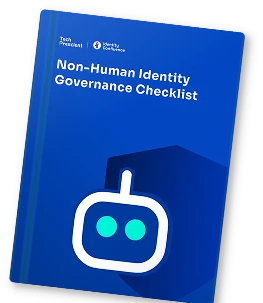
Managing human identities through Identity and Access Management (IAM) and non-human identities (NHIs) through workload or machine identity frameworks should no longer happen in isolation. Bringing both under a unified governance model gives organizations complete visibility into who or what has access to resources and when. This integration strengthens Zero Trust security, enhances compliance, and eliminates blind spots in identity management.
Align IAM (humans) and IGA (governance) for complete oversight
Traditional IAM systems handle human users, defining their roles, permissions, and authentication mechanisms. Identity Governance and Administration (IGA) frameworks oversee provisioning, de-provisioning, and compliance for human identities. However, NHIs such as API tokens, service accounts, and workloads often fall outside these governance cycles, leading to unmanaged access. By extending IGA processes to cover both human and non-human identities, organizations ensure that every identity is included in access reviews, audits, and lifecycle management, establishing consistency, accountability, and ownership.
Map machine identities into the same lifecycle model
Human identities follow clear lifecycle stages that include onboarding, role changes, and offboarding. NHIs, on the other hand, are frequently created on demand by developers or automation tools and left active long after their purpose is fulfilled. To achieve unified control, machine identities should be included in the same lifecycle as human identities: discovery, classification, assignment, access, monitoring, and decommissioning. This approach prevents orphaned accounts and reduces the risk of excessive or lingering permissions.
Implementation Tip
Add machine identities into the same access review cycles used for employees. If it has permissions, it must be certified, regardless of whether it's human or automated.
Apply consistent policies and monitoring across both
When human and non-human identities are managed under separate systems, security inconsistencies can arise. Humans may be subject to MFA, role-based access reviews, and detailed monitoring, while NHIs often operate with static credentials and minimal oversight. A unified framework applies the same security principles to both: the principle of least privilege, credential rotation, contextual access, and real-time monitoring. Centralized dashboards and continuous anomaly detection offer a single pane of visibility into all identity activities, whether initiated by a person or a machine.
How to Monitor Both Human and Non-Human Identity Behavior
Monitoring human and non-human identities requires behavioral analytics, centralized logging, and anomaly detection across authentication events and workload activity. Oversight must extend beyond login activity to include machine-to-machine interactions and credential usage patterns.
For Human Identities:
- Login anomaly detection
- MFA enforcement tracking
- Privilege escalation alerts
- Access review and certification auditing
For Non-Human Identities:
- API key usage monitoring
- Token misuse and abnormal request detection
- Credential expiration and rotation alerts
- Unusual service-to-service communication patterns
Governance Standard:
Implement centralized monitoring that consolidates visibility across both human and machine identities. Unified dashboards and correlated event analysis enable consistent detection, investigation, and policy enforcement across identity types.
The Future of Identity Management: AI and Automation
The future of identity management lies in the seamless blend of artificial intelligence and automation. As organizations handle an increasing number of human and non-human identities, traditional manual processes are no longer enough. AI and automation are becoming the driving forces behind secure, efficient, and scalable identity governance.
AI-driven anomaly detection for unified oversight
AI analyzes patterns across both human and machine identities to identify unusual behaviors, access attempts, or usage trends. This enables security teams to detect potential threats early and respond before they escalate into breaches.
Automated policy enforcement to maintain least privilege
Automated identity workflows ensure that every user and system account is granted only the access needed for specific tasks. By continuously adjusting permissions and rotating credentials, automation helps maintain compliance and reduce attack surfaces.
Predictive analytics for proactive identity risk management
Machine learning models forecast potential access risks and highlight accounts that may become over privileged or inactive. This predictive capability allows organizations to act before vulnerabilities are exploited.
Strengthening Zero Trust through continuous verification
AI and automation reinforce Zero Trust principles by verifying every access request in real time. Continuous authentication ensures that identities, whether human or machine, are always validated within context, creating a dynamic and secure environment.
Together, these advancements are reshaping identity management into an intelligent, self-regulating system that protects data, ensures compliance, and supports the evolving needs of digital enterprises.
Final Thoughts
Human and non-human identities are now at the core of enterprise security, defining how access is granted, managed, and protected across digital ecosystems. While human identities are tied to people, non-human identities represent the growing web of applications, devices, and bots that keep systems running, both demanding equal attention and control.
In today's multi-cloud environments, effective identity management relies on unifying governance for both human and non-human identities. Automating discovery, enforcing the principle of least privilege, and integrating them into modern IAM and IGA frameworks strengthen security while maintaining seamless, compliant access.
FAQs
Non-human identities (NHIs) are digital credentials that allow applications, bots, and machines to access systems or data without human involvement. They use elements like API keys, tokens, and certificates to authenticate. Essentially, they enable automated processes to function securely within digital environments.
Human identities are tied to real people and managed through IAM systems with methods like passwords, MFA, or SSO. Non-human identities, on the other hand, belong to automated entities such as services, devices, or scripts. They rely on credentials like tokens or keys and often operate continuously without manual oversight.
Non-human identities often exist in far greater numbers than human users and can remain active long after they're needed. Because they're easy to create and hard to monitor, they can expand an organization's attack surface. Unmanaged keys or tokens can quickly turn into hidden entry points for cyber threats.
Organizations should adopt centralized secrets management systems to store and rotate credentials securely. Automating discovery and lifecycle management helps identify unused or risky NHIs. Integrating NHI governance within IAM and IGA ensures consistency, compliance, and reduced exposure to misuse.
IAM focuses on controlling access to systems, while IGA adds governance and compliance oversight. Non-human identity management extends both by bringing visibility and control to machine-based identities. Together, they create a unified framework that protects every user and system across the organization.
Traditional IAM focuses on managing employee access, while non-human identity management secures machine credentials such as API keys, tokens, and service accounts. Modern enterprises require both under a unified governance model.
Non-human identities often outnumber human users and operate continuously. Without monitoring, compromised API keys or service accounts can lead to large-scale breaches.
Share



Yatin Laygude
Content Writer
A content writer with 6 years of experience turning complex topics into clear, engaging, and meaningful content. From blogs and web pages to whitepapers and thought pieces, he creates content that not only explains but also connects with both the audience and business goals.
Most Popular Blogs
Identity Security· 21 min read
Data Access Governance Solutions: How to Secure Sensitive Data at Scale
Compare data access governance solutions for 2026: how DAG platforms discover sensitive data, run access reviews, automate remediation, and prove compliance.
Brinda Bhatt· September 7, 2026
Identity Security· 24 min read
What Is Zero Trust Network Access (ZTNA)?
Learn what Zero Trust Network Access (ZTNA) is, how it works, and why it’s replacing VPNs for secure, identity-based access control.
Yatin Laygude· August 14, 2026

Identity Security· 24 min read
Cyber Essentials Certification: Complete Guide
Learn Cyber Essentials certification, cost, requirements, and steps. Compare Cyber Essentials vs Plus and get certified faster.
Yatin Laygude· August 10, 2026