




On this page
See Tech Prescient in Action
Automate access, reduce risk, and stay audit-ready
Identity and access management (IAM) metrics provide measurable insight into how effectively identity controls protect the organization and govern access to systems, applications, and data. Metrics such as access review completion, orphaned account detection, privileged access usage, and multi-factor authentication adoption help security and IT leaders assess both risk exposure and control maturity.
When applied consistently, IAM metrics act as proof points for identity security posture. They demonstrate whether access controls, governance processes, and risk mitigation efforts are functioning as intended. Effective measurement enables organizations to identify misconfigurations, enforce least-privilege access, and systematically improve IAM maturity over time.
According to the 2025 Ponemon-Sullivan Privacy Report, only 20% of organizations say they have fully adopted Zero Trust, and only 24% have fully implemented passwordless authentication, showing that many are still catching up in key IAM practices.
In this blog, we'll walk through the IAM metrics that truly matter, why they're important, and how they can help you strike the right balance between security, compliance, and productivity.
Key Takeaways:
- Understand which IAM metrics directly reflect identity security posture and access effectiveness
- Discover the top 9 IAM metrics every organization should track in 2026
- Learn how IAM metrics act as proof points for converged identity programs (IAM + IGA)
- Explore best practices and dashboards to improve and monitor IAM metrics
- See real-world use cases and future trends shaping IAM metrics with AI and Zero Trust
What are Identity and Access Management (IAM) Metrics?
Identity and Access Management (IAM) metrics are quantifiable measures used to evaluate how effectively identities are governed, access is enforced, and risk is managed across users, applications, and data. These metrics track how users are authenticated, authorized, and managed, giving businesses the clarity to spot weaknesses, improve processes, and stay compliant with regulations.
By monitoring IAM metrics, organizations can validate whether their identity governance framework is meeting its objectives. For example, a rising authorization failure rate may indicate that access controls are too restrictive, while a consistently high authentication success rate shows that the login process is smooth and user-friendly.
Tracking IAM metrics provides visibility into:
- The overall security posture of the IAM infrastructure
- The speed and accuracy of onboarding and offboarding users
- Compliance alignment with regulatory requirements
- The ability to detect and respond to insider and external threats
Organizations that consistently track and analyze their IAM metrics, especially when following Gartner's IAM metrics best practices, are better equipped to identify risks early, prevent breaches, and maintain a seamless user experience.
Why IAM Metrics Are Important
IAM metrics are important because they translate identity controls into measurable outcomes across security, compliance, operational efficiency, and risk reduction.
By tracking and analyzing these indicators, organizations gain the visibility needed to strengthen governance and continuously improve their identity programs.
Reducing insider threats:
IAM metrics provide visibility into user access patterns and privilege escalations, helping security teams detect anomalies that may indicate insider misuse. Continuous tracking ensures that users retain only the access necessary for their roles, limiting opportunities for abuse.
Improving operational efficiency:
Metrics that measure provisioning, deprovisioning, and access approval times streamline the onboarding and offboarding process. Faster and more accurate adjustments reduce administrative overhead while ensuring employees and contractors have the right level of access at the right time.
In short, IAM metrics are essential for creating a secure, compliant, and efficient identity environment while driving continuous improvement and supporting business resilience.
What Metrics Should You Track to Measure Identity Security Posture?
Identity security posture is defined by how consistently access is governed, how quickly risk is reduced, and how effectively least-privilege and Zero Trust principles are enforced across the environment.
Accurately measuring posture requires moving beyond surface-level IAM reporting and focusing on metrics that demonstrate control effectiveness across five core dimensions:
Coverage
Visibility into who has access to which systems, applications, and data, across on-premises and cloud environments.
Control
The extent to which access policies are enforced, including least-privilege adherence, multi-factor authentication adoption, and privileged access usage.
Governance
The reliability and completeness of access reviews, certifications, and segregation-of-duties enforcement.
Risk
Indicators of elevated exposure, including orphaned or dormant accounts, anomalous access behavior, and authentication failure trends.
Efficiency
The speed and consistency of access provisioning and revocation, adherence to deprovisioning SLAs, and the effectiveness of automation.
Taken together, these metrics provide clear, defensible answers to executive-level questions: Are we secure? Are we compliant? Can we demonstrate it?
9 Core IAM Metrics for Identity Security
The following IAM metrics provide direct insight into access risk, governance maturity, and identity security effectiveness.
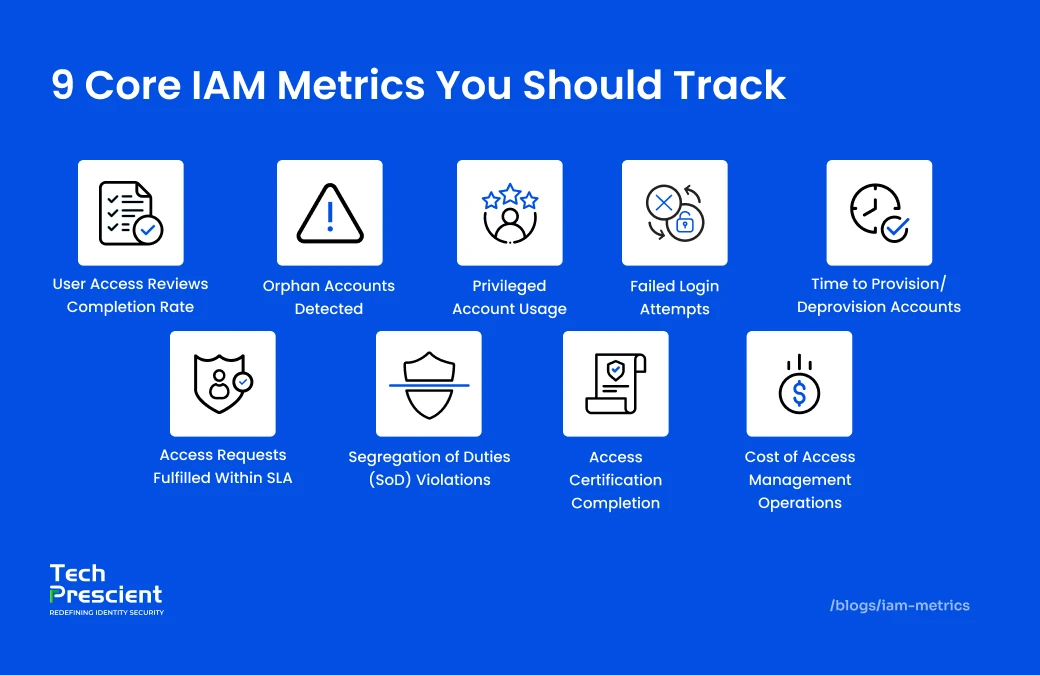
User Access Reviews Completion Rate
User access reviews completion rate measures how consistently organizations verify that users still require the access they hold. It reflects whether scheduled recertifications are completed in time and ensures permissions remain aligned with current roles and responsibilities. A strong completion rate helps eliminate outdated or unnecessary access that can lead to privilege creep and compliance failures. Automating reminders, simplifying role-based reviews, and scheduling periodic checks are effective ways to maintain high completion and reduce security gaps.
Orphan Accounts Detected
Orphaned accounts pose a significant security risk by creating unauthorized access points to organizational resources. These accounts typically belong to employees who have left the company or contractors whose projects have ended. If not deactivated promptly, they leave the environment vulnerable to exploitation.
To address this, it is critical to ensure that accounts are properly deactivated during the offboarding process of employees and contractors. Even with automated IAM systems in place, errors, delays, or oversights can still occur.
Key metrics for identifying orphan accounts include:
- Inactive Users: Accounts not used for login within a defined period, often referred to as dormant accounts. Many organizations set the threshold at around 90 days of inactivity.
- Never-Logged-In Users: Accounts created but never actually used for login.
- Uncorrelated User Accounts (Ghost Accounts): Accounts that are not linked to any active user record.
- User Accounts with Inactive Status: Accounts marked with an inactive attribute in the IAM system, such as an employment status of "retired" or an activity status of "inactive." Reviewing these attributes helps flag potential inactivity.
Privileged Account Usage
Privileged accounts, such as administrator or root accounts, hold elevated permissions to critical systems and must be closely monitored. Tracking their activity helps organizations understand how often these accounts are used and by whom. Unusual usage patterns, like logins outside business hours or privilege escalations, may indicate misuse or compromise. Enforcing the principle of least privilege, enabling multifactor authentication, and logging every action are vital steps in preventing privileged account abuse.
Failed Login Attempts
The number of failed login attempts is a useful metric for spotting brute-force attacks, credential stuffing, or weak password practices. A sudden rise in login failures can indicate an attacker systematically guessing passwords. Establishing thresholds for failed attempts, triggering alerts, and locking accounts temporarily after repeated failures are effective defenses. Combined with multi-factor authentication and rate limiting, this metric becomes a powerful early-warning indicator against external attacks.
Time to Provision/Deprovision Accounts
This metric tracks how long it takes to grant access to a new user or remove access when someone changes roles or leaves. Fast provisioning supports productivity, while timely deprovisioning is crucial for security. Delays in deprovisioning create windows of opportunity for unauthorized access, while provisioning delays frustrate employees and slow work. Automating lifecycle management and tying access directly to HR events improves both efficiency and compliance.
Access Requests Fulfilled Within SLA
Access request turnaround time shows how efficiently organizations process access approvals within defined service levels. This directly impacts user productivity and the smooth flow of business operations. Automation of low-risk requests, use of self-service portals, and clearly defined SLAs help reduce delays. Monitoring this metric helps identify bottlenecks and ensures access is delivered promptly without unnecessary administrative overhead.
Segregation of Duties (SoD) Violations
SoD violations occur when users are assigned conflicting roles that create opportunities for fraud or misuse, such as approving and processing the same transaction. Tracking this metric ensures that critical business processes remain free of conflicts. Auditors often flag SoD violations as high risk, making regular monitoring essential. Defining clear SoD policies, automating conflict checks, and remediating violations quickly not only reduces fraud risk but also strengthens audit readiness.
Access Certification Completion
Access certification measures how effectively managers or data owners review and confirm user access. Completion rates indicate whether these campaigns are being carried out as intended. High completion rates reduce the risk of unauthorized or excessive access while ensuring audit compliance. Making reviews intuitive for managers, scheduling regular certification campaigns, and escalating overdue tasks are proven ways to improve this metric.
Cost of Access Management Operations
This metric evaluates the expenses associated with IAM, including tool licensing, helpdesk support, manual reviews, and labor hours. It provides a clear view of how much effort and money go into managing access. Tracking these costs helps organizations identify inefficiencies and calculate the ROI of automation. By breaking down and benchmarking expenses, businesses can optimize resource allocation and demonstrate the value of IAM investments.
How Do Your IAM Metrics Compare?
Score governance, privilege, and lifecycle maturity in minutes
Benefits of Tracking IAM Metrics
Tracking IAM metrics strengthens identity security posture by improving threat detection, compliance readiness, risk control, and operational efficiency. Rather than serving as static reports, these metrics provide continuous insight into whether identity controls are working as intended and where corrective action is required.
Enhanced Security
IAM metrics give organizations real-time visibility into user activity, making it easier to spot anomalies and prevent threats before they escalate. By monitoring failed login attempts, privilege misuse, and unusual access patterns, security teams can act proactively rather than waiting for a breach. Here, the real benefit lies in being able to:
- Detect brute-force attempts, credential stuffing, or insider misuse early on
- Reduce the attack surface by eliminating orphan or unused accounts that attackers often target
- Accelerate incident response through real-time alerts tied directly to identity events
Regulatory Compliance
For businesses operating under SOX, GDPR, HIPAA, or PCI DSS, compliance demands ongoing proof that access policies are enforced. IAM metrics make this seamless by offering audit-ready evidence at any time, eliminating the scramble for reports during inspections. In practice, these metrics help organizations:
- Generate reliable reports that satisfy auditors quickly and accurately
- Demonstrate consistent enforcement of IAM policies across systems
- Reduce regulatory penalties while also reinforcing customer and partner trust
Risk Reduction
Every unchecked identity increases exposure to fraud, insider threats, or operational mistakes. IAM metrics highlight these vulnerabilities by surfacing orphan accounts, segregation of duties (SoD) violations, and unused privileges that might otherwise slip through the cracks. This means businesses can:
- Uncover and remediate orphan accounts before attackers or insiders exploit them
- Detect SoD violations that could lead to financial fraud or policy breaches
- Minimize insider threats by keeping privileged access under tighter control
- Strengthen governance and prevent gaps from surfacing during audits
Support Zero Trust
Zero Trust depends on continuous verification, and IAM metrics provide the insights needed to enforce it effectively. By tracking contextual access behavior, authentication trends, and privilege usage, organizations can enforce adaptive, risk-based policies. For example, metrics in a Zero Trust model enable security teams to:
- Monitor user access against device, location, and behavioral context
- Apply dynamic access decisions informed by real-time identity data
- Continuously validate privileges instead of relying on one-time approvals
Cost Optimization
IAM metrics also expose inefficiencies in access management processes and tooling. By measuring manual effort, request volumes, and unused entitlements, organizations can reduce cost while improving service reliability.
- Eliminate unnecessary software licenses and duplicate access rights
- Reduce IT workload through automation and employee self-service features
- Demonstrate ROI by showing cost savings tied directly to IAM improvements
Challenges in Tracking IAM Metrics
Organizations often struggle to track IAM metrics consistently due to fragmented data sources, manual reporting processes, and unclear ownership across teams. While IAM metrics can provide meaningful insights, these challenges limit their reliability and usefulness if left unaddressed.
These challenges usually arise from structural, technical, and organizational gaps that slow down effective monitoring.
Data Silos
A common hurdle in IAM metric tracking comes from scattered data across multiple platforms. Identity information lives in cloud applications, on-premises systems, and HR tools, each capturing events in its own format. Because of this fragmentation, pulling everything together into a unified view becomes a major task. The lack of consolidation creates blind spots that weaken visibility and make decision-making less reliable.
Manual Reporting
Another issue many teams face is the reliance on outdated reporting methods. Spreadsheets and manual data pulls remain the default way of tracking IAM performance in many organizations. This approach consumes valuable time and often introduces human errors. As a result, reporting cycles drag on, accuracy suffers, and organizations find it harder to be audit-ready when regulators or stakeholders demand proof.
Lack of Ownership
The responsibility for IAM metrics often falls into a gray area, with different teams owning different pieces of the process. Security focuses on authentication, HR manages onboarding, and IT handles provisioning, but no one has end-to-end accountability. Without a single owner, metrics are tracked inconsistently, definitions vary across teams, and the organization never gains a complete picture of its identity security posture.
Best Practices for Improving IAM Metrics
Improving IAM metrics requires more than collecting data. It depends on aligning measurement with business objectives, automating identity processes, and continuously monitoring access risk. The following practices help organizations turn IAM metrics into reliable, actionable controls.
The following best practices help transform IAM metrics into actionable levers that drive meaningful outcomes.
Define KPIs Aligned with Business Goals
IAM metrics are most effective when they directly support organizational objectives. Instead of focusing on vanity numbers, companies should select KPIs that improve compliance, efficiency, or user satisfaction. Clear alignment ensures that every IAM metric provides value to both IT and business stakeholders.
- Track onboarding and offboarding timelines to measure process efficiency
- Monitor authentication success rates for insights into usability and security
- Measure audit and compliance completion rates to ensure readiness
Automate Provisioning and Deprovisioning
Manual provisioning creates delays and security blind spots, while slow deprovisioning often leaves orphaned accounts open to exploitation. Automating the identity lifecycle minimizes risk and speeds up access for legitimate users, making IAM processes more reliable and secure.
- Reduce provisioning and deprovisioning times to improve efficiency
- Eliminate orphaned or inactive accounts through automated workflows
Implement MFA Everywhere
Multi-factor authentication is a baseline control for reducing credential-based risk. Tracking MFA adoption and enforcement rates provides insight into coverage gaps and control effectiveness, while authentication metrics help identify both security risks and user friction.
- Track MFA adoption and enforcement rates across the organization
- Monitor login success and failure trends to identify friction points
- Evaluate user experience to balance security with usability
Regular Access Certifications
Periodic access certifications are essential for enforcing least privilege and maintaining governance integrity. Measuring completion rates and remediation outcomes ensures reviews are not only performed but also acted upon.
Effective tracking includes:
- Certification completion within defined timeframes
- Percentage of access adjusted or revoked following reviews
Continuous Monitoring
IAM metrics should not be static snapshots but part of a continuous monitoring cycle. Real-time visibility into login activity, unusual access attempts, and privilege escalations enables quicker detection and response to threats.
- Measure time to detect identity-related incidents
- Track time to respond to and remediate security issues
- Monitor trends in failed or suspicious login activity
Industry Use Cases of IAM Metrics
IAM metrics are applied differently across industries based on regulatory obligations, operating models, and threat exposure. Tailoring IAM measurement to sector-specific requirements allows organizations to strengthen identity controls while meeting compliance expectations more efficiently.
Banking & Finance
Financial institutions operate in high-risk environments where privileged access and transaction integrity are primary targets. IAM metrics such as privileged account usage, MFA enforcement, and access review completion provide early indicators of misuse or control breakdowns. These metrics also support ongoing compliance with financial regulations by producing repeatable evidence for audit and risk oversight functions.
Healthcare
Healthcare organizations must protect sensitive patient records while maintaining strict HIPAA compliance. Tracking failed logins helps detect potential credential misuse, while keeping an eye on orphan accounts ensures that only authorized staff have access to medical data. IAM metrics also support smoother access reviews, which are essential to proving compliance during audits and safeguarding patient trust in electronic health systems.
Retail & E-Commerce
Retailers and e-commerce companies often struggle with high employee turnover and seasonal workforce expansion. IAM metrics help measure how quickly departing employees are deprovisioned and highlight potential segregation-of-duties issues that could lead to fraud. During peak seasons, monitoring access activity becomes even more critical, as it reduces insider threats while ensuring operations run without disruption for millions of customers.
Technology & SaaS
Technology companies and SaaS providers must maintain customer trust while constantly adapting to evolving security standards. Metrics around risk-based authentication provide valuable insights into whether users are accessing systems from safe contexts, while automation in compliance reporting reduces audit fatigue. For organizations embracing Zero Trust, IAM metrics become the backbone of proving both security maturity and a customer-first approach.
IAM Metrics as Proof Points for Converged Identity Effectiveness
Converged identity effectiveness is demonstrated when IAM metrics, governance controls, and access analytics operate together to consistently reduce risk and enforce access policy. In this model, metrics move beyond system-level reporting and serve as objective evidence that identity processes are functioning as an integrated control framework.
In modern enterprise environments, IAM does not operate independently. When integrated with Identity Governance and Administration (IGA), privileged access controls, and analytics, IAM metrics provide measurable validation of end-to-end identity effectiveness rather than isolated tool performance.
Key proof metrics include:
- Time to access for employees, contractors, and partners, reflecting lifecycle automation and process reliability
- Revocation SLA adherence following role changes or terminations, indicating risk containment effectiveness
- Access certification accuracy across critical systems, demonstrating governance consistency
- Reduction in orphaned and over-privileged accounts, confirming sustained access hygiene
Together, these metrics answer a fundamental question for security and audit leaders: whether identity controls are consistently enforced in practice—not simply deployed in architecture.
Future of IAM Metrics: AI, Zero Trust & Real-Time Compliance
The future of IAM metrics is defined by real-time analysis, behavioral context, and continuous enforcement of access policy. As identity environments grow more distributed and threat patterns become less predictable, metrics must evolve from retrospective reporting to active risk signaling and control validation.
Rather than measuring only what has already occurred, next-generation IAM metrics are increasingly used to anticipate risk, support Zero Trust enforcement, and provide continuous evidence of compliance.
AI anomaly detection & predictive analytics to spot risks in real time
Machine learning techniques are being applied to identity data to identify abnormal behavior that deviates from established patterns. By correlating historical authentication activity, access changes, and device context, AI-driven metrics can surface elevated risk earlier than manual review processes. This shift reduces exposure windows and supports more proactive access decisions.
Zero Trust trust score metrics for users, devices, and sessions
Zero Trust demands that no identity, device, or session is automatically trusted. Future IAM systems will assign trust scores based on context such as location, device posture, past behavior, and risk level. These trust scores help enforce fine-grained policies and dynamic access controls. With trust score metrics, organizations can better quantify how zero-trust their environment truly is and show progress over time.
Behavioral monitoring to detect insider threats and abnormal access
Metrics driven by user and entity behavior analytics (UEBA) are becoming central to detecting risks originating from within. Rather than simply counting failed logins or expired credentials, future IAM metrics will chart deviation from normal behavior, such as sudden escalations of privilege, access outside typical hours, or unusual access to sensitive data. These help catch threats earlier, whether from negligent insiders or malicious actors.
Unified multi-cloud metrics for hybrid and SaaS environments
As identity spans on-premises systems, cloud platforms, and SaaS applications, IAM metrics must aggregate data across environments to remain meaningful. Unified metrics that combine access activity, entitlement data, device signals, and compliance state provide consistent visibility, simplify audits, and enable policy enforcement at scale.
Final Thoughts
Identity and Access Management (IAM) metrics are no longer limited to operational reporting. They serve as measurable proof of identity security posture, governance maturity, and access effectiveness across the enterprise. When applied consistently, these metrics translate identity controls into verifiable outcomes that security, audit, and business leaders can trust.
In an identity-centric operating model, the right metrics convert raw identity data into actionable insight. They enable earlier risk detection, simplify audit readiness, and support continuous optimization of access controls as environments scale and evolve.
Tech Prescient helps organizations move beyond fragmented reporting by delivering real-time visibility across IAM, governance, and access risk. By measuring access reviews, lifecycle controls, privileged activity, and Zero Trust enforcement, organizations can focus on outcomes that matter: reduced risk, sustained compliance, and operational efficiency.
IAM metrics should not exist solely to satisfy audit requirements. When treated as control signals, they become a foundation for stronger identity governance and long-term resilience.
How Do Your IAM Metrics Compare?
Score governance, privilege, and lifecycle maturity in minutes
FAQs
The four pillars of IAM, authentication, authorization, administration, and auditing, form the foundation of secure access. Together, they ensure the right users get the right access at the right time, while maintaining control and visibility.
IAM metrics act as audit-ready proof for regulations like SOX, GDPR, and HIPAA. By tracking access reviews, SoD violations, and provisioning timelines, organizations can demonstrate compliance and avoid penalties with confidence.
The 4 A's, authentication, authorization, administration, and audit, represent the core processes of identity governance. They help validate user identities, manage access rights, oversee identity lifecycles, and ensure accountability.
IAM rests on three principles: verify identity, enforce least privilege, and continuously monitor. This ensures that only the right people access the right resources, with ongoing oversight to catch risks early.
IAM metrics should be tracked continuously to spot risks in real time, but formal reviews should happen at least quarterly. This cadence supports compliance, reduces insider threats, and keeps your IAM program audit-ready.
Share



Yatin Laygude
Content Writer
A content writer with 6 years of experience turning complex topics into clear, engaging, and meaningful content. From blogs and web pages to whitepapers and thought pieces, he creates content that not only explains but also connects with both the audience and business goals.
Most Popular Blogs

Identity Security· 21 min read
Data Access Governance Solutions: How to Secure Sensitive Data at Scale
Compare data access governance solutions for 2026: how DAG platforms discover sensitive data, run access reviews, automate remediation, and prove compliance.
Brinda Bhatt· September 7, 2026

Identity Security· 24 min read
What Is Zero Trust Network Access (ZTNA)?
Learn what Zero Trust Network Access (ZTNA) is, how it works, and why it’s replacing VPNs for secure, identity-based access control.
Yatin Laygude· August 14, 2026

Identity Security· 24 min read
Cyber Essentials Certification: Complete Guide
Learn Cyber Essentials certification, cost, requirements, and steps. Compare Cyber Essentials vs Plus and get certified faster.
Yatin Laygude· August 10, 2026