




On this page
See Tech Prescient in Action
Automate access, reduce risk, and stay audit-ready
An IT compliance audit evaluates whether an organization's technology systems, security controls, and policies meet regulatory requirements and industry standards. These audits verify that systems handling sensitive data operate securely and follow recognized compliance frameworks.
As organizations adopt cloud services, remote work, and SaaS platforms, the scope of IT compliance audits has expanded significantly. Regulators and customers increasingly require organizations to demonstrate that security controls align with recognized IT audit standards.
This guide explains what an IT compliance audit is, how internal and external audits differ, the major compliance frameworks organizations must follow, and the checklist auditors commonly evaluate in 2026.
Key Takeaways:
- IT compliance audits evaluate whether security controls, IT systems, and policies meet regulatory requirements and recognized IT audit standards.
- Organizations conduct IT compliance audits to verify data protection controls, demonstrate regulatory compliance, and maintain security certifications.
- Common IT audit frameworks include ISO 27001, SOC 2, PCI DSS, HIPAA, GDPR, and the NIST Cybersecurity Framework.
- Preparing for an IT compliance audit requires access governance, documented security controls, continuous monitoring, and strong identity management.
What Is an IT Compliance Audit
An IT compliance audit is a formal assessment that verifies whether an organization's technology systems, security controls, and policies comply with regulatory requirements, industry standards, and internal governance rules.
During the audit, auditors evaluate systems, security controls, documentation, and operational processes to determine whether required IT audit standards are being followed. The goal is not only to confirm compliance but also to identify gaps that could expose the organization to security risks or regulatory penalties.
IT compliance audits are especially important for organizations operating in regulated industries such as finance, healthcare, SaaS, and e-commerce. These sectors must prove that they protect sensitive data, maintain secure systems, and follow strict governance practices. Regular audits help demonstrate that controls such as access management, encryption, logging, and incident response are implemented and functioning correctly.
Most compliance certifications are not permanent. Many frameworks require periodic reassessment or annual audits to maintain certification status. For example, organizations pursuing SOC 2 or ISO 27001 must demonstrate that their controls remain effective over time, not just during the initial certification.
Compliance Audit Example
For example, a financial institution undergoing a compliance audit may be required to demonstrate that customer data is encrypted, access to sensitive systems is restricted using role-based access controls, multi-factor authentication is enforced, and disaster recovery plans are tested regularly. Auditors will verify that these controls are implemented and supported with documentation, logs, and policy evidence.
Internal vs External IT Compliance Audit
Internal IT audits evaluate security controls and processes within the organization, while external IT audits are performed by independent auditors to verify compliance with regulatory frameworks or certification standards.
Internal IT Compliance Audit
An internal IT compliance audit is conducted by an organization's own security, risk, or audit teams. The purpose is to evaluate whether internal policies, security controls, and operational processes are working as intended.
Internal audits typically review areas such as:
- Access management
- Security policies
- System configurations
- Change management processes
- Incident response practices
These assessments help identify weaknesses before they become security incidents or regulatory violations.
The primary goal of internal audits is risk reduction and continuous improvement. Organizations use them to strengthen security controls, prepare for external audits, and ensure that teams follow established policies consistently.
External IT Compliance Audit
An external IT compliance audit is performed by an independent third-party auditor or certified audit firm. These audits verify whether an organization meets the requirements of recognized frameworks, regulations, or certification programs.
External audits are often required for standards such as SOC 2, ISO 27001, PCI DSS, HIPAA, or regulatory compliance programs. Auditors evaluate evidence such as security documentation, system configurations, activity logs, and governance processes to confirm that controls meet the required standards.
Because the audit is conducted by an independent party, the results carry greater credibility. Successful external audits help organizations demonstrate compliance to regulators, partners, and customers, building trust and reducing business risk.
Internal vs External IT Compliance Audit Comparison
| Aspect | Internal IT Compliance Audit | External IT Compliance Audit |
|---|---|---|
| Conducted By | Internal security, risk, or audit teams | Independent third-party auditors |
| Primary Purpose | Improve internal controls and identify risks | Validate compliance with external standards |
| Scope | Security policies, processes, operational controls | Regulatory frameworks and certification requirements |
| Frequency | Regularly scheduled or ongoing | Periodic (annual or certification cycles) |
| Outcome | Internal improvements and readiness | Formal audit report or certification |
| Business Impact | Helps prepare for external audits | Builds trust with regulators and customers |

Pro Tip
Organizations that run regular internal audits usually pass external compliance audits with significantly fewer remediation findings.
Types of Internal IT Compliance Audits
Internal IT audits can focus on different aspects of an organization's technology environment, including operational performance, regulatory compliance, system security, and financial oversight. Each audit type evaluates specific controls to ensure IT systems operate securely, efficiently, and in alignment with business objectives.
1. Operational Audits
Operational IT audits evaluate how efficiently IT services and processes support business operations. These audits review areas such as incident management, service delivery processes, system availability, and IT support workflows.
For example, auditors may assess whether incidents are resolved within defined service-level agreements (SLAs), whether system downtime is properly documented, and whether operational processes follow established procedures. The goal is to identify inefficiencies, improve service reliability, and ensure that IT operations run smoothly.
2. Compliance Audits
Compliance audits verify that the organization follows applicable regulations, industry standards, and internal security policies. These audits ensure that required controls are implemented and documented correctly.
Auditors typically review areas such as access controls, data protection policies, logging practices, and regulatory reporting requirements. Compliance audits are especially important for organizations subject to frameworks such as HIPAA, PCI DSS, SOC 2, or GDPR, where failure to comply may lead to penalties or certification issues.
3. Information Systems Audits
Information systems audits focus on the security and resilience of the organization's IT infrastructure. This includes reviewing system configurations, network security controls, patch management processes, and data protection measures.
Auditors evaluate whether systems are protected against common threats such as unauthorized access, data breaches, and service disruptions. These audits also examine how organizations handle backup processes, disaster recovery planning, and overall cyber resilience.
4. Financial Audits (IT Context)
Financial audits within IT evaluate how technology investments, budgets, and spending are managed. The goal is to ensure that IT resources are used responsibly and align with business priorities.
These audits may examine IT procurement processes, software licensing costs, cloud spending, infrastructure investments, and vendor contracts. They help organizations identify unnecessary costs, improve financial accountability, and ensure that technology investments deliver measurable value.
Why You Need to Perform an IT Compliance Audit
Organizations perform IT compliance audits to protect sensitive data, demonstrate regulatory compliance, and identify security gaps before they lead to breaches or penalties.
Protect customer data and maintain trust
Customers and partners expect organizations to handle sensitive data responsibly. IT compliance audits confirm that security controls, such as encryption, access management, and monitoring, are properly implemented to protect personal and business information.
Mandatory regulatory compliance
Many industries must follow strict regulatory requirements related to data security and privacy. IT compliance audits ensure that organizations meet the standards set by frameworks and regulations, helping avoid penalties, legal issues, or certification failures.
Strengthen competitive trust signals
Demonstrating strong compliance practices can provide a competitive edge. Certifications and successful audit reports signal to customers, partners, and investors that the organization takes security and governance seriously.
Auditor attestation and credibility
Independent audit results provide formal verification that an organization's systems and controls meet recognized standards. This third-party validation builds credibility with regulators, auditors, and stakeholders.
Reduce exposure to cyber threats
Compliance audits often uncover security gaps such as weak access controls, outdated systems, or missing monitoring mechanisms. Addressing these issues reduces the organization's attack surface and strengthens its ability to defend against cyberattacks.
Are You Ready for Your Next Compliance Audit?
Score your security controls and identify compliance gaps before auditors do
Major IT Compliance Regulatory Frameworks
IT compliance audits are typically based on recognized regulatory frameworks and security standards. These frameworks define how organizations should manage data protection, access control, monitoring, and risk management.
Below are some of the most widely adopted IT audit standards and regulatory frameworks used in modern compliance programs.
1. HIPAA – Healthcare Data Protection
The Health Insurance Portability and Accountability Act (HIPAA) governs how healthcare organizations protect sensitive patient data. IT audits under HIPAA focus on safeguarding electronic protected health information (ePHI). Auditors typically review access controls, encryption practices, audit logging, and breach notification procedures to ensure patient data is handled securely.
2. PCI DSS – Payment Card Security
The Payment Card Industry Data Security Standard (PCI DSS) applies to organizations that process, store, or transmit payment card information. IT compliance audits for PCI DSS verify controls such as secure payment processing environments, strong authentication, network segmentation, encryption, and vulnerability management.
3. SOC 2 – Cloud Service Provider Controls
SOC 2 audits evaluate how service organizations manage customer data based on five trust principles: security, availability, processing integrity, confidentiality, and privacy. Technology companies and SaaS providers commonly undergo SOC 2 audits to demonstrate that their infrastructure and processes meet strong security and governance standards.
4. ISO 27001 – ISMS and Risk Management
ISO 27001 is an international standard for establishing and maintaining an Information Security Management System (ISMS). Organizations implementing ISO 27001 must demonstrate structured risk management, access governance, asset management, security monitoring, and incident response processes. Regular audits confirm that the ISMS continues to operate effectively.
5. GDPR – EU Data Protection Regulation
The General Data Protection Regulation (GDPR) governs how organizations collect, process, and protect personal data of individuals in the European Union. IT audits for GDPR focus on data protection controls, privacy safeguards, consent management, data retention policies, and breach reporting processes.
6. NIST Cybersecurity Framework (NIST CSF)
The NIST Cybersecurity Framework (CSF) provides a widely used structure for managing cybersecurity risks. It organizes security practices across five core functions: identify, protect, detect, respond, and recover. Many organizations use NIST CSF as a foundation for building their cybersecurity and IT audit compliance programs.
| Framework | Primary Focus | Organizations That Use It |
|---|---|---|
| HIPAA | Protection of healthcare and patient data | Healthcare providers, insurers |
| PCI DSS | Payment card transaction security | Retailers, payment processors |
| SOC 2 | Data protection and operational trust | SaaS providers, technology companies |
| ISO 27001 | Information security management systems | Global enterprises across industries |
| GDPR | Personal data protection and privacy | Organizations handling EU resident data |
| NIST CSF | Cybersecurity risk management framework | Government agencies and enterprises |
IT Compliance Audit Checklist for 2026
Preparing for an IT compliance audit requires reviewing key technical and governance controls across systems, infrastructure, and security processes. Organizations must ensure required safeguards are implemented, documented, and functioning effectively.
Auditors rely on structured evaluation criteria when performing an IT compliance audit. The checklist below highlights the most common controls organizations must prepare before an audit.
1. Define scope and applicable regulations
Identify which systems, data, and processes fall within the audit scope and determine the relevant compliance frameworks.
2. Enforce least privilege and multi-factor authentication (MFA)
Ensure user access follows least-privilege access principles and that strong authentication protects sensitive systems.
3. Verify encryption and backup protections
Confirm that sensitive data is encrypted in transit and at rest, and that reliable backup mechanisms exist.
4. Review network security and patch management
Check that systems are regularly updated, vulnerabilities are patched, and network defenses are properly configured.
5. Test incident response plans
Validate that documented incident response procedures exist and that teams can detect, respond to, and recover from security incidents.
6. Assess third-party vendors and integrations
Evaluate whether vendors and service providers meet required security and compliance standards.
7. Enable continuous monitoring and logging
Ensure security monitoring tools capture user activity, system events, and audit logs needed for compliance evidence.
Pro Tip
Access reviews are one of the first things auditors check. Regularly reviewing user permissions and removing unnecessary access can prevent many audit findings.
Common IT Audit Findings in 2026
During an IT compliance audit, auditors frequently identify governance gaps, missing documentation, or poorly enforced security controls. These findings often reveal weaknesses in access management, patching, or change management practices.
Many audit findings are caused not by missing tools but by inconsistent governance, incomplete documentation, or poorly enforced policies. Addressing these gaps helps organizations strengthen their security posture and meet required IT audit standards.
Common findings in IT compliance audits include:
- Inadequate user access reviews: Organizations often fail to review user permissions regularly. This can lead to excessive privileges, orphaned accounts, or employees retaining access after role changes.
- Missing patches or outdated systems: Auditors frequently identify systems running outdated software or missing security patches. Unpatched vulnerabilities increase the risk of exploitation and indicate weak patch management practices.
- Poor change management documentation: Changes to systems, configurations, or infrastructure may occur without proper documentation or approval workflows. Without clear records, auditors cannot verify whether changes followed approved security procedures.
Identifying and resolving these issues early helps organizations maintain stronger IT audit compliance and reduces the likelihood of audit failures.
How to Pass an IT Compliance Audit
Passing an IT compliance audit requires structured preparation, clear governance processes, and continuous monitoring of security controls.
Compliance preparation is not a one-time effort. Organizations pass IT compliance audits by implementing strong security controls, maintaining documentation, and continuously monitoring access and system activity. Establishing clear ownership and maintaining strong security controls makes the audit process far smoother.
The following practices help organizations meet IT audit requirements and prepare effectively for compliance assessments.
Compile Applicable IT Regulations
The first step is identifying which regulatory frameworks apply to the organization. Some frameworks are mandatory based on industry or geography, while others are voluntary certifications used to demonstrate strong security practices. Clearly defining applicable standards helps determine the controls and documentation auditors will expect.
Appoint a Data Protection Officer
Many organizations designate a Data Protection Officer (DPO) or compliance lead responsible for overseeing regulatory requirements and security governance. This role helps coordinate compliance activities across departments, maintain policies, and ensure that required security controls remain aligned with regulatory expectations.
Conduct Risk Assessments
Risk assessments identify critical systems, sensitive data, and potential vulnerabilities that could impact compliance. Organizations evaluate assets, threats, and weaknesses to determine where stronger controls or monitoring are required.
Perform Regular Self-Audits
Internal self-audits help organizations evaluate their readiness before external auditors review the environment. Using official compliance checklists allows teams to detect gaps early and resolve issues before formal IT compliance audits take place.
Implement Required Controls
Organizations must implement the security controls required by relevant frameworks. These typically include identity and access management (IAM), access control policies, encryption, monitoring, and incident response capabilities. Strong control implementation demonstrates that compliance requirements are enforced in practice.
Maintain IT Audit Trails
Maintaining detailed audit trails and system logs is critical during compliance reviews. These records allow auditors to verify user activity, access decisions, system changes, and incident responses. Well-maintained logs also support forensic investigations if security incidents occur.
Build a Long-Term Compliance Strategy
Compliance should not be treated as a one-time certification effort. Organizations benefit from developing a long-term governance strategy that integrates security, compliance, and operational processes. This approach ensures that compliance remains sustainable as systems evolve.
Automate Compliance Activities
Automation helps reduce manual effort and minimize human errors in compliance processes. Tools that automate access reviews, monitoring, evidence collection, and policy enforcement make audits easier and improve visibility. Automation also ensures that controls operate consistently across environments.
Train Employees on Compliance
Employees play an important role in maintaining compliance. Regular training programs help staff understand security policies, recognize risks, and follow approved procedures. Clear awareness and accountability across teams help organizations maintain consistent IT audit compliance practices.
Making IT Audits Easier with Access Governance
Access governance simplifies IT compliance audits by enforcing least-privilege access, improving visibility across systems, and automating access reviews and remediation.
One of the most common challenges in IT audit and compliance is proving who has access to what systems, why that access exists, and whether it is still appropriate. In many organizations, user accounts, SaaS applications, and permissions are spread across multiple platforms, making it difficult to maintain consistent oversight.
Access governance addresses this problem by centralizing identity and access visibility while enforcing policy-driven controls. When organizations implement structured access governance practices, they can demonstrate to auditors that permissions are properly managed, reviewed regularly, and aligned with IT audit requirements.
Key capabilities that simplify IT audits include:
1. SaaS visibility and discovery
Organizations often use dozens or hundreds of SaaS applications. Access governance platforms help identify connected applications and user accounts, giving security teams a clear view of where access exists and how it is used.
2. Centralized access directory
A centralized access directory provides a unified view of users, roles, and permissions across systems. This simplifies audit preparation because auditors can quickly verify access assignments and governance policies.
3. Role-based access privileges
Role-based access structures ensure users receive permissions aligned with their job responsibilities. Clear role definitions help demonstrate that the organization follows least-privilege access principles, a key requirement in many IT audit standards.
4. Activity monitoring and alerts
Continuous monitoring of user activity helps detect suspicious behavior, unauthorized access attempts, or policy violations. Alerting mechanisms also provide evidence that security events are actively monitored.
5. Automated access reviews and remediation
Automated certification campaigns allow managers and security teams to review user permissions regularly. If unnecessary access is identified, remediation actions, such as revoking permissions, can be triggered automatically.
By improving visibility and automating governance processes, access governance solutions like Identity Confluence help organizations maintain stronger security controls while making IT compliance audits faster and easier to complete.
Know If Your Security Controls Will Pass an Audit?
Evaluate access governance, monitoring, & policies with this audit readiness assessment
Final Thoughts
IT compliance audits are evolving from periodic assessments into continuous governance processes. As organizations adopt cloud infrastructure, SaaS platforms, and distributed work environments, maintaining IT audit compliance requires stronger identity governance, automated monitoring, and consistent security controls.
Static policies and occasional assessments are no longer sufficient to demonstrate strong security governance. Instead, organizations are moving toward continuous compliance models, where access controls, monitoring systems, and governance processes operate year-round. This approach ensures that security controls remain effective even as systems change and new risks emerge.
FAQs
A compliance audit is a formal review that evaluates whether an organization's systems, processes, and policies follow applicable laws, regulations, industry standards, and internal governance rules. In an IT compliance audit, auditors examine areas such as access controls, data protection practices, security policies, and system configurations to confirm that the organization meets required IT audit standards and regulatory requirements.
A common compliance audit example is a financial institution undergoing an audit to verify that customer financial data is protected according to regulatory standards. Auditors may review whether sensitive data is encrypted, whether access to financial systems follows least-privilege principles, and whether user activities are logged and monitored. If gaps are identified, such as excessive permissions or missing audit logs, the organization must address them to maintain compliance.
Audit compliance testing refers to the process auditors use to verify that security controls and compliance policies are working as intended. During testing, auditors examine evidence such as system configurations, access logs, policy documents, and operational procedures. The objective is to confirm that controls required by regulations or IT audit requirements are implemented correctly and consistently followed.
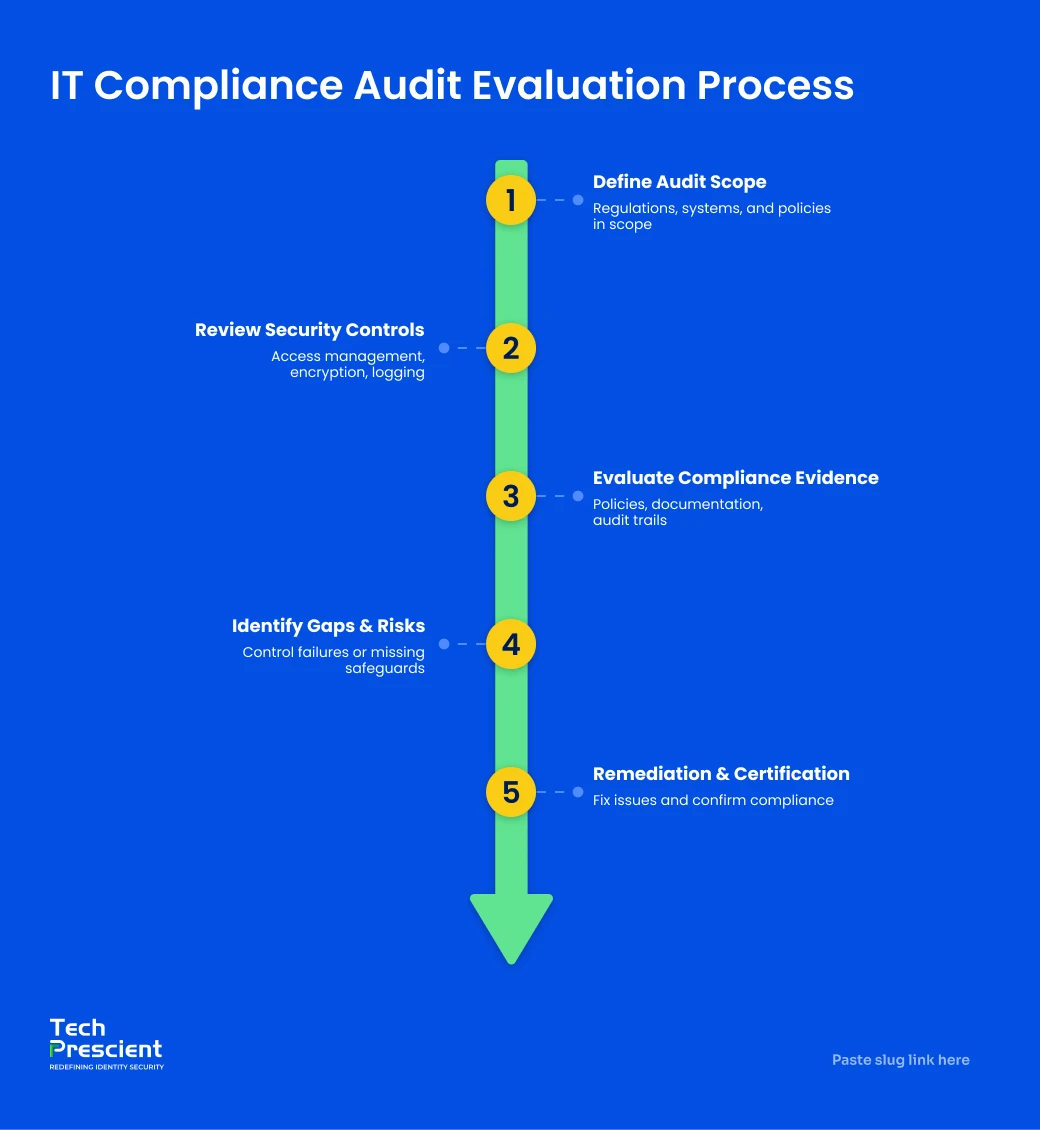
The audit compliance procedure typically follows a structured process to evaluate an organization's adherence to required standards. A typical procedure includes: Defining the audit scope and identifying applicable regulations or frameworks, Reviewing policies and documentation related to security and compliance, Evaluating technical controls such as access management, encryption, and monitoring, Testing security controls to confirm they operate correctly, Documenting findings and remediation actions to resolve compliance gaps. This process ensures organizations can demonstrate adherence to required IT audit compliance standards.
Compliance audits provide several important benefits beyond regulatory validation. Key advantages include: Stronger data protection by identifying security weaknesses, Improved regulatory readiness for industry certifications and legal requirements, Higher customer trust through independent security validation, Better risk management by detecting control failures early, Improved governance and accountability across IT systems and processes. Regular IT compliance audits help organizations maintain secure systems while ensuring they meet evolving regulatory expectations.
An IT compliance audit checklist outlines the technical and governance controls auditors review when evaluating regulatory compliance. Common checklist items include access controls, encryption, logging, vulnerability management, incident response plans, and vendor security assessments.
Most organizations perform internal IT compliance audits annually or quarterly, while external audits depend on certification requirements such as SOC 2 or ISO 27001. Continuous monitoring and regular access reviews help maintain audit readiness year-round.
Share



Rashmi Ogennavar
Content Strategist
A content strategist translating complex Tech and SaaS concepts into compelling narratives for business and technical audiences. With a strategic, data-informed approach, the work bridges content and product storytelling, crafting messaging that resonates and drives decisions across the buyer journey.
Most Popular Blogs
Identity Security· 21 min read
Data Access Governance Solutions: How to Secure Sensitive Data at Scale
Compare data access governance solutions for 2026: how DAG platforms discover sensitive data, run access reviews, automate remediation, and prove compliance.
Brinda Bhatt· September 7, 2026
Identity Security· 24 min read
What Is Zero Trust Network Access (ZTNA)?
Learn what Zero Trust Network Access (ZTNA) is, how it works, and why it’s replacing VPNs for secure, identity-based access control.
Yatin Laygude· August 14, 2026
Identity Security· 24 min read
Cyber Essentials Certification: Complete Guide
Learn Cyber Essentials certification, cost, requirements, and steps. Compare Cyber Essentials vs Plus and get certified faster.
Yatin Laygude· August 10, 2026