




On this page
See Tech Prescient in Action
Automate access, reduce risk, and stay audit-ready
HIPAA violation reporting is essential for protecting patient privacy and maintaining healthcare compliance. Unauthorized access to medical records, improper sharing of protected health information (PHI), and weak security practices can all lead to serious compliance risks. Understanding how to report a HIPAA violation helps patients and employees take the right action when sensitive healthcare data is exposed.
HIPAA violations can happen across hospitals, clinics, insurance providers, and third-party healthcare vendors. Common examples include unauthorized employee access, unsecured communication of PHI, lost devices, and improper handling of patient records. Knowing where to report a HIPAA violation and how the complaint process works can help organizations improve accountability and data protection.
According to the U.S. Department of Health & Human Services (HHS) Office for Civil Rights Breach Portal, hundreds of major healthcare data breaches affecting millions of individuals are reported every year. This highlights the growing need for stronger HIPAA enforcement, faster incident reporting, and better healthcare security practices. In this blog, we'll explore how to report a HIPAA violation step by step, where to file complaints, anonymous reporting options, reporting deadlines, and what happens after a HIPAA violation report is submitted.
Key Takeaways:
- Understand what qualifies as a HIPAA violation and the most common causes of PHI exposure in healthcare.
- Learn who to report a HIPAA violation to, including internal compliance teams and the HHS OCR.
- Follow the step-by-step process to gather evidence, file complaints, and meet HIPAA reporting deadlines.
- Explore anonymous HIPAA reporting options and understand what happens after a complaint is submitted.
- Discover how stronger access controls, monitoring, and identity governance help reduce HIPAA compliance risks.
What Qualifies as a HIPAA Violation?
A HIPAA violation occurs when protected health information (PHI) is accessed, disclosed, or handled improperly in a way that violates HIPAA privacy or security requirements. These violations can result from unauthorized access, weak security controls, accidental disclosures, or failure to protect sensitive patient data.
Understanding what qualifies as a HIPAA violation helps organizations, employees, and patients identify reportable incidents and take the right compliance actions.
1. Protected Health Information (PHI) and Covered Entities
PHI includes identifiable patient information such as medical records, treatment history, insurance details, test results, billing data, and other healthcare-related information. HIPAA regulations apply to covered entities including healthcare providers, health plans, healthcare clearinghouses, and business associates that handle patient data.
2. Common Examples of HIPAA Violations
Some of the most common HIPAA violations include:
- Unauthorized access to patient records
- Sharing PHI without patient consent
- Discussing patient information in public areas
- Lost or stolen devices containing medical data
- Weak passwords or lack of access controls
- Improper disposal of medical records
These incidents can expose sensitive healthcare information and lead to compliance penalties or investigations.
3. Not Every Privacy Issue Is a HIPAA Violation
Not all healthcare privacy concerns fall under HIPAA regulations. HIPAA only applies to covered entities and business associates responsible for handling PHI. For example, information shared by employers, schools, or individuals outside covered healthcare environments may not qualify as a HIPAA violation. Understanding this distinction is important before filing a HIPAA complaint or report.
Identify hidden PHI access risks before they become compliance violations.
A structured framework to identify PHI access risks, evaluate access governance controls, and strengthen healthcare access governance.
Who Do You Report a HIPAA Violation To?
If you suspect protected health information (PHI) has been exposed or mishandled, it's important to report the incident to the appropriate authority. Depending on the situation, HIPAA violations can be reported internally within the organization, directly to the HHS Office for Civil Rights (OCR), or to state-level authorities.
Choosing the correct reporting channel can help speed up investigations, improve resolution efforts, and ensure the incident reaches the appropriate compliance authority.
1. Internal Reporting: Privacy Officer or Compliance Team
Many healthcare organizations have a designated HIPAA Privacy Officer or compliance department responsible for handling privacy and security concerns. Employees are often encouraged to report suspected violations internally first, especially when the issue involves unauthorized employee access, improper handling of records, or policy violations.
Internal reporting may help organizations investigate incidents quickly, contain risks, and take corrective action before the issue escalates further.
2. Report to the HHS Office for Civil Rights (OCR)
The U.S. Department of Health & Human Services Office for Civil Rights (OCR) is the primary federal authority responsible for enforcing HIPAA regulations. Patients, employees, or affected individuals can file complaints with OCR if they believe a covered entity or business associate violated HIPAA Privacy, Security, or Breach Notification Rules. Complaints can typically be submitted online, by email, mail, or fax.
OCR investigates eligible complaints, reviews evidence, and may require organizations to implement corrective actions, compliance improvements, or penalties depending on the severity of the violation.
3. Report to Your State Attorney General
In some cases, HIPAA violations can also be reported to your State Attorney General's office, especially if state privacy laws or consumer protection laws are involved. State authorities may investigate healthcare organizations operating within their jurisdiction and pursue additional enforcement actions when necessary.
State-level reporting can be especially relevant in cases involving repeated violations, large-scale breaches, or broader patient privacy concerns.
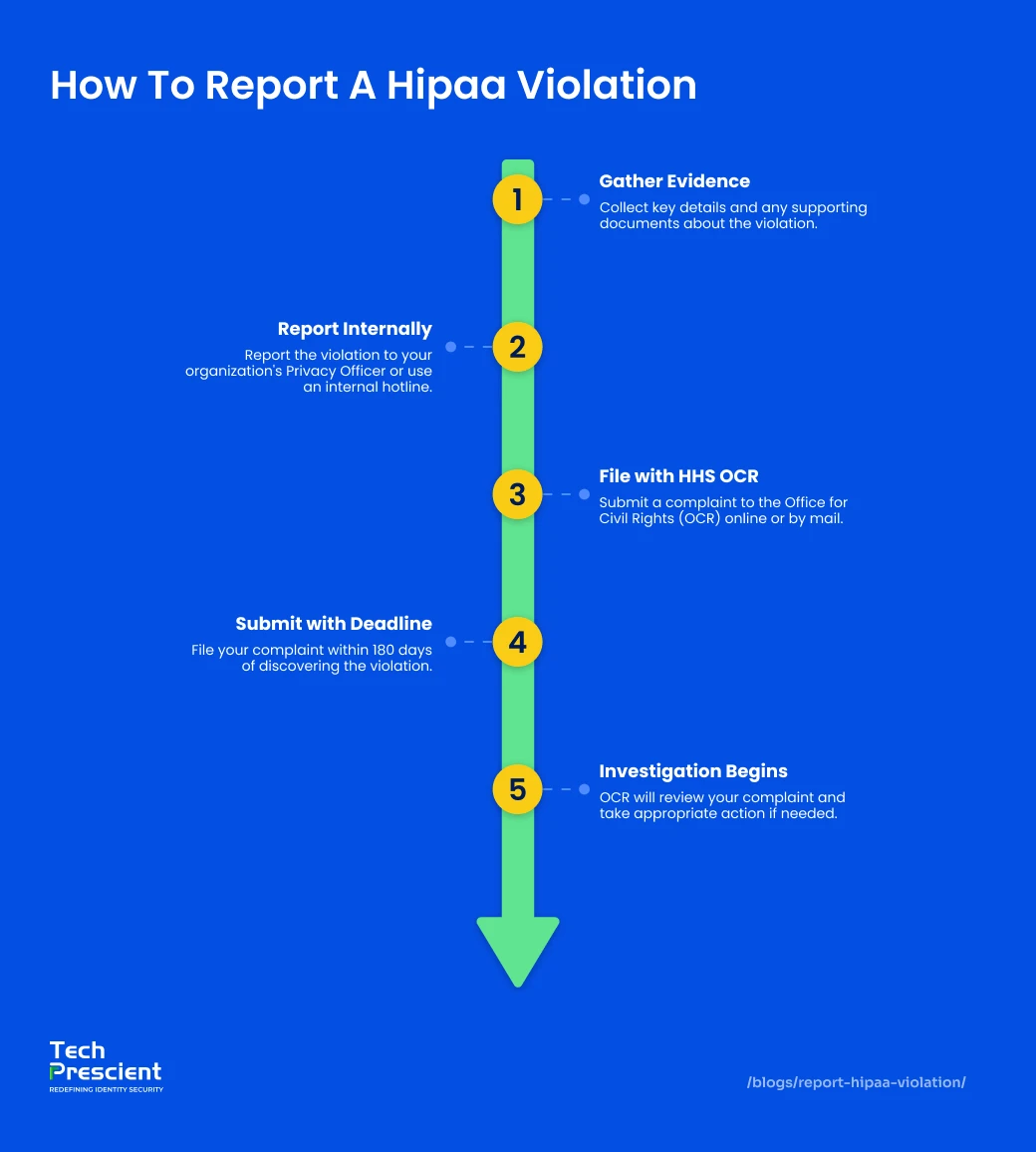
Step-by-Step: How to Report a HIPAA Violation
Knowing how to report a HIPAA violation properly can help speed up investigations, improve compliance response, and protect sensitive patient information from further exposure. Whether you are a patient, employee, or healthcare partner, following the right reporting process ensures the complaint reaches the appropriate authority with the necessary details.
Gather Evidence
Before filing a complaint, collect all relevant details related to the suspected HIPAA violation. Important information may include the date and time of the incident, names of individuals involved, the healthcare organization or provider, and a clear explanation of what happened.
Supporting evidence such as screenshots, emails, text messages, medical documents, audit logs, or written communication can strengthen your HIPAA violation report and help investigators assess the incident more effectively.
Quick Tip
If you suspect a HIPAA violation, document the incident immediately. Even small details like timestamps, screenshots, or email records can strengthen the investigation process.
Report Internally (Optional)
In many cases, employees or patients may choose to report the issue internally before escalating it externally. Most healthcare organizations have a HIPAA Privacy Officer, compliance department, or ethics hotline responsible for handling privacy and security concerns.
Internal reporting can sometimes lead to faster issue resolution, corrective action, or immediate containment of the incident without requiring external escalation.
File a Complaint with OCR
If the issue is not resolved internally or involves a serious privacy concern, you can file a complaint with the U.S. Department of Health & Human Services Office for Civil Rights (OCR). The OCR complaint portal allows individuals to submit HIPAA complaints online, while additional submission options may include email, mail, or fax.
When filing the complaint, include accurate incident details, supporting documentation, and information about the covered entity or business associate involved.
Submit Within the Reporting Deadline
HIPAA complaints generally must be filed within 180 days of discovering the violation. In certain situations, OCR may extend the deadline if there is a valid reason for delayed reporting.
Submitting complaints as early as possible helps preserve evidence, improve investigation accuracy, and reduce the risk of additional exposure of protected health information (PHI).
Where to Report a HIPAA Violation (Official Channels)
If you believe protected health information (PHI) has been improperly accessed, disclosed, or exposed, reporting the incident through the correct channel is important for initiating an investigation and ensuring compliance action. Depending on the nature of the violation, complaints can be submitted to federal authorities, healthcare organizations, or state agencies.
Several official reporting options are available based on the severity of the incident and the organization involved.
1. HHS Office for Civil Rights (OCR) Complaint Portal
The primary authority for HIPAA enforcement is the U.S. Department of Health & Human Services (HHS) Office for Civil Rights (OCR). Individuals can report HIPAA violations directly through the OCR Complaint Portal if they believe a covered entity or business associate failed to protect patient information properly.
The online portal allows users to submit complaint details, describe the incident, upload supporting documentation, and identify the healthcare organization involved. OCR reviews eligible complaints and may launch investigations or require corrective actions when violations are confirmed.
2. Email and Mail Complaint Submission
In addition to online filing, HIPAA complaints can also be submitted to OCR through email, mail, or fax. This option may be useful for individuals who prefer offline reporting methods or need to provide detailed written documentation related to the incident.
When submitting complaints through these channels, include clear information about the violation, affected parties, dates, supporting evidence, and contact details to help investigators review the case efficiently.
3. State-Level Reporting Authorities
Certain HIPAA-related privacy concerns may also be reported to State Attorney General offices or state healthcare regulators. State authorities can investigate incidents involving consumer protection laws, healthcare privacy violations, or broader data protection concerns within their jurisdiction.
State-level reporting may be especially relevant in cases involving repeated non-compliance, large-scale healthcare data breaches, or violations affecting multiple individuals.
Can You Report a HIPAA Violation Anonymously?
Yes, it is possible to report a HIPAA violation anonymously in certain situations. Patients, employees, and healthcare workers may choose anonymous reporting when they are concerned about retaliation, workplace conflict, or protecting their identity while reporting privacy or security concerns involving protected health information (PHI).
The level of anonymity available may vary depending on the reporting channel and the nature of the complaint.
1. Anonymous vs Confidential Reporting
Anonymous reporting means your identity is not shared during the complaint process. Confidential reporting, on the other hand, allows authorities or compliance teams to know your identity while limiting disclosure to others involved in the investigation.
Many healthcare organizations offer anonymous ethics hotlines or compliance reporting systems, while the HHS Office for Civil Rights (OCR) may keep complaint information confidential to the extent allowed by law during investigations.
2. Benefits and Limitations of Anonymous Reporting
Choosing to report a HIPAA violation anonymously can help individuals feel safer when reporting sensitive incidents, especially in workplace environments. It may encourage employees or patients to come forward without fear of retaliation or professional consequences.
However, anonymous complaints can sometimes make investigations more difficult if investigators cannot contact the reporter for additional details, supporting evidence, or clarification related to the incident.
3. Tips to Protect Your Identity While Reporting
If you want to report a HIPAA violation anonymously or reduce the disclosure of your identity, consider limiting unnecessary personal details in the complaint and using official compliance hotlines or secure reporting portals. Keep copies of any supporting documentation and avoid discussing the complaint publicly or with unrelated parties.
Providing clear evidence, timelines, and incident details can still help strengthen the investigation, even when limited personal information is shared during the reporting process.
Assess PHI access gaps and strengthen HIPAA-ready access governance controls.
A structured framework to identify PHI access risks, evaluate access governance controls, and strengthen healthcare access governance.
How Long Do You Have to Report a HIPAA Violation?
HIPAA complaints must generally be reported within a specific time frame to be considered for investigation. Acting quickly after discovering a potential violation helps preserve evidence, improve investigation accuracy, and reduce the risk of additional exposure of protected health information (PHI).
Filing within the required reporting window increases the likelihood of a timely review and appropriate compliance action.
1. The 180-Day HIPAA Reporting Rule
In most cases, complaints must be submitted to the HHS Office for Civil Rights (OCR) within 180 days of when the violation was discovered. The countdown typically begins from the date the individual became aware of the unauthorized disclosure, access, or misuse of PHI.
This reporting window applies to complaints involving HIPAA Privacy Rule, Security Rule, and Breach Notification Rule violations.
2. Exceptions and Deadline Extensions
OCR may allow extensions beyond the 180-day limit if there is a valid reason for delayed reporting. Situations such as medical emergencies, lack of awareness about reporting procedures, or other reasonable circumstances may qualify as "good cause" for late submission.
However, complaints submitted after the deadline without sufficient justification may not move forward for investigation.
3. Why Timely Reporting Matters
Reporting HIPAA violations as early as possible helps organizations and regulators respond faster to potential privacy and security risks. Early reporting can support evidence collection, reduce ongoing exposure of sensitive healthcare information, and improve the chances of corrective action being taken promptly.
Timely reporting also helps healthcare organizations identify compliance gaps, strengthen security controls, and prevent similar violations in the future.
Compliance Insight
Delayed reporting can make investigations harder and increase the risk of additional PHI exposure. Reporting incidents early often leads to faster containment and corrective action.
What Happens After You Report a HIPAA Violation?
After a HIPAA complaint is submitted, the reported incident goes through a review process to determine whether the case falls under HIPAA regulations and whether further investigation is required. The response may vary depending on the severity of the violation, the evidence provided, and the organization involved.
The investigation process is designed to assess compliance gaps, evaluate patient privacy risks, and determine whether corrective action is necessary.
1. OCR Complaint Review and Investigation
The HHS Office for Civil Rights (OCR) typically begins by reviewing the complaint to confirm that it involves a covered entity or business associate and falls within HIPAA enforcement authority. OCR may request additional details, supporting documentation, or clarification from the complainant during this stage.
If the complaint qualifies for investigation, OCR may contact the healthcare organization involved, review internal policies, examine security practices, and assess how protected health information (PHI) was handled during the incident.
2. Possible Outcomes of a HIPAA Complaint
Depending on the findings, organizations may be required to take corrective actions such as improving security controls, updating privacy policies, conducting employee training, or strengthening access management practices. In more serious cases, HIPAA violations may result in financial penalties, settlement agreements, or ongoing compliance monitoring.
The severity of enforcement actions often depends on factors such as negligence, repeated violations, the number of affected individuals, and the organization's response to the incident.
4. When a HIPAA Complaint May Be Dismissed
Not every complaint results in a formal investigation or enforcement action. OCR may dismiss complaints if they fall outside HIPAA jurisdiction, involve non-covered entities, lack sufficient evidence, or are submitted after the reporting deadline without valid justification.
In some situations, complaints may also be resolved through voluntary corrective actions without additional penalties or legal enforcement.
Common HIPAA Violations (Real Examples)
HIPAA violations can occur in many different healthcare environments, from hospitals and clinics to insurance providers and third-party vendors. Reviewing common HIPAA violation examples can help patients, employees, and organizations recognize reportable incidents and take faster corrective action when protected health information (PHI) is at risk.
Many violations are caused by weak access controls, human error, improper data handling, or failure to follow HIPAA privacy and security requirements.
Sharing Medical Records Without Patient Consent
One of the most common HIPAA violations involves disclosing patient information without proper authorization. This may include sending medical records to the wrong person, discussing patient details publicly, or sharing PHI with unauthorized individuals who are not involved in treatment, payment, or healthcare operations.
Improper disclosure of sensitive healthcare information can lead to privacy complaints, compliance investigations, and reputational damage for healthcare organizations.
Lost or Stolen Devices Containing PHI
Laptops, smartphones, USB drives, and other devices containing electronic protected health information (ePHI) can create serious compliance risks if lost or stolen. Organizations that fail to encrypt devices or implement adequate security safeguards may face HIPAA penalties if patient data becomes exposed.
Healthcare data breaches involving unsecured devices remain a major cause of reported HIPAA incidents across the industry.
Unauthorized Employee Access to Patient Records
Accessing patient records without a legitimate job-related reason is another common HIPAA violation. Examples include employees viewing medical records of friends, family members, coworkers, or public figures without authorization.
Healthcare organizations are expected to enforce role-based access controls, monitor user activity, and maintain audit trails to reduce unauthorized access risks.
Billing and Privacy-Related Violations
HIPAA violations can also occur during billing and administrative processes. Examples may include sending billing statements containing PHI to the wrong address, failing to provide patients access to their records, or improperly disposing of healthcare documents containing sensitive information.
These issues can expose confidential patient data and result in compliance concerns if proper privacy safeguards are not followed consistently.
Did You Know?
Many reported HIPAA violations are caused by internal employee actions such as unauthorized access, misdirected emails, or weak access controls rather than external cyberattacks.
HIPAA Reporting for Employees vs Patients
The process for reporting a HIPAA violation can vary depending on whether the complaint is being filed by a healthcare employee or a patient. While both groups can report privacy and security concerns, the reporting path, escalation process, and available protections may differ based on their role and relationship with the organization.
Knowing the appropriate reporting approach can help ensure complaints are handled more effectively and directed to the right authority.
1. Reporting HIPAA Violations as an Employee
Healthcare employees often identify HIPAA violations internally while handling patient records, systems, or administrative processes. In many organizations, employees are encouraged to report concerns first through internal channels such as a HIPAA Privacy Officer, compliance department, ethics hotline, or security team.
Examples may include unauthorized employee access, improper data sharing, policy violations, or weak security practices involving protected health information (PHI). Internal escalation allows organizations to investigate incidents quickly, contain potential exposure, and implement corrective actions when needed.
2. Reporting HIPAA Violations as a Patient
Patients who believe their healthcare information was improperly accessed, disclosed, or mishandled can file complaints directly with the HHS Office for Civil Rights (OCR). Common patient complaints may involve unauthorized disclosure of medical records, denial of access to health information, or privacy breaches involving healthcare providers or insurers.
Patients may also choose to report concerns directly to the healthcare organization before escalating the issue externally, depending on the severity of the incident.
3. Whistleblower and Retaliation Protections
HIPAA regulations include protections for individuals who report suspected violations in good faith. Healthcare organizations are generally prohibited from retaliating against employees for raising legitimate compliance or patient privacy concerns through approved reporting channels.
Maintaining confidential reporting processes, ethics hotlines, and documented investigation procedures can help organizations encourage responsible reporting while supporting a stronger culture of healthcare compliance and accountability.
Best Practices for Organizations to Prevent Violations
Preventing HIPAA violations requires more than basic compliance policies. Healthcare organizations must continuously monitor access to protected health information (PHI), strengthen security controls, and maintain visibility into how patient data is accessed and shared across systems. Proactive governance and identity security practices play a major role in reducing privacy risks and minimizing reportable incidents.
A strong compliance strategy helps organizations improve accountability, reduce unauthorized access, and respond faster to potential security gaps.
1. Implement Role-Based Access Controls
Healthcare employees should only have access to the systems and patient information necessary for their specific responsibilities. Applying least privilege access helps reduce unnecessary exposure of PHI and limits the risk of unauthorized record access.
Role-based access controls also make it easier for organizations to manage permissions consistently across departments, applications, and healthcare environments.
2. Conduct Regular Access Reviews
Periodic access reviews are critical for identifying excessive permissions, inactive accounts, or inappropriate access rights. Identity governance and administration (IGA) practices help organizations continuously validate whether employees, contractors, and third-party users still require access to sensitive healthcare systems.
Regular certification and review processes can help reduce insider risks, strengthen HIPAA compliance, and improve visibility into user access activity.
3. Maintain Audit Trails and Continuous Monitoring
Audit logs and monitoring systems help healthcare organizations track who accessed patient records, what actions were performed, and when activity occurred. Continuous monitoring can help security teams detect unusual behavior, policy violations, or suspicious access patterns before they lead to larger healthcare data breaches.
Maintaining detailed audit trails also supports compliance investigations and incident response efforts when HIPAA complaints arise.
4. Strengthen Identity Lifecycle Management
Managing the full identity lifecycle is essential for preventing outdated or unnecessary access. Organizations should automate onboarding, role changes, and offboarding processes to ensure access rights are updated promptly when employees join, transfer roles, or leave the organization.
Strong identity lifecycle management reduces orphaned accounts, improves compliance enforcement, and helps healthcare organizations maintain tighter control over sensitive patient information.
For organizations looking to improve healthcare security posture, implementing stronger identity governance and access management practices can significantly reduce HIPAA compliance risks and reporting incidents.
Final Thoughts
Reporting a HIPAA violation is critical for protecting patient privacy, reducing healthcare compliance risks, and preventing further exposure of protected health information (PHI). Whether the issue involves unauthorized access, improper disclosure, weak security controls, or healthcare data breaches, timely reporting helps organizations investigate incidents, strengthen safeguards, and maintain regulatory accountability.
Tech Prescient helps healthcare organizations improve identity governance, strengthen PHI protection, and reduce HIPAA compliance risks through secure access controls, continuous monitoring, audit visibility, and least-privilege security practices aligned with healthcare regulations.
Assess PHI access gaps and strengthen HIPAA-ready access governance controls.
A structured framework to identify PHI access risks, evaluate access governance controls, and strengthen healthcare access governance.
FAQs
You can report a HIPAA violation internally through your organization's privacy officer or compliance team, or file a complaint directly with the HHS Office for Civil Rights (OCR). Complaints can usually be submitted online, by email, or through mail. Including detailed evidence and incident information helps strengthen the review process.
Yes, in many cases you can report a HIPAA violation anonymously, especially through ethics hotlines or compliance reporting systems. However, sharing your contact information can help investigators gather additional details if needed. Confidential reporting options may also help protect your identity during the investigation.
HIPAA violations can be reported to your healthcare organization, a HIPAA Privacy Officer, the HHS Office for Civil Rights (OCR), or your State Attorney General. The right reporting channel often depends on the severity of the incident and the organization involved. Serious privacy or security breaches are commonly escalated to OCR.
Most HIPAA complaints must be filed within 180 days from the date the violation was discovered. In certain situations, OCR may allow deadline extensions if there is a valid reason for delayed reporting. Reporting incidents early helps improve investigation accuracy and compliance response.
A HIPAA violation occurs when protected health information (PHI) is accessed, shared, exposed, or handled improperly without authorization or required safeguards. Common examples include unauthorized employee access, improper disclosure of patient records, and weak security controls. HIPAA violations can involve Privacy Rule, Security Rule, or Breach Notification Rule failures.
After a complaint is submitted, OCR reviews the incident to determine whether it falls under HIPAA enforcement authority. Depending on the findings, organizations may face investigations, corrective actions, compliance monitoring, or financial penalties. Some complaints may also be resolved through voluntary remediation efforts.
Share



Yatin Laygude
Content Writer
A content writer with 6 years of experience turning complex topics into clear, engaging, and meaningful content. From blogs and web pages to whitepapers and thought pieces, he creates content that not only explains but also connects with both the audience and business goals.
Most Popular Blogs

Identity Security· 21 min read
Data Access Governance Solutions: How to Secure Sensitive Data at Scale
Compare data access governance solutions for 2026: how DAG platforms discover sensitive data, run access reviews, automate remediation, and prove compliance.
Brinda Bhatt· September 7, 2026
Identity Security· 24 min read
What Is Zero Trust Network Access (ZTNA)?
Learn what Zero Trust Network Access (ZTNA) is, how it works, and why it’s replacing VPNs for secure, identity-based access control.
Yatin Laygude· August 14, 2026
Identity Security· 24 min read
Cyber Essentials Certification: Complete Guide
Learn Cyber Essentials certification, cost, requirements, and steps. Compare Cyber Essentials vs Plus and get certified faster.
Yatin Laygude· August 10, 2026