




On this page
See Tech Prescient in Action
Automate access, reduce risk, and stay audit-ready
A security audit is a structured evaluation of an organization's IT systems, policies, and controls to identify vulnerabilities, validate compliance, and reduce security risk.
It assesses how effectively security measures protect data, infrastructure, and user access against threats and regulatory gaps.
A security audit is a structured review of an organization's systems, policies, and controls to identify vulnerabilities, validate compliance, and strengthen overall security posture. The audit will help the organization identify where security gaps are within their infrastructure, application, identity and data and if their existing controls operate as intended.
This means that in addition to performing routine vulnerability scans, security auditors conduct thorough evaluations of how access is managed; how systems are configured; how risks are monitored; as well as the extent to which security practices comply with applicable regulatory standards (such as GDPR, HIPAA, PCI-DSS) and industry standards (ISO 27001).
This guide explains what a security audit is, the different types of security audits, the step-by-step audit process, and a practical security audit checklist you can use to standardize reviews, support compliance efforts, and reduce risk in 2026.
Key Takeaways
- Security audits uncover misconfigurations, compliance gaps, and potential vulnerabilities before attackers can exploit them.
- Core types include penetration testing, vulnerability assessments, configuration audits, compliance audits, and cloud security audits.
- A structured audit process follows a lifecycle: scoping → testing → analysis → reporting → remediation → verification.
- Using a standardized checklist ensures consistent coverage, strengthens regulatory alignment, and improves operational resilience.
What is a Security Audit?
In cybersecurity, a security audit is a governance-driven control review designed to validate whether technical and administrative safeguards are operating effectively.
Security audits typically examine:
- Identity and access management (IAM) controls
- Network configurations and segmentation
- Data protection mechanisms
- Logging and monitoring systems
- Regulatory control implementation
Unlike vulnerability scanning alone, security audits assess both technical controls and operational processes.
Put simply, a security audit shows how well your technology and data are protected, and whether those protections are sufficient. It examines both technical and operational controls, including network configurations, access management, and processes such as User Access Reviews (UAR), to uncover weaknesses that attackers or compliance auditors could exploit.
A security audit acts like a full health check for your IT environment. It looks for common issues such as unpatched software, weak or reused passwords, excessive user privileges, misconfigured firewalls, exposed cloud services, and gaps in security monitoring. It also evaluates how employees follow security policies and handle sensitive data.
The outcome of a security audit is a clear view of your overall security posture: what controls are working, where gaps exist, and what needs to be fixed to reduce risk and meet compliance requirements.
Why Security Audits Matter (Benefits & Outcomes)
1. Key Benefits of Security Audits
Security audits help organizations shift from a reactive, incident-driven approach to a proactive, risk-focused security model. By identifying gaps early, teams can fix weaknesses before they escalate into breaches or compliance issues, resulting in faster remediation, lower costs, and stronger overall controls.
Key benefits include:
- Early risk detection: Identify security gaps before they are exploited or flagged during audits
- Improved compliance readiness: Validate alignment with key regulatory and industry standards without last-minute remediation
- Reduced attack surface: Address common weaknesses such as unpatched systems, misconfigured firewalls, exposed cloud services, and weak authentication
- Operational efficiency: Spend less time firefighting incidents and more time improving security posture
2. Business and Security Outcomes
When performed effectively, a security audit delivers measurable business value by reducing risk and improving resilience during disruptions. Audits give organizations clearer visibility into their security posture, enabling better decision-making and more consistent enforcement of controls.
Typical outcomes include:
- Fewer security incidents: Reduced exposure through tighter controls and improved visibility
- Faster response times: A clearer understanding of risks improves incident detection and response
- Stronger access governance: Identification of over-permissioned users, inactive accounts, and excessive access rights
- Least-privilege enforcement: Improved control over who has access to what, and why
- Greater stakeholder confidence: Stronger assurance in the organization's ability to protect critical systems and data while meeting compliance expectations
Types of Security Audits
Security audits can be categorized based on their objective: exploit testing, risk detection, configuration validation, compliance verification, or cloud-specific governance.
Organizations utilize various security audits tailored to their unique risk profiles, as well as their respective regulatory requirements and technology stack. Each of these audits provides a unique service to the organization; however, they do work together as a part of an overall security strategy.
The following is a breakdown of the types of security audits available to organizations:
1. Penetration Testing
Penetration Testing is the process by which organizations can test their systems and applications against real-world attacks and identify potential weaknesses. The emphasis here is on how a real-world threat would approach your organization versus examining your security systems without considering the actual outside element of attacks.
This type of audit is very beneficial to organizations with publicly available resources and internet-facing applications (i.e., web applications, APIs, VPNs, cloud workloads), since this is where the greatest threat of attack occurs.
2. Vulnerability Assessments
The purpose of conducting a Vulnerability Assessment is to scan an organization's systems and applications for known security vulnerabilities (i.e., missing patches, outdated applications, or insecure services).
Unlike Penetration Testing, a Vulnerability Assessment does not attempt to exploit or determine how an issue could be exploited, but provides a view of an organization's overall level of security hygiene, allowing the organization to prioritize how to remediate vulnerabilities or issues before they are exploited.
3. Configuration Audit
A configuration audit reviews whether systems are set up according to internal security standards and recognized best-practice frameworks. Often called a configuration review or hardening/compliance audit, it focuses on identifying misconfigurations, one of the most common causes of security breaches, as highlighted by industry guidance such as Gartner research.
The audit typically examines:
- Network devices: Firewall rules, open ports, and overly permissive network policies
- Servers: Secure hardening aligned to CIS or NIST recommendations
- Endpoints: Operating system policies, antivirus settings, and baseline configurations
By uncovering insecure defaults, exposed services, and excessive permissions, configuration audits help reduce preventable risk and strengthen the organization's overall security posture.
4. Compliance Audit
Compliance audits focus on determining whether companies' systems and processes comply with the regulatory and industry controls, such as the GDPR, HIPAA, SOX, PCI DSS, and ISO 27001.
Compliance audits focus upon gathering evidence to validate controls in place (i.e., policies, procedures, logs, and technical safeguards) and do not identify vulnerabilities; they verify that security controls in place are being effectively implemented. They also follow a strict plan defined by regulatory authorities.
5. Cloud Security Audit
A cloud security audit involves an assessment of the security measures in place across various cloud environments, including IAM policies, access control measures, encryption settings, network segmentation, and logging.
If organizations utilize AWS, Azure, or GCP, conducting regular cloud security audits is crucial to ensure that any misconfigured permissions or identity-related roles do not create opportunities for the large-scale exposure of sensitive data.
| Audit Type | Primary Purpose | What It Tests | Example Outcome | Best Used When |
|---|---|---|---|---|
| Penetration Testing | Identify exploitable security weaknesses | Real-world attack paths, privilege escalation, and data access | Discovers a web app flaw that allows attackers to bypass authentication | You need to test external exposure or validate breach risk |
| Vulnerability Assessment | Detect known security weaknesses | Unpatched systems, outdated software, and known CVEs | Flags servers running vulnerable software versions | You want continuous visibility into technical risks |
| Configuration Audit | Validate secure system setup | Firewall rules, server hardening, IAM settings | Finds overly permissive firewall or admin configurations | Preventing exposure due to misconfigurations |
| Compliance Audit | Verify regulatory alignment | Policies, controls, logs, evidence against standards | Confirms whether controls meet PCI DSS or GDPR requirements | Preparing for regulatory or customer audits |
| Cloud Security Audit | Assess cloud-specific risks | IAM roles, storage access, encryption, and network controls | Identifies publicly accessible cloud storage or broad IAM roles | Operating in AWS, Azure, or GCP environments |
Security Audit Process: Step-by-Step
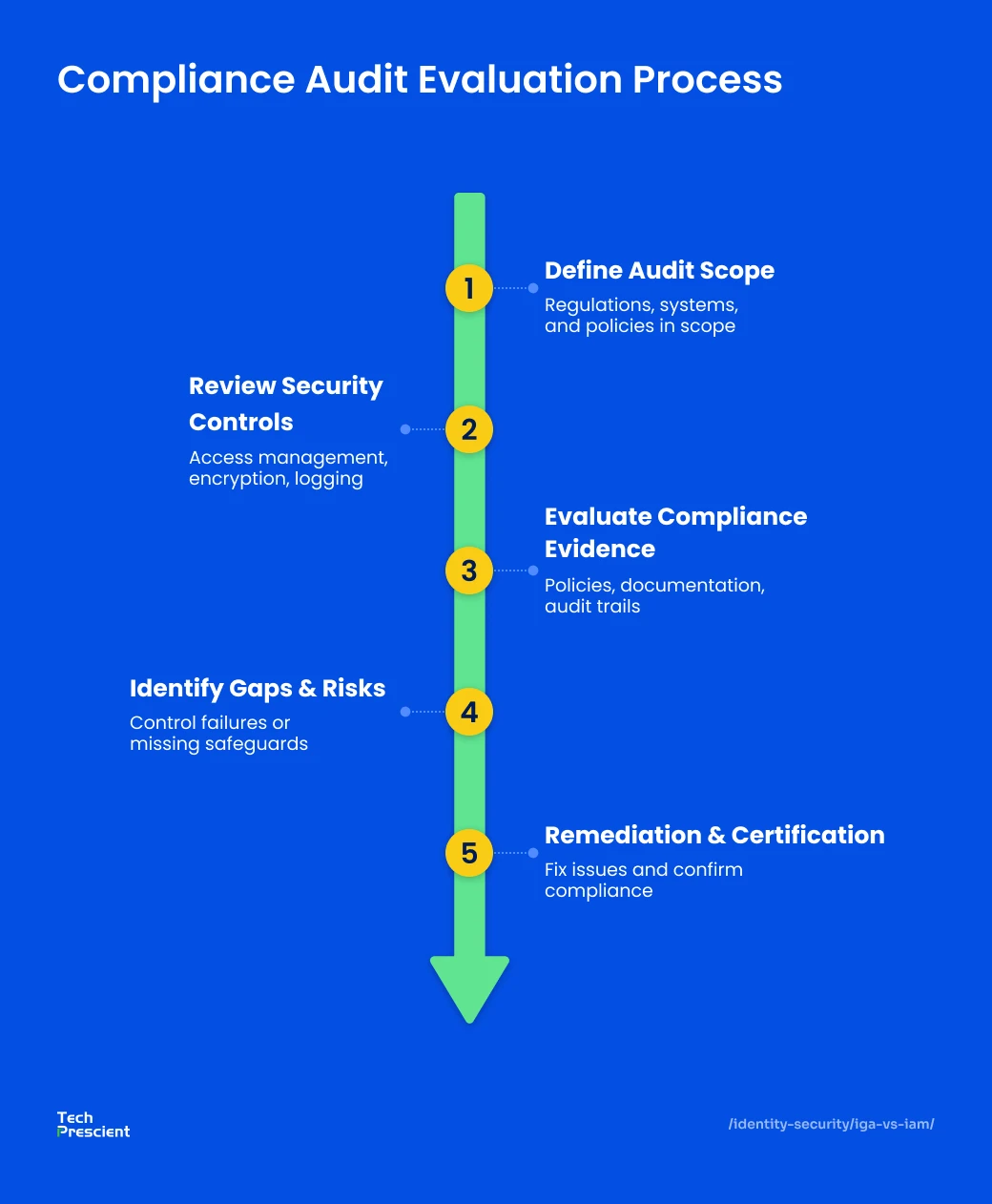
A comprehensive security audit is conducted systematically. The audit lifecycle is defined, which provides an outline for the audit process. The lifecycle consists of six phases: setting the scope and objectives, collecting evidence, assessing the technical risks, risk analysis, reporting findings, and verifying corrective actions taken. Each phase must be performed thoroughly to eliminate the possibility of missing critical vulnerabilities.
Define Scope and Objectives
The scope and objectives of the security audit should be clearly defined. This includes identifying the systems and applications that are subject to review, the users who access those systems and applications, the types of data that will be collected, and the regulatory compliance frameworks that are applicable (e.g., GDPR, HIPAA, or PCI DSS). Establishing clear objectives reduces the potential for "audit blind spots" and enhances the focus of the assessment.
Gather Documentation & Logs
Auditors utilize documentation and logs to collect evidence to verify the status of a company's existing security posture. The type of evidence includes security policies, network diagrams, system inventories, access control lists, security logs, and incident records. Accurate documentation of these items helps ensure that the audit findings are based on factual evidence and can be defended in court if necessary.
Conduct Technical Assessment
The technical assessment phase evaluates the effectiveness of security controls in real-world environments. A technical security assessment often involves the following components: vulnerability assessments to identify known vulnerabilities, penetration testing to confirm the ability to exploit vulnerabilities, configuration reviews to identify configuration errors in servers, networks and identity management systems.
Risk Assessment & Prioritization
Organizations can see where they should target their remediation efforts by analyzing the audit results, and rating said audit results based on severity, exploitability, and potential business impact - in essence, concentrating on the most risky findings first as opposed to treating all findings the same.
Report & Recommendation
At the conclusion of the audit process, a comprehensive report will be produced that summarizes the audit findings with an executive summary, all findings ranked with risk ratings, and detailed remediation guidance on how to resolve the issues listed in the report. This report is valuable for security teams and executive leadership to align on how to proceed.
Verification & Continuous Monitoring
Auditors perform a re-test of affected systems to validate that the fixes were made properly. Long-term, continual monitoring of systems and periodic re-audits will assure that security controls continue to be effective as the environments evolve.
Security Audit Checklist 2026
Use this cybersecurity checklist to ensure your IT security audit covers critical control areas including identity management, network security, data protection, application security, and incident readiness. The security audit checklist is designed to create a consistent approach to performing audits, ensuring that no critical controls have been overlooked, and provide support for performing an internal review, and/or formal compliance assessment.
1. Security Policy Review
The first step in the audit process is to confirm that all core security policies have been documented, are current, and have been implemented consistently throughout the organization. Additionally, the following items should be reviewed and confirmed:
- Access control policy and acceptable use policy exist and are formally validated.
- Security policies include enforced password standards and authentication requirements.
- Joiner, mover, and leaver processes (account provisioning, change, and deprovisioning) are documented, implemented, and consistently followed.
- Security policy reviews occur regularly.
Policies should not remain static. They must undergo continuous review and periodic refinement to stay aligned with evolving technology stacks, emerging threat vectors, regulatory expectations, and changes in business processes and operating models.
2. Network Security
To assess how well the network perimeter and internal traffic are protected, the following items should be confirmed:
- Firewall rules are documented, reviewed, and implemented based on the least-access principle.
- Alerts and logs from the intrusion detection/intrusion prevention system are monitored and maintained.
- Critical systems are segmented on the network.
- Inbound and outbound network traffic is monitored for anomalies
- Network assessments include penetration testing, vulnerability scans, and configuration reviews.
- Fixing identified weaknesses helps prevent unauthorized access and data compromise.
3. Access Control
To assess how user and privileged access is created, reviewed, and deleted, the auditor should review the following items:
- All users and systems are given the minimum privilege required to perform their job responsibilities.
- Roles and role-based access control (RBAC) are defined and documented.
- Privileged accounts are clearly defined, have limited access, and are consistently reviewed.
- Where possible, access reviews utilize identity and access management (IAM) and identity governance and administration (IGA) processes
- Conduct regular access reviews to prevent privilege creep and align access with current roles.
4. Data Protection
Protect sensitive data for its entire lifecycle.
- Encrypting data at rest as well as during the transmission phase
- Creating and managing a documented/monitored (backup) procedure with tests
- Keeping policies for data retention and deletion enforced
- Recording users accessing sensitive data with auditable logs
5. Application Security
Look at how the applications are developed, maintained, and secured.
- Have secure coding practices and conduct code review
- Authenticate, authorize and monitor APIs
- Have the patch management process developed and applied
- Track any third-party or open source dependencies
6. Incident Response Readiness
Check whether the organization can respond and recover from an incident.
- Approval and documentation of the Incident Response (IR) Plan
- Clearly defined roles and escalation paths
- Logging and alerting to detect incidents are enabled
- Post-incident review and reporting process is implemented
7. Employee Security Awareness
A measure of users' ability to identify and respond to threats.
- Regular security awareness training is provided
- Phishing simulation tests are performed, and results are tracked
- High-risk positions of employment are given additional focused training
- Review and improve upon outcomes from security awareness training
Who Conducts a Security Audit?
A Security Audit can be performed by either an internal team or an external professional; internal security audits are used for the continuous management of risk, while external security audits provide an independent validation of compliance and provide assurance regarding compliance with regulations.
Internal Security Audits
An organization's in-house security and risk management teams usually perform internal security audits.
Typically, internal security audits perform the following activities:
- Conduct routine security reviews and control checks
- Identify misconfiguration, policy gaps, and operational risks
- Provide support for continuous improvement and remediation tracking of identified security weaknesses
- Prepare organization for formal compliance or third-party audits
Best utilized in:
- Continuous security hygiene and internal risk assessment
- Routine quarterly or event-driven reviews, e.g. (new systems, major changes)
- Identifying early access gaps (configuration and process)
External Security Audits
Independent third-party audit firms or certified auditors perform external security audits.
External security audits typically perform the following activities:
- Provide an objective and unbiased view of security controls
- Validate compliance with regulatory requirements/standards (e.g., ISO 27001, SOC 2, PCI DSS)
- Issue formal audit reports required by regulators, customers, or partners
- Benchmark security posture against industry best practices
Best utilized in:
- Compliance with regulatory or contractual obligations
- Formal/annual certification audits
- High-risk environments that require independence
Why Both Matter?
The complementary roles of external and internal audits are evident. An internal audit identifies and fixes problems/concerns continually. By contrast, the objective of an external audit is to formally establish compliance through independent verification/certification, assurances and trustworthiness.
When Should You Perform a Security Audit?
Security audits should be performed on a risk-based schedule rather than a fixed annual routine. Most organizations conduct security audits once per year, but some perform them more frequently, depending on the level of risk associated with their environments (e.g., a company operating in the financial, healthcare, technology, etc. industry). When auditing for compliance with laws and regulations, organizations should base their frequency on risk rather than on a fixed date.
Risk-Based Audit Frequency
The frequency of security audits should be driven by risk, not a fixed calendar.
- Annually: Standard practice for most organizations to assess overall security posture and compliance readiness
- Quarterly or biannually: Recommended for high-risk industries (finance, healthcare, SaaS, critical infrastructure)
- Continuous or rolling audits: Used by mature security programs to review specific controls throughout the year
Higher-risk environments, complex infrastructures, and organizations handling sensitive data typically require more frequent audits.
Common Triggers For an Audit
Several events should trigger a security audit in addition to the regularly scheduled audits. These include:
- A breach or violation of security policies
- Deployment of a new application or system, hosted in a cloud environment
- Major changes in network architecture, including changes to user authentication and access
- Renewals of regulatory compliance or preparing for an upcoming regulatory review
- Major restructures of an organization, including mergers and acquisitions, or significant new onboarding of users
Running audits after these events helps ensure new risks are identified early and controls remain effective as the environment evolves.
Real-World Security Audit Example
A real-world example shows how a security audit uncovers risks, prioritizes them, and drives measurable improvements to security posture.
Example: How a Security Audit Reduced Risk in a SaaS Company
The mid-size SaaS company underwent an annual IT security review to prepare for a compliance audit and to lower the risk of a data breach. The IT security audit included an overview of external infrastructure, user account access, and the company's cloud services.
Key Findings Identified
The following items were identified during the audit:
- The RDP Port is exposed: A production server has a publicly accessible RDP service, increasing the potential for brute-force attacks to occur.
- Several admin accounts were created for former employees, or remain active and are no longer being used.
- There are too many users with admin rights who do not need them for the roles they perform.
All of the identified items were assessed as to their likelihood and severity of effect.
Remediation Actions Taken
Action was taken to fix the identified issues promptly:
- The RDP port was restricted to being accessed only through a secure VPN and a monitored access list
- All unused and orphaned admin accounts were deleted
- The principle of least privilege was utilized to reduce the excessive admin rights possessed by users utilizing role-based access control systems to limit their access.
Outcome
As a result of the audit:
- The external attack surface is significantly reduced
- Privileged access risk is lowered
- The organization improves audit readiness and overall security maturity
Security Audits vs Security Assessments vs Compliance Audits
Security audits, security assessments, and compliance audits are often used interchangeably, but they serve different purposes. Audits formally evaluate controls, assessments identify security gaps, and compliance audits verify adherence to specific regulations.
| Criteria | Security Audit | Security Assessment | Compliance Audit |
|---|---|---|---|
| Primary Purpose | Evaluate effectiveness of security controls | Identify vulnerabilities and weaknesses | Validate adherence to regulatory or legal requirements |
| Level of Formality | High (structured, documented, repeatable) | Medium (technical and exploratory) | Very high (evidence-driven, regulator-focused) |
| Typical Focus | Policies, controls, access, configurations | Technical gaps, misconfigurations, exposures | Regulatory controls and mandated safeguards |
| Scope Definition | Clearly defined and scoped upfront | Flexible and risk-driven | Strictly defined by regulation or standard |
| Methodology | Interviews, control reviews, testing, documentation | Scanning, testing, analysis | Control mapping, evidence collection, validation |
| Output | Audit report with findings and remediation guidance | Risk findings and improvement recommendations | Pass/fail or compliance report |
| Who Performs It | Internal audit team or third-party auditor | Security team or external assessor | Certified third-party auditors |
| Common Examples | IT security audit, access control audit | Vulnerability assessment, risk assessment | PCI DSS audit, GDPR review, SOC 2 audit |
| Frequency | Periodic (annual or scheduled) | On-demand or continuous | Defined by regulation (annual, quarterly, etc.) |
When to Use Each
- Security audits are best when you need a formal review of how well your security controls are designed and operating.
- Security assessments are useful for proactively finding weaknesses before attackers do.
- Compliance audits are required when proving adherence to laws, regulations, or industry standards.
Final Thoughts
Security audits today are continuous, not one-time or purely compliance-driven exercises. Cloud, SaaS, and remote-first environments demand ongoing auditing to maintain visibility into risk and prevent control drift over time.
Access governance plays a critical role, as many audit findings stem from excessive permissions, inactive accounts, and inconsistent access reviews. When audits and access governance work together, user access stays aligned with job roles and business needs.
Mature security programs treat audits as a continuous cycle, not a checklist. By embedding frequent audits, automation, and access governance into daily operations, organizations remain audit-ready and better equipped to adapt to evolving threats.
FAQs
In simple terms, a security audit simply refers to a methodical examination of an organization's systems, policies, and security controls for any deficiencies, and an assessment of how effective the organization's security measures are. By conducting a security audit, organizations will know how well their security posture aligns with their own internal policies and with external standards (e.g., ISO, SOC 2, or any relevant industry regulations).
The typical steps of a security audit are as follows: establish a security audit scope; gather evidence (such as system logs, configuration files, access logs, etc.) to aid in evaluating the systems being audited; test the controls of the systems being audited; assess the risks associated with the systems being audited; document the audit findings; and conduct remediation or review of the systems audited to confirm that corrective actions have been taken.
Common examples of security audits include evaluating firewall rules for misconfigurations, performing vulnerability scans on the systems audited, and ensuring that user access rights conform to the least-privilege concept. Additionally, auditors may review the lack of use of, or excess of, administrator privileges assigned to individuals and evaluate if periodic access reviews are performed.
Typically, organizations conduct annual security audits as part of their obligation to comply with governance and compliance practices. High-risk organizations generally perform quarterly audits based on the level of risk and their business environment (finance, health care, etc.), or they may choose to do so following major events such as significant system upgrades, security breaches, or finalizing any regulations.
While a vulnerability assessment is focused on identifying technical vulnerabilities (e.g., unpatched software), a security audit examines all of the organization's security controls, processes and governance structures to determine whether they have been appropriately designed, implemented and maintained according to established regulations or standards.
A security audit checklist typically includes access control review, vulnerability assessment, firewall configuration validation, encryption verification, incident response readiness, and compliance evidence collection.
No. Penetration testing simulates real-world attacks, while a security audit evaluates the effectiveness of broader security controls and governance processes.
The duration depends on scope and complexity, but most mid-sized organizations complete audits within several weeks to a few months.
Share



Rashmi Ogennavar
Content Strategist
A content strategist translating complex Tech and SaaS concepts into compelling narratives for business and technical audiences. With a strategic, data-informed approach, the work bridges content and product storytelling, crafting messaging that resonates and drives decisions across the buyer journey.
Most Popular Blogs
Identity Security· 21 min read
Data Access Governance Solutions: How to Secure Sensitive Data at Scale
Compare data access governance solutions for 2026: how DAG platforms discover sensitive data, run access reviews, automate remediation, and prove compliance.
Brinda Bhatt· September 7, 2026
Identity Security· 24 min read
What Is Zero Trust Network Access (ZTNA)?
Learn what Zero Trust Network Access (ZTNA) is, how it works, and why it’s replacing VPNs for secure, identity-based access control.
Yatin Laygude· August 14, 2026
Identity Security· 24 min read
Cyber Essentials Certification: Complete Guide
Learn Cyber Essentials certification, cost, requirements, and steps. Compare Cyber Essentials vs Plus and get certified faster.
Yatin Laygude· August 10, 2026