




On this page
See Tech Prescient in Action
Automate access, reduce risk, and stay audit-ready
A SOC 1 report is an independent audit report that evaluates whether a service organization's internal controls are designed and operating effectively to support accurate financial reporting. Conducted under SSAE 18 by a licensed CPA firm, it provides assurance that services affecting financial data are backed by reliable Internal Control over Financial Reporting (ICFR).
Organizations such as payroll providers, payment processors, fintech companies, and financial SaaS vendors often undergo a SOC 1 audit because their services can directly impact their clients' financial statements. Rather than being a certification, SOC 1 compliance demonstrates that an organization's financial controls have been independently assessed, helping strengthen audit readiness, regulatory compliance, and customer confidence.
According to the Association of Certified Fraud Examiners (ACFE) 2024 Report to the Nations, organizations lose an estimated 5% of their annual revenue to occupational fraud, with weak or overridden internal controls being among the most common contributing factors. Effective financial controls, like those evaluated in a SOC 1 report, help reduce these risks and strengthen financial reporting integrity. In this blog, let's explore what a SOC 1 report is, how it works, its different types, and why it matters for organizations that impact financial reporting.
Key Takeaways
- Learn what a SOC 1 report is, how it works, and why it matters for financial reporting integrity.
- Understand the differences between SOC 1 Type 1 and SOC 1 Type 2 reports and their use cases.
- Explore the complete SOC 1 audit process, from readiness assessment to report issuance by a CPA.
- Discover who needs SOC 1 compliance, why clients request it, and how it strengthens vendor trust.
- Learn the key benefits, common compliance challenges, and best practices for successful SOC 1 audits.
What Is a SOC 1 Report?
A SOC 1 report is an independent audit report that evaluates whether a service organization's internal controls are designed and operating effectively to support accurate financial reporting.
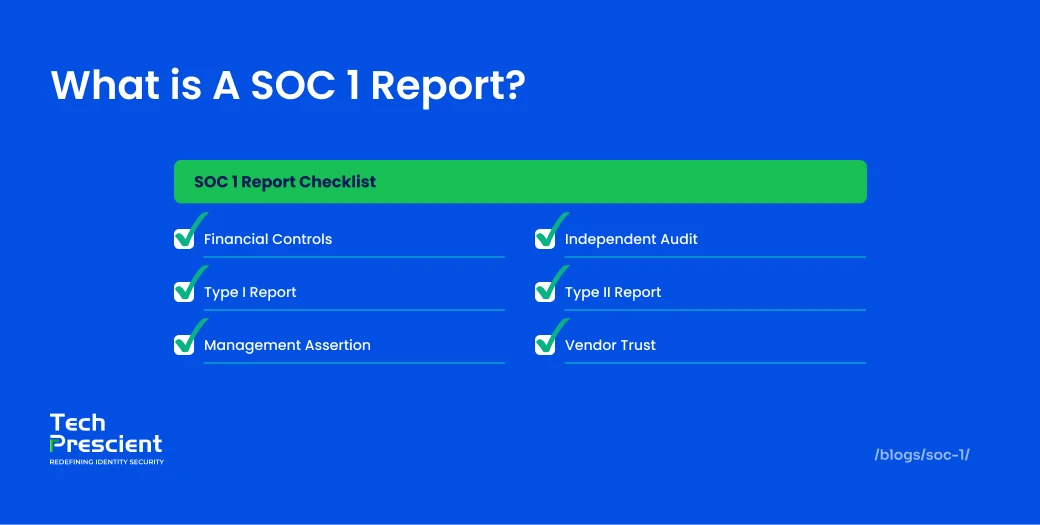
Organizations increasingly rely on third-party service providers to manage critical financial processes, from payroll and payment processing to accounting and loan servicing. When these services influence a client's financial statements, businesses need assurance that the provider has effective controls in place. A SOC 1 report provides this assurance by independently evaluating the controls that support accurate, reliable, and secure financial reporting.
Let's understand the key components of a SOC 1 report.
Internal Control over Financial Reporting (ICFR)
At the core of every SOC 1 report is Internal Control over Financial Reporting (ICFR). ICFR refers to the policies, procedures, and operational controls that help ensure financial transactions are recorded accurately, processed consistently, and protected from errors or unauthorized changes. Strong ICFR reduces financial reporting risks and helps organizations maintain compliance with regulatory and audit requirements.
SSAE 18 and Independent CPA Assessment
A SOC 1 audit is performed by an independent Certified Public Accountant (CPA) under the Statement on Standards for Attestation Engagements (SSAE) No. 18, issued by the AICPA. During the assessment, the auditor reviews whether the organization's controls are appropriately designed and, where applicable, whether they operate effectively over a specified period before issuing the SOC 1 report.
A Simple Example
Consider a payroll service provider that calculates employee salaries, taxes, and deductions for multiple businesses. Since payroll data directly impacts a client's financial records, inaccurate processing or weak controls could lead to reporting errors. A SOC 1 report gives customers confidence that the provider has implemented appropriate financial controls to ensure payroll information is processed accurately and consistently.
What Does SOC 1 Mean in Compliance?
SOC 1 compliance ensures that service organizations maintain effective controls that support accurate and reliable financial reporting.
When discussing what SOC 1 compliance is, it is important to understand that it is not a certification but an independent assessment of a service organization's controls over financial reporting. A SOC 1 report provides assurance that these controls have been evaluated by a licensed CPA under SSAE 18, helping organizations strengthen customer trust, support audits, and demonstrate financial accountability.
To better understand SOC 1 compliance, let's look at how it differs from certification, its role in SOX compliance, and why organizations pursue it.
SOC 1 Compliance vs. SOC 1 Certification
Many organizations search for "what is SOC 1 certification," but the term is technically incorrect. Unlike standards such as ISO 27001, SOC 1 does not result in a formal certificate. Instead, an independent CPA performs a SOC 1 audit and issues either a SOC 1 Type 1 or SOC 1 Type 2 report. This report confirms that the organization's financial reporting controls have been independently assessed rather than certified.
How SOC 1 Supports SOX Compliance
Although SOC 1 and the Sarbanes-Oxley Act (SOX) are separate frameworks, they complement each other. Organizations subject to SOX remain responsible for maintaining effective Internal Control over Financial Reporting (ICFR), even when financial processes are outsourced. A SOC 1 report helps customers and their auditors evaluate whether a service provider's controls can be relied upon during financial statement audits.
An Audit-Driven Assurance Framework
SOC 1 compliance is typically driven by customer requirements, contractual obligations, and audit expectations rather than by law. Service providers that manage payroll, payment processing, accounting, or other financially significant services often obtain a SOC 1 report to demonstrate strong internal controls, simplify customer due diligence, and build confidence in their financial processes.
Expert Insight
A SOC 1 report is an assurance report, not a certification. Understanding this distinction helps organizations set accurate customer expectations and prepare more effectively for independent CPA assessments.
What Is a SOC 1 Audit?
A SOC 1 audit is an independent examination performed to determine whether a service organization's processes and controls can be relied upon to support accurate financial reporting. The audit focuses on controls that may influence a client's financial statements, helping customers, auditors, and stakeholders gain confidence in the organization's financial control environment.
Who Conducts a SOC 1 Audit?
A SOC 1 audit is performed by an independent Certified Public Accountant (CPA) or a licensed CPA firm in accordance with SSAE 18, the attestation standard established by the AICPA. The auditor reviews the organization's control environment, gathers evidence, tests relevant controls, and issues a SOC 1 report with an opinion on whether the controls meet the defined control objectives.
What Does a SOC 1 Audit Cover?
The scope of a SOC 1 audit varies depending on the services provided, but it always centers on controls that affect Internal Control over Financial Reporting (ICFR). Typical areas include financial transaction processing, user access management, segregation of duties, change management, system operations, and data processing controls. Together, these controls help ensure financial information remains accurate, complete, and reliable.
SOC 1 Audit Lifecycle
A typical SOC 1 audit follows a structured process that begins with defining the audit scope and identifying key financial reporting controls. Auditors then evaluate the design of these controls and, for SOC 1 Type 2 reports, test their operating effectiveness over a specified review period. After completing the assessment, the CPA issues a SOC 1 report outlining the audit scope, testing performed, results, and overall opinion on the organization's controls.
Who Needs a SOC 1 Report?
Organizations whose services can influence their customers' financial statements typically require a SOC 1 report to demonstrate effective financial reporting controls.
The following are some of the most common SOC 1 report use cases across industries.
Payroll Service Providers
Payroll providers calculate employee salaries, tax deductions, benefits, and reimbursements that directly impact a client's financial records. Since payroll data forms part of financial statements, customers often require a SOC 1 report to verify that payroll processing controls are reliable and accurate.
SaaS Providers Handling Financial Data
Software providers offering accounting platforms, ERP systems, billing applications, or financial management solutions may process transactions that feed directly into customer financial records. A SOC 1 report demonstrates that the underlying controls supporting these systems have been independently evaluated.
Payment Processors and Fintech Companies
Payment gateways, merchant service providers, and fintech platforms process high volumes of financial transactions every day. Effective controls over transaction processing, reconciliation, and data integrity are essential, making a SOC 1 report an important assurance document for customers and auditors.
Loan Servicing and Financial Service Organizations
Organizations that manage loan origination, servicing, collections, escrow accounts, or other financial operations often influence customers' financial reporting. A SOC 1 report helps demonstrate that the controls governing these critical financial processes are consistently designed and operating as intended.
Why Is a SOC 1 Report Important?
A SOC 1 report helps organizations build trust, support financial audits, and demonstrate that controls affecting financial reporting are reliable and effective.
Builds Customer Trust and Credibility
A SOC 1 report demonstrates that an organization's financial reporting controls have been independently evaluated by a licensed CPA. This independent assurance increases customer confidence, strengthens business relationships, and can become a competitive differentiator when clients evaluate potential service providers.
Improves Audit Readiness
Many organizations rely on third-party vendors for services that impact financial reporting. During financial statement audits, a SOC 1 report provides external auditors with evidence that the service provider's controls have already been assessed, reducing the need for additional testing and streamlining the audit process.
Strengthens Vendor Risk Management
Vendor risk assessments often require organizations to evaluate the effectiveness of a supplier's internal controls. A SOC 1 report gives procurement teams, compliance officers, and risk managers greater visibility into how financial processes are governed, helping them make more informed vendor decisions.
Supports Regulatory and Financial Compliance
While a SOC 1 report is not a regulatory requirement, it helps organizations demonstrate effective Internal Control over Financial Reporting (ICFR). It also supports customers that must comply with financial reporting regulations, including the Sarbanes-Oxley Act (SOX), by providing assurance over outsourced financial processes.
How to Get a SOC 1 Report (Process Overview)
Obtaining a SOC 1 report involves assessing financial controls, preparing for an audit, completing an independent CPA evaluation, and addressing any identified gaps.
The following steps outline how organizations typically obtain a SOC 1 report.
Step 1: Perform a Readiness Assessment
Begin by identifying services that impact customer financial reporting and reviewing existing controls against SSAE 18 requirements. Many organizations perform an internal readiness assessment or work with external advisors to identify documentation gaps before the formal audit begins.
Step 2: Implement and Document Controls
Establish policies and procedures that support Internal Control over Financial Reporting (ICFR). This may include access management, segregation of duties, transaction approvals, change management, monitoring activities, and documentation that demonstrates how controls are consistently performed.
Step 3: Complete the Independent SOC 1 Audit
Once controls are in place, an independent CPA firm conducts the SOC 1 audit. The auditor evaluates the design of the controls and, for SOC 1 Type 2 reports, tests whether those controls operated effectively throughout the review period before forming an audit opinion.
Step 4: Receive the SOC 1 Report and Maintain Compliance
After the audit is complete, the CPA issues the SOC 1 report detailing the scope, testing performed, control effectiveness, and audit opinion. Organizations should treat the report as part of an ongoing compliance program by continuously monitoring controls, addressing identified gaps, and preparing for future audit cycles.
Best Practices for SOC 1 Readiness
Organizations that achieve successful SOC 1 audits typically prepare well before the assessment begins. Maintaining clear process documentation, automating financial controls where possible, regularly reviewing user access, retaining audit evidence, and conducting periodic internal control reviews can significantly improve audit outcomes and reduce remediation efforts.
Common Challenges in SOC 1 Compliance
Organizations often face challenges with documenting controls, reducing manual effort, integrating systems, and maintaining consistent compliance throughout the audit lifecycle.
The following are some of the most common obstacles organizations encounter when preparing for and maintaining SOC 1 compliance.
Lack of Control Documentation
Many organizations have effective financial controls in place but fail to document them adequately. Missing policies, incomplete procedures, or insufficient audit evidence can make it difficult for auditors to verify that controls are properly designed and consistently performed.
Reliance on Manual Processes
Manual approvals, spreadsheet-based tracking, and paper-driven workflows increase the likelihood of human error and inconsistent control execution. As organizations scale, these processes become difficult to manage and often require additional audit effort to validate.
Integration Gaps Across Business Systems
Financial reporting frequently depends on data flowing between payroll systems, ERP platforms, accounting applications, and other business tools. When these systems are not well integrated, organizations may struggle to maintain consistent controls, complete audit trails, and accurate financial reporting.
Maintaining Continuous Control Effectiveness
SOC 1 compliance is not a one-time exercise. Changes to business processes, applications, user access, or organizational structure can affect existing controls over time. Regular monitoring, periodic control reviews, and timely remediation are essential to ensure controls remain effective and audit-ready throughout the year.
Many organizations implement effective financial controls but fail to document how those controls operate. Without complete evidence, even well-designed controls can lead to additional audit testing and remediation.
Final Thoughts
A SOC 1 report provides organizations with independent assurance that their internal controls over financial reporting are designed and operating effectively. By strengthening Internal Control over Financial Reporting (ICFR), supporting audit readiness, and demonstrating accountability to customers and auditors, SOC 1 compliance helps organizations reduce financial risk, build stakeholder trust, and meet evolving vendor assurance expectations.
Tech Prescient helps organizations strengthen the identity and access controls that support SOC 1 readiness through AI-driven Identity Confluence. By automating user access governance, enforcing least privilege, maintaining continuous visibility into access activities, and simplifying audit evidence collection, organizations can improve control effectiveness, streamline compliance efforts, and stay prepared for SOC 1 audits across hybrid and multi-cloud environments.
FAQs
SOC 1 stands for System and Organization Controls 1, an audit framework developed by the AICPA. It focuses on evaluating the internal controls of service organizations that could affect their clients' financial reporting. A SOC 1 report provides independent assurance that these controls are appropriately designed and, where applicable, operating effectively.
Organizations whose services can directly impact their customers' financial statements typically require a SOC 1 report. Common examples include payroll providers, payment processors, financial SaaS platforms, loan servicing companies, and other service organizations that manage financial transactions or reporting data. Clients and external auditors often request the report during vendor assessments and financial audits.
The cost of a SOC 1 audit depends on factors such as the size of the organization, the complexity of its systems, the number of controls being evaluated, and whether it is a Type 1 or Type 2 engagement. While costs vary widely, organizations should also account for preparation, documentation, and remediation efforts in addition to the audit itself.
A SOC 1 report is not legally mandatory for most organizations. However, many customers, business partners, and auditors require it before engaging with service providers whose services affect financial reporting. For organizations operating in regulated industries, it has become an important business and compliance requirement.
The timeline depends on the type of SOC 1 report being performed. A SOC 1 Type 1 audit can often be completed within a few weeks once the organization is ready, while a SOC 1 Type 2 audit typically takes 6 to 12 months because it evaluates how effectively controls operate over an observation period.
Share



Yatin Laygude
Content Writer
A content writer with 6 years of experience turning complex topics into clear, engaging, and meaningful content. From blogs and web pages to whitepapers and thought pieces, he creates content that not only explains but also connects with both the audience and business goals.
Most Popular Blogs
Identity Security· 21 min read
Data Access Governance Solutions: How to Secure Sensitive Data at Scale
Compare data access governance solutions for 2026: how DAG platforms discover sensitive data, run access reviews, automate remediation, and prove compliance.
Brinda Bhatt· September 7, 2026
Identity Security· 24 min read
What Is Zero Trust Network Access (ZTNA)?
Learn what Zero Trust Network Access (ZTNA) is, how it works, and why it’s replacing VPNs for secure, identity-based access control.
Yatin Laygude· August 14, 2026
Identity Security· 24 min read
Cyber Essentials Certification: Complete Guide
Learn Cyber Essentials certification, cost, requirements, and steps. Compare Cyber Essentials vs Plus and get certified faster.
Yatin Laygude· August 10, 2026