




On this page
See Tech Prescient in Action
Automate access, reduce risk, and stay audit-ready
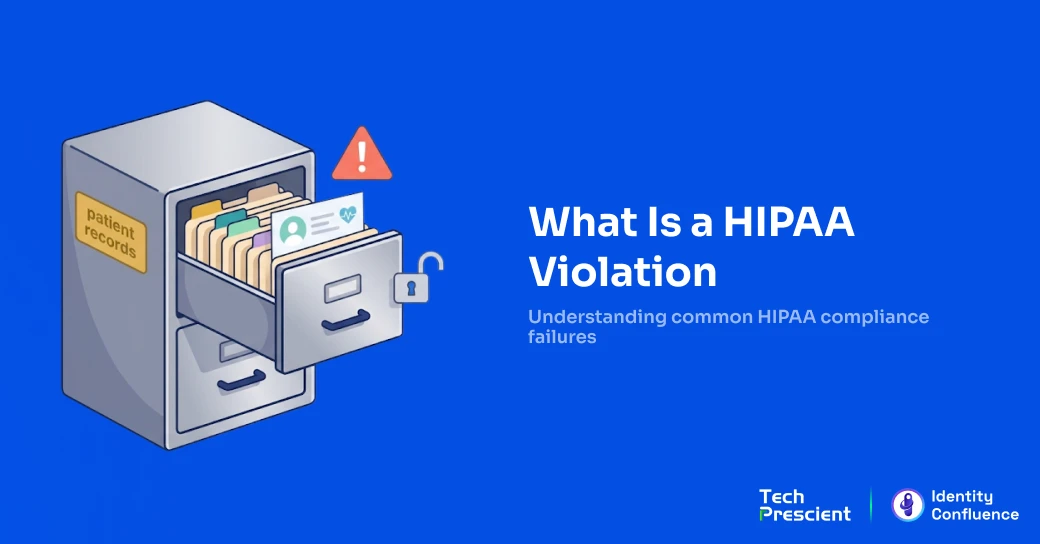
HIPAA violations can expose sensitive patient data, trigger costly penalties, and damage trust in healthcare organizations. From unauthorized access to weak security controls, even small mistakes involving Protected Health Information (PHI) can lead to serious compliance issues.
Originally introduced in 1996, HIPAA established national standards for protecting patient information and regulating how PHI is accessed, stored, and shared. Today, with rising cyber threats and stricter compliance expectations, healthcare organizations must strengthen both security practices and identity governance controls to reduce risk.
According to HIPAA Journal, nearly 57 million individuals were affected by healthcare data breaches in 2025, with more than 640 major breach incidents reported. These numbers highlight how quickly weak access controls, insider misuse, and unsecured systems can turn into serious HIPAA compliance violations. In this blog, we'll explore what is considered a HIPAA violation, common workplace examples, penalties, and how Identity Governance helps healthcare organizations prevent unauthorized access to PHI and maintain compliance.
Key Takeaways:
- Understand what is considered a HIPAA violation, including unauthorized access, disclosure, or mishandling of Protected Health Information (PHI).
- Explore common HIPAA violation examples in healthcare workplaces, from employee snooping to unsecured emails and lost devices.
- Learn how poor access controls, weak password practices, and lack of employee training increase HIPAA compliance risks.
- Discover the financial, legal, and reputational consequences organizations may face due to HIPAA violation fines and penalties.
- See how identity governance, role-based access control, and continuous monitoring help prevent unauthorized PHI exposure.
What Is Considered a HIPAA Violation?
A HIPAA violation occurs when Protected Health Information (PHI) is accessed, shared, exposed, or handled without proper authorization or security safeguards. This can include intentional misuse of patient data, accidental disclosures, or failure to implement adequate security controls to protect healthcare information. HIPAA regulations apply to covered entities such as hospitals, healthcare providers, insurers, and their business associates, all of whom are responsible for ensuring PHI remains secure, private, and accessible only to authorized individuals.
Below are some common situations that are considered HIPAA violations:
1. Unauthorized Viewing of Patient Records
Accessing patient information without a legitimate medical or business reason is one of the most common HIPAA violations. Employee snooping, curiosity-based access, or viewing records beyond a user's role can expose PHI and create serious compliance risks.
2. Sending PHI Through Unsecured Channels
Sharing patient data through personal email accounts, unsecured messaging apps, or unencrypted communication channels can lead to unauthorized disclosure of PHI. Healthcare organizations must ensure sensitive information is transmitted securely.
3. Weak Password & Access Control Practices
Poor password hygiene, shared login credentials, and excessive user permissions increase the risk of unauthorized access. Without strong Identity Governance and role-based access controls, organizations may struggle to protect sensitive healthcare data.
Pro Tip
Regularly review who has access to PHI across your healthcare systems. Over-permissioned accounts are one of the most common causes of insider-related HIPAA violations.
4. Failure to Secure Devices & Systems
Lost laptops, unsecured mobile devices, or improperly configured systems containing PHI can result in data exposure. HIPAA requires organizations to implement safeguards such as encryption, monitoring, and secure access management.
5. Improper Handling or Disposal of PHI
Throwing away medical records without shredding them, leaving documents unattended, or exposing patient information in public spaces can all violate HIPAA privacy requirements and compromise patient confidentiality.
Identify hidden PHI access risks before they become compliance violations.
Common HIPAA Violation Examples
Most HIPAA violations occur because of human mistakes, excessive access privileges, weak security controls, or insufficient employee awareness around handling Protected Health Information (PHI). In many cases, organizations fail to monitor who can access sensitive data, how it is being used, or whether adequate safeguards are in place to prevent unauthorized exposure.
Unauthorized Disclosure of PHI
One of the most common HIPAA violations involves sharing patient information with individuals who are not authorized to access it. This may include discussing patient details in public spaces, sending PHI to the wrong recipient, or posting identifiable healthcare information on social media platforms. Even accidental disclosures can result in compliance violations if patient privacy is compromised.
Employee Snooping
Healthcare employees sometimes access medical records out of curiosity rather than professional necessity. Viewing the records of coworkers, family members, celebrities, or patients without a valid job-related reason is considered unauthorized access under HIPAA regulations. Organizations without proper audit trails and monitoring systems may struggle to detect these incidents early.
Lost or Stolen Devices
Unsecured laptops, smartphones, external drives, or USB devices containing PHI can create serious security risks if they are lost or stolen. When healthcare data is stored on unencrypted devices, unauthorized individuals may gain access to sensitive patient information, potentially leading to large-scale data breaches and regulatory penalties.
Did You Know?
Many HIPAA violations are caused by internal errors like unsecured emails, shared passwords, and unlocked devices rather than external cyberattacks.
Improper Disposal of Sensitive Information
Discarding medical records, billing documents, prescription labels, or storage devices without secure destruction can expose PHI to unauthorized access. Paper records should be shredded, while digital data must be permanently erased before disposal to maintain compliance with HIPAA privacy and security requirements.
Lack of Training & Risk Analysis
Many HIPAA violations happen because employees are not properly trained on compliance policies or cybersecurity best practices. Without regular risk assessments, security audits, and continuous monitoring, organizations may fail to identify vulnerabilities such as excessive user access, weak passwords, or unsecured systems that put PHI at risk.
What Is a HIPAA Violation in the Workplace?
Workplace HIPAA violations occur when employees, contractors, or healthcare staff improperly access, share, or fail to secure Protected Health Information (PHI). Most workplace violations stem from human error, weak access controls, poor security practices, or lack of awareness around healthcare data privacy.
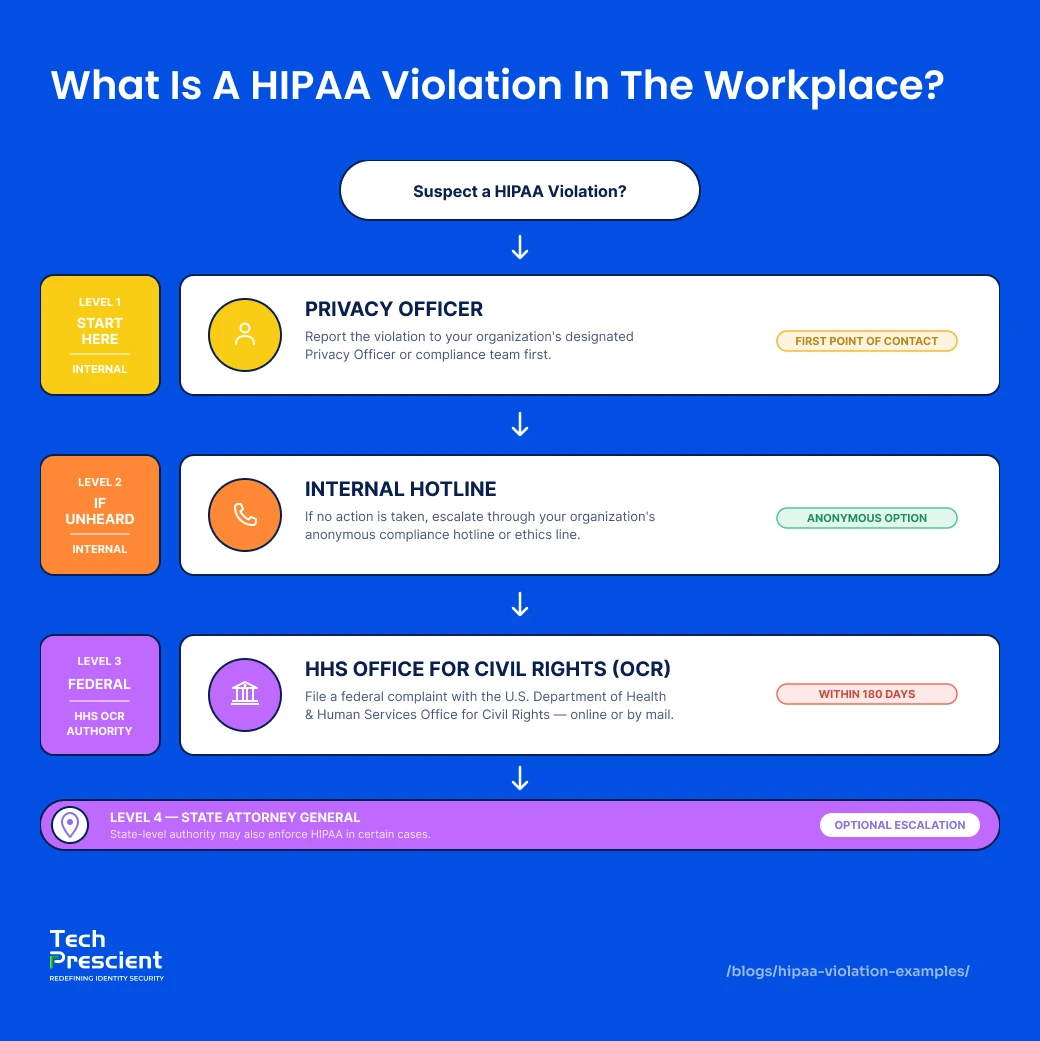
Below are some of the most common HIPAA violations that occur in workplace environments:
1. Discussing Patient Information in Unauthorized Settings
Conversations about patients in hallways, elevators, cafeterias, or public spaces can unintentionally expose confidential health information. Even casual discussions between employees may become a HIPAA violation if unauthorized individuals can identify the patient being discussed.
2. Leaving Systems & Screens Unsecured
Unattended workstations, unlocked devices, or visible patient records increase the risk of unauthorized access to PHI. In busy healthcare environments, failing to log out of systems or secure screens can allow employees or visitors to view sensitive information without permission.
3. Sharing Login Credentials
Using shared usernames and passwords removes accountability and makes it difficult to track who accessed patient records. Weak identity controls often lead to over-permissioned access, increasing the likelihood of unauthorized activity going unnoticed.
Quick Reality Check
If employees can access patient records beyond their job responsibilities, your organization may already be at risk of a HIPAA compliance gap without realizing it.
4. Sending PHI Without Encryption
Emailing patient information through unsecured channels or personal accounts can expose PHI during transmission. Healthcare organizations must ensure that sensitive healthcare data is encrypted and shared only through approved communication platforms.
5. Excessive Access & Lack of Identity Governance
Many workplace HIPAA violations stem from employees having broader access than necessary for their job roles. Without role-based access controls, automated access reviews, and proper identity governance, organizations may struggle to enforce least privilege access and prevent unnecessary exposure to sensitive patient data.
6. No Audit Trails or Monitoring
When organizations lack audit logs and monitoring capabilities, it becomes difficult to detect suspicious access patterns or investigate compliance incidents. Continuous monitoring and access visibility are critical for identifying insider threats and maintaining accountability across healthcare systems.
HIPAA Violations in Healthcare Settings
Healthcare environments face a higher risk of HIPAA violations due to the large volume of Protected Health Information (PHI) they manage across multiple users, devices, and systems. Without strong access controls and continuous monitoring, sensitive healthcare data can easily be exposed through misuse, excessive permissions, or third-party security gaps.
Below are some of the most common HIPAA violations seen in healthcare settings:
1. EMR & EHR Misuse
Electronic Medical Records (EMRs) and Electronic Health Records (EHRs) store highly sensitive patient information that should only be accessed for authorized medical or operational purposes. Unauthorized viewing, editing, or sharing of patient records can result in serious HIPAA compliance violations, especially when employees access records outside their job responsibilities.
2. Improper Role-Based Access
Healthcare employees often require different levels of access depending on their role, department, or clinical responsibilities. When organizations fail to enforce proper role-based access controls (RBAC), users may gain access to more PHI than necessary, increasing the risk of insider misuse, accidental exposure, and compliance failures.
3. Third-Party Vendor Risks
Healthcare organizations frequently rely on billing partners, cloud providers, consultants, and external vendors that process or store PHI. If these third parties lack proper security controls, compliance practices, or access governance measures, they can become a major source of HIPAA violations and healthcare data breaches.
What Are the Penalties for a HIPAA Violation?
HIPAA penalties depend on the severity of the violation, the level of negligence involved, and how quickly the organization takes corrective action. Penalties can range from relatively small financial fines for accidental violations to significant criminal charges, large settlements, and imprisonment in cases involving willful neglect or intentional misuse of Protected Health Information (PHI).
1. Civil Penalties
Civil penalties are typically issued when organizations fail to comply with HIPAA requirements due to negligence, weak safeguards, or inadequate security practices. Fines are generally structured in tiers based on the seriousness of the violation and whether reasonable efforts were made to correct the issue. Penalties can start at around $100 per violation and increase to as much as $50,000 per incident, with annual caps that may exceed $1.5 million for repeated violations of the same provision.
2. Criminal Penalties
Criminal penalties apply in cases where PHI is knowingly obtained, disclosed, or misused in violation of HIPAA regulations. Individuals found guilty of intentionally accessing or sharing patient information for personal gain, malicious intent, or fraudulent purposes may face substantial fines, criminal prosecution, and imprisonment. In severe cases, penalties can reach up to $250,000 in fines and up to 10 years in prison.
3. Factors That Affect HIPAA Penalties
Several factors influence the severity of HIPAA penalties, including whether the violation was accidental or caused by willful neglect, the number of patient records affected, and how quickly the organization responded to contain the issue. Regulators also evaluate whether the organization had appropriate compliance programs, employee training, access controls, audit mechanisms, and identity governance measures in place to reduce the risk of unauthorized PHI exposure.
Assess PHI access gaps and strengthen HIPAA-ready access governance controls.
How HIPAA Violations Are Discovered
HIPAA violations are often uncovered through security investigations, compliance reviews, employee reporting, or patient complaints. In many cases, organizations may not realize a violation has occurred until suspicious activity, unauthorized access, or a healthcare data breach is identified through audits or monitoring systems.
Healthcare organizations and regulators typically identify HIPAA violations through the following channels:
1. OCR Investigations
The Office for Civil Rights (OCR), which enforces HIPAA compliance, investigates reported breaches and potential violations involving Protected Health Information (PHI). Investigations may begin after a breach notification, media report, or formal complaint and often involve reviewing security practices, access controls, policies, and audit records.
2. Internal Audits & Security Monitoring
Healthcare organizations frequently identify HIPAA violations through internal audits, access reviews, and continuous monitoring of user activity. Audit logs can reveal suspicious behavior such as unauthorized access to patient records, excessive permissions, unusual login patterns, or attempts to bypass security controls.
3. Patient Complaints
Patients who believe their health information was improperly accessed, shared, or exposed can file complaints with healthcare providers or regulatory authorities. Complaints related to privacy breaches, unauthorized disclosures, or mishandling of PHI often trigger further investigations and compliance reviews.
4. Data Breach Notifications
Large-scale healthcare breaches involving lost devices, ransomware attacks, or unauthorized system access may expose HIPAA violations during mandatory breach reporting processes. Organizations are required to notify affected individuals and regulators when unsecured PHI is compromised.
5. Employee Reporting & Insider Investigations
Employees may report suspicious activity, policy violations, or improper handling of patient data internally. Insider threat investigations often uncover cases involving employee snooping, credential misuse, or unauthorized sharing of PHI within healthcare environments.
How to Prevent HIPAA Violations (IGA-Focused)
Preventing HIPAA violations requires more than basic security policies and employee training. Healthcare organizations need strong identity governance and access control frameworks to ensure the right individuals can access the right Protected Health Information (PHI) only when necessary. By combining automation, continuous monitoring, and least privilege access, organizations can reduce insider threats, strengthen compliance, and improve visibility across healthcare systems.
A strong HIPAA prevention strategy should focus on the following areas:
Implement Advanced Role-Based Access Controls (RBAC)
Healthcare employees should only have access to the data and systems required for their specific responsibilities. Modern role-based access controls go beyond static permissions by aligning access with clinical roles, departments, and operational needs. Fine-grained access policies help reduce unnecessary exposure to sensitive patient information across EMR and EHR systems.
Enforce Least Privilege Access Through Identity Governance
Least privilege access ensures users receive only the minimum level of access needed to perform their jobs. Identity governance platforms help organizations automate access provisioning, detect excessive permissions, and continuously right-size access as user responsibilities change. Features such as Just-in-Time (JIT) access can further limit unnecessary standing privileges.
Automate Access Reviews & Compliance Certifications
Manual access reviews are time-consuming and often inconsistent in large healthcare environments. Automated certification campaigns allow organizations to regularly validate user permissions, identify risky access patterns, and maintain audit-ready compliance records. AI-assisted review insights can also help security teams prioritize high-risk access decisions more effectively.
Enable Continuous Monitoring & Identity Threat Detection
Continuous monitoring helps healthcare organizations identify suspicious behavior before it leads to a breach. User activity analytics, audit logging, and identity threat detection tools can detect unusual PHI access patterns, insider misuse, credential abuse, or unauthorized access attempts across healthcare systems.
Strengthen Identity Lifecycle Management
Healthcare organizations frequently onboard employees, contractors, vendors, and temporary staff, making identity lifecycle management critical for HIPAA compliance. Automated joiner-mover-leaver processes ensure users receive appropriate access when they join, have permissions adjusted when roles change, and lose access immediately upon termination or departure.
Secure Third-Party & Vendor Access
Business associates, consultants, billing providers, and external vendors often require access to healthcare systems containing PHI. Organizations should implement controlled vendor access, federated identity management, and zero trust security models to limit unnecessary exposure and maintain visibility into third-party activity.
Improve Audit Trails & Compliance Visibility
Detailed audit logs and access records are essential for demonstrating HIPAA compliance and investigating security incidents. Identity governance solutions provide centralized visibility into who accessed PHI, when access occurred, and whether permissions aligned with organizational policies. This improves accountability, simplifies audits, and strengthens forensic investigations after security incidents.
Strong identity governance not only helps healthcare organizations reduce HIPAA violations but also improves operational security, minimizes insider risks, and creates a more scalable approach to healthcare compliance management.
Final Thoughts
A HIPAA violation is more than just a compliance failure. It can expose sensitive patient data, disrupt healthcare operations, and lead to serious financial and legal consequences. By implementing strong access controls, continuous monitoring, employee training, and identity governance practices, healthcare organizations can reduce compliance risks and better protect Protected Health Information (PHI).
Tech Prescient helps healthcare organizations strengthen HIPAA compliance through identity governance, automated access management, compliance visibility, and audit ready reporting across complex healthcare environments.
Assess PHI access gaps and strengthen HIPAA-ready access governance controls.
FAQs
A HIPAA violation happens when Protected Health Information (PHI) is accessed, shared, exposed, or handled without proper authorization or security safeguards. These violations can be intentional or accidental and often occur due to weak security controls, human error, or non-compliance with HIPAA regulations.
A workplace HIPAA violation occurs when employees improperly handle PHI during daily operations. This may include accessing patient records without a valid reason, discussing patient information publicly, sharing login credentials, or sending sensitive data through unsecured communication channels.
One common HIPAA violation example is accessing a patient's medical record without being directly involved in their care or job responsibilities. Other examples include emailing PHI without encryption, losing unprotected devices containing patient data, or exposing records to unauthorized individuals.
HIPAA penalties vary depending on the severity of the violation and whether it resulted from negligence or intentional misuse. Organizations may face fines ranging from hundreds to thousands of dollars per violation, while severe cases can also lead to criminal charges and imprisonment.
Yes, discussing patient information can become a HIPAA violation if the patient can be identified and the conversation is not authorized. Conversations in public areas such as hallways, elevators, or cafeterias can unintentionally expose confidential healthcare information.
Healthcare organizations can reduce HIPAA violations by implementing strong access controls, employee training, encryption, continuous monitoring, and identity governance practices. Role-based access, audit trails, and automated access reviews also help ensure only authorized users can access PHI.
Share



Yatin Laygude
Content Writer
A content writer with 6 years of experience turning complex topics into clear, engaging, and meaningful content. From blogs and web pages to whitepapers and thought pieces, he creates content that not only explains but also connects with both the audience and business goals.
Most Popular Blogs
Identity Security· 21 min read
Data Access Governance Solutions: How to Secure Sensitive Data at Scale
Compare data access governance solutions for 2026: how DAG platforms discover sensitive data, run access reviews, automate remediation, and prove compliance.
Brinda Bhatt· September 7, 2026
Identity Security· 24 min read
What Is Zero Trust Network Access (ZTNA)?
Learn what Zero Trust Network Access (ZTNA) is, how it works, and why it’s replacing VPNs for secure, identity-based access control.
Yatin Laygude· August 14, 2026
Identity Security· 24 min read
Cyber Essentials Certification: Complete Guide
Learn Cyber Essentials certification, cost, requirements, and steps. Compare Cyber Essentials vs Plus and get certified faster.
Yatin Laygude· August 10, 2026