




On this page
See Tech Prescient in Action
Automate access, reduce risk, and stay audit-ready
Zero Trust Identity reframes how organizations approach security. Traditional models assumed that users and systems operating inside a corporate network could be trusted. Zero Trust removes that assumption entirely. Every access request, whether originating from a cloud workload, a corporate office, or a remote location, must be explicitly validated, authenticated, and authorized.
The Zero Trust security model is built on one core idea: no user, device, or system should ever be trusted by default. Instead, every access request must be continuously verified using identity, context, and behavior. This identity-first approach is why Zero Trust Identity and IAM have become central to modern cybersecurity strategies.
Adoption of cloud computing has sped up this change. Sqmagazine claims that 60% of all company data will be kept on the cloud by 2025, with 94% of businesses using cloud services. The COVID-19 epidemic accelerated this change by raising the need for remote access and broadening the attack surface. Identity has become the first line of security since so many devices, apps, and users are connecting from outside of conventional boundaries.
This article examines what Zero Trust Identity entails in practice. It outlines the core components of a Zero Trust Identity strategy, the challenges organizations face during implementation, and the best practices that enable long-term effectiveness. Zero Trust Identity and Access Management acknowledges that threats may arise both externally and internally, which is why it demands a holistic security approach. By emphasizing continuous verification and enforcing strict access controls, this framework reduces the risk of unauthorized access, data breaches, and lateral movement across networks. Ultimately, this approach helps organizations improve security, meet compliance needs, and protect critical data in today's digital world.
Key Takeaways:
- Zero Trust Identity moves beyond perimeter security by continuously checking every user and device
- Identity and access management (IAM) is the foundation of Zero Trust, handling authentication, authorization, and real-time access control
- Strong multi-factor authentication, the principle of least privilege, continuous monitoring, and automation are core to Zero Trust IAM
- Remote work, cloud adoption, and credential attacks make Zero Trust a critical security strategy
- A phased roadmap with best practices ensures smooth and effective Zero Trust implementation
What Is Zero Trust Identity?
Zero Trust Identity applies the Zero Trust security model to identities by continuously verifying users and devices before and during access. It removes default trust and enforces strict identity-based controls.
Zero Trust Identity is a security framework where every individual or device seeking access to a private network must go through identification and authorization checks, regardless of whether they are inside or outside the network. Unlike traditional security models, it does not automatically trust users or devices simply because they are within the organization's network boundaries.
At its core, Zero Trust follows the principle of "never trust, always verify." This approach directly addresses the weaknesses of conventional IT security models. While traditional models excel at defending against external attacks, they create a blind spot by inherently trusting users and devices that are already on the network. Such trust can be dangerous, as it leaves organizations exposed to insider threats, cases where employees or contractors exploit access for financial gain, retaliation, or other motives.
By eliminating default trust, Zero Trust Identity compels organizations to continuously validate every access request. This proactive stance ensures that IT managers can minimize risks tied to insider threats and maintain stronger control over sensitive data and systems.
What Is the Zero Trust Security Model?
The Zero Trust security model is a cybersecurity framework that assumes breaches are inevitable and removes implicit trust. Every access request is verified in real time using identity, device posture, and contextual signals.
In a traditional security model, users and devices inside the network perimeter are trusted by default. Zero Trust eliminates this assumption by enforcing strict verification for every access attempt, whether it comes from inside the office, the cloud, or a remote location.
Core principles of the Zero Trust security model include:
- Never trust; always verify every access request
- Enforce least-privilege access using identity and role-based controls
- Continuously authenticate users and devices throughout a session
Unlike perimeter-based security, Zero Trust treats identity as the new perimeter. This makes Identity and Access Management (IAM) the foundation of Zero Trust implementation.
The Role of IAM in Zero Trust
IAM enables Zero Trust by authenticating users, enforcing least privilege, and continuously validating access based on identity and context.
Identity and Access Management (IAM) is at the heart of the Zero Trust security model. It acts as the foundation for maintaining the integrity of digital defenses, orchestrating strict access controls and rigorous verification processes. In the dynamic landscape of Zero Trust, IAM is indispensable, ensuring that every user and device, regardless of location, is authenticated and continuously validated to uphold the highest security standards.
Here's how IAM enables Zero Trust in practice:
Strong Identity Assurance
IAM enforces multi-factor authentication (MFA) to confirm identities before access is granted. This forms the first barrier against unauthorized access attempts.
Role-Based Permissioning
By defining role-based security policies, IAM grants permissions strictly aligned with user responsibilities. This principle of least privilege reduces risk exposure and strengthens security posture.
Proactive Activity Oversight
IAM solutions monitor user and device activity throughout a session. Anomalous or high-risk behavior can trigger policy-based responses, such as step-up authentication or access revocation.
Adaptive Access Decisions
IAM evaluates contextual factors, such as user location, device posture, and time of access, to inform decisions. This aligns directly with Zero Trust's focus on adaptive and dynamic access control.
Secure Data Handling
IAM supports secure handling of sensitive data by integrating access controls with encryption and policy enforcement, helping protect information both in transit and at rest.
How Do You Verify Every Access Request in Real Time?
Real-time access verification is achieved through continuous authentication combined with contextual and behavioral analysis. Identity and Access Management (IAM) systems evaluate identity signals, device health, location, and user behavior before granting access and continue to assess risk throughout the session.
When risk conditions change, such as an unexpected geographic login, a compromised device posture, or anomalous behavior, access policies can adapt immediately. This may include requiring additional authentication, limiting permissions, or revoking access altogether. Continuous verification ensures that trust is never static and that access decisions remain aligned with current risk, which is a foundational requirement of the Zero Trust security model.
Evaluate Access Reviews Function as a Zero Trust Control
Identify where approvals fail, gaps persist, or excessive access remains across systems.
Key Components of Zero Trust Identity and IAM
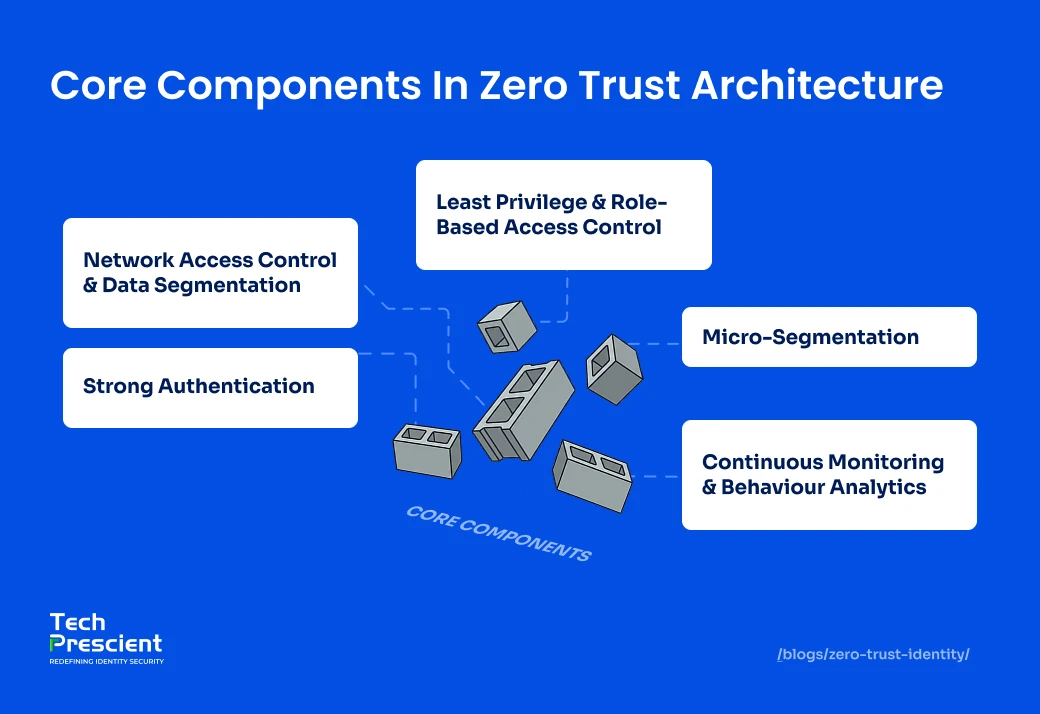
Implementing Zero Trust Identity and Access Management (IAM) requires a set of foundational capabilities that work together to secure access across users, devices, applications, and environments. These components move beyond one-time authentication to support continuous verification, precise access control, and ongoing risk evaluation.
Strong Authentication (MFA & Passwordless)
Authentication and authorization are fundamental to safeguarding sensitive data and resources in a Zero Trust Identity model. Every user and device requesting access must undergo rigorous verification before being allowed entry. A key mechanism here is multi-factor authentication (MFA), which combines different verification factors: something you know (passwords), something you have (security tokens), or something you are (biometric data). This layered approach significantly reduces the risk of compromised credentials by demanding multiple proofs of identity.
Modern IAM solutions also extend beyond passwords with passwordless authentication methods such as biometrics or security keys, offering both stronger protection and a smoother user experience. After authentication, users are assigned access rights strictly according to the principle of least privilege, meaning they only receive permissions necessary for their roles. This ensures tighter control, minimizes unnecessary exposure, and enhances the overall security posture.
The Principle of Least Privilege
The principle of least privilege is a cornerstone of the Zero Trust model, designed to limit users' access strictly to what is necessary for their job responsibilities. By minimizing permissions, organizations reduce the chances of unauthorized access to critical systems and contain the potential damage in case of compromised credentials. This approach also extends to detailed analysis of user identities and authentication events, ensuring that access rights remain tightly aligned with real business needs. A unified identity protection platform can further enhance this process by giving administrators complete visibility into all identities, including human users and machine-to-machine service accounts, so that the right access levels can be defined and enforced.
Role-Based Access Control
Role-Based Access Control (RBAC) provides a structured approach to managing permissions at scale. Instead of assigning access individually, users are mapped to defined roles, each associated with a specific set of privileges. This reduces administrative complexity and helps prevent inconsistent or excessive access provisioning.
When combined with least-privilege principles, RBAC supports a governed access model that improves security, simplifies audits, and aligns access decisions with business requirements.
Continuous Monitoring & Behavioral Analytics
Continuous authentication ensures that trust is never permanent and access decisions are re-evaluated throughout the user session. By combining User and Entity Behavior Analytics (UEBA), machine learning algorithms, and real-time monitoring tools, organizations gain the ability to detect, investigate, and respond to threats with speed and precision.
User and Entity Behavior Analytics (UEBA) acts as an early warning system, establishing baselines for normal activity and flagging any deviations that suggest suspicious behavior. Complementing this, machine learning algorithms analyze patterns across vast amounts of data in real time, identifying even subtle anomalies that might otherwise go unnoticed. Finally, real-time monitoring tools continuously scan the digital environment, providing instant alerts and enabling security teams to take immediate action before threats can escalate. Together, these capabilities create a proactive defense that strengthens detection and response against evolving cyber risks.
Network Segmentation
In a Zero Trust Identity and Access Management framework, network segmentation plays a crucial role in strengthening defenses and limiting the spread of potential threats. By applying strict network access controls and closely inspecting every device that attempts to connect, organizations ensure that access is tightly regulated and unauthorized sources are blocked before they can cause harm.
To further reduce risk, techniques like application segmentation and micro-segmentation divide the network into smaller, controlled zones. This containment strategy ensures that even if a breach occurs, its impact is isolated, preventing compromise from spreading across the environment. At the same time, data segmentation combined with encryption safeguards sensitive information, preserving confidentiality while also supporting compliance requirements. Together, these measures not only protect critical assets but also foster trust with stakeholders in today's highly dynamic digital landscape.
Micro-Segmentation
While network segmentation provides broad control, micro-segmentation takes security to a far more granular level by dividing the network into tightly controlled, isolated segments. Each of these segments operates as an independent security zone with its own access controls and policies, ensuring that permissions are applied precisely where needed.
This approach significantly reduces the risk of lateral movement within the network, making it much more difficult for attackers to move from one system to another or reach sensitive assets once inside. A related practice, known as identity segmentation, applies the same principle to users, isolating them according to their job functions and business requirements. Together, micro-segmentation and identity segmentation reinforce Zero Trust by creating multiple layers of defense that restrict unauthorized access and protect critical resources.
Why are Organizations Adopting Zero Trust Access Management?
Organizations are increasingly embracing Zero Trust because it offers a stronger and more resilient way to protect sensitive information and critical resources from cyber threats. The model operates on the assumption that no access request, regardless of origin or whether legitimate credentials are presented, can be trusted by default. Every request must be explicitly verified before access is granted. This reduces the overall attack surface and makes it far more challenging for attackers to infiltrate systems or move laterally within them.
Key drivers for this adoption include:
Stronger Cyber Defense
Identity Zero Trust requires explicit verification for every authentication attempt and enforces access through the principle of least privilege, making it significantly harder for cybercriminals to compromise sensitive resources.
Regulatory & Insurance Compliance
Frameworks such as PCI DSS, HIPAA, and SOC 2 mandate strict security controls, while cyber insurance providers increasingly require robust safeguards to issue policies. Identity Zero Trust enables organizations to meet these evolving compliance and insurance standards.
Securing Remote Workforces
Remote and hybrid work models require reliable verification regardless of user location. Zero Trust ensures that access decisions are based on identity, context, and risk rather than network proximity.
Cloud Resource Protection
As businesses migrate workloads and applications to the cloud, a unified Identity Zero Trust platform can authenticate and monitor all identities, human and machine, across hybrid and multi-cloud environments.
Enhanced Visibility & Control
By monitoring every access request, Identity Zero Trust gives organizations clear oversight of their environments. This includes detecting shadow admin accounts, flagging anomalous behavior, and blocking compromised service accounts before they can escalate threats.
How Zero Trust Eliminates Implicit Trust in Identity Systems
Implicit trust occurs when users or devices are granted access based solely on network presence or prior authentication. Zero Trust removes this assumption by requiring explicit identity verification for every access request, regardless of location, device, or previously issued credentials.
Access decisions are continuously evaluated using identity signals, contextual data, and policy enforcement. Least-privilege access ensures that permissions remain narrowly scoped, while ongoing monitoring detects changes in risk during a session. This approach limits the ability of attackers to abuse trusted access, restricts lateral movement, and ensures that access remains aligned with current risk conditions.
Benefits of Implementing Zero Trust Identity
Adopting an Identity-Focused Zero Trust Architecture delivers measurable benefits that go beyond traditional security models. By centering on identity, organizations can ensure strict authentication, continuous monitoring, and adaptive access controls that collectively strengthen their overall cybersecurity posture.
Reduces Risk of Credential Theft and Phishing Attacks
Zero Trust Identity enforces strong identity verification, including multi-factor authentication (MFA), and applies least-privilege access consistently. This limits the effectiveness of stolen credentials and reduces the impact of phishing-based attacks.
Strengthens Compliance with Regulations
Zero Trust Identity aligns seamlessly with key compliance frameworks such as GDPR, HIPAA, SOX, and PCI DSS. It also meets growing requirements from cyber insurance providers, who now mandate controls like MFA enforcement for administrative access before issuing policies.
Improves Visibility into Access Rights
Centralized identity governance provides clear insight into who has access to which resources. This visibility helps identify excessive privileges, unmanaged administrative accounts, and anomalous activity across both human and non-human identities.
Enhances Security in Hybrid and Cloud Environments
As workloads and applications move across hybrid and multi-cloud infrastructures, Zero Trust Identity provides consistent, identity-based controls. This ensures secure access regardless of whether resources reside on-premises or in the cloud.
Simplifies Audits with Automated Access Reviews
Automated user access reviews streamline audit processes, helping organizations maintain continuous compliance. By validating permissions regularly and removing excessive privileges, Zero Trust Identity makes it easier to demonstrate adherence to regulatory and security requirements.
By replacing implicit trust with identity-driven verification, Zero Trust Identity represents a paradigm shift in cybersecurity. It reduces exposure to credential-based threats, enhances governance, and equips organizations with the visibility and agility needed to safeguard critical assets in an increasingly complex digital landscape.
Common Challenges in Zero Trust Identity Implementation
Implementing an identity-centric Zero Trust model introduces operational and architectural complexity, particularly in environments built on legacy systems and distributed infrastructure. While the security benefits are well established, organizations commonly encounter the following challenges during adoption:
Integrating Legacy Apps Lacking Modern IAM Support
Many organizations still rely on legacy applications and infrastructure that do not natively support modern IAM capabilities such as multi-factor authentication (MFA), single sign-on (SSO), or adaptive authentication. These systems can become bottlenecks, limiting the effectiveness of Zero Trust. To address this, organizations may need to adopt bridging technologies, employ API-based connectors, or pursue phased migration strategies that modernize legacy systems without disrupting business continuity.
Balancing Security with User Friction (e.g., MFA Fatigue)
Stronger identity verification can introduce user friction if applied without context. Excessive authentication prompts or poorly designed MFA workflows can lead to user fatigue and reduced productivity. Organizations must balance security and usability by adopting single sign-on (SSO), risk-based adaptive authentication, and clear user communication to ensure controls are effective without becoming obstructive.
Cost and Complexity of IAM/IGA Platforms
Deploying and managing comprehensive IAM and IGA (Identity Governance and Administration) solutions often requires significant investment in licensing, infrastructure, and skilled personnel. The complexity of configuring policies, managing role definitions, and maintaining ongoing governance can be daunting. Organizations should plan for scalable solutions, leverage automation for access reviews and provisioning, and carefully evaluate vendor offerings to optimize cost and operational efficiency.
Managing Multiple Identity Providers
In modern hybrid and multi-cloud environments, organizations often rely on multiple identity providers across different platforms. Ensuring interoperability, consistent policy enforcement, and centralized visibility can be challenging when dealing with diverse protocols and standards. A successful strategy requires adopting platforms that support federated identity management, API-driven integrations, and unified dashboards to monitor all identities, human and machine, across the ecosystem.
Best Practices for Successful Zero Trust Identity Implementation
Effective Zero Trust Identity and Access Management (IAM) adoption requires more than tooling. It demands a structured roadmap, clear governance, and continuous enforcement. The following practices help organizations implement Zero Trust in a controlled, sustainable manner:
Assess Current IAM Maturity and Access Gaps
Begin with a thorough assessment of your identity infrastructure. Identify gaps in authentication, authorization, and access governance to prioritize where Zero Trust controls should be applied first.
Enforce MFA and Adaptive Authentication Across Apps
Strengthen identity assurance by requiring multi-factor authentication (MFA) everywhere, including critical admin tools. Use adaptive authentication to factor in device health, location, and user behavior for dynamic access decisions.
Define Least Privilege Policies with RBAC/ABAC
Implement the principle of least privilege through role-based access control (RBAC) and attribute-based access control (ABAC). These models ensure permissions are aligned with user roles, attributes, and business needs, minimizing unnecessary access.
Automate Provisioning, Access Reviews, and De-Provisioning
Use IGA (Identity Governance and Administration) tools to automate lifecycle processes. Automated provisioning and de-provisioning reduce human error, while periodic user access reviews ensure privileges remain accurate and compliant.
Apply Context-Aware, Risk-Based Access Controls
Strengthen access decisions by evaluating contextual signals such as device posture, geolocation, time of access, and risk scores. This enables smarter enforcement that adapts to evolving threats without overburdening users.
Monitor Activity Continuously and Alert Anomalies
Deploy User and Entity Behavior Analytics (UEBA) and real-time monitoring to detect abnormal activity. Immediate alerts and automated remediation steps help contain threats before they escalate.
Roll Out in Phases to Reduce Disruption
Implement Zero Trust Identity gradually, starting with high-risk applications and privileged accounts, before extending it across the enterprise. Phased deployment minimizes operational disruption while steadily strengthening security posture.
By following these practices, organizations can align Zero Trust Identity with business goals, reduce risks tied to compromised credentials, and maintain consistent governance across hybrid and cloud environments.
Final Thoughts
Zero Trust Identity is the practical application of the Zero Trust security model in a cloud-first, perimeter-less world. By replacing implicit trust with continuous verification, organizations can dramatically reduce risks, ensure compliance, and build a resilient security foundation.
At Tech Prescient, we partner with enterprises to accelerate their Zero Trust journey. From strengthening IAM with strong authentication and the principle of least privilege to enabling continuous monitoring, segmentation, and compliance with global standards, we help businesses modernize access security without slowing down innovation.
Now is the time to rethink your security strategy. Embrace Zero Trust Identity with Tech Prescient and safeguard your people, data, and applications against tomorrow's threats.
FAQs
Traditional security models rely on the castle-and-moat approach, once inside the network, users are trusted by default. Zero Trust flips this logic: no user, device, or application is inherently trusted. Every access request is continuously verified, regardless of whether it originates inside or outside the corporate network.
In a cloud-first and remote work environment, the network perimeter no longer exists. Identity becomes the new perimeter because it's the one constant across devices, apps, and locations. By enforcing strong IAM practices like MFA, least privilege, and continuous monitoring, organizations can ensure secure access everywhere.
IAM is the backbone of Zero Trust. It authenticates and authorizes users, applies granular access controls, and monitors behavior in real time. Features like context-aware access, encryption, and UEBA (User and Entity Behavior Analytics) make IAM critical for ensuring only the right users get the right level of access.
Common challenges include integrating legacy systems, balancing security with user experience, and ensuring scalability as identities grow. Organizations also face hurdles with interoperability between platforms and maintaining governance for compliance. A phased roadmap and strong identity governance can help overcome these barriers.
Zero Trust Identity reduces the attack surface, strengthens compliance, and improves incident response with real-time monitoring. It also enhances visibility and control over both human and non-human identities. Beyond security, it builds stakeholder trust by protecting sensitive data against credential theft, insider threats, and modern cyberattacks.
Zero Trust verifies every access request using continuous authentication and contextual analysis. IAM systems assess identity, device posture, location, and behavior before granting or maintaining access, and revoke permissions instantly if risk increases.
Continuous authentication is the ongoing verification of user identity throughout a session. Instead of authenticating only at login, Zero Trust continuously evaluates behavior and context to detect anomalies and prevent unauthorized access.
Zero Trust removes implicit trust by treating every access request as untrusted by default. Even authenticated users must be continuously verified, ensuring attackers cannot exploit trusted network positions or stolen credentials.
Share



Yatin Laygude
Content Writer
A content writer with 6 years of experience turning complex topics into clear, engaging, and meaningful content. From blogs and web pages to whitepapers and thought pieces, he creates content that not only explains but also connects with both the audience and business goals.
Most Popular Blogs
Identity Security· 21 min read
Data Access Governance Solutions: How to Secure Sensitive Data at Scale
Compare data access governance solutions for 2026: how DAG platforms discover sensitive data, run access reviews, automate remediation, and prove compliance.
Brinda Bhatt· September 7, 2026
Identity Security· 24 min read
What Is Zero Trust Network Access (ZTNA)?
Learn what Zero Trust Network Access (ZTNA) is, how it works, and why it’s replacing VPNs for secure, identity-based access control.
Yatin Laygude· August 14, 2026
Identity Security· 24 min read
Cyber Essentials Certification: Complete Guide
Learn Cyber Essentials certification, cost, requirements, and steps. Compare Cyber Essentials vs Plus and get certified faster.
Yatin Laygude· August 10, 2026