
Cybersecurity Risk Assessment: A Complete Guide for 2026
Last Updated date: July 16, 2026
On this page
See Tech Prescient in Action
Automate access, reduce risk, and stay audit-ready
A cybersecurity risk assessment is a structured, data-driven process used to identify, analyze, and prioritize risks to systems, data, and identities. Rather than focusing solely on technical weaknesses, it evaluates how threats and vulnerabilities translate into measurable business impact. By grounding security decisions in risk context, organizations can allocate resources to what matters most. For this reason, cybersecurity risk assessment is a foundational element of effective cyber governance.
In simple terms, a cybersecurity risk assessment helps organizations understand what could go wrong, how likely it is to happen, and how much it would cost the business. It connects technical weaknesses to financial, operational, and compliance impact.
The process combines asset inventory, threat modeling, vulnerability analysis, and impact assessment. Not all assets carry the same business value, and not all vulnerabilities present meaningful risk. Mature assessments account for contextual factors such as likelihood, adversary behavior, and control effectiveness. The outcome is actionable insight that informs mitigation strategies and security investment decisions.
The need for rigor continues to increase. According to Varonis, 62% of breaches that did not involve error, misuse, or physical action relied on stolen credentials, brute-force techniques, or phishing. This underscores how identity-driven threats translate directly into business risk and why identity must be central to modern risk assessments. In the sections that follow, we examine the assessment lifecycle, leading frameworks, practical examples, and best practices for operationalizing cybersecurity risk assessments in 2026.
Key Takeaways:
- Cybersecurity risk assessments connect threats and vulnerabilities to measurable business impact.
- Identity and access risks, including privileged and orphaned accounts, are central to modern assessments.
- A structured, step-by-step approach ensures risks are identified, prioritized, mitigated, and continuously monitored.
- Established frameworks such as NIST, ISO 27001, FAIR, and DoD RMF standardize risk evaluation and governance.
- Continuous assessment and integrated identity governance measurably reduce organizational risk exposure.
What Is a Cybersecurity Risk Assessment?
A cybersecurity risk assessment is a structured, evidence-based process used to identify, analyze, and prioritize threats according to their potential business impact. Its purpose is not to catalog technical findings, but to determine how cyber exposure affects organizational objectives, financial performance, regulatory standing, and operational continuity.
The assessment evaluates critical assets including applications, infrastructure, data repositories, cloud environments, and identity systems. It examines threat vectors such as malware, ransomware, credential compromise, insider activity, configuration weaknesses, and third-party dependencies. Each risk is assessed based on likelihood, exploitability, and impact to the business.
This approach shifts the focus from technical severity alone to material risk. A vulnerability is relevant only to the extent that it introduces meaningful exposure. By aligning threat analysis with business context, organizations gain defensible clarity on where risk concentration exists and which remediation actions warrant priority.
At its core, a cybersecurity risk assessment provides the analytical foundation required to manage cyber risk in a disciplined and defensible manner.
Cyber Risk Assessment vs Risk Management
A clear distinction between cyber risk assessment and risk management is essential for building an effective cybersecurity program. While closely related, each serves a distinct role within an organization's overall risk strategy.
- Cyber risk assessment focuses on identifying and analyzing threats, vulnerabilities, likelihood, and potential impact across IT systems and digital assets. It enables organizations to understand what risks exist, how severe they may be, and which areas of the environment are most exposed.
- Risk management applies the findings of the assessment to guide decision-making. It defines security policies, implements controls, allocates resources, and determines how risks are addressed over time. This includes deciding whether risks are mitigated, accepted, transferred, or avoided in alignment with business objectives and risk tolerance.
The Role of Identity and Access in Reducing Cybersecurity Risk
Identity and access risks are central to cybersecurity risk assessments because unauthorized access remains a leading cause of security incidents. Weak authentication, excessive privileges, ineffective access governance, unmanaged service accounts, and unsecured third-party access materially increase breach likelihood.
Assessing how users, devices, and external entities authenticate and interact with systems is essential to accurately measuring cyber risk. A strong focus on identity and access controls reduces exposure to credential misuse, limits lateral movement, and protects sensitive data and business-critical systems.
Why Cybersecurity Risk Assessments Are Critical in 2026
Cybersecurity risk assessments are critical in 2026 because expanding cloud environments, SaaS adoption, remote work models, and AI-integrated systems have increased organizational exposure and made cyber risk a direct business liability.
As digital ecosystems grow more complex, unmanaged risk translates into measurable financial and operational impact. Industry reporting shows the global average cost of a data breach reached USD 4.88 million in 2024, reinforcing that cyber incidents carry material consequences.
A formal risk assessment enables organizations to align security controls and investment with actual business exposure. By identifying, measuring, and prioritizing risk across data, applications, infrastructure, and identity systems, leadership can allocate resources based on impact, not technical severity alone.
Reality Check
If your organization can't quantify its top three cyber risks in business terms, you're managing assumptions, not risk. Executive alignment starts with clarity, not dashboards.
1. Increasing Attack Surface Across Cloud, SaaS, and Remote Access
Hybrid cloud environments, SaaS ecosystems, third-party integrations, and distributed workforces significantly expand the attack surface. Each additional workload, application, API, endpoint, or identity introduces new exposure, often through misconfigurations, unsecured remote access, and identity-based attack techniques such as credential phishing and password spraying.
Cybersecurity risk assessments provide the visibility required to understand how architectural decisions and access sprawl increase exposure, making regular reassessment essential to maintaining an accurate view of organizational risk.
2. Compliance Drivers Continue to Intensify
Regulatory and industry frameworks continue to raise expectations for formalized risk management. In 2026, many standards explicitly require organizations to demonstrate ongoing risk identification, evaluation, and mitigation.
Cybersecurity risk assessments support compliance efforts by helping organizations:
- Meet risk assessment requirements under standards such as ISO 27001, SOC 2, and HIPAA
- Identify control gaps before audits or regulatory reviews
- Establish documented risk baselines and repeatable assessment processes
- Demonstrate due diligence in protecting sensitive and regulated data
Without a formal assessment process, organizations risk audit failures, legal exposure, financial penalties, and loss of customer trust.
3. Financial and Reputational Impact of Cyber Risk
The consequences of cyber incidents extend well beyond immediate containment and recovery. Data breaches, service outages, and identity compromise can result in sustained financial loss, regulatory action, operational disruption, and long-term reputational damage. The loss or compromise of sensitive data, including customer information, intellectual property, and regulated data, can erode trust, trigger legal liabilities, and significantly increase recovery costs.
Cybersecurity risk assessments shift the focus from isolated technical findings to measurable business impact. By identifying high-impact risks early, organizations can reduce the likelihood and severity of incidents, protect business continuity, and maintain availability of both internal and customer-facing systems.
Specifically, cybersecurity risk assessments help organizations:
- Protect against loss or compromise of sensitive data by identifying where critical data resides, how it is accessed, and which identity, access, or configuration weaknesses could expose it to unauthorized use.
- Reduce costs associated with security incidents by preventing high-impact breaches, shortening detection and response timelines, and avoiding the cascading financial effects of prolonged outages, regulatory fines, and post-incident remediation.
- Prioritize security investments based on business impact rather than isolated technical findings, ensuring resources are allocated to the risks that pose the greatest financial and operational threat.
- Limit reputational damage and customer trust erosion by proactively addressing the risks most likely to result in public incidents, service disruptions, or data exposure.
This proactive, risk-driven posture strengthens incident response and recovery planning and contributes to greater organizational resilience in an increasingly adversarial threat environment.
What Does a Cybersecurity Risk Assessment Include?
A structured cybersecurity risk assessment evaluates assets, threats, vulnerabilities, likelihood, and business impact to determine where risk is most concentrated.
The process establishes a repeatable framework for analyzing how technology environments, identity systems, data stores, and operational processes contribute to enterprise exposure. It distinguishes between technical findings and material risk by assessing exploitability, control effectiveness, and potential impact on financial performance, operations, and compliance posture.
By correlating assets to threat scenarios and quantifying potential consequences, the assessment produces a prioritized risk view. This enables organizations to focus remediation and investment decisions on exposures that create measurable business impact rather than isolated technical deficiencies.
Asset Identification
The assessment begins by identifying and cataloging assets across the IT environment. This includes systems, applications, databases, cloud workloads, endpoints, networks, SaaS platforms, and the sensitive data they store or process. Without complete and accurate asset visibility, risk analysis is incomplete and unreliable.
Identity-related assets require heightened attention. User identities, service accounts, privileged accounts, and orphaned or inactive accounts often represent elevated risk because they provide direct access to critical systems. Excessive privileges, unmanaged credentials, and undocumented access paths materially expand the attack surface and must be included within the assessment scope.
Threat and Vulnerability Analysis
After assets are defined, the assessment evaluates the threats and vulnerabilities that could be used to compromise them. This analysis considers both external and internal attack paths, with a strong focus on identity and access weaknesses.
Common areas of evaluation include:
- External threats such as malware, ransomware, phishing campaigns, credential theft, and exploitation of misconfigured cloud services
- Identity-based attack techniques, including password spraying, token abuse, and abuse of excessive privileges
- Internal risks such as privilege misuse, insider activity, weak authentication controls, and lack of segregation of duties (SOD)
- Technical and configuration vulnerabilities, including outdated software, insecure defaults, weak credentials, and unsecured third-party access
Threats and vulnerabilities are assessed together to determine how an attack could realistically occur, not just whether a theoretical weakness exists.
Likelihood and Impact Evaluation
The final component evaluates the likelihood of threat realization and the resulting business impact. Organizations may apply qualitative models that classify risk levels, quantitative models that estimate financial impact using measures such as downtime cost or loss expectancy, or a hybrid of both.
Impact is assessed from a business perspective rather than a purely technical one, including operational disruption, data loss, regulatory exposure, reputational impact, and customer service interruption. By directly linking likelihood and impact to business outcomes, organizations can prioritize remediation based on material risk rather than volume of findings.
Advanced organizations increasingly use quantitative risk models to estimate financial exposure using metrics such as annualized loss expectancy (ALE), downtime cost, regulatory penalties, and revenue impact. This approach enables security leaders to communicate cyber risk in financial terms to executive stakeholders and boards.
Inherent Risk vs Residual Risk
Inherent risk represents the level of cyber exposure that exists before security controls are applied. It reflects the baseline risk associated with assets, threat actors, and operational dependencies in the absence of mitigation.
Residual risk reflects the remaining exposure after controls, safeguards, and governance measures are implemented. It accounts for control effectiveness, implementation gaps, and practical limitations in prevention and detection.
Distinguishing between inherent and residual risk enables organizations to evaluate control performance, measure risk reduction, and determine whether remaining exposure aligns with defined risk appetite and tolerance thresholds.
Cybersecurity Risk Assessment Process (Step-by-Step)
The cybersecurity risk assessment process follows a structured lifecycle: define scope, identify and value assets, analyze threats and vulnerabilities, evaluate likelihood and business impact, implement controls, and continuously monitor risk.
This repeatable approach translates technical exposure into prioritized remediation decisions. It evaluates exploitability, control effectiveness, and potential impact to determine where risk is materially concentrated. When treated as an ongoing governance function rather than a one-time activity, the process enables sustained risk reduction and consistent executive oversight.
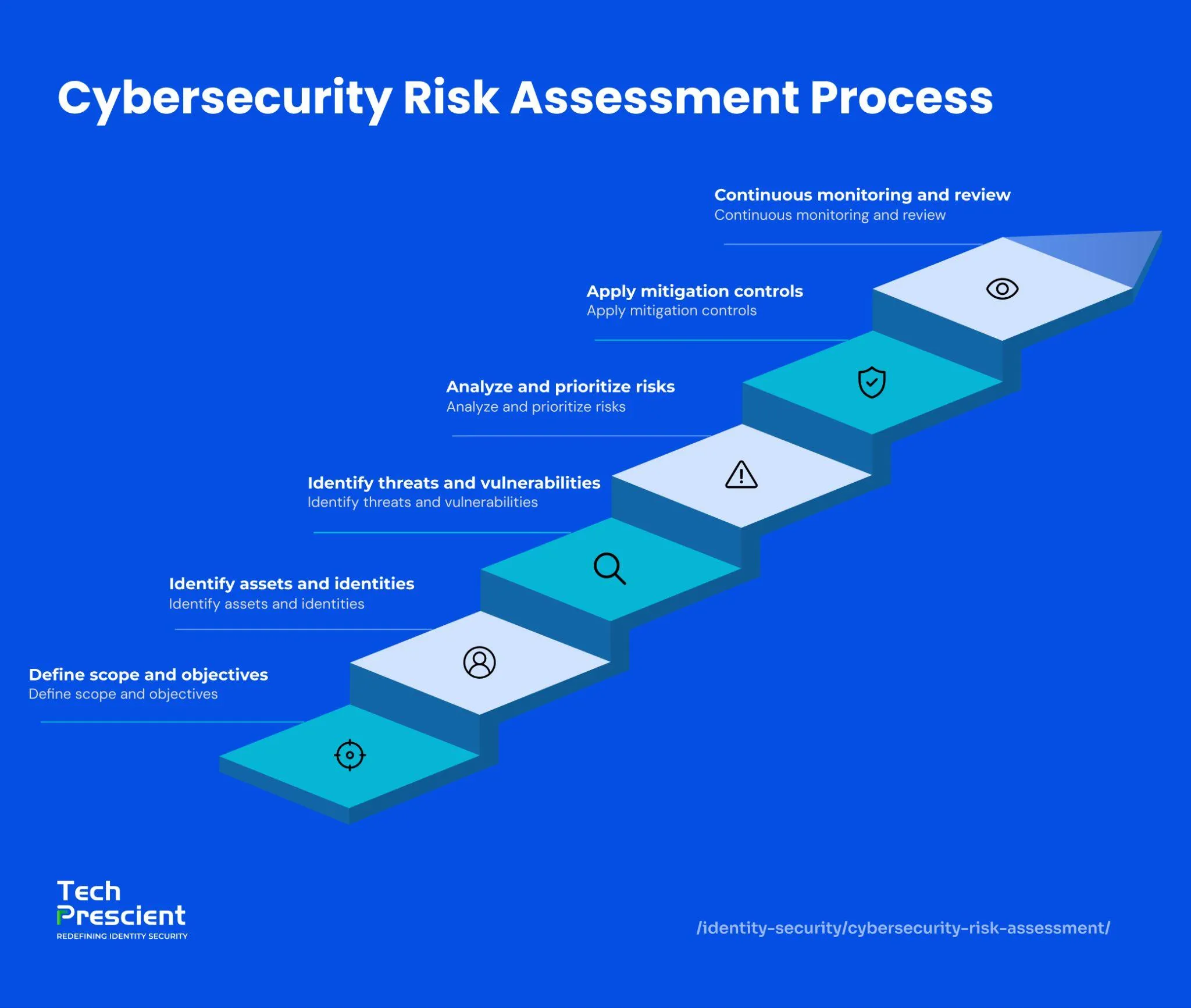
Step 1 – Define Scope and Objectives
The process begins by defining the scope of the assessment based on business priorities and risk exposure. Scope may include the entire organization or be limited to specific business units, applications, cloud environments, data domains, or operational processes that are critical to business operations.
Scope definition should focus on systems that support revenue, customer interactions, sensitive data processing, or mission critical services. Clear boundaries ensure the assessment remains focused, actionable, and aligned with real business risk.
Objectives should also be established at this stage. Organizations must determine whether the assessment is intended to reduce material risk, inform security strategy, support executive decision making, or improve incident readiness. Clear objectives guide how results will be analyzed, reported, and acted upon.
Step 2 – Identify Assets and Identities
Once scope is established, organizations identify and inventory assets within that boundary. This includes infrastructure, applications, cloud workloads, SaaS platforms, networks, endpoints, data repositories, APIs, and third-party integrations.
Identity assets are especially critical at this stage. Users, roles, service accounts, privileged accounts, and orphaned or inactive identities often represent the highest-risk access paths. Understanding who has access to what, at what level, and under which conditions is essential for identifying exposure tied to excessive privileges, unmanaged credentials, and access sprawl.
Quick Self-Check
Can you instantly list all privileged accounts and service identities tied to critical systems? If not, your risk assessment likely has blind spots.
Step 3 – Identify Threats and Vulnerabilities
With assets identified, the assessment evaluates threats and vulnerabilities that could be exploited. Technical vulnerabilities include misconfigurations, unpatched systems, insecure cloud settings, weak passwords, exposed services, and missing security controls.
Threat analysis considers both external and internal risks. External threats may include malware, ransomware, phishing, credential theft, exploit kits, and denial-of-service attacks. Internal threats include insider misuse, privilege abuse, weak access governance, and inadequate segregation of duties. Frameworks such as MITRE ATT&CK and data sources like the National Vulnerability Database help map realistic attack techniques to identified weaknesses.
Step 4 – Analyze and Prioritize Risks
Risk analysis combines assets, threats, and vulnerabilities to determine overall risk levels. Organizations assess the likelihood of exploitation and the potential impact on confidentiality, integrity, availability, operations, and financial outcomes.
At this stage, risks are also evaluated against regulatory, contractual, and policy obligations. Understanding where risk intersects with compliance requirements helps prioritize remediation where business and regulatory exposure is highest. Risk scoring may be qualitative, quantitative, or hybrid. Effective prioritization focuses on business impact rather than technical severity alone.
Step 5 – Mitigation and Controls
Once risks are prioritized, organizations define mitigation strategies aligned with risk severity and business impact. Controls should be selected based on the nature of the exposure and the systems, data, or identities affected.
Common mitigation approaches include:
- Technical controls: Patching and vulnerability remediation, encryption of data at rest and in transit, firewalls, endpoint protection, intrusion detection and prevention systems, and cloud security tooling to reduce exploitable weaknesses.
- Administrative controls: Security policies and procedures, audits and assessments, data classification standards, incident response plans, and vendor and third-party risk management processes that support consistent risk governance.
- Identity and access controls: Multi factor authentication, access reviews, privileged access management, role based access enforcement, and removal of excessive or unused access to reduce identity driven risk and limit unauthorized access.
At this stage, organizations also align implemented controls with regulatory and industry requirements such as ISO 27001, SOC 2, HIPAA, and PCI DSS through documentation, validation, and evidence collection.
Step 6 – Continuous Monitoring
Cybersecurity risk assessments are not static. Risk posture changes continuously due to configuration drift, new deployments, user access changes, third-party integrations, and evolving threat activity. Continuous monitoring ensures that risk insights remain current and actionable.
Organizations should conduct periodic reassessments for high-impact systems and integrate ongoing monitoring through vulnerability management, cloud posture management, and control validation. Moving from one-time audits to continuous assessment strengthens resilience and enables faster detection and response to emerging risks.
Cybersecurity Risk Assessment Frameworks
Cybersecurity risk assessment frameworks establish structured methodologies for identifying, measuring, and governing cyber risk consistently across the enterprise.
These frameworks provide standardized guidance for evaluating threats, vulnerabilities, control effectiveness, and business impact in a repeatable manner. By grounding assessments in recognized models, organizations reduce subjectivity and ensure methodological consistency.
Aligning risk assessments with established frameworks also supports regulatory compliance, industry alignment, and executive reporting. Most importantly, it connects technical risk evaluation to business objectives, enabling defensible risk governance at scale.
1. NIST Cybersecurity Framework (CSF)
The NIST Cybersecurity Framework, developed by the National Institute of Standards and Technology, provides a flexible, risk-based approach for assessing and managing cybersecurity risk through five core functions: Identify, Protect, Detect, Respond, and Recover. It supports systematic evaluation of assets, threats, vulnerabilities, and controls, and is widely adopted across industries as a practical foundation for enterprise risk assessments.
2. ISO/IEC 27001
ISO/IEC 27001, published by the International Organization for Standardization and the International Electrotechnical Commission, defines a risk-based Information Security Management System that requires formal identification, assessment, and treatment of information security risk. Its structured and auditable approach makes it well suited for organizations operating in regulated environments or pursuing compliance-driven risk management programs.
3. FAIR Framework
The FAIR Framework, which stands for Factor Analysis of Information Risk, provides a quantitative methodology for measuring cyber risk in financial terms by analyzing loss event frequency and potential impact. It enables organizations to express risk using defensible metrics, supporting investment prioritization, executive decision making, and cyber insurance evaluation.
4. DoD Risk Management Framework (High-Level)
The DoD Risk Management Framework defines a structured approach for managing security and privacy risk in regulated and high assurance environments. It organizes cyber risk management into six steps: categorize, select, implement, assess, authorize, and monitor.
While originally developed for Department of Defense systems, the DoD RMF is applicable to any organization operating in highly regulated sectors. It emphasizes continuous monitoring, control effectiveness, and formal authorization, making it particularly relevant for environments with strict governance, compliance, and security assurance requirements.
Cybersecurity Risk Assessment Examples
Real-world cybersecurity risk assessment examples demonstrate how organizations identify identity and access weaknesses that create fraud, data exposure, and compliance risk. Across industries, structured assessments are used to uncover gaps in access governance, control effectiveness, and risk prioritization that directly affect business outcomes.
1. Finance: Excess Privileged Access Leading to Fraud Risk
A financial services organization conducts a cybersecurity risk assessment to evaluate access to core banking systems and financial applications. The assessment identifies excessive privileged access among administrators and service accounts, including standing permissions that exceed job requirements.
By correlating identities, roles, and permissions to critical systems, the organization identifies elevated risk of insider misuse and account compromise, leading to tighter access governance, privileged access management controls, and recurring access reviews to reduce fraud and support regulatory compliance.
2. Healthcare: Dormant User Accounts Increasing HIPAA Exposure
A healthcare provider uses a risk-based assessment aligned with HIPAA (Health Insurance Portability and Accountability Act) requirements to evaluate how protected health information (PHI) is accessed across clinical and administrative systems. The assessment identifies dormant and orphaned user accounts belonging to former employees and contractors that still retain access to sensitive systems.
These unmanaged identities significantly increase the risk of unauthorized access and compliance violations. As a result of the cybersecurity risk assessment, the organization implements automated deprovisioning, periodic access certification, and identity lifecycle controls to reduce exposure and maintain HIPAA compliance.
3. SaaS Provider: Over-Permissioned Applications Causing Data Exposure
A software-as-a-service provider performs a cybersecurity risk assessment as part of its SOC 2 compliance efforts. During the assessment, security teams analyze application permissions, third-party integrations, and API access across the SaaS environment.
The assessment uncovers over-permissioned applications and excessive access granted to internal tools and external services, creating unnecessary data exposure risk. By remediating these findings, enforcing least privilege access, and strengthening monitoring controls, the provider reduces the risk of data leakage while improving customer trust and audit readiness.
4. E-Commerce: Payment Data Risk Under PCI DSS
An online retailer conducts regular cybersecurity risk assessments aligned with PCI DSS requirements to protect cardholder data. The assessment evaluates encryption, access controls, network segmentation, and identity access to the cardholder data environment (CDE).
The findings highlight gaps in access restriction and monitoring that could expose payment data to unauthorized users. Addressing these risks helps the organization strengthen payment security, reduce breach likelihood, and maintain compliance with PCI DSS standards.
Best Practices for Cybersecurity Risk Assessments
Effective cybersecurity risk assessments focus on business impact, identity exposure, automation, and continuous visibility rather than checklist compliance.
Assessments should function as ongoing governance processes, not point-in-time audits. They must align risk evaluation to financial, operational, and regulatory objectives.
Priority areas include identity-driven exposure, control effectiveness, and continuous monitoring. When embedded into governance workflows, assessments deliver defensible prioritization and measurable risk reduction.
1. Treat cyber risk as business risk
Cybersecurity risk assessments should be grounded in business impact rather than isolated technical findings. Instead of focusing solely on whether systems are secure, organizations should evaluate how cyber risk affects revenue, operations, regulatory obligations, and reputation. Framing risk in terms of financial loss, downtime, or compliance exposure enables leadership to make informed decisions about risk tolerance and security investment.
2. Prioritize identity and access risks
Identity represents the primary attack surface in modern environments. Risk assessments should emphasize user access, privileged accounts, service identities, third-party access, and entitlement sprawl. Excessive permissions, weak authentication controls, and unmanaged identities frequently introduce more material risk than traditional infrastructure vulnerabilities and should be assessed accordingly.
This identity-centric approach aligns directly with Zero Trust principles, where every access request is continuously verified based on context, device posture, and risk signals rather than implicit trust.
3. Automate access reviews and validation
Manual access reviews are slow, inconsistent, and difficult to scale. Automating access certifications, entitlement reviews, and policy enforcement improves accuracy while reducing operational burden. Automation also enables organizations to detect orphaned accounts, privilege creep, and policy violations more quickly, keeping risk assessments aligned with real-world access conditions.
4. Align with enterprise risk management (ERM) programs
Cybersecurity risk assessments are most effective when integrated with broader enterprise risk management initiatives. Aligning cyber risk metrics with ERM frameworks helps organizations compare technology risk alongside financial, operational, and strategic risks, creating a unified view of organizational exposure and improving governance consistency.
5. Perform assessments continuously, not periodically
Modern IT environments change too quickly for annual or one-time assessments to remain relevant. Cloud deployments, SaaS adoption, identity changes, and third-party integrations constantly reshape risk posture. Best practices favor continuous or recurring assessments supported by monitoring, telemetry, and automated controls to ensure risk insights remain current and actionable.
How Identity Governance Reduces Cybersecurity Risk
Identity governance reduces cyber risk by enforcing least privilege, automating access lifecycle controls, and maintaining visibility into access across systems and data.
Compromised or overprivileged accounts remain a primary source of exposure. Identity governance addresses this risk through policy-based access controls, automated provisioning and deprovisioning, and periodic access validation. By institutionalizing least privilege and continuous oversight, organizations reduce attack surface and lower residual risk in a measurable, defensible manner.
1. Enforcing Least Privilege at Scale
One of the most effective ways identity governance reduces cyber risk is by enforcing least privilege access. Instead of granting broad or permanent permissions, access is limited to what users need to perform their roles and nothing more.
By continuously evaluating entitlements across systems, identity governance platforms identify excessive permissions, privilege creep, and high-risk access paths. This reduces the blast radius of compromised credentials and limits lateral movement during an attack, directly lowering the likelihood and impact of security incidents.
2. Strengthening Risk Posture Through Access Certifications
Access certifications are a critical control for validating whether access is still appropriate over time. Identity governance enables organizations to run periodic access reviews where managers and application owners certify user access based on business context.
These reviews help uncover orphaned accounts, unused privileges, and policy violations that traditional security tools often miss. When tied to cybersecurity risk assessments, access certifications provide measurable evidence of risk reduction and demonstrate that access decisions are reviewed, justified, and accountable.
3. Automating Joiner Mover Leaver Controls
Manual identity lifecycle processes are a major source of cyber risk. Delays in provisioning, role changes, or deprovisioning frequently leave users with inappropriate access long after their responsibilities change.
Automated joiner mover leaver workflows ensure that access is granted, modified, and revoked in real time based on identity attributes and policy. This automation minimizes human error, reduces insider risk, and prevents former employees or contractors from retaining access to critical systems, a common root cause of breaches.
4. Improving Audit Readiness and Compliance Confidence
Identity governance plays a central role in audit readiness by maintaining a clear record of access decisions, policy enforcement, and control effectiveness. Whether supporting ISO 27001, SOC 2, HIPAA, or internal governance requirements, identity governance provides auditors with traceable evidence of who has access, why it was granted, and how it is reviewed.
By aligning identity controls with cybersecurity risk assessments, organizations can demonstrate due diligence, reduce audit friction, and avoid last-minute remediation that increases operational risk.
Quantify your identity-driven cyber risk.
Use our Identity Risk Exposure Self-Assessment to measure privileged access and access-based breach exposure.
Cybersecurity Risk Assessment Checklist (Quick Reference)
Use this checklist as a practical reference to ensure the fundamentals are in place before drawing conclusions from a cybersecurity risk assessment. Gaps in any of these areas can skew results, hide identity-related exposure, or limit the effectiveness of remediation efforts.
1. Asset inventory is complete and current
Confirm that all systems, applications, cloud workloads, SaaS platforms, data repositories, and third-party integrations are identified and within scope. Incomplete inventories create blind spots and result in underestimated risk.
2. Privileged access has been reviewed
Validate that privileged accounts, service accounts, and administrative roles are identified and reviewed. Check for excessive privileges, shared accounts, and standing access that increases the impact of credential compromise.
3. Multi-factor authentication (MFA) is enforced where required
Ensure multi-factor authentication (MFA) is enabled for privileged users, remote access, cloud consoles, and sensitive applications. Lack of MFA remains a common contributor to identity-based attacks and elevated breach risk.
4. Access reviews are documented and traceable
Verify that periodic access certifications are conducted and recorded, with clear approval history and remediation actions. Documentation is essential for demonstrating governance, accountability, and audit readiness.
5. Compliance requirements are mapped to risks and controls
Confirm that relevant regulatory and industry requirements are linked to identified risks and mitigation controls. This helps ensure alignment with standards such as ISO 27001, SOC 2, HIPAA, or PCI DSS and prevents gaps during audits.
Expert Insight: Identity Is the New Risk Perimeter
In modern breach investigations, compromised credentials and excessive privileges consistently appear as primary root causes. Organizations that embed identity governance into their risk assessment lifecycle consistently reduce breach impact, audit friction, and remediation cost.
Risk assessments that exclude identity visibility provide an incomplete view of enterprise exposure.
Final Thoughts
Cybersecurity risk assessments are no longer just a compliance requirement. They are essential for understanding how threats, vulnerabilities, and identity risks impact business-critical systems, data, and operations. A structured approach ensures cyber risks are identified and prioritized consistently across the organization.
As cloud, hybrid, and SaaS environments grow, attack surfaces expand and identity risks increase. Modern assessments must go beyond static checklists by continuously reviewing access, enforcing least privilege, and focusing on business impact.
FAQs
A cybersecurity risk assessment is the process of identifying threats, vulnerabilities, and potential impacts to an organization's systems, data, and identities. It helps teams understand where cyber risks exist and which ones matter most to the business. The goal is to prioritize risks before they turn into incidents.
At a minimum, cybersecurity risk assessments should be conducted annually. They should also be performed after major changes such as cloud migrations, new applications, mergers, or regulatory updates. Frequent assessments help keep pace with evolving threats and access changes.
The core steps include defining scope, identifying assets and identities, analyzing threats and vulnerabilities, evaluating likelihood and impact, and prioritizing risks. This is followed by implementing controls and monitoring risks continuously. The process is cyclical, not a one-time activity.
Commonly used frameworks include the NIST Cybersecurity Framework, ISO/IEC 27001, and the FAIR framework. These provide structured methods to assess, measure, and manage cyber risk. Organizations often combine frameworks based on regulatory and business needs.
Identity governance reduces cyber risk by controlling who has access to what and why. It enforces least privilege, manages joiner-mover-leaver events, and documents access decisions for audits. Strong identity governance directly limits breach impact and improves compliance posture.
Inherent risk is the level of exposure before security controls are applied. Residual risk is the remaining risk after mitigation measures are implemented. Measuring both helps organizations evaluate control effectiveness and determine if risk aligns with business tolerance.


GET A PERSONALIZED DEMO
See Identity Confluence in Action
“One platform to govern identities, automate access decisions, and prove compliance; across every app, user, and system in your environment.”



Murli Ramsunder
Senior Architect, Vonage