




On this page
See Tech Prescient in Action
Automate access, reduce risk, and stay audit-ready
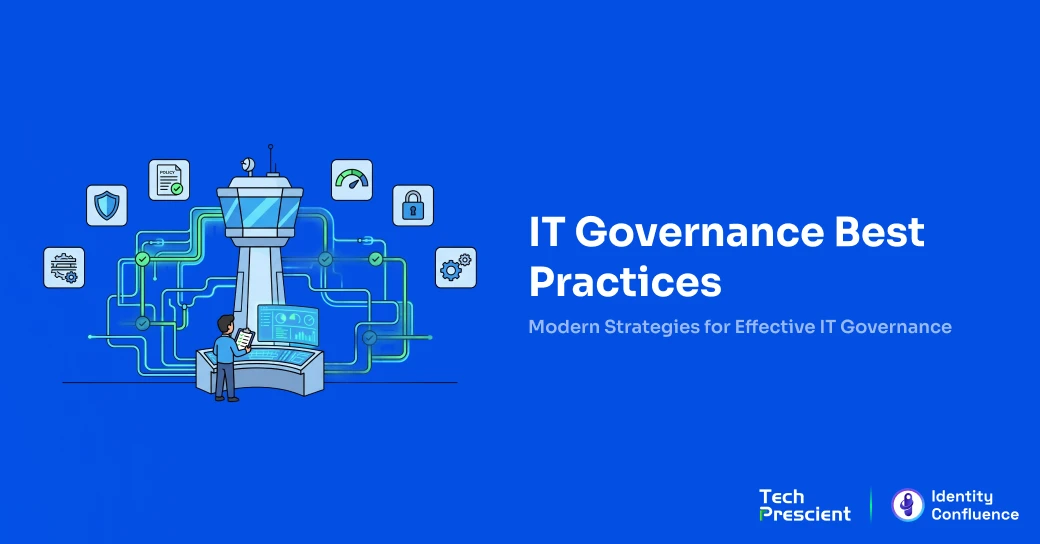
IT governance ensures that every technology decision an organization makes is tied to a business outcome, managed for risk, and demonstrable to auditors when it matters. Without it, technology budgets grow without measurable returns, users retain access long after their roles change, and compliance evidence gets assembled under pressure days before an audit, not maintained as a matter of routine.
This guide covers the IT governance frameworks that structure good governance, the practices that sustain it, the step-by-step process to implement it, and why identity governance sits at the foundation of every layer.
Key Takeaways:
- What IT governance actually is and why it is not the same as IT management
- Frameworks explained: COBIT, ITIL, NIST CSF, ISO/IEC 38500 to fit which governance priorities
- How to measure governance performance with KPIs that reflect real enforcement, not activity
- Why identity governance is the enforcement layer every IT governance program depends on
- How to implement governance as a continuous cycle, not a one-time project
What Is IT Governance?
IT governance is a structured framework of policies, processes, roles, and accountability mechanisms that ensures an organization's technology systems support strategic objectives, manage risk, and meet regulatory obligations. According to IBM, it is a core component of corporate strategy, not a function handled exclusively within the IT department. Effective IT governance frameworks give that strategy structure: a consistent, auditable approach to aligning technology decisions with business objectives, enforcing compliance, and embedding best practices across the organization. The distinction most organizations miss is between IT management and IT governance.
IT management is operational: keeping systems running, resolving incidents, and delivering services. IT governance is structural and strategic: it sets the policies and accountability frameworks within which IT management operates.
You can have fast incident response and reliable systems and still have poor governance. The gaps show up in predictable places: audit findings that repeat year after year, security incidents traced back to access that should have been revoked, and technology projects that consumed budget without delivering the business outcome they were approved for. Governance determines who makes decisions and sets direction; management directs and implements those decisions. Both are necessary.
IT governance plays a direct role in cybersecurity governance and regulatory compliance. Regulations, including GDPR, HIPAA, and SOX, do not simply require security tools. They require demonstrable, auditable controls over who accesses data, how that access is approved, and how it is reviewed and revoked over time. Governance is the mechanism through which those controls are established, maintained, and evidenced on demand, not assembled under pressure when an auditor arrives. At its core, IT governance exists to do three things: create measurable value, manage risk before it becomes an incident, and ensure resource optimization where it delivers the most return.
Why IT Governance Matters for Businesses
Strong enterprise IT governance does more than keep IT organized. It directly influences business performance, risk exposure, and regulatory standing. A CIO.com survey cited by IBM found that CEOs rank managing IT risk as the second greatest priority for IT leaders, right behind digital transformation.
Strategic Alignment
Without governance, technology investments drift. Tools are adopted that solve local problems but create integration complexity. Duplicate capabilities accumulate across business units. IT strategy and governance close this gap by requiring every IT decision to map to a defined business priority before resources are committed and by reviewing that alignment on a consistent cadence rather than at annual planning.
Risk Reduction
Risk management in IT embedded in governance ensures risks are identified, classified by likelihood and impact, assigned to named owners, and tracked through a formal risk register (a risk register is a live log that captures each identified risk, who owns it, how likely it is to occur, and what is being done to address it). This moves risk management from a reactive response to incidents into a proactive discipline built into how technology operations run day to day.
Regulatory Compliance
IT compliance strategies ensure that HIPAA, SOX, and GDPR requirements are met with auditable evidence on demand, not assembled under pressure. Governance maps each regulatory obligation to a specific control with a named owner, making compliance a continuous output of operations rather than a periodic project. This systematic approach helps organizations avoid legal penalties and maintain the trust of customers, auditors, and stakeholders.
Cost Optimization
According to the Productive State of SaaS 2024 Report, the average enterprise wastes approximately 40% of its annual SaaS spend through underutilized licenses and redundant applications. Governance processes - application inventories, license reviews tied to actual usage data, and renewal workflows - turn that waste into a recoverable budget.
Core IT Governance Frameworks You Should Know
IT governance frameworks give organizations a repeatable, structured method for managing IT decisions. No single framework addresses every governance need. Mature organizations typically use two or more layers, based on which governance dimension each covers most effectively. The starting point is selecting the framework that aligns with the organization's primary governance priority, then expanding as that foundation becomes stable.
COBIT (Control Objectives for Information and Related Technologies)
COBIT 2019, developed by ISACA and used by governance professionals across more than 188 countries, with 200+ chapters, is the most comprehensive enterprise IT governance framework available. It covers six governance principles and 40 governance and management objectives, addressing strategic alignment, value delivery, risk management in IT, resource management, and performance measurement as a connected system. Its objective and components align with and support compliance mapping directly to SOX, GDPR, HIPAA, and ISO 27001, making it particularly suited to regulated industries. COBIT 2019's flexible design model allows organizations to tailor governance to their specific risk profile rather than implementing the full framework uniformly. Best for: Large enterprises, regulated industries, end-to-end governance with auditable control objectives.
ITIL (IT Infrastructure Library)
ITIL 4 is a framework for IT service management, built around one straightforward goal: aligning IT services with what the business actually needs. It improves service delivery, reduces friction between IT and end users, and brings structure to processes that otherwise run on habit and tribal knowledge.
In practice, ITIL covers the operational layer: how incidents are handled, how changes are approved, how problems are investigated and resolved, and how service continuity is maintained when things go wrong. Where COBIT governs strategy and decision-making, ITIL governs execution. The two are designed to work together, not replace each other.
ITIL 4 also reflects how modern IT teams actually work; it integrates cleanly with Agile, DevOps, and cloud-native delivery models rather than sitting in tension with them.
Best for: organizations where service quality, incident response consistency, and disciplined change management are the primary governance priorities.
ISO/IEC 38500
ISO/IEC 38500 is an international standard that specifies principles for effective IT governance at the board and executive levels. It guides directors in ensuring that technology is used efficiently, securely, and in direct alignment with organizational goals, based on six principles: responsibility, strategy, acquisition, performance, conformance, and human behavior. It is principles-based rather than prescriptive about specific controls, giving boards a clear framework for their governance responsibilities without requiring operational detail. It is designed to sit above operational frameworks like COBIT and ITIL. Best for: Boards, executive teams, and organizations seeking a leadership-level governance foundation.
NIST Cybersecurity Framework
The NIST Cybersecurity Framework provides a risk-based approach to cybersecurity governance: Identify, Protect, Detect, Respond, Recover, and - as of NIST CSF 2.0 in 2024 - Govern. That sixth function explicitly embeds governance as a prerequisite for effective cybersecurity. According to Gartner's 2026 Audit Plan Hot Spots report, 96% of surveyed organizations have cybersecurity assurance activities planned for their 2026 audit programs, making this framework more relevant than ever. Best for: organizations prioritizing cybersecurity governance, particularly those with US federal compliance requirements.
CMMI (Capability Maturity Model Integration)
CMMI is a process-level improvement framework that helps organizations build productive, efficient behaviors that reduce risk across IT operations, software delivery, and service management.
It works on a five-level maturity scale, from ad hoc and reactive at Level 1 to continuously optimizing at Level 5. For IT governance, CMMI is valuable because it identifies where governance processes depend on individual effort rather than repeatable systems and provides a structured path to close that gap.
Where COBIT defines what good governance looks like and NIST CSF governs cybersecurity risk, CMMI measures how consistently governance actually operates in practice, making it a natural complement to any framework implementation.
Best for: Organizations building governance maturity that scales, reduces process risk, and holds up under audit pressure.
Framework Comparison at a Glance
| Framework | Developed By | Primary Focus | Key Compliance Coverage |
|---|---|---|---|
| COBIT 2019 | ISACA | End-to-end enterprise IT governance | SOX, GDPR, HIPAA, ISO 27001 |
| ITIL 4 | Axelos / PeopleCert | IT service management | ISO/IEC 20000 |
| ISO/IEC 38500 | ISO / IEC | Board-level governance principles | Corporate governance |
| NIST CSF 2.0 | NIST (US) | Cybersecurity risk governance | US federal, international |
| CMMI | ISACA / CMMI Institute | Process maturity and improvement | CMMI V2.0, ISO/IEC 330xx |
Top 10 IT Governance Best Practices
These IT governance best practices address the specific failure modes that show up in audit findings, security incidents, and post-incident reviews; not theoretical gaps, but the ones organizations actually encounter.
Align IT with Business Goals
IT strategy and governance begin by defining what IT is accountable for delivering in business outcome terms, not technical ones. According to research cited in the CloudEagle IT Governance Report 2026, organizations that align IT and business strategies are 80% more likely to realize the benefits of technology investments than those that do not. In practice, this means establishing a technology steering committee that includes both IT leadership and business unit heads, requiring documented business cases with measurable outcomes for investments above a defined threshold, and reviewing IT investment performance against stated outcomes quarterly, not annually.
Define Roles and Accountability
Most IT governance failures trace back to accountability gaps: policies without named owners, access decisions without defined approvers, and audit findings assigned to committees rather than individuals. When accountability is collective, it effectively belongs to no one.
Document a RACI matrix for all major IT governance processes, assign a named application owner for every system in the technology inventory, and include governance accountability in the performance reviews of IT leadership and application owners.
Domain Insight:
Orphaned accounts are active user accounts with no identifiable current owner, and almost always indicate a deprovisioning accountability gap. When no named person is responsible for revoking access at offboarding, that step does not reliably happen. This is one of the most consistently cited findings in enterprise IT security reviews.
Adopt Governance Frameworks
Now that you know what each framework covers, the decision is not which one is most comprehensive; it is which one most closely addresses the organization's primary governance priority and regulatory environment. Conduct an IT governance assessment before selecting a framework to understand where current gaps are largest.
Start with one framework and implement it with discipline before layering additional ones. Assign a named framework owner responsible for keeping the implementation current as the regulatory and technology environment evolves.
Implement Risk Management Processes
Risk management in IT is an ongoing cycle of identifying, classifying, and treating technology risks, including cybersecurity threats, third-party vendor risks, and compliance gaps.
Maintain a formal IT risk register reviewed at a minimum quarterly. Classify risks by likelihood and impact with escalation thresholds for high-impact items. Include third-party risk assessments for all technology vendors handling sensitive data at both procurement and each renewal decision.
Ensure Compliance and Audit Readiness
IT compliance strategies are most effective when continuous, not assembled before audit windows. According to Gartner, legal and compliance department investment in GRC tools is set to increase 50% by 2026.
Map each applicable regulation to specific governance controls with named owners. Automate evidence collection: access logs, provisioning records, and access review completions so audit preparation becomes retrieval, not assembly. Run internal compliance reviews on a fixed schedule between external audits.
Measure Performance with Governance KPIs
A governance program without defined metrics cannot evaluate whether it is working. Activity metrics trend positively, while governance KPIs that actually matter, access review completion rates, deprovisioning speed, and policy violation rates deteriorate without anyone noticing.
| Governance KPI | What It Measures | Target |
|---|---|---|
| Mean Time to Provision (MTTP) | New-hire to access granted | Under 4 hours |
| Mean Time to Deprovision (MTTD) | Exit event to full revocation | Under 1 hour |
| Orphaned account rate | Accounts with no current owner | Under 1% |
| Access review completion rate | Certifications completed on schedule | Above 95% |
| Policy violation rate | Access grants breaching policy | 0% |
Establish baseline measurements before setting targets. Report governance KPIs to both IT and business leadership; a KPI visible only within the IT team is not creating the accountability it should.
Optimize Resource Allocation
Accurate visibility into what technology resources exist, who uses them, and what each costs is what separates deliberate resource governance from reactive spending. Without it, renewal decisions are driven by vendor relationships rather than demonstrated value.
Maintain a continuously updated IT asset and application inventory. Review licenses at least 90 days before major vendor renewals using actual usage data rather than prior-year commitments. Run annual application rationalization cycles. Decisions made with usage data are defensible; those made without it are guesswork.
Strengthen Information Security
Cybersecurity governance means controls are defined at the policy level and enforced through systems, not improvised by individual administrators responding to ad hoc requests.
Define a minimum security baseline covering authentication requirements, encryption standards, and audit logging for all systems handling sensitive data. Formalize the principle of least privilege in governance policy; access is granted to the minimum required for a role to function. Include access anomalies and policy exceptions in governance reporting alongside security incidents, not just after them.
Enable Change and Incident Management
Change management ensures modifications to systems and access rights are evaluated, approved, and recorded before implementation. Without it, changes happen informally and create audit trail gaps.
Require formal change requests and approval records for all IT changes affecting sensitive or regulated systems. Classify changes by risk level: standard, normal, and emergency, with differentiated approval workflows for each. Route post-incident review findings back into the IT risk register. This closes the loop between incident response and governance improvement rather than treating incidents as isolated events.
Commit to Continuous Improvement
IT governance is not a destination. Technology environments change, regulations evolve, and frameworks not actively maintained become obsolete.
Conduct a formal IT governance assessment at a minimum annually. Maintain a governance improvement backlog with tracked gaps, assigned owners, and target resolution timescales treated with the same discipline as a software development backlog. Make quarterly KPI reviews and annual framework assessments non-negotiable on the calendar.
Where does your IT governance program actually stand?
Scores your IT governance across five dimensions and tells you exactly where to focus next.
IT Governance Process: Step-by-Step Implementation
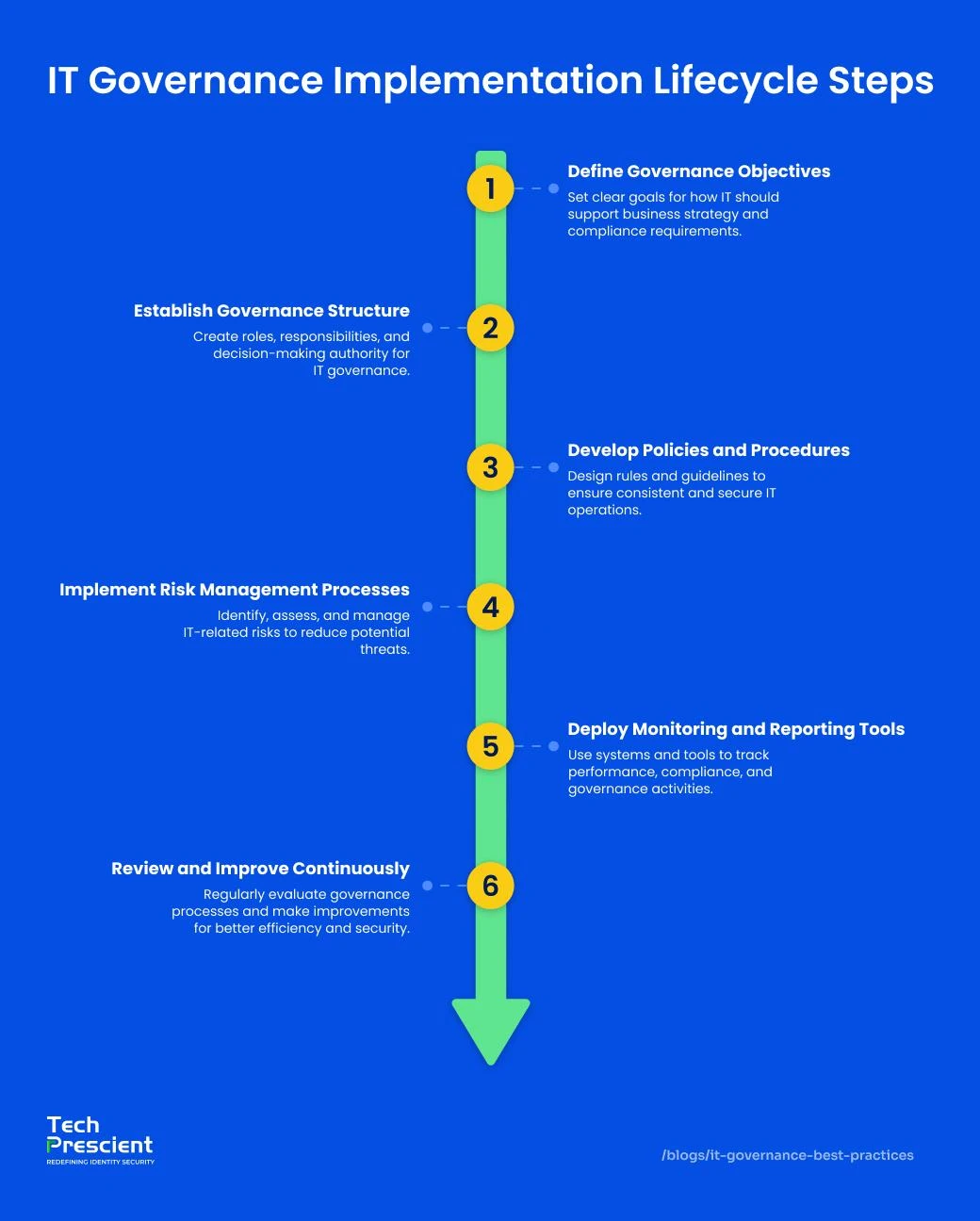
A structured IT governance process ensures governance is applied consistently across the organization rather than varying based on who is most engaged at any given time. The five steps below apply whether an organization is implementing governance for the first time or restructuring a program that has drifted from its original design.
Step 1 - Assess the Current IT Environment
Before defining how governance should work, organizations need an accurate picture of how IT currently operates. A thorough IT governance assessment covers the current technology inventory with owner assignments, existing access control practices, and how provisioning decisions are made; recent audit findings and outstanding remediation items; and the regulatory obligations relevant to the organization's industry and geography. This produces the documented baseline against which all subsequent improvements are measured. Without it, governance programs are designed against assumptions rather than facts.
Step 2 - Define the Governance Framework
Select the framework that best addresses the organization's primary governance priorities and regulatory environment. Document how it will be applied, which domains it covers in its initial scope, and what governance maturity targets are realistic over an 18-24 month horizon. This step also produces the initial governance structure: the committees, steering groups, and reporting lines through which governance decisions will be made and escalated. Governance structures not tied to the organization's actual decision-making hierarchy tend to operate in parallel to real decisions rather than influencing them.
Step 3 - Establish Policies and Documentation
Governance policies are the formal rules that operationalize the chosen IT governance framework, defining what is required, what is prohibited, and the consequences of non-compliance. Write policies in specific, unambiguous language. A policy that can be interpreted in multiple ways will be applied in multiple ways. Version control all governance documentation with review dates recorded. Make policies accessible to all staff responsible for following them - governance policies that no one can locate cannot be followed.
Step 4 - Train Stakeholders
Training is role-specific: IT administrators need a detailed understanding of access provisioning policies and change management procedures; application owners need to understand their access review responsibilities; and business leaders need to know which decisions require their involvement. Governance training is an ongoing obligation, not a one-time implementation activity. Regulatory requirements change, frameworks release updated versions, and new systems bring new governance requirements.
Step 5 - Monitor, Audit, and Continuously Improve
Governance without monitoring is governance on paper only. Track the governance KPIs established earlier and build reporting mechanisms that surface them to both IT and business leadership on a consistent cadence. Schedule internal audits as formal, structured reviews of whether policies and controls are being followed as designed. Use findings and KPI trends to identify and prioritize improvements. Monitoring should operate continuously between audit cycles - not just at scheduled review points.
Common IT Governance Challenges (And How to Solve Them)
IT governance challenges appear consistently across organizations of different sizes, industries, and maturity levels. Recognizing them early prevents them from becoming structural problems that take multiple audit cycles to resolve.
Lack of Clear Accountability
When governance responsibilities are distributed across committees or implied rather than assigned, controls exist on paper but are not enforced in practice. The solution is assigning responsibilities to named individuals, documenting them in formal role descriptions, and including them in performance review criteria. Accountability without personal consequence is not accountability.
Shadow IT and SaaS Sprawl
Business units adopt applications outside formal IT procurement, motivated by speed or by the gap between what IT can deliver and what a team needs immediately. According to the CloudEagle IT Governance Report 2026, the average organization now manages more than 130 SaaS applications, many of which were never formally approved. Implement SaaS discovery that surfaces applications accessed through corporate credentials, and simultaneously create a lightweight, fast-track approval process that removes the friction driving shadow IT adoption in the first place.
Poor KPI Tracking
Activity metrics may show positive trends while governance outcomes deteriorate without anyone noticing. The fix is not more reporting - it is the right reporting. Define outcome-based governance KPIs, establish baselines, and report them consistently to both IT and business leadership.
Compliance Gaps
Compliance gaps form when regulatory requirements are mapped to governance controls at audit time rather than during policy design. Map obligations to controls during framework implementation. Automate evidence collection so compliance reporting becomes a retrieval exercise rather than a manual assembly effort that exposes gaps under pressure.
Role of Identity Governance in IT Governance
Identity governance and administration (IGA) is the practice of managing, controlling, and auditing who has access to what across an organization's systems, ensuring that access is appropriate, properly approved, current, and regularly reviewed. It is not a parallel workstream. It is a foundational layer of enterprise IT governance.
For a structured view of how an identity governance framework is designed and implemented, Tech Prescient's identity security hub covers the full scope.
Why IT Governance Fails Without Identity Controls
Consider what happens in the absence of identity governance. An employee changes roles and retains access from their previous position. An employee leaves, and their accounts remain active across three systems because deprovisioning required manual tickets that were never submitted. A SOX audit requires a list of every user with access to financial systems over the past 12 months, and that list does not exist in retrievable form. These are not exceptional failures. They are the predictable outcome of identity processes that are manual, inconsistent, and disconnected from governance controls.
The Joiner-Mover-Leaver (JML) Lifecycle
The JML process is provisioning access when employees join, adjusting it when they change roles, and revoking it when they leave. It is one of the most operationally significant governance workflows in any organization. When manual, it is slow, inconsistent, and error-prone at all three lifecycle events. For a full breakdown of how the process works end-to-end, see user lifecycle management, user provisioning, and deprovisioning.
Tech Prescient's Identity Confluence automates the JML lifecycle by ingesting HR system events directly from platforms such as Workday, SAP, and other leading HRMS platforms. A new hire triggers provisioning workflows across all connected applications within hours. A role change adjusts the employee's access bundle automatically, removing access tied to the previous role and granting what the new role requires. An employee exit triggers immediate revocation across all connected systems, without a manual ticket in the process.
Access Reviews and Certifications
Access certification is the periodic process through which managers confirm that their direct reports hold appropriate access. It is a core governance control and a regulatory requirement under SOX, GDPR, HIPAA, and ISO 27001. When manual, access reviews are expensive to run, frequently completed as a rubber-stamp exercise, and poorly documented for audit purposes. Automated certification campaigns give managers one-click attestation with full context - what access each user holds, when it was granted, and whether it aligns with their current role - and generate exportable audit reports that satisfy evidentiary requirements across regulations.
Pro Tip:
Automated access reviews with contextual data - showing role, last login, and entitlement age alongside the certification decision - reduce rubber-stamping significantly. Managers make informed decisions in seconds rather than approving bulk spreadsheet rows without context.
RBAC and Segregation of Duties
Role-Based Access Control (RBAC) aligns access rights with job function, making access governance consistent and auditable at scale. Segregation of Duties (SoD) ensures no single user can both initiate and approve the same sensitive transaction - a key control under SOX and a requirement in HIPAA environments. Identity governance platforms enforce both RBAC and SoD policies automatically and surface violations before they appear in external audit findings.
For a full view of how these disciplines relate, see IGA vs IAM: What Is the Difference?
Tools and Technologies for IT Governance
Modern tools automate IT governance processes, enforce policies at scale, and provide the visibility needed to make governance decisions on accurate information rather than assumptions.
GRC (Governance, Risk, and Compliance) Platforms
GRC platforms centralize governance documentation, risk registers, policy libraries, and compliance reporting into a single system of record. They provide structured workflows for risk assessment, policy reviews, and internal audit management and generate the audit-ready reports that compliance frameworks require. Key capabilities to evaluate when selecting a platform: ownership tracking across controls, version-controlled policy documentation, integrated compliance mapping, and audit management workflows that track findings from identification through remediation.
Identity Governance and Administration (IGA) Tools
IGA tools are the operational layer of identity governance - automating user access reviews, provisioning, deprovisioning, and policy enforcement across the IT environment. They connect HR systems, cloud applications, and on-premise infrastructure to execute the JML lifecycle, enforce RBAC, run access certifications, and generate access audit evidence on demand. Identity Confluence connects to 50-plus cloud and on-premise systems, including Salesforce, Azure AD, Google Workspace, and SAP, through pre-built connectors and SCIM, REST, SAML, and OAuth integrations. Its identity analytics layer uses ML to score user risk, surface access anomalies, and identify unused entitlements before they become compliance issues.
Automation and Analytics
Automation and analytics tools extend governance visibility across the IT environment: monitoring for policy exceptions in real time, tracking governance KPI trends over time, and surfacing anomalies that indicate either access misuse or misconfiguration. Controls that previously required dedicated analyst time can now run continuously as automated monitoring, converting governance from a periodic reporting exercise into a live operational function.
Future Trends in IT Governance (2026 and Beyond)
IT governance frameworks and practices are shaped by the technology environments they govern. These trends are actively reshaping governance in 2026 and the years ahead.
AI-Driven Governance
AI is improving the information available for governance decisions - through ML-powered risk scoring, anomaly detection across access patterns, and predictive identification of compliance gaps before they become findings.
Zero Trust Architecture
Zero Trust is built on one principle: no user or system is trusted by default, regardless of network location. Every access request is verified explicitly against the defined policy. Implementing Zero Trust requires mature identity governance as a prerequisite - contextual access decisions cannot be enforced without accurate, current data on what access each user legitimately holds and what their current role requires.
Cloud and SaaS Governance
Traditional perimeter-based controls do not apply to SaaS applications. Cloud IT governance requires identity-centric controls, API-level visibility, and automated discovery of applications adopted outside formal procurement. With the average organization managing over 130 SaaS applications, governing that environment requires purpose-built tooling connected to HR systems and identity infrastructure - not manual tracking in spreadsheets.
Continuous Compliance
Regulatory environments are not simplifying. GDPR enforcement scope is broadening. AI-specific regulations are emerging across multiple jurisdictions. Organizations are shifting from point-in-time compliance reporting to continuous compliance: maintaining audit evidence as an ongoing output of governance operations, with real-time dashboards replacing periodic manual evidence collection. This shift is enabled by automated IGA and GRC tooling, transforming compliance from a high-pressure periodic project into a routine operational function.
Final Thoughts
Effective IT governance works when accountability, policy, and enforcement operate as a connected system, not independently. The organizations that get it right are not the best-resourced; they are the most deliberate. Tech Prescient's Identity Confluence automates the identity governance layer that makes the system real, from access lifecycle enforcement to continuous audit readiness.
FAQs
IT governance best practices include aligning IT decisions with defined business objectives, establishing explicit accountability for systems, policies, and risk decisions; adopting recognized IT governance frameworks such as COBIT 2019 or the NIST Cybersecurity Framework; implementing identity governance controls for access provisioning and review, measuring performance with defined governance KPIs, and running continuous compliance monitoring rather than periodic evidence-gathering exercises.
The IT governance process follows five stages: assess the current IT environment to identify gaps, risks, and compliance obligations; select and define the governance framework appropriate to the organization's context; establish governance policies and documentation standards; train stakeholders on their specific governance responsibilities; and continuously monitor performance through defined KPIs and internal audits. Each monitoring cycle feeds improvements into the next, making governance iterative rather than static.
IT governance ensures technology investments deliver measurable business value, risks are managed before they become incidents, and organizations can demonstrate compliance with applicable regulations on demand. Without it, technology decisions are made inconsistently, access rights accumulate beyond what roles require, and compliance evidence is assembled reactively under pressure.
The four most widely adopted IT governance frameworks are COBIT 2019 for end-to-end enterprise governance; ITIL 4 for IT service management; ISO/IEC 38500 for board-level governance principles; and the NIST Cybersecurity Framework 2.0 for cybersecurity risk governance. TOGAF and CMMI address enterprise architecture and process maturity, respectively. Framework selection depends on the organization's size, industry, regulatory environment, and primary governance priority.
Identity governance operationalizes the access control policies that IT governance frameworks define. It automates the Joiner-Mover-Leaver lifecycle, enforces Role-Based Access Control (RBAC) at scale, runs access certification campaigns with documented outcomes, and generates the audit evidence that SOX, GDPR, HIPAA, and ISO 27001 compliance requires. Every IT governance objective depends in part on knowing that access rights are appropriate, current, and correctly maintained.
IT governance is structural and strategic - it defines the policies, accountability structures, and decision-making criteria through which IT serves the organization's objectives and manages risk. IT management is operational - it covers delivering IT services, resolving incidents, managing vendors, and keeping systems available. An organization can have well-functioning IT management and still fail at governance, particularly when access decisions are made inconsistently, compliance obligations are unmet, or technology investments are approved without measurable business justification.
Core governance KPIs include Mean Time to Provision (MTTP), Mean Time to Deprovision (MTTD), orphaned account rate, access review completion rate, policy violation rate, and the percentage of access decisions completed through automated workflows rather than manual tickets. These provide a measurable baseline and the trend data needed to evaluate governance improvement over time.
Share



Brinda Bhatt
Digital Marketing Strategist
A Digital Marketing Strategist who makes complex identity governance accessible to security and technology leaders through clear, data-driven content. Her insight-led, audience-focused approach supports Tech Prescient's mission of redefining identity security for modern enterprises.
Most Popular Blogs
Identity Security· 21 min read
Data Access Governance Solutions: How to Secure Sensitive Data at Scale
Compare data access governance solutions for 2026: how DAG platforms discover sensitive data, run access reviews, automate remediation, and prove compliance.
Brinda Bhatt· September 7, 2026
Identity Security· 24 min read
What Is Zero Trust Network Access (ZTNA)?
Learn what Zero Trust Network Access (ZTNA) is, how it works, and why it’s replacing VPNs for secure, identity-based access control.
Yatin Laygude· August 14, 2026
Identity Security· 24 min read
Cyber Essentials Certification: Complete Guide
Learn Cyber Essentials certification, cost, requirements, and steps. Compare Cyber Essentials vs Plus and get certified faster.
Yatin Laygude· August 10, 2026