




On this page
See Tech Prescient in Action
Automate access, reduce risk, and stay audit-ready
PCI DSS 4.0 is the latest version of the Payment Card Industry Data Security Standard, designed to help organizations protect payment card data against evolving cyber threats. It introduces a stronger focus on continuous security, risk-based controls, and improved protection for modern payment environments.
Developed by the Payment Card Industry Security Standards Council (PCI SSC), PCI DSS applies to any organization that stores, processes, or transmits cardholder data. The latest revision, PCI DSS v4.0.1, provides clarifications to the standard while maintaining the core objective of strengthening payment security and reducing the risk of data breaches.
According to the PCI Security Standards Council, all PCI DSS 4.0 requirements became mandatory on March 31, 2025, marking a major shift from point-in-time compliance to ongoing security validation. In this guide, we'll explore what PCI DSS 4.0 is, what's new in the standard, the 12 core requirements, compliance deadlines, and a practical checklist to help your organization achieve and maintain compliance.
Key Takeaways:
- Learn what PCI DSS 4.0 is and which organizations must comply with it.
- Understand the key changes introduced in PCI DSS 4.0 and their business impact.
- Get an overview of the 12 core PCI DSS 4.0 requirements and security objectives.
- Follow a practical PCI DSS 4.0 compliance checklist to prepare for assessments.
- Discover compliance deadlines, penalties, and best practices for maintaining continuous compliance.
What Is PCI DSS 4.0?
PCI DSS 4.0 is a global cybersecurity standard designed to protect cardholder data through 12 security requirements and continuous monitoring practices.
PCI DSS 4.0 is the latest version of the Payment Card Industry Data Security Standard (PCI DSS), created to help organizations protect cardholder data from evolving cyber threats. It establishes a set of security controls for securing payment environments, reducing fraud risks, and maintaining the confidentiality of sensitive payment information. Compared to previous versions, PCI DSS 4.0 places greater emphasis on continuous security, risk-based controls, and stronger authentication measures.
To understand the scope of PCI DSS 4.0, it's important to know who it applies to and the environments it is designed to protect.
Who Needs PCI DSS 4.0 Compliance?
PCI DSS 4.0 applies to any organization that stores, processes, or transmits payment card data. This includes merchants, payment processors, financial institutions, e-commerce businesses, and third-party service providers that can impact the security of cardholder data.
Understanding the Cardholder Data Environment (CDE)
The Cardholder Data Environment (CDE) includes all systems, networks, applications, and processes involved in storing, processing, or transmitting cardholder data. Properly defining the CDE helps organizations determine compliance scope and implement the appropriate security controls.
Why PCI DSS 4.0 Matters
PCI DSS 4.0 helps organizations strengthen payment security through continuous monitoring, enhanced access controls, and a risk-based approach to compliance. These measures improve resilience against modern threats while supporting long-term compliance efforts.
What's New in PCI DSS 4.0?
PCI DSS 4.0 introduces stronger authentication controls, continuous security validation, and greater flexibility in how organizations meet compliance requirements.
One of the biggest changes in PCI DSS 4.0 is its shift from periodic compliance checks to a more proactive security model. While the framework retains the same core objectives as previous versions, it introduces new requirements and implementation options that better align with today's threat landscape, cloud environments, and digital payment ecosystems.
The following updates highlight what's new in PCI DSS 4.0 and why organizations must rethink their approach to payment security and compliance.
1. Continuous Security vs. Point-in-Time Compliance
Earlier versions of PCI DSS focused heavily on demonstrating compliance during annual assessments. PCI DSS 4.0 places greater emphasis on maintaining security controls throughout the year through ongoing monitoring, regular validation, and continuous testing. This approach helps organizations identify risks sooner and reduce security gaps between audit cycles.
2. Enhanced MFA Requirements
Multi-factor authentication (MFA) has become a central requirement under PCI DSS 4.0. The standard expands MFA expectations to strengthen access controls and reduce the risk of credential-based attacks. Organizations must ensure that users accessing the Cardholder Data Environment (CDE) are authenticated using multiple verification factors, particularly for administrative and remote access scenarios.
3. Customized Approach to Compliance
PCI DSS 4.0 introduces a Customized Approach that allows organizations to implement alternative security measures when traditional controls may not be suitable for their environment. Rather than prescribing a single path to compliance, the framework enables businesses to demonstrate that their chosen controls achieve the intended security objective while maintaining equivalent protection.
4. New E-Commerce Security Controls
With web-based payment attacks on the rise, PCI DSS 4.0 introduces additional requirements focused on securing payment pages and client-side technologies. Organizations are now expected to maintain greater visibility into scripts running on payment pages, validate their integrity, and detect unauthorized changes that could expose cardholder data to threats such as digital skimming and Magecart-style attacks.
5. Risk-Based Security and Targeted Risk Analysis
Another significant enhancement is the introduction of targeted risk analysis. Instead of relying solely on predefined frequencies for security activities, organizations can evaluate their unique risk profile and determine appropriate intervals for tasks such as log reviews, vulnerability assessments, and security testing. This provides greater flexibility while ensuring that security decisions are supported by documented risk assessments.
Collectively, these changes make PCI DSS 4.0 more adaptable, security-focused, and aligned with modern business environments. The standard encourages organizations to move beyond compliance checklists and adopt a continuous, risk-driven approach to protecting payment card data.

Pro Tip:
Organizations that adopt continuous monitoring early often find PCI DSS 4.0 audits less disruptive and easier to manage. Ongoing validation helps uncover security gaps before they become compliance findings.
PCI DSS 4.0 Requirements Overview (12 Core Controls)
The PCI DSS 4.0 framework continues to be built around 12 foundational requirements that help organizations secure payment environments and reduce the risk of data breaches. These requirements are grouped into six broader security objectives, making it easier for businesses to understand how different controls work together to protect cardholder data throughout its lifecycle.
6 Security Objectives and 12 PCI DSS 4.0 Requirements
| Sr No | Security Objective | PCI DSS 4.0 Requirement | Purpose |
|---|---|---|---|
| 1 | Build and Maintain a Secure Network and Systems | Requirement 1: Install and maintain network security controls | Protect payment environments from unauthorized network traffic and external threats. |
| Requirement 2: Apply secure configurations to all system components | Reduce vulnerabilities by eliminating insecure settings and default configurations. | ||
| 2 | Protect Account Data | Requirement 3: Safeguard stored account data | Ensure sensitive cardholder information is securely stored and protected. |
| Requirement 4: Secure cardholder data during transmission | Protect payment data as it moves across public or untrusted networks. | ||
| 3 | Maintain a Vulnerability Management Program | Requirement 5: Defend systems against malware | Detect, prevent, and respond to malicious software threats. |
| Requirement 6: Develop and maintain secure systems and software | Address vulnerabilities through secure development and patch management practices. | ||
| 4 | Implement Strong Access Controls | Requirement 7: Restrict access based on business need-to-know | Ensure users only have access to the data and systems required for their roles. |
| Requirement 8: Identify and authenticate users | Verify user identities through strong authentication mechanisms, including MFA where required. | ||
| Requirement 9: Control physical access to cardholder data | Prevent unauthorized physical access to systems and facilities handling payment data. | ||
| 5 | Regularly Monitor and Test Security | Requirement 10: Log and monitor system activity | Maintain visibility into user actions and security events across the environment. |
| Requirement 11: Test security controls and systems regularly | Validate the effectiveness of security measures through scanning, testing, and monitoring. | ||
| 6 | Maintain an Information Security Policy | Requirement 12: Support security through policies and governance | Establish governance, risk management, awareness, and security responsibilities across the organization. |
Why These Requirements Matter
Together, these PCI DSS 4.0 requirements create a layered security framework that addresses network protection, data security, access management, vulnerability reduction, monitoring, and governance. Rather than operating as standalone controls, the 12 requirements work collectively to help organizations build a resilient payment security program and maintain ongoing compliance.
For organizations beginning their compliance journey, understanding this PCI DSS 4.0 requirements overview provides a strong foundation before moving into implementation planning and assessment activities.
Not sure how your organization measures up against the 12 PCI DSS 4.0 requirements?
Assess control maturity, identify compliance gaps, and build a clear path to audit readiness.
PCI DSS 4.0 Compliance Checklist
Achieving PCI DSS 4.0 compliance requires a structured approach that combines security, governance, and ongoing monitoring. From defining the scope of payment data to validating controls through assessments, each step plays a critical role in building a secure and compliant payment environment.
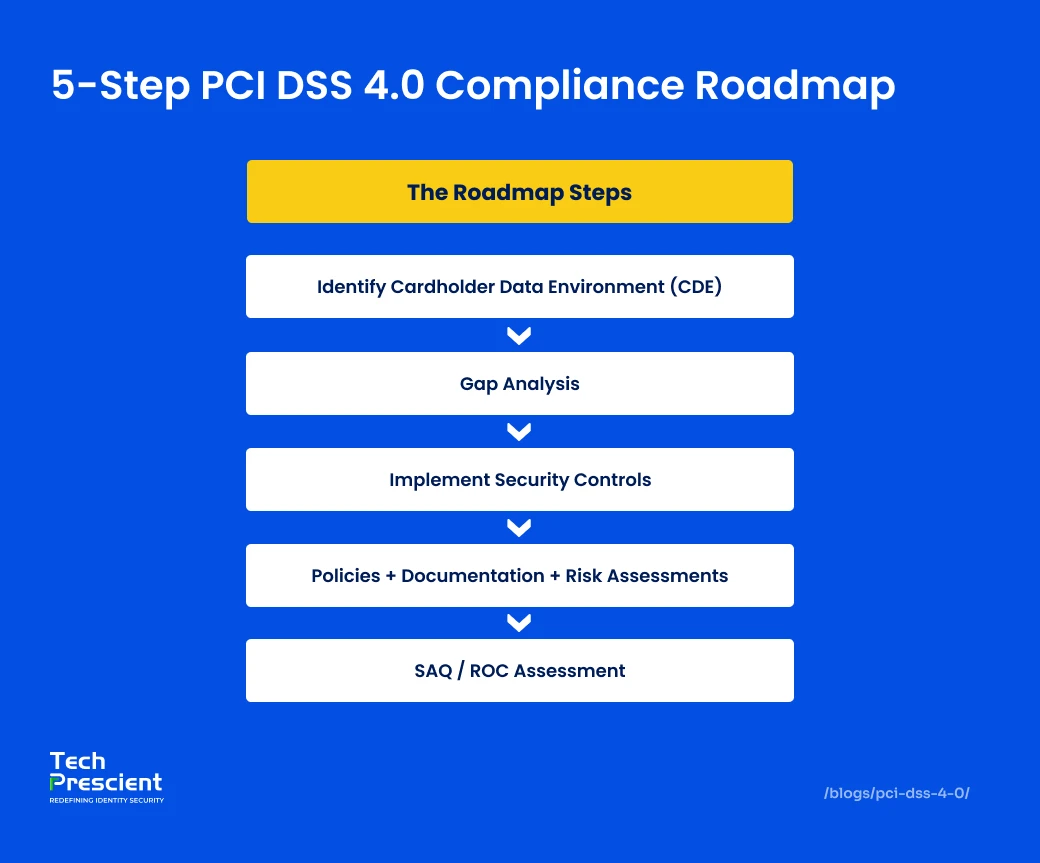
Step 1: Define Scope and Identify the Cardholder Data Environment (CDE)
Begin by identifying where cardholder data is stored, processed, and transmitted across your organization. A clearly defined Cardholder Data Environment (CDE) helps establish the scope of compliance efforts, ensuring that all systems, applications, and third parties that interact with payment data are appropriately secured.
Step 2: Conduct a Gap Analysis
Assess your current security posture against PCI DSS 4.0 requirements to identify areas that need improvement. A gap analysis helps organizations understand which controls are already in place, where deficiencies exist, and what remediation efforts are required before a formal assessment.
Step 3: Implement Security Controls
Once gaps have been identified, deploy the technical and administrative controls required to protect cardholder data. This includes strengthening access controls, securing networks, encrypting sensitive data, implementing continuous monitoring, and maintaining effective vulnerability management processes.
Step 4: Document Policies and Risk Assessments
PCI DSS 4.0 places significant emphasis on documentation and risk-based decision-making. Organizations should maintain up-to-date security policies, operational procedures, control evidence, and targeted risk analyses to demonstrate compliance and support audit readiness.
Step 5: Complete the Compliance Assessment
The final step is validating compliance through the appropriate assessment process. Depending on business size and transaction volume, organizations may complete a Self-Assessment Questionnaire (SAQ) or undergo a formal assessment that results in a Report on Compliance (ROC).
PCI DSS 4.0 Compliance Checklist at a Glance
- Define and validate the scope of the Cardholder Data Environment (CDE)
- Assess existing controls and identify compliance gaps
- Implement required PCI DSS 4.0 security controls
- Document policies, procedures, and risk analyses
- Complete the applicable SAQ or ROC assessment
- Establish processes for continuous compliance and monitoring
Following this PCI DSS 4.0 checklist can help organizations streamline compliance efforts, improve security resilience, and maintain alignment with evolving PCI DSS requirements.
Reality Check:
Most PCI assessment delays are caused by missing evidence, unclear ownership, and incomplete scoping rather than technical control failures. Audit readiness often depends as much on documentation as security controls.
PCI DSS 4.0 Timeline & Deadlines
PCI DSS 4.0 was introduced to address evolving payment security challenges and provide organizations with time to adapt to new compliance expectations. The transition followed a structured timeline, allowing businesses to assess their environments, implement updated controls, and prepare for full compliance before enforcement deadlines took effect.
March 2022: PCI DSS 4.0 Released
The PCI Security Standards Council officially released PCI DSS 4.0 in March 2022. The new version introduced enhanced security requirements, greater flexibility through customized controls, stronger authentication measures, and a shift toward continuous compliance.
March 2024: PCI DSS 3.2.1 Retired
Two years after the release of PCI DSS 4.0, version 3.2.1 was officially retired. From this point forward, organizations undergoing assessments were required to validate compliance against PCI DSS 4.0 rather than the previous standard.
March 2025: All PCI DSS 4.0 Requirements Became Mandatory
While some new requirements were initially considered future-dated, March 31, 2025 marked the deadline for full implementation. Organizations were expected to have all applicable PCI DSS 4.0 controls in place, including enhanced authentication, targeted risk analysis, continuous monitoring, and new e-commerce security requirements.
Why These Deadlines Matter
Organizations that have not fully aligned with PCI DSS 4.0 may face increased audit findings, financial penalties, higher compliance costs, and potential restrictions from payment brands or acquiring banks. Understanding these milestones helps businesses assess their current compliance posture and prioritize any remaining remediation efforts.
PCI DSS 4.0 Timeline at a Glance
| Sr No | Date | Milestone |
|---|---|---|
| 1 | March 2022 | PCI DSS 4.0 officially released |
| 2 | March 2024 | PCI DSS 3.2.1 retired |
| 3 | March 31, 2025 | All PCI DSS 4.0 requirements became mandatory |
With the transition period now complete, organizations should focus on maintaining continuous compliance and ensuring security controls remain effective as threats and business environments evolve.
Did You Know?
Since March 31, 2025, all future-dated PCI DSS 4.0 requirements became mandatory. Organizations still relying on legacy compliance practices may face increased audit scrutiny and remediation efforts.
Benefits of PCI DSS 4.0 Compliance
PCI DSS 4.0 compliance helps organizations strengthen payment security, build customer confidence, and align with evolving cybersecurity requirements.
While PCI DSS 4.0 is often viewed as a compliance obligation, its value extends far beyond meeting industry requirements. By implementing the standard's security controls, organizations can reduce exposure to cyber threats, improve operational resilience, and create a stronger foundation for protecting sensitive payment data.
1. Reduced Risk of Data Breaches
PCI DSS 4.0 promotes a proactive security posture through stronger access controls, continuous monitoring, vulnerability management, and enhanced authentication requirements. These measures help organizations identify and address security gaps before they can be exploited, reducing the likelihood of payment card fraud and data breaches.
2. Increased Customer Trust
Customers expect businesses to handle their payment information securely. Demonstrating PCI DSS 4.0 compliance signals a commitment to protecting sensitive data, helping organizations strengthen customer confidence, enhance brand reputation, and foster long-term loyalty.
3. Better Alignment with Modern Security Standards
The latest version of PCI DSS reflects today's threat landscape by emphasizing risk-based security, continuous compliance, and stronger protection for digital payment environments. As a result, organizations can improve their overall cybersecurity maturity while supporting broader governance, risk, and compliance initiatives.
4. Stronger Business Resilience
Beyond protecting cardholder data, PCI DSS 4.0 encourages organizations to establish repeatable security processes, maintain visibility into critical systems, and respond more effectively to emerging threats. This strengthens operational resilience and helps minimize the impact of security incidents.
By treating PCI DSS 4.0 as a strategic security framework rather than a compliance exercise, organizations can improve both their security posture and their ability to maintain trust in an increasingly digital payment ecosystem.
Turn your PCI DSS checklist into an actionable compliance plan.
Evaluate readiness, prioritize remediation efforts, and prepare for successful assessments.
Penalties for Non-Compliance
Failing to meet PCI DSS 4.0 requirements can expose organizations to financial consequences, operational challenges, and increased security risks.
1. Financial Consequences
Organizations that fail to meet PCI DSS requirements may face penalties imposed through acquiring banks or payment card brands. In addition to potential fines, businesses may incur higher transaction fees, increased compliance costs, mandatory remediation expenses, and the costs associated with investigating security incidents or data breaches.
2. Damage to Customer Trust and Brand Reputation
A payment card data breach can have lasting effects on customer confidence. Public disclosure of security incidents may lead customers to question an organization's ability to protect sensitive information, resulting in reputational damage, reduced customer loyalty, and potential loss of business opportunities.
3. Operational and Business Disruption
Non-compliance can trigger additional audits, stricter oversight from payment partners, and increased scrutiny during future assessments. In severe cases, organizations may face restrictions on their ability to process payment card transactions, creating operational challenges and revenue impacts.
4. Increased Security and Legal Risks
Beyond compliance-related penalties, organizations that lack adequate security controls are more vulnerable to cyberattacks, fraud, and data exposure. A successful breach can result in legal liabilities, regulatory investigations, customer compensation claims, and prolonged recovery efforts.
Maintaining PCI DSS 4.0 compliance helps organizations avoid these risks while strengthening their overall security posture and protecting the trust of customers, partners, and stakeholders.
PCI DSS 4.0 vs 4.0.1 – What's the Difference?
PCI DSS 4.0.1 refines and clarifies the original 4.0 standard without introducing new security requirements or changing compliance obligations.
Organizations reviewing PCI DSS documentation may notice references to both PCI DSS 4.0 and PCI DSS 4.0.1. While the version numbers suggest a significant update, the differences between the two are relatively minor. PCI DSS 4.0.1 was released to improve readability, correct inconsistencies, and provide additional clarification around existing requirements.
Why Was PCI DSS 4.0.1 Released?
Following the release of PCI DSS 4.0, the PCI Security Standards Council identified opportunities to enhance the clarity of the standard. Version 4.0.1 addresses editorial issues, formatting inconsistencies, and areas where additional guidance could help organizations better interpret the requirements.
Did Any Requirements Change?
No. PCI DSS 4.0.1 does not introduce new controls, remove existing requirements, or alter compliance deadlines. Organizations that were working toward PCI DSS 4.0 compliance do not need to redesign their compliance programs because of the 4.0.1 update.
Key Differences at a Glance
| Sr No | PCI DSS 4.0 | PCI DSS 4.0.1 |
|---|---|---|
| 1 | Introduced the latest set of PCI DSS requirements and security enhancements | Provides clarifications and editorial updates to the existing standard |
| 2 | Established new compliance expectations and future-dated requirements | Does not add, remove, or modify requirements |
| 3 | Released in March 2022 | Released as a maintenance update to improve usability and consistency |
| 4 | Served as the foundation for the PCI DSS 4.x framework | Continues the same framework with clearer guidance |
Which Version Should Organizations Follow?
Organizations should reference PCI DSS 4.0.1 as the current version of the standard. Since it contains the same core requirements as PCI DSS 4.0, compliance efforts remain focused on implementing and maintaining the controls introduced in the original release.
In practical terms, PCI DSS 4.0.1 is best viewed as a clarification update rather than a new version of the standard. The compliance expectations remain the same, with the emphasis continuing to be on continuous security, risk-based decision-making, and stronger protection of cardholder data.
Best Practices for Achieving Continuous Compliance
Maintaining PCI DSS 4.0 compliance requires organizations to embed security into daily operations through automation, strong identity controls, and continuous visibility across critical systems.
Enforce Least-Privilege Access
Limiting access to cardholder data based on job responsibilities is a fundamental security principle. Organizations should regularly review permissions and ensure users only have access to the systems and data required to perform their roles. Reducing unnecessary privileges helps minimize insider threats and limits the potential impact of compromised accounts.
Automate User Access Reviews
Manual access certifications can be time-consuming and prone to oversight, particularly in large or dynamic environments. Automating user access reviews enables organizations to continuously validate permissions, identify excessive access rights, and demonstrate compliance with PCI DSS access control requirements more efficiently.
Leverage Identity Governance and Administration (IGA)
Identity Governance and Administration (IGA) solutions provide centralized visibility into user identities, access privileges, and policy enforcement. By integrating IGA capabilities into compliance programs, organizations can streamline access provisioning, automate certification campaigns, support segregation-of-duties controls, and maintain a clear audit trail for compliance reporting.
Implement Continuous Monitoring and Logging
Continuous monitoring is a key component of PCI DSS 4.0. Organizations should establish real-time visibility into user activity, system events, and security anomalies across the Cardholder Data Environment (CDE). Effective logging and monitoring not only support compliance requirements but also help security teams detect and respond to threats before they escalate.
Build Compliance into Everyday Operations
Sustainable compliance is achieved when security and governance processes become part of routine business operations rather than annual audit preparations. Organizations that combine automation, identity security, risk-based controls, and continuous oversight are better positioned to maintain PCI DSS 4.0 compliance while adapting to evolving threats and business requirements.
By adopting these best practices, organizations can reduce compliance overhead, improve audit readiness, and create a stronger foundation for long-term payment security.
Final Thoughts
PCI DSS 4.0 represents a significant shift from periodic compliance assessments to a continuous, risk-based approach to payment security. While the 12 core requirements remain the foundation of the standard, enhanced authentication controls, ongoing monitoring, and greater implementation flexibility help organizations better protect cardholder data in today's evolving threat landscape.
Tech Prescient helps organizations simplify PCI DSS 4.0 compliance through identity governance, automated access reviews, least-privilege enforcement, continuous monitoring, and audit-ready reporting. By automating critical compliance processes, organizations can reduce risk, improve visibility, and stay continuously compliant.
FAQs
PCI DSS 4.0 is the latest version of the Payment Card Industry Data Security Standard (PCI DSS), created to help organizations protect cardholder data from evolving cyber threats. It establishes 12 core security requirements covering areas such as network security, access control, data protection, and monitoring. The standard also places a stronger emphasis on continuous compliance and risk-based security practices.
PCI DSS 4.0 was officially released in March 2022, with organizations given a transition period to prepare for the new requirements. PCI DSS 3.2.1 was retired in March 2024, making PCI DSS 4.0 the active standard. All future-dated requirements became mandatory on March 31, 2025.
PCI DSS 4.0.1 is a maintenance update to PCI DSS 4.0 that focuses on improving clarity and usability. It includes editorial revisions, formatting updates, and minor clarifications to existing requirements. However, it does not introduce new controls, remove requirements, or change compliance deadlines.
PCI DSS 4.0 applies to any organization that stores, processes, or transmits payment card data. This includes merchants, payment processors, financial institutions, e-commerce businesses, and service providers that support payment environments. Even organizations that outsource payment processing may still have compliance responsibilities depending on their involvement with cardholder data.
The 12 PCI DSS requirements are grouped into six security objectives designed to protect payment card data throughout its lifecycle. They cover network security, secure system configurations, data protection, vulnerability management, access control, monitoring, testing, and security governance. Together, these requirements form the foundation of a comprehensive payment security program.
Share



Yatin Laygude
Content Writer
A content writer with 6 years of experience turning complex topics into clear, engaging, and meaningful content. From blogs and web pages to whitepapers and thought pieces, he creates content that not only explains but also connects with both the audience and business goals.
Most Popular Blogs

Identity Security· 21 min read
Data Access Governance Solutions: How to Secure Sensitive Data at Scale
Compare data access governance solutions for 2026: how DAG platforms discover sensitive data, run access reviews, automate remediation, and prove compliance.
Brinda Bhatt· September 7, 2026

Identity Security· 24 min read
What Is Zero Trust Network Access (ZTNA)?
Learn what Zero Trust Network Access (ZTNA) is, how it works, and why it’s replacing VPNs for secure, identity-based access control.
Yatin Laygude· August 14, 2026
Identity Security· 24 min read
Cyber Essentials Certification: Complete Guide
Learn Cyber Essentials certification, cost, requirements, and steps. Compare Cyber Essentials vs Plus and get certified faster.
Yatin Laygude· August 10, 2026