




On this page
See Tech Prescient in Action
Automate access, reduce risk, and stay audit-ready
The Payment Card Industry Data Security Standard (PCI DSS) is a globally recognized security standard designed to protect cardholder data from theft, fraud, and unauthorized access. Any organization that stores, processes, or transmits payment card information must comply with PCI DSS requirements to safeguard payment data and meet industry security obligations.
PCI DSS consists of 12 core security requirements covering network security, encryption, vulnerability management, access control, monitoring, and security governance. With PCI DSS v4.0 emphasizing continuous compliance and stronger authentication, organizations must adopt a proactive approach to securing their payment environments.
According to IBM's Cost of a Data Breach Report 2024, the global average cost of a data breach reached USD 4.88 million, while breaches in the financial sector averaged USD 6.08 million. These figures highlight the importance of implementing strong security controls such as those required by PCI DSS. Let's explore the 12 PCI DSS requirements, the latest PCI DSS v4.0 updates, and the best practices for achieving and maintaining compliance.
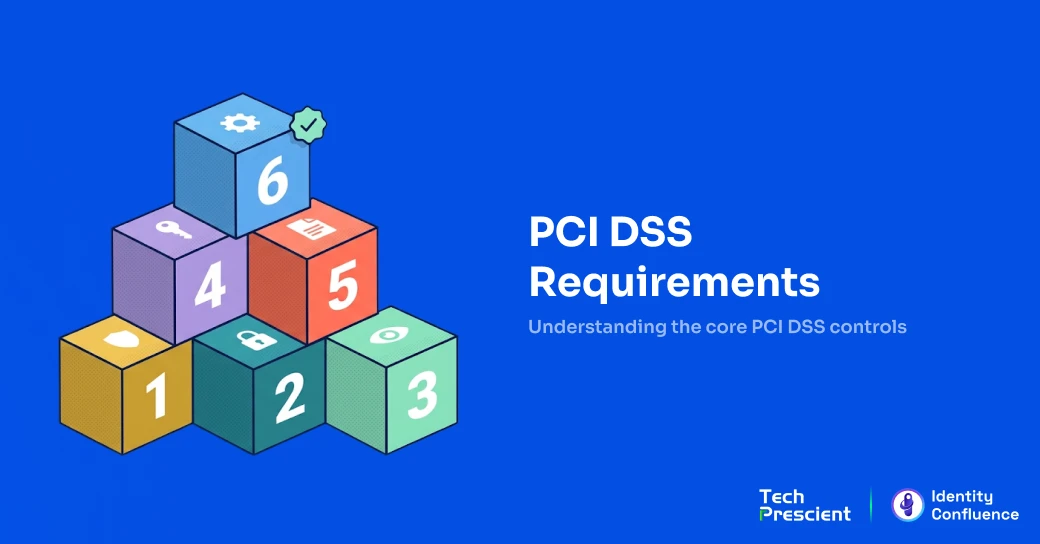
Key Takeaways:
- Learn the 12 PCI DSS requirements and the purpose behind each security control.
- Understand the six PCI DSS security goals and how they map to the 12 requirements.
- Explore the latest PCI DSS v4.0 updates and what they mean for your organization.
- Follow a practical PCI DSS compliance checklist to achieve and maintain compliance.
- See how identity governance, access control, and continuous monitoring support PCI DSS compliance.
What Is PCI DSS and Why It Matters
The Payment Card Industry Data Security Standard (PCI DSS) is a globally recognized security framework developed and maintained by the PCI Security Standards Council (PCI SSC) to protect cardholder data. It establishes 12 security requirements that help organizations securely store, process, and transmit payment information while reducing the risk of cyberattacks, fraud, and data breaches. PCI DSS applies to any organization that handles payment card data and provides a standardized approach to securing payment environments.
Let's explore who PCI DSS applies to, why compliance matters, and how identity security supports it.
Who Governs PCI DSS?
The PCI Security Standards Council (PCI SSC) develops and maintains the PCI DSS framework. Founded by major payment brands including Visa, Mastercard, American Express, Discover, and JCB, the Council continuously updates the standard to address evolving cyber threats and modern payment technologies. While the PCI SSC defines the requirements, compliance is enforced by payment brands and acquiring banks.
Who Needs to Comply?
PCI DSS applies to every organization that stores, processes, or transmits payment card data, regardless of its size or transaction volume. This includes merchants, e-commerce businesses, payment processors, payment gateways, financial institutions, and third-party service providers that support or manage payment environments. If your organization handles cardholder data in any capacity, PCI DSS compliance is mandatory under payment card industry agreements.
Risks of Non-Compliance
Failure to comply with PCI DSS can result in data breaches, financial penalties, increased transaction fees, reputational damage, and even the loss of the ability to process payment cards. Beyond avoiding these consequences, implementing PCI DSS requirements strengthens an organization's overall cybersecurity posture and helps protect sensitive payment data from evolving threats.
The Role of Identity Security
Identity security plays a vital role in meeting PCI DSS requirements related to access control, user authentication, and audit logging. Controls such as role-based access control (RBAC), least privilege, multi-factor authentication (MFA), and periodic access reviews ensure that only authorized users can access cardholder data. Combined with identity governance and continuous monitoring, these practices simplify compliance, improve audit readiness, and reduce identity-related security risks.
PCI DSS Requirements Overview (6 Control Objectives)
The 12 PCI DSS requirements are organized into six control objectives that help organizations secure payment environments, protect cardholder data, manage vulnerabilities, control access, monitor systems, and maintain an effective security program.
The table below shows how the six PCI DSS control objectives map to the 12 requirements.
| PCI DSS Control Objective | Purpose | Mapped Requirements |
|---|---|---|
| Build and Maintain Secure Network and Systems | Protect payment environments by implementing secure network configurations and eliminating insecure system settings. | Requirement 1: Install and maintain network security controls Requirement 2: Apply secure configurations to all system components |
| Protect Account Data | Safeguard stored account data and secure cardholder information while it is transmitted across public networks. | Requirement 3: Protect stored account data Requirement 4: Encrypt cardholder data during transmission |
| Maintain a Vulnerability Management Program | Reduce security risks by defending systems against malware and promptly addressing software vulnerabilities. | Requirement 5: Protect systems from malware Requirement 6: Develop and maintain secure systems and software |
| Implement Strong Access Control Measures | Ensure only authorized users can access systems and cardholder data based on business requirements. | Requirement 7: Restrict access by business need Requirement 8: Identify and authenticate users Requirement 9: Restrict physical access to cardholder data |
| Regularly Monitor and Test Networks | Detect suspicious activity through logging, monitoring, and regular security testing to validate the effectiveness of security controls. | Requirement 10: Log and monitor system activity Requirement 11: Test security controls regularly |
| Maintain an Information Security Policy | Establish governance policies, security awareness, and risk management practices that support long-term PCI DSS compliance. | Requirement 12: Support information security with organizational policies and programs |

Pro Tip:
Don't treat the 12 PCI DSS requirements as independent checkboxes. They are interconnected controls, and a weakness in one area can impact compliance across multiple requirements.
The 12 PCI DSS Requirements Explained
The 12 PCI DSS requirements define the technical and operational security controls organizations must implement to protect cardholder data, reduce cyber risk, and maintain compliance.
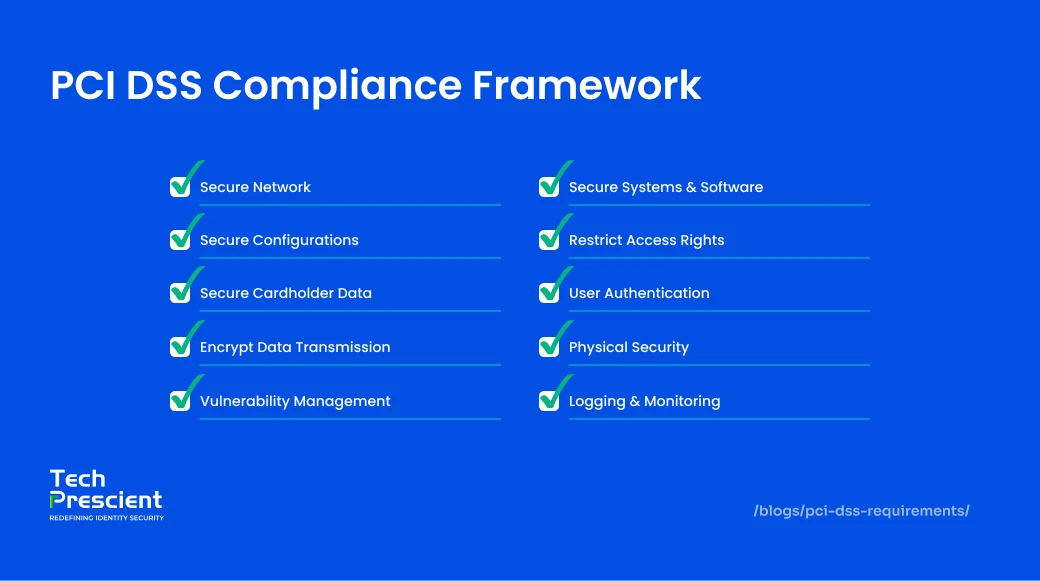
PCI DSS Requirement 1: Install and Maintain Network Security Controls
The first PCI DSS requirement focuses on protecting the cardholder data environment from unauthorized network access. Organizations should deploy and maintain firewalls, network security controls, and network segmentation to regulate traffic between trusted and untrusted networks. Properly configured network boundaries reduce the attack surface and help prevent external threats from reaching systems that store or process payment card data.
PCI DSS Requirement 2: Apply Secure Configurations
Default system settings often introduce unnecessary security risks. PCI DSS requires organizations to replace default passwords, remove unused services, disable insecure configurations, and establish secure baseline settings for all system components. Regular configuration reviews and system hardening reduce vulnerabilities and improve the overall resilience of payment environments.
PCI DSS Requirement 3: Protect Stored Account Data
Organizations must safeguard stored cardholder data using strong encryption, tokenization, masking, or truncation wherever applicable. Sensitive authentication data should never be retained after authorization unless explicitly permitted. Businesses should also implement data retention policies that ensure payment information is stored only for legitimate business purposes and securely deleted when no longer required.
PCI DSS Requirement 4: Encrypt Data During Transmission
Cardholder data transmitted across public or untrusted networks must be protected using strong cryptographic protocols such as TLS. Encryption prevents attackers from intercepting or altering sensitive payment information while it is in transit. Secure communication channels should be used for all systems, applications, APIs, and payment services that exchange cardholder data.
PCI DSS Requirement 5: Protect Systems Against Malware
Organizations must deploy anti-malware solutions capable of detecting, preventing, and responding to malicious software. These tools should be regularly updated and continuously monitored to defend endpoints, servers, and other systems against evolving threats. User awareness and secure browsing practices further strengthen malware protection across the organization.
PCI DSS Requirement 6: Develop and Maintain Secure Systems and Software
Requirement 6 focuses on reducing vulnerabilities throughout the software lifecycle. Organizations should promptly apply security patches, remediate known vulnerabilities, and integrate secure coding practices into application development. Regular code reviews, vulnerability assessments, and secure software development lifecycle (SSDLC) processes help ensure systems remain protected against newly discovered threats.
PCI DSS Requirement 7: Restrict Access by Business Need
Access to cardholder data should be granted only to individuals whose job responsibilities require it. Implementing role-based access control (RBAC) and enforcing the principle of least privilege minimizes unnecessary permissions and reduces the likelihood of insider threats or unauthorized access to sensitive payment systems.
PCI DSS Requirement 8: Identify and Authenticate Users
Every individual accessing systems within the cardholder data environment should have a unique identity. PCI DSS requires strong authentication mechanisms, including multi-factor authentication (MFA), robust password policies, and secure identity verification. These controls improve accountability while preventing unauthorized access using compromised credentials.
PCI DSS Requirement 9: Restrict Physical Access
Protecting physical infrastructure is just as important as securing digital systems. Organizations should implement physical security measures such as badge-controlled entry, surveillance systems, visitor logs, secure media storage, and restricted access to data centers. These controls help prevent unauthorized individuals from accessing systems containing cardholder data.
PCI DSS Requirement 10: Log and Monitor Access
Organizations should maintain detailed audit logs that record user activities, administrative actions, and access to sensitive systems. Continuous monitoring and centralized log management enable security teams to detect suspicious behavior, investigate incidents, and demonstrate compliance during security assessments. SIEM platforms further enhance visibility by correlating events across the environment.
PCI DSS Requirement 11: Test Security Regularly
Security controls should be validated on an ongoing basis to ensure they remain effective. PCI DSS requires organizations to perform vulnerability scans, penetration testing, network testing, and other security assessments to identify weaknesses before attackers can exploit them. Continuous testing helps organizations adapt to evolving threats and maintain a strong security posture.
PCI DSS Requirement 12: Maintain Security Policies
A comprehensive information security policy establishes the governance needed to support long-term PCI DSS compliance. Organizations should define security responsibilities, conduct employee awareness training, assess risks regularly, and document security procedures. Strong governance ensures that security becomes an ongoing business process rather than a one-time compliance initiative.
Common Mistake:
Many organizations focus on passing the annual audit but overlook continuous monitoring throughout the year. PCI DSS v4.0 expects security controls to remain effective every day, not just during assessments.
Not sure how your organization measures up against all 12 PCI DSS requirements?
Assess your compliance readiness identify control gaps and prioritize remediation before your next audit.
PCI DSS v4.0 Updates You Should Know
PCI DSS v4.0 introduces greater flexibility, stronger authentication requirements, and a continuous compliance approach to help organizations address evolving cyber threats.
Here are some of the most significant updates introduced in PCI DSS v4.0.
1. Continuous Compliance Instead of Annual Validation
PCI DSS v4.0 shifts the focus from treating compliance as a once-a-year assessment to maintaining security controls throughout the year. Organizations are expected to continuously monitor critical systems, review security controls regularly, and promptly address vulnerabilities to ensure compliance is sustained between audits.
2. Stronger Multi-Factor Authentication (MFA)
The updated standard expands the use of multi-factor authentication (MFA) beyond administrative and remote access scenarios. MFA is now expected for all access into the cardholder data environment, helping reduce the risk of unauthorized access resulting from compromised credentials and phishing attacks.
3. Greater Flexibility Through a Risk-Based Approach
PCI DSS v4.0 introduces a more flexible implementation model by allowing organizations to adopt Customized Approaches where appropriate. Instead of following only predefined control methods, businesses can implement alternative security measures if they demonstrate that the intended security objective is achieved through documented risk assessments and supporting evidence.
4. Enhanced Security Requirements
The latest version strengthens several technical controls by placing greater emphasis on secure configurations, password management, phishing resistance, vulnerability management, targeted risk analyses, and periodic validation of security controls. These enhancements help organizations improve resilience against emerging attack techniques while supporting long-term compliance.
5. Increased Focus on Identity and Access Security
Identity security plays a larger role in PCI DSS v4.0, particularly for requirements involving authentication, least privilege, access reviews, and activity monitoring. Organizations are encouraged to implement centralized identity governance, role-based access control (RBAC), and continuous access monitoring to reduce identity-related risks and improve audit readiness.
6. What These Updates Mean for Organizations
PCI DSS v4.0 moves organizations beyond simply passing an audit. It encourages a proactive security strategy that combines continuous monitoring, stronger authentication, risk-based decision-making, and automated governance. By embedding these practices into daily operations, organizations can better protect cardholder data while simplifying compliance and adapting to evolving cybersecurity threats.
PCI DSS Compliance Checklist (Step-by-Step)
A structured PCI DSS compliance checklist helps organizations systematically implement security controls, validate compliance, and continuously protect cardholder data.
Step 1: Define the Scope of Your PCI DSS Environment
Start by identifying all systems, applications, networks, and third-party services that store, process, or transmit cardholder data. Clearly defining the Cardholder Data Environment (CDE) helps reduce unnecessary compliance efforts and ensures that security controls are applied where they are needed most.
Step 2: Discover and Classify Cardholder Data
Identify where payment card data is collected, stored, transmitted, and backed up across your organization. Understanding the complete data flow enables you to eliminate unnecessary storage, minimize risk, and implement appropriate protection measures for sensitive information.
Step 3: Implement the Required Security Controls
Deploy the technical and operational controls required by PCI DSS. This includes securing networks, encrypting cardholder data, applying secure system configurations, protecting against malware, managing vulnerabilities, enforcing access controls, and maintaining detailed audit logs. Every control should be implemented consistently across the cardholder data environment.
Step 4: Strengthen Identity and Access Management
Ensure that only authorized users can access systems containing cardholder data. Implement role-based access control (RBAC), enforce the principle of least privilege, require multi-factor authentication (MFA), and conduct periodic access reviews to prevent excessive or unauthorized access.
Step 5: Test and Validate Security Controls
Regularly verify that security controls are functioning as intended. Perform vulnerability scans, penetration testing, configuration reviews, and log analysis to identify weaknesses before they can be exploited. Continuous testing helps organizations maintain a strong security posture between compliance assessments.
Step 6: Maintain Documentation and Security Policies
Document security policies, operating procedures, risk assessments, incident response plans, and evidence of implemented controls. Maintaining accurate documentation simplifies audits and demonstrates that compliance activities are consistently followed throughout the organization.
Step 7: Monitor Compliance Continuously
PCI DSS compliance is an ongoing process, not a one-time certification. Continuously monitor critical systems, review user access, apply security patches promptly, investigate suspicious activity, and reassess risks as your environment evolves. Ongoing governance helps ensure compliance is maintained year-round.
Quick Reminder:
Completing a compliance checklist doesn't guarantee ongoing compliance. Regular access reviews, policy updates, and continuous monitoring are essential for maintaining PCI DSS requirements over time.
Role of Identity Governance in PCI DSS Compliance
Identity governance helps organizations control access to cardholder data, enforce least privilege, and support PCI DSS requirements related to access control, authentication, and auditability.
Here's how identity governance supports key PCI DSS requirements.
1. Strengthens Access Control
PCI DSS Requirements 7 and 8 emphasize limiting access to cardholder data based on business need and verifying the identity of every user. Identity governance enforces role-based access control (RBAC), the principle of least privilege, and automated provisioning and deprovisioning to ensure users receive only the access necessary for their roles. This reduces the risk of excessive permissions and unauthorized access.
2. Simplifies Access Certification
Periodic access reviews are essential for confirming that user permissions remain appropriate as employees change roles or leave the organization. Identity governance automates access certification campaigns, enabling managers and application owners to review, approve, or revoke access efficiently. This helps eliminate dormant accounts, excessive privileges, and policy violations before they become security risks.
3. Improves Audit Readiness
Preparing for PCI DSS assessments often requires collecting evidence of user access, authentication controls, and review activities. Identity governance centralizes access records, approval workflows, certification results, and audit logs, making it easier to produce compliance evidence and demonstrate that access controls are consistently enforced across the organization.
4. Enables Continuous Compliance
As organizations adopt the continuous compliance model introduced in PCI DSS v4.0, identity governance plays an increasingly important role. Automated access reviews, policy enforcement, segregation of duties (SoD) checks, and continuous monitoring help organizations detect access risks early, respond to changes quickly, and maintain compliance throughout the year instead of only during annual assessments.
5. Supporting PCI DSS with Identity Governance
A modern Identity Governance and Administration (IGA) solution brings together identity lifecycle management, access governance, policy enforcement, and compliance reporting within a single platform. By automating identity-related processes and providing complete visibility into who has access to what, organizations can strengthen PCI DSS compliance, reduce operational effort, and improve their overall security posture.
Move beyond spreadsheets and manual checklists with a structured PCI DSS readiness framework.
Measure compliance maturity track audit readiness and build a clear remediation roadmap.
Common PCI DSS Compliance Challenges
Organizations often face challenges such as limited visibility, excessive user access, and manual compliance processes that make maintaining PCI DSS compliance difficult.
Some of the most common PCI DSS compliance challenges include:
1. Shadow IT and Unmanaged Assets
Employees often adopt unauthorized applications, cloud services, or devices outside approved IT processes. These unmanaged assets may store, process, or transmit cardholder data without appropriate security controls, increasing the organization's attack surface and making it difficult to accurately define the Cardholder Data Environment (CDE).
2. Excessive User Permissions
Users frequently accumulate access privileges as they change roles or responsibilities. Without regular access reviews, these unnecessary permissions remain active, increasing the risk of insider threats, unauthorized access, and violations of PCI DSS access control requirements.
3. Manual Compliance Processes
Many organizations continue to rely on spreadsheets, emails, and manual documentation to manage compliance activities. These time-consuming processes are prone to human error, create inconsistent audit evidence, and make it difficult to demonstrate ongoing compliance during assessments.
4. Limited Security Visibility
Monitoring multiple applications, cloud environments, and on-premises systems can be challenging without centralized visibility. Disconnected security tools often make it difficult to detect unauthorized access, policy violations, or suspicious activities that could impact cardholder data.
5. Keeping Pace with Continuous Compliance
PCI DSS v4.0 encourages organizations to maintain security controls continuously rather than focusing only on annual assessments. Sustaining this level of oversight requires regular monitoring, timely remediation, and ongoing validation of security controls, which can be difficult without automation.
Best Practices to Achieve PCI DSS Compliance
Combining automation, identity governance, and continuous monitoring helps organizations build a sustainable PCI DSS compliance program while reducing security risks.
1. Automate Access Reviews
Replace manual access certification processes with automated workflows that regularly validate user permissions. Periodic access reviews help identify excessive privileges, remove unnecessary access, and ensure that only authorized users can access cardholder data.
2. Enforce Least Privilege
Grant users only the minimum level of access required to perform their responsibilities. Combining role-based access control (RBAC) with the principle of least privilege reduces the risk of unauthorized access and supports PCI DSS requirements related to access management.
3. Centralize Logging and Monitoring
Collect security logs from networks, applications, databases, and identity systems into a centralized monitoring platform. Continuous log analysis improves threat detection, accelerates incident response, and provides the audit evidence required during PCI DSS assessments.
4. Continuously Monitor Security Controls
Security controls should be reviewed and validated throughout the year rather than only before an audit. Regular vulnerability assessments, configuration reviews, patch management, and policy validation help organizations maintain compliance and quickly address emerging risks.
5. Strengthen Identity Governance
Implement identity governance to automate user provisioning, enforce separation of duties, manage access certifications, and maintain complete visibility into user access. These capabilities improve operational efficiency while supporting multiple PCI DSS requirements related to authentication, authorization, and audit readiness.
6. Build a Culture of Security
Technology alone cannot ensure compliance. Regular employee training, clearly defined security policies, incident response planning, and executive oversight help embed security into everyday business operations and reduce the likelihood of human error.
Final Thoughts
Understanding the PCI DSS requirements is the first step toward protecting cardholder data and building a resilient payment security program. By implementing all 12 security requirements, adopting the latest PCI DSS v4.0 practices, and maintaining continuous compliance, organizations can reduce security risks, strengthen audit readiness, and meet industry expectations with confidence.
Tech Prescient helps organizations strengthen PCI DSS compliance through centralized identity governance, automated access reviews, role-based access control, and continuous access monitoring. By streamlining identity and access management across complex enterprise environments, organizations can simplify compliance efforts while improving security and operational efficiency.
FAQs
The 12 PCI DSS requirements are a set of security controls designed to protect cardholder data throughout its lifecycle. They cover key areas such as network security, data protection, vulnerability management, access control, monitoring, and security governance. Together, these requirements help organizations reduce cyber risks and maintain PCI DSS compliance.
The six goals of PCI DSS provide the foundation for the 12 security requirements. They focus on building secure networks, protecting cardholder data, managing vulnerabilities, implementing strong access controls, continuously monitoring systems, and maintaining an information security policy. These goals work together to create a comprehensive payment security framework.
PCI DSS is not a government law or regulation, but it is a contractual requirement for organizations that accept, process, store, or transmit payment card data. Compliance is mandated by major payment card brands and enforced through acquiring banks. Failing to comply can lead to financial penalties, increased transaction fees, or the loss of payment processing privileges.
Any organization that stores, processes, or transmits cardholder data must comply with PCI DSS, regardless of its size or industry. This includes merchants, e-commerce businesses, payment processors, financial institutions, and third-party service providers. If your business handles payment card information in any way, PCI DSS compliance applies to you.
PCI DSS v4.0 is the latest version of the Payment Card Industry Data Security Standard. It introduces stronger authentication requirements, greater implementation flexibility, and a greater emphasis on continuous compliance rather than annual assessments alone. The update helps organizations address evolving cyber threats while strengthening the protection of cardholder data.
Share



Yatin Laygude
Content Writer
A content writer with 6 years of experience turning complex topics into clear, engaging, and meaningful content. From blogs and web pages to whitepapers and thought pieces, he creates content that not only explains but also connects with both the audience and business goals.
Most Popular Blogs

Identity Security· 21 min read
Data Access Governance Solutions: How to Secure Sensitive Data at Scale
Compare data access governance solutions for 2026: how DAG platforms discover sensitive data, run access reviews, automate remediation, and prove compliance.
Brinda Bhatt· September 7, 2026
Identity Security· 24 min read
What Is Zero Trust Network Access (ZTNA)?
Learn what Zero Trust Network Access (ZTNA) is, how it works, and why it’s replacing VPNs for secure, identity-based access control.
Yatin Laygude· August 14, 2026
Identity Security· 24 min read
Cyber Essentials Certification: Complete Guide
Learn Cyber Essentials certification, cost, requirements, and steps. Compare Cyber Essentials vs Plus and get certified faster.
Yatin Laygude· August 10, 2026