




On this page
See Tech Prescient in Action
Automate access, reduce risk, and stay audit-ready
Ask an auditor for the fastest way to fail an access control review, and the answer is consistent: a policy that exists in a folder and nowhere else. IBM's Cost of a Data Breach report puts the average time to identify and contain a breach at 241 days, and breaches caught after 200 days cost roughly 52% more. Most organizations have an IAM document. Far fewer have one that names owners, sets measurable requirements, and matches what their systems actually enforce; the gap between having a policy and running an IAM strategy.
An identity and access management policy template solves the first half of that problem. It defines how the organization controls user identities, authenticates access, manages permissions, and enforces security standards in a structure that has already survived audits elsewhere. A well-structured enterprise IAM policy reduces security risk, supports compliance, and gives the organization an access management framework its systems can actually enforce. This guide walks through every section a complete access control policy template needs, then provides the template itself.
Key Takeaways:
- An IAM policy only works when it sets measurable standards, not intentions; every control in it should be testable by an auditor.
- User provisioning and deprovisioning belong in the policy as timed obligations, with termination access removal treated as immediate, not eventual.
- Least privilege and role-based access control are the authorization backbone; segregation of duties catches the combinations they miss.
- MFA and SSO requirements written into policy give security teams enforcement authority instead of negotiation rounds.
- Audit readiness comes from the policy producing records as it operates: reviews, logs, and certifications that exist before anyone asks.
What Is an Identity and Access Management (IAM) Policy?
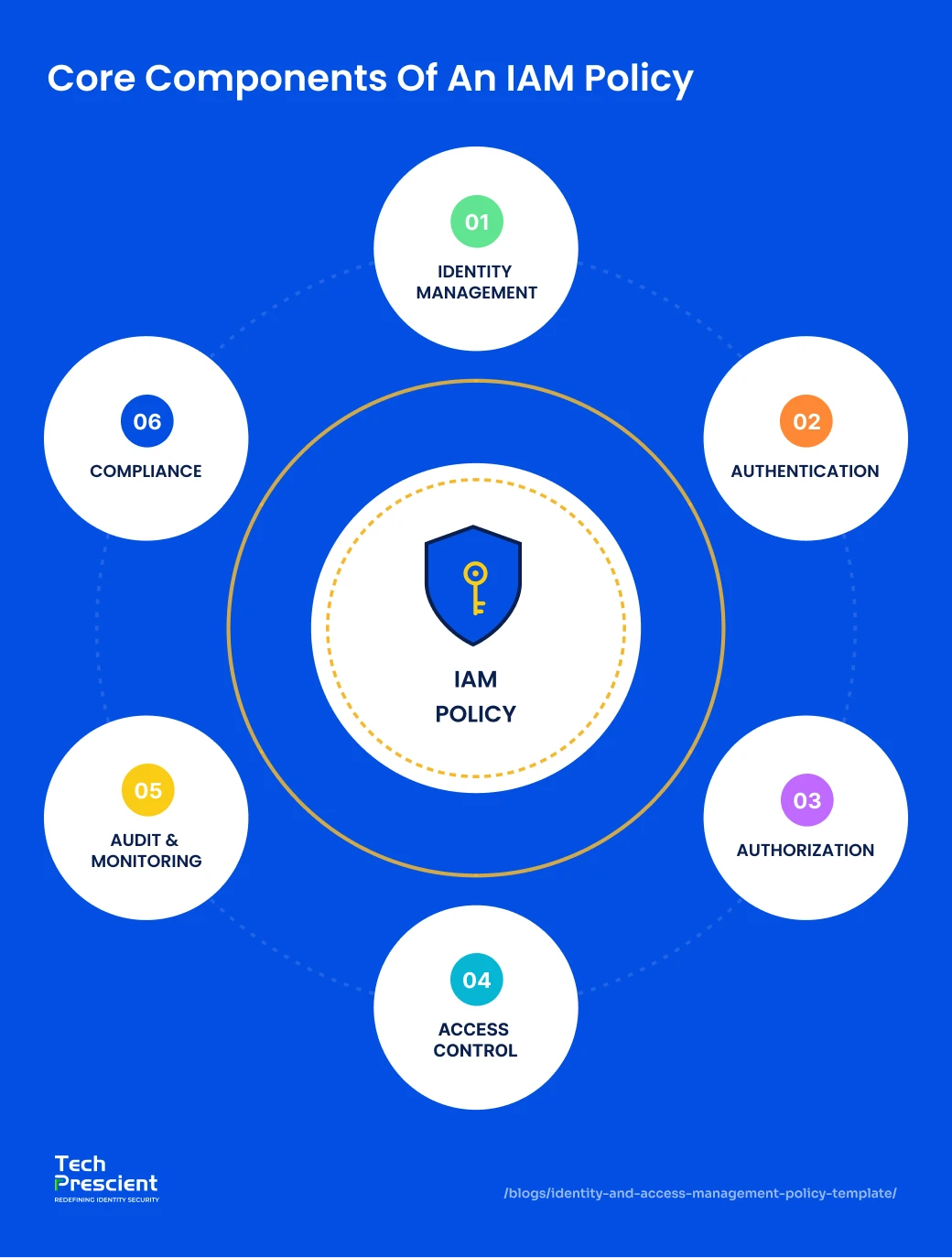
An IAM security policy establishes rules and controls for managing user identities, authentication and authorization, and access across systems and applications. It is the document that turns access management from a set of habits into a set of obligations: who approves access, how identity is verified, what users can reach, and what happens when any of that changes.
Organizations need the formal version for a reason that becomes obvious the first time something goes wrong. Without written access governance, every decision is precedent-free. One admin grants access on a Slack message, another demands a ticket, and neither can point to a rule when the auditor asks why. The policy is where security requirements, compliance obligations, and daily operations meet in one enforceable place, which is also why it sits at the center of any broader workforce identity and access management program.
The business risks of running without one are specific: access granted with no approval trail, departed employees with live credentials, privileged accounts nobody reviews, and audit findings that repeat year after year because no standard existed to enforce. The Verizon 2026 Data Breach Investigations Report, drawn from more than 22,000 confirmed breaches, found that 83% of incidents involving privilege escalation used no vulnerability exploit at all — attackers moved up through access that had already been granted. A written policy that bounds and reviews that access is the control that gap calls for.
Purpose of an IAM Policy
The primary purpose of an IAM policy is to ensure only authorized users have appropriate access to business systems and sensitive data. Everything else the policy does flows from that single sentence.
In practice, the purpose breaks into four commitments. The policy protects confidential information by putting an approval and a standard between every identity and every resource. It supports compliance requirements by producing the documented controls that SOX, HIPAA, GDPR, and ISO 27001 audits test. It reduces insider threats by bounding what any single identity can reach and by separating duties that should never sit together. And it standardizes access management so the process works the same way for the hundredth request as it did for the first, which is what turns compliance management from an annual scramble into a running state.
Why is an IAM policy important?
- Prevents unauthorized access
- Supports regulatory compliance
- Improves audit readiness
- Enforces least privilege
Scope of an IAM Policy
An IAM policy should apply to all users, systems, applications, cloud environments, privileged accounts, and third-party access. A policy that scopes narrower than the environment it governs leaves exactly the gaps auditors and attackers find first.
Users Covered
The user scope extends past employees. Contractors, vendors, partners, interns, and temporary staff all hold access, and the policy applies to every one of them. Service accounts and machine identities belong in scope too, since they authenticate and hold entitlements just as people do; the same principle that drives unified human and non-human identity governance applies at the policy level. If an identity can reach a system, the policy covers it.
Systems and Applications Covered
The system scope covers everything holding organizational data: cloud applications, on-premises systems, databases, network infrastructure, and endpoints. Legacy applications without modern integration support stay in scope as well, because compliance obligations follow the data, not the connector; extending controls to them is the problem disconnected application governance exists to solve. Shared drives and file servers carry access through directory groups and deserve explicit mention, which is where file server access management practices apply.
Third-Party and Vendor Access
Third parties get their own scope statement because their access follows different rules: it is sponsored rather than employed, time-bound rather than open-ended, and revoked on contract terms rather than HR events. The policy names these differences up front so that vendor access never defaults to employee treatment.
Roles and Responsibilities in IAM Governance
Successful IAM programs require clearly defined responsibilities across management, security teams, system owners, and end users. A policy without named roles is a policy nobody is accountable for executing.
Management Responsibilities
Management approves the policy, funds its enforcement, and accepts the residual risk of any exception. Executive sign-off is what gives the security team authority when a business unit pushes back on a control. Management also reviews program metrics on a defined cadence, since a policy that never reaches leadership review is a policy drifting from the organization it governs.
Information Security Team Responsibilities
The security team maintains the policy, defines the technical standards beneath it, monitors compliance, and investigates violations. They own the controls: MFA configuration, logging requirements, and the review calendar. They do not own every decision; access approvals belong to the people who understand the business need behind them.
System Owner Responsibilities
Every system in scope has a named owner responsible for approving access to it, defining its permission levels, and certifying its access during reviews. Owner accountability is what separates a review that means something from one that rubber-stamps. The policy should require that ownership is always current, including when the owner leaves, which is the gap ownership succession closes automatically.
User Responsibilities
Users protect their credentials, use access only for authorized purposes, and report suspected compromise. The policy states these obligations plainly because they are the basis for enforcement action when violated.
| Activity | Management | Security Team | System Owner | User |
|---|---|---|---|---|
| Approve and fund the policy | A | R | C | I |
| Define technical standards | C | A/R | C | I |
| Approve access requests | I | C | A/R | I |
| Certify access in reviews | I | C | A/R | I |
| Protect credentials, report incidents | I | C | I | A/R |
R = Responsible, A = Accountable, C = Consulted, I = Informed
User Access Management Requirements
User access management governs account creation, modification, and removal throughout the user lifecycle, the discipline of identity lifecycle management. This section of the policy is where most audit findings originate, so its requirements should be timed and testable, not aspirational.
User Provisioning
Every account starts with an approved access request tied to a documented business need. Each user receives a unique ID; shared accounts are prohibited except where a documented exception exists. Access at creation follows the user's role, nothing more. The strongest implementations remove the manual step entirely by driving provisioning from the HR record, the model behind HRMS-driven lifecycle automation, where a new hire's access exists on day one without a ticket.
Access Modification
Role changes trigger access re-evaluation, not just access addition. The policy requires that a transfer removes the old role's entitlements in the same operation that grants the new ones, because access that only ever accumulates is how a five-year employee ends up with five roles' worth of permissions.
User Deprovisioning
Termination removes access immediately, triggered by the HR event itself rather than a ticket filed afterward. The policy should state the window in hours, not days, and require that active sessions and tokens be revoked alongside the account, since sessions issued before termination can survive a password reset.
Key requirements in summary: approved access requests, unique user IDs, timely role updates, and immediate access removal upon termination.
Authentication Requirements
Authentication controls verify user identity and protect organizational resources through strong security measures. Here, the policy sets a floor. Systems may exceed it; none may fall below it.
Password Policy Requirements
Password standards cover minimum length, complexity, storage, and prohibited practices such as reuse across systems and sharing between users. The policy also states what happens on a suspected compromise: an immediate reset and an investigation trigger, not a note for the next review.
Multi-Factor Authentication (MFA)
A multi-factor authentication policy requires MFA for privileged accounts, remote access, cloud applications, and any system holding sensitive data. The policy names the acceptable factor types and can distinguish tiers, reserving phishing-resistant factors for administrative and financial access where plain push approval no longer meets the bar.
Single Sign-On (SSO)
Single sign-on centralizes authentication so MFA, session control, and revocation apply in one place rather than per application. The policy should require that new applications integrate with SSO where technically possible, because every application outside it keeps its own credentials and its own risk.
What authentication controls should an IAM policy include?
- Strong passwords
- MFA enforcement
- SSO implementation
- Credential protection standards
Authorization and Access Control Standards
Authorization determines what users can access after authentication, and the policy's job is to make those decisions principled instead of ad hoc.
Principle of Least Privilege
Least privilege access means every identity holds the minimum its function requires for the minimum time required. The policy operationalizes least privilege through role design at grant time and reviews at certification time, with elevated access issued as time-bound exceptions that expire by default rather than permanent entitlements that never do.
Role-Based Access Control (RBAC)
A role-based access control policy assigns entitlements through roles mapped to job functions, which keeps access consistent, explainable, and reviewable at scale.
The policy requires that roles be documented, owned, and reviewed on a schedule, since a role definition that nobody has revisited in three years is quietly granting access to a job that no longer exists.
Segregation of Duties (SoD)
Segregation of duties prohibits any single identity from holding permission combinations that enable fraud or conceal it: creating vendors and approving payments, or writing code and deploying it unreviewed. The policy defines the prohibited pairings and requires that requests creating a conflict are blocked or escalated at grant time. Individually harmless permissions that become dangerous together are known as toxic access, and they are invisible to reviews that check one entitlement at a time, which is exactly why the policy addresses combinations explicitly.
Privileged Access Management Requirements
Privileged accounts require additional controls because they can access sensitive systems and perform administrative actions that ordinary accounts cannot. The policy treats them as a separate class, not as regular accounts with extra permissions.
Administrative account controls start with separation: administrators use distinct privileged accounts for administrative work, never their daily-driver identity. Privileged sessions are monitored and logged. Elevation follows an approval workflow, and standing administrative access gives way to just-in-time elevation wherever the environment supports it, so admin rights exist for the window a task requires and no longer. Privileged access reviews run more frequently than standard reviews, because the blast radius of a stale admin entitlement is larger than anything else in the program. Our guide to privileged access management covers the operational detail behind each of these controls.
Access Reviews and Certification Process
An access review policy helps organizations identify excessive permissions and maintain compliance.
The policy defines who reviews, how often, and what record each review produces, because the gradual accumulation of the reviews exists to catch, known as privilege creep, never announces itself between cycles.
Quarterly Reviews
The policy sets the review cadence by risk: quarterly for sensitive systems, semi-annually where risk allows, and event-driven when a role change or incident warrants it. Each campaign covers a defined population, and completeness is part of the requirement; a user access review that skips the systems hardest to reach certifies a partial picture.
Manager Certifications
Managers and system owners certify that each entitlement under their responsibility is still required, with revoke as an equally available answer to approve. The policy requires that reviewers receive context, what the entitlement does and when it was last used, since a reviewer clearing a queue without context is performing access certification in name only.
Compliance Reporting
Every completed review produces a timestamped, reviewer-attributed record, retained per the policy's retention schedule. Those records are what auditors sample, and organizing them by the specific control they satisfy, the practice behind clause-level compliance reporting, turns each audit request into a lookup. Platforms that map review output to framework clauses continuously, the way the Evidence Center does, remove the assembly step entirely.
Monitoring, Logging, and Audit Requirements
Organizations should continuously monitor authentication events, privileged activity, and unauthorized access attempts. The policy defines what gets logged, how long logs are retained, and who investigates what they surface.
Audit logs capture authentication events, authorization changes, privileged actions, and failed access attempts, with timestamps and the acting identity on every entry. Security monitoring reviews these logs for anomalies rather than archiving them unread; a log nobody examines is storage, not a control. Incident investigations rely on log integrity, so the policy protects logs from modification, including by administrators, and states the retention period that applicable regulations require.
What should IAM logs track?
- Authentication events
- Authorization changes
- Privileged activity
- Failed login attempts
Third-Party and Vendor Access Controls
Third-party access should be approved, monitored, time-bound, and revoked when no longer required. Four words, and the policy's job is to make each one a requirement rather than a hope.
Vendor onboarding assigns every external identity a named internal sponsor accountable for its access. Temporary access carries an expiry date tied to the contract or engagement, not an open end. Monitoring applies to vendor activity the same way it applies to employee activity, and contract termination procedures revoke access on the termination date itself. The reason for the rigor is structural: no HR termination event fires when a vendor engagement ends, so the policy has to create the trigger that employment provides automatically.
IAM Policy Template: Section-by-Section Language
The sections below are the template itself. Each one gives sample clause language you can lift directly, followed by a drafting note on what auditors look for in that section and where the wording most often goes wrong. Replace the bracketed items with your organization's specifics, and cut nothing without a documented reason, because every section here exists because its absence has been an audit finding somewhere.
Purpose
Sample clause: This policy establishes requirements for managing identities and controlling access to [Organization] systems, applications, and data. Its purpose is to protect information assets, meet regulatory obligations, and enforce least privilege across the environment, so that every identity holds only the access its function requires, for only as long as it is required.
Drafting note: Keep the purpose to a single paragraph of intent. Auditors read this section to establish what the policy claims to govern, then test whether the rest of the document delivers it. Listing individual controls here creates a second, competing scope statement that the later sections will eventually contradict.
Scope
Sample clause: This policy applies to all employees, contractors, vendors, partners, and service accounts accessing [Organization] resources, and to all systems, applications, databases, network infrastructure, and cloud environments that store or process organizational data, including legacy applications without modern integration support.
Drafting note: State exclusions explicitly if any exist. An unstated exclusion reads as an oversight during an audit, while a documented one reads as a decision. The most common gap is a scope that names employees and systems but never mentions service accounts, which leaves the fastest-growing part of the identity population ungoverned by the organization's own policy.
Policy Statements
Sample clause: Access is granted only on documented business need with recorded approval. Every identity is unique and attributable to one person or one system function; shared accounts are prohibited except under a documented, time-bound exception. Access is reviewed on the schedule defined in this policy and removed when no longer required. Authentication meets or exceeds the standards defined herein, and every access change, review, and exception produces an auditable record.
Drafting note: These are the assertions an auditor will sample against. Write each one so that a record can prove or disprove it. A statement like "access is managed appropriately" cannot be tested and adds nothing; "access is granted only on documented business need with recorded approval" can be tested against any five requests pulled at random.
Roles & Responsibilities
Sample clause: [Executive sponsor] owns and approves this policy, funds its enforcement, and accepts residual risk on exceptions. [Information security] maintains the policy, defines the technical standards beneath it, monitors compliance, and investigates violations. [System owners] approve access to their systems, define permission levels, and certify access during reviews; ownership must remain current at all times, including on personnel change. All users protect their credentials, use access only for authorized purposes, and report suspected compromise immediately.
Drafting note: Name roles, not individuals. A policy that names people needs reissuing every time someone changes jobs, and in practice it simply goes stale instead. The clause about ownership remaining current on personnel change matters more than it looks: it is what prevents a resignation from silently orphaning approval authority for an entire system.
Access Management
Sample clause: Provisioning begins with an approved request tied to documented business need, and access at creation follows the identity's role, nothing more. Role changes trigger re-evaluation of all held access: new entitlements are granted and obsolete entitlements are removed in the same operation. Termination removes access within [X hours] of the HR event, including active sessions and tokens, not only the account login.
Drafting note: Put a number in the termination window. Words like "promptly" and "in a timely manner" are the single most common finding in access control reviews, because no auditor can test them and no team can be held to them. Choose a window you can actually meet across every in-scope system, then hold the line on it.
Authentication
Sample clause: Passwords meet [length/complexity standard] and are never shared or reused across systems; suspected compromise triggers immediate reset and investigation. MFA is required for privileged accounts, remote access, cloud applications, and systems classified at or above [sensitivity tier], with phishing-resistant factors required for administrative and financial access. New applications integrate with SSO where technically feasible.
Drafting note: Reference your password standard rather than embedding its parameters here. Factor requirements and complexity rules change as attacks evolve, and every change to an embedded parameter drags the whole policy back through an approval cycle. The policy states that MFA is required; the standard beneath it states which factors qualify this quarter.
Authorization
Sample clause: Access follows least privilege and is assigned through defined, owned, and documented roles. Requests that would create a segregation-of-duties conflict defined in [SoD matrix reference] are blocked or escalated at request time. Elevated access is time-bound and expires automatically.
Drafting note: Maintain the SoD matrix as a referenced annex, not an inline list. Conflicting pairs are organization-specific and change whenever a business process changes, so they belong somewhere that can be updated without a policy revision. The phrase worth defending in review is "at request time," since a policy that only detects conflicts during audits is describing a report, not a control.
Monitoring & Compliance
Sample clause: Authentication events, authorization changes, privileged activity, and failed access attempts are logged with timestamps and the acting identity, protected from modification, and retained for [retention period]. Access reviews run [cadence], with high-risk entitlements reviewed first and most often, and every completed review produces a timestamped, reviewer-attributed record retained for audit.
Drafting note: Set the retention period to the strictest requirement that applies to you, not the average across your frameworks. Where several regulations overlap, the shortest retention wins nothing and the longest satisfies all of them. The protection-from-modification clause should extend to administrators, since an administrator who can edit the log can erase the evidence of anything else they did.
Exceptions
Sample clause: Exceptions require documented business justification, risk acceptance by [role], and an expiry date. No exception is permanent by default, and all active exceptions are re-reviewed at each policy review.
Drafting note: The expiry requirement is the entire value of this section. Exceptions granted without one become the permanent shadow policy that governs the environment in practice, and they are usually where the highest-risk access lives. Keep a live exception register and open every policy review with it, because an exception nobody has revisited has quietly become a standard.
Enforcement
Sample clause: Violations of this policy are subject to disciplinary action up to and including termination of employment or contract, and to access revocation pending investigation.
Drafting note: Align this wording with your HR disciplinary policy and contract terms before publishing. An enforcement clause that conflicts with either one is unenforceable in the moment it matters, which turns the policy into guidance. For contractors and vendors, the equivalent consequence has to appear in the contract itself, not only here.

Pro Tip:
Keep the template at policy altitude. A policy states what must be true, a standard states the measurable requirement, and a procedure states how it gets done; the workflow of our user access management procedure lays it out step by step. When teams stuff procedures into the policy, every tooling change forces a policy re-approval cycle. Write "MFA is required for privileged access" here, and put which factors and which enrollment steps in the standards beneath it.
IAM Policy Best Practices for 2026
Modern IAM policies should align with Zero Trust principles, cloud environments, automation, and continuous compliance. The template above is the structure; these practices are what keep it current.
Adopt Zero Trust Access Controls
Write the policy so that no request is trusted by network location, the operating rule of Zero Trust Identity. Every access decision verifies identity explicitly, applies least privilege, and assumes compromise is possible, which changes the policy's language from "internal users may" to "verified identities with entitlement may."
Automate User Lifecycle Management
Policy requirements that depend on humans remembering will eventually be missed, so the policy should require automation where it exists: provisioning driven by HR events, deprovisioning triggered on termination, and access changes executed through workflow automation rather than ticket queues. Account lifecycle management written as an automated obligation is enforceable; written as a manual duty, it is a hope.
Strengthen MFA Enforcement
Extend MFA past the privileged tier toward universal coverage, and upgrade factor quality as attacks evolve. Push-notification bombing has made plain push approval insufficient for sensitive systems, so the policy should permit number matching and phishing-resistant factors to be mandated by classification.
Conduct Regular Access Reviews
Move the review requirement from calendar-driven to risk-informed. High-risk entitlements get reviewed first and most often, and review prioritization improves when the program can rank exposure numerically, the function an identity risk score serves, rather than treating every entitlement as equally urgent.
Integrate IAM with IGA Platforms
The policy defines the rules; an identity governance and administration platform is what enforces them at scale and proves it. Integration turns policy statements into system-enforced controls with an audit trail, which is the difference between a policy that describes the program and one that runs it. That enforcement layer, with the records to prove it, is what Identity Confluence provides.
Your policy says it. Do your systems enforce it?
Check whether IAM best practices actually hold up across users, applications, and privileged access.
Common IAM Policy Mistakes to Avoid
Many organizations create IAM policies but fail to operationalize them effectively. The failure patterns repeat often enough to list.
Granting more access than roles require, which accumulates into excessive permissions no review cycle fully claws back. Shared accounts that make actions unattributable. Missing MFA on systems that "were getting it next quarter" for six consecutive quarters. Reviews run infrequently enough that the access being certified no longer matches the access that exists. Vendor controls that end at onboarding, with no expiry and no revocation trigger. And a policy written for manual execution in an environment that changes faster than any human queue can track, because a policy without automation behind it is only as strong as the busiest person responsible for it.
Final Thoughts
An identity and access management policy template provides the foundation for secure access management, compliance, and identity governance, but the template is the starting point, not the achievement. The policy earns its value when its requirements are timed, owned, measurable, and enforced by systems rather than memory.
Organizations should review and update the policy on a defined schedule, because threats, regulations, and cloud environments all move, and a policy frozen at its approval date governs an organization that no longer exists. Treat the document the way this guide treats access itself: granted deliberately, reviewed regularly, and never assumed to still be right just because it was right once. If you want a baseline before the next revision, the Identity Security Assessment scores where your access program stands today. When you're ready to enforce the policy in a system rather than a document, book a demo.
FAQs
An IAM policy template is a standardized document that outlines rules, responsibilities, and controls for managing user identities and access permissions. It gives organizations a proven structure to customize rather than a blank page to fill.
It helps prevent unauthorized access, supports compliance requirements, and establishes consistent access management procedures. Without one, every access decision is precedent-free and every audit finding repeats.
Purpose, scope, roles and responsibilities, access controls, authentication requirements, privileged access controls, monitoring, and compliance processes. The section-by-section template above covers each one with sample clause language.
Most organizations conduct access reviews quarterly or semi-annually, depending on risk and compliance requirements. Risk-informed programs review high-exposure entitlements more frequently than the baseline cadence.
Yes. MFA is considered a best practice for privileged accounts, remote access, cloud applications, and sensitive systems, and modern policies increasingly extend it toward universal coverage.
IAM manages access and authentication, while IGA governs access decisions, certifications, and compliance. IAM answers who gets in and what they reach; IGA verifies those answers were correct and keeps the proof.
Share



Brinda Bhatt
Digital Marketing Strategist
A Digital Marketing Strategist who makes complex identity governance accessible to security and technology leaders through clear, data-driven content. Her insight-led, audience-focused approach supports Tech Prescient's mission of redefining identity security for modern enterprises.
Most Popular Blogs
Identity Security· 21 min read
Data Access Governance Solutions: How to Secure Sensitive Data at Scale
Compare data access governance solutions for 2026: how DAG platforms discover sensitive data, run access reviews, automate remediation, and prove compliance.
Brinda Bhatt· September 7, 2026
Identity Security· 24 min read
What Is Zero Trust Network Access (ZTNA)?
Learn what Zero Trust Network Access (ZTNA) is, how it works, and why it’s replacing VPNs for secure, identity-based access control.
Yatin Laygude· August 14, 2026
Identity Security· 24 min read
Cyber Essentials Certification: Complete Guide
Learn Cyber Essentials certification, cost, requirements, and steps. Compare Cyber Essentials vs Plus and get certified faster.
Yatin Laygude· August 10, 2026